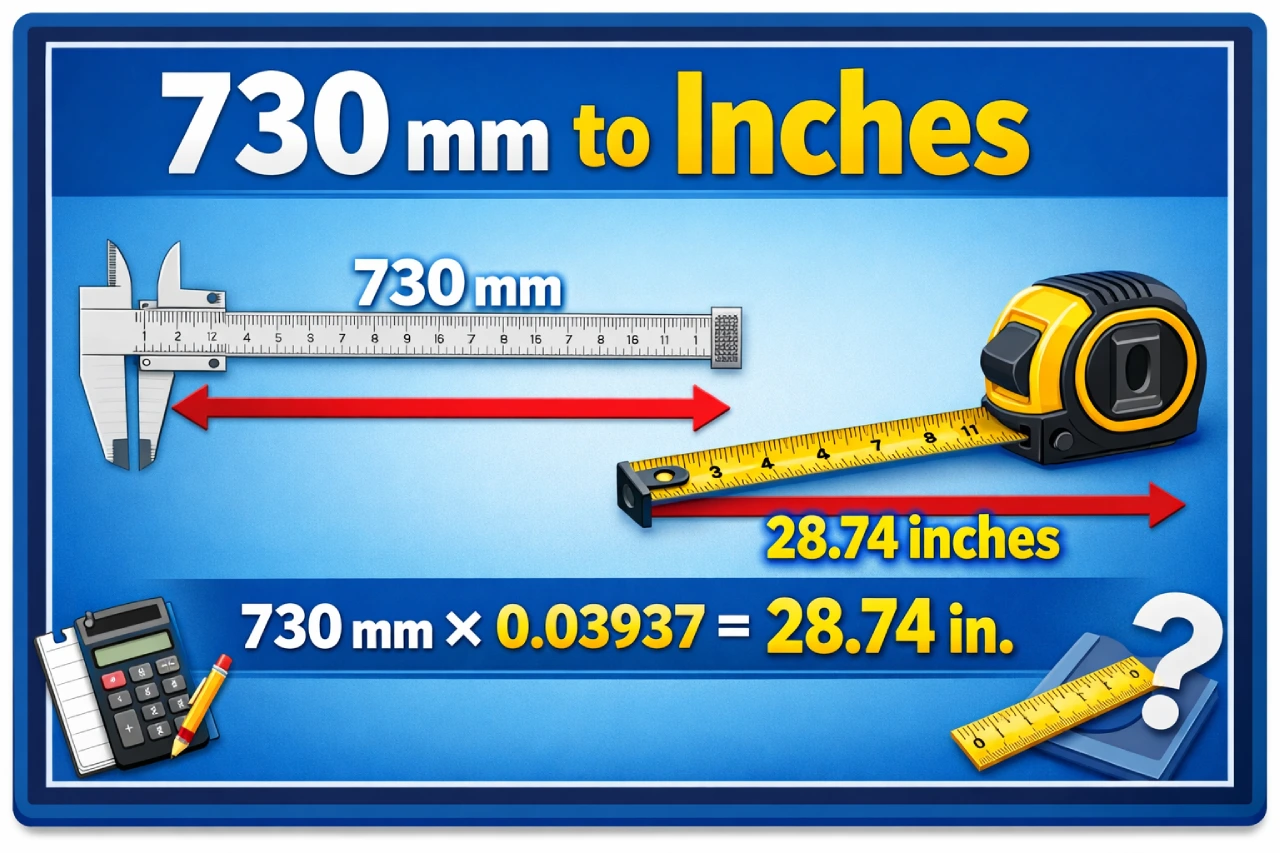
If you’re looking for the quick answer, here it is:
730 millimeters = 28.74 inches (approximately).
This means that when you convert 730 mm to inches, the result is about 28.74 in. The conversion is useful when translating measurements from the metric system—used by most of the world—to the U.S. customary system, which commonly uses inches and feet.
Measurements like 730 mm often appear in product specifications, furniture dimensions, construction plans, and engineering drawings. Converting those measurements into inches helps make them easier to visualize and understand, especially in the United States.
In this guide, we’ll break down exactly how to convert 730 mm into inches, explain the formula behind the calculation, explore practical examples, and show how millimeters and inches relate to each other in real-world measurements.
Understanding Millimeters and Inches
Before performing the conversion, it’s helpful to understand what each unit represents.
What Is a Millimeter?
A millimeter (mm) is a unit of length in the metric system, which is used internationally for science, engineering, manufacturing, and everyday measurements in most countries.
The prefix “milli-” means one thousandth, so:
1 millimeter = 0.001 meters
Millimeters are used when precise measurements are needed, such as in:
- Mechanical engineering
- Construction blueprints
- Furniture dimensions
- Electronic device design
- Manufacturing tolerances
For example:
- The thickness of a credit card is about 0.76 mm
- A smartphone might be 7–8 mm thick
- A sheet of plywood may be 12–18 mm thick
Millimeters are small units, which makes them ideal for detailed measurements.
What Is an Inch?
An inch (in) is a unit of length in the U.S. customary measurement system.
Inches are commonly used in the United States for:
- Screen sizes (TVs, laptops, phones)
- Construction measurements
- Furniture dimensions
- Tools and hardware
One inch equals:
1 inch = 2.54 centimeters
or
1 inch = 25.4 millimeters
This relationship forms the basis for converting millimeters to inches.
The Formula to Convert Millimeters to Inches
MM to Inches Converter
Enter a value in millimeters to convert it into inches.
The standard conversion formula is:
Inches = Millimeters ÷ 25.4
This works because:
1 inch = 25.4 mm
Applying the Formula
To convert 730 mm to inches:
730 ÷ 25.4 = 28.7402 inches
Rounded to two decimal places:
730 mm ≈ 28.74 inches
This is the value commonly used in product specifications and measurement conversions.
Step-by-Step Conversion
Let’s go through the calculation clearly.
Step 1: Start with the millimeter measurement
730 mm
Step 2: Divide by the conversion factor
730 ÷ 25.4
Step 3: Perform the calculation
= 28.7402 inches
Final Result
730 millimeters equals approximately 28.74 inches.
Converting 730 mm to Inches and Feet
Sometimes measurements are easier to visualize in feet and inches rather than inches alone.
First convert to inches:
730 mm ≈ 28.74 inches
Now convert inches to feet.
Since:
1 foot = 12 inches
28.74 ÷ 12 = 2.395 feet
This means:
730 mm ≈ 2.39 feet
Or expressed in feet and inches:
2 feet 4.74 inches
This format can be easier to picture when measuring objects like furniture or shelving.
Quick Millimeters-to-Inches Conversion Table
Here’s a helpful reference table for similar measurements.
| Millimeters | Inches |
|---|---|
| 500 mm | 19.69 in |
| 600 mm | 23.62 in |
| 700 mm | 27.56 in |
| 730 mm | 28.74 in |
| 750 mm | 29.53 in |
| 800 mm | 31.50 in |
| 1000 mm | 39.37 in |
Tables like this allow you to estimate conversions quickly.
Visualizing 730 mm
Numbers are easier to understand when compared with familiar objects.
Furniture Dimensions
A tabletop height or cabinet width of 730 mm equals roughly 28.7 inches, which is similar to:
- A standard desk height
- A small kitchen cabinet width
- A medium coffee table dimension
Screen Measurements
Although screens are usually measured diagonally, a dimension around 28–29 inches could correspond to a medium-sized computer monitor.
Tool Measurements
In woodworking or DIY projects, boards or panels may be measured in millimeters internationally but converted to inches for use in the United States.
Why Convert Millimeters to Inches?
Conversions between metric and U.S. customary units happen frequently.
Product Specifications
Many products are manufactured internationally using metric measurements.
When those products are sold in the U.S., their dimensions are often converted to inches.
Construction and Carpentry
Architectural drawings sometimes use millimeters, while tools and materials in the U.S. are measured in inches.
Furniture and Interior Design
Furniture imported from Europe or Asia often lists measurements in millimeters.
Converting those dimensions helps determine whether the item fits in a room.
Engineering and Manufacturing
Engineers working with international designs frequently switch between metric and imperial measurements.
Millimeters vs Inches: Key Differences
Although both units measure length, they belong to different systems.
| Unit | Measurement System | Equivalent |
|---|---|---|
| Millimeter | Metric system | 0.001 meter |
| Inch | U.S. customary system | 25.4 mm |
The metric system is used globally for science and manufacturing, while the U.S. commonly uses inches and feet.
Converting Inches Back to Millimeters
If you need to reverse the conversion, use this formula:
Millimeters = Inches × 25.4
Example
28.74 × 25.4 ≈ 730 mm
This confirms the accuracy of our earlier result.
Common Mistakes in Unit Conversion
Even simple conversions can lead to errors if the wrong values are used.
Using the Wrong Conversion Factor
Always remember:
1 inch = 25.4 mm
Using 2.5 or another rounded value may produce inaccurate results.
Rounding Too Early
It’s best to round only at the final step of the calculation to maintain accuracy.
Confusing Millimeters with Centimeters
Remember:
- 1 cm = 10 mm
Mixing these units can significantly change the result.
Tips for Quick Mental Conversion
Here are a few quick tricks.
First, remember that 25 mm is approximately 1 inch.
Second, divide the millimeter value by 25 for a quick estimate.
Example:
730 ÷ 25 ≈ 29 inches
This rough estimate is close to the exact value of 28.74 inches.
Third, remember that:
1000 mm ≈ 39.37 inches
This benchmark helps estimate many metric measurements quickly.
Real-World Examples of 730 mm
Let’s look at situations where 730 mm might appear.
Desk Height
Many ergonomic desks have heights around 720–750 mm, which equals about 28–30 inches.
Cabinet Dimensions
Kitchen cabinets or storage units may measure around 730 mm wide.
Industrial Equipment
Machine components and structural parts are often specified in millimeters internationally.
Understanding the inch equivalent helps engineers and technicians interpret these measurements.
Frequently Asked Questions (FAQs)
How many inches is 730 mm?
730 mm equals approximately 28.74 inches.
How do you convert millimeters to inches?
Divide the millimeter value by 25.4.
What is 730 mm in feet?
730 mm ≈ 2.39 feet.
Is 730 mm close to 30 inches?
Yes. It is slightly smaller than 30 inches.
Why is 25.4 used in the formula?
Because 1 inch equals exactly 25.4 millimeters.
How many centimeters are in 730 mm?
730 mm = 73 cm.
Is 730 mm a common measurement?
Yes. It frequently appears in furniture heights and product dimensions.
Can calculators convert mm to inches automatically?
Yes. Many calculators, engineering tools, and apps include built-in unit conversions.
Why do different countries use different measurement systems?
Most countries use the metric system, while the United States still commonly uses the U.S. customary system.
What is the easiest way to estimate mm to inches?
Divide by 25 for a quick estimate.
Final Thoughts
Converting 730 mm to inches is straightforward once you understand the relationship between millimeters and inches.
Using the formula mm ÷ 25.4, we find that:
730 mm equals approximately 28.74 inches.
Understanding this conversion helps when interpreting international product dimensions, construction measurements, or engineering drawings.
Once you remember the key rule—1 inch equals 25.4 millimeters—converting between these units becomes quick and intuitive.
The next time you see a measurement like 730 mm, you’ll immediately know that it’s roughly 28.7 inches, making it much easier to visualize.
Leave a Reply