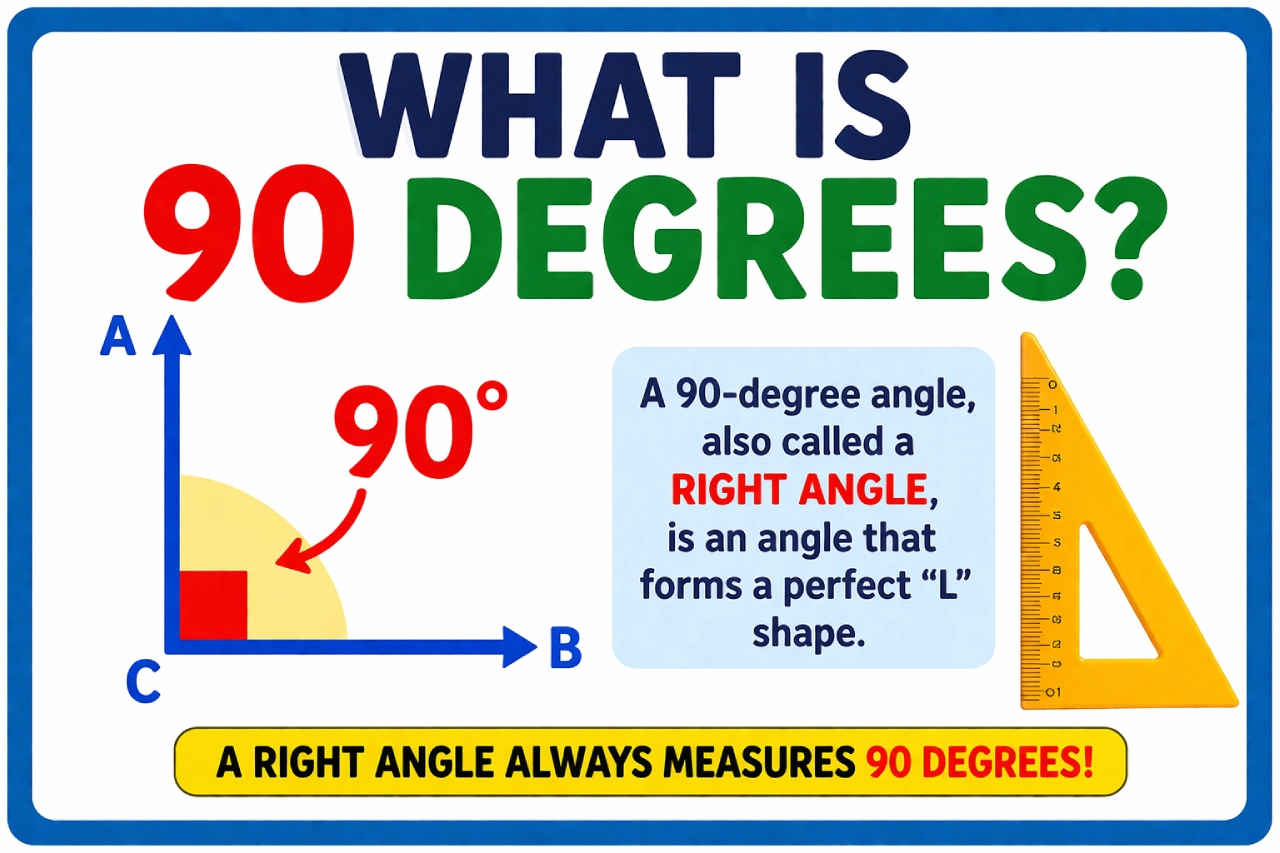
The quick answer is simple: 90° (90 degrees) represents a right angle.
In geometry and mathematics, a 90-degree angle is formed when two lines meet exactly perpendicular to each other. You see this angle everywhere—from the corners of a book or a room to the layout of streets and the design of buildings.
But 90° is more than just a common angle in geometry. It plays an essential role in trigonometry, engineering, architecture, navigation, physics, and everyday measurements.
In this guide, we’ll explore what 90 degrees really means, how it relates to other angle measurements like radians and turns, where it appears in real life, and why it’s one of the most important angles in mathematics.
What Does 90° Mean?
An angle measures the amount of rotation between two lines that meet at a point.
A 90-degree angle occurs when one line turns exactly one quarter of a full rotation from another line.
A full circle contains:
360 degrees
So when we divide a circle into four equal parts:
360 ÷ 4 = 90°
That’s why 90 degrees is often called a quarter turn.
When two lines meet at this angle, they are said to be perpendicular.
Examples of 90-degree angles include:
- The corner of a square or rectangle
- The edges of a book
- The intersection of perpendicular roads
- The corners of a window frame
Because of its symmetry and balance, the 90° angle is one of the most commonly used angles in design and mathematics.
Why 90 Degrees Is Called a Right Angle
A 90-degree angle is traditionally known as a right angle.
The term comes from classical geometry and simply means the angle is “correct” or “upright.” In early architectural and engineering practices, ensuring a corner was perfectly square (90°) meant the structure would be stable.
A right angle has special properties:
- The two lines forming the angle are perpendicular.
- Adjacent angles sum to 180°.
- It divides shapes into symmetrical parts.
In geometry diagrams, a right angle is usually marked with a small square in the corner.
Visualizing a 90° Angle
One of the easiest ways to imagine a 90-degree angle is to picture the hands of a clock.
When the minute hand points at 12 and the hour hand points at 3, the angle between them is exactly 90 degrees.
This representation helps students quickly understand what a right angle looks like.
Another way to visualize it is to imagine turning a straight line upward until it forms an L shape.
That L-shaped corner represents a perfect 90° angle.
90 Degrees in the Metric and Mathematical Systems
Angles can be measured in several systems.
The most common units include:
- Degrees
- Radians
- Turns
Let’s see how 90° compares.
| Measurement System | Value Equivalent to 90° |
|---|---|
| Degrees | 90° |
| Radians | π/2 |
| Turns | 0.25 |
| Gradians | 100 grad |
This means:
- 90° = π/2 radians
- 90° = one quarter of a full circle
Radians are especially important in advanced mathematics and physics.
Converting 90° to Radians
Degrees to Radians Converter
Convert any degree value into radians instantly.
Radians are another way of measuring angles, commonly used in trigonometry.
The formula for converting degrees to radians is:
Radians = Degrees × (π / 180)
So:
90 × (π / 180) = π / 2
Therefore:
90° = π/2 radians
This value appears frequently in trigonometric calculations.
90 Degrees in Trigonometry
In trigonometry, the 90-degree angle is extremely important because it appears in right triangles.
A right triangle always contains one 90° angle.
The three sides of a right triangle are:
- Hypotenuse
- Opposite side
- Adjacent side
These relationships form the basis for trigonometric functions like:
- sine (sin)
- cosine (cos)
- tangent (tan)
For example:
sin(90°) = 1
cos(90°) = 0
tan(90°) is undefined because division by zero occurs.
These relationships are fundamental in engineering, physics, and computer graphics.
Real-World Examples of 90° Angles
You might be surprised how often 90-degree angles appear in everyday life.
Architecture and Construction
Buildings rely heavily on right angles.
Walls, floors, and ceilings typically meet at 90 degrees to ensure structural stability.
Carpenters even use special tools—like framing squares—to confirm that corners form perfect right angles.
Furniture Design
Tables, cabinets, shelves, and desks almost always contain right angles.
These shapes make furniture easier to manufacture and more stable.
Street Intersections
Many city grids are designed using perpendicular streets.
When two roads meet at a perfect cross, they create four 90° angles.
Sports Fields
Sports fields often rely on right angles.
For example:
- Soccer field corners
- Basketball court lines
- Baseball diamond baselines
These layouts help maintain standardized playing dimensions.
Technology and Graphics
Computer graphics and digital design rely heavily on 90-degree angles for pixel alignment and layout structures.
Even website designs frequently use right-angle layouts for readability and balance.
90 Degrees in Geometry
Many geometric shapes rely on 90° angles.
Squares
A square contains four right angles.
Each interior angle measures exactly 90 degrees.
Rectangles
Rectangles also have four 90-degree angles.
The only difference from a square is that adjacent sides may have different lengths.
Cubes
A cube contains multiple right angles where edges meet.
This property gives cubes their strong structural shape.
Because of these properties, right angles are foundational in geometric design.
Why Right Angles Are So Important
Right angles simplify measurement and construction.
Imagine building a house without them—walls would lean, floors would tilt, and structures would collapse.
Right angles provide:
- stability
- symmetry
- predictable measurements
- efficient construction
That’s why engineers and architects rely heavily on them.
Common Mistakes When Understanding 90 Degrees
Even though the concept is simple, a few misunderstandings are common.
Confusing 90° with 180°
A 90-degree angle is a right angle, while 180 degrees forms a straight line.
Misreading Angle Symbols
The degree symbol (°) represents degrees, not multiplication or exponent notation.
Mixing Degrees and Radians
Students often confuse radians with degrees in trigonometry.
Always confirm which unit is being used.
Quick Reference: Angle Types
To understand where 90° fits, it helps to compare it with other angles.
| Angle Type | Measurement |
|---|---|
| Acute Angle | Less than 90° |
| Right Angle | Exactly 90° |
| Obtuse Angle | Between 90° and 180° |
| Straight Angle | 180° |
| Full Rotation | 360° |
This classification helps students quickly identify angle types.
Tips for Recognizing 90° Angles
Here are a few easy tricks.
First, look for perpendicular lines.
Second, imagine the corner of a square or book.
Third, remember the clock example where the hands form an L shape.
These visual cues make identifying right angles easy.
Frequently Asked Questions (FAQs)
What does 90° mean?
A 90° angle represents a right angle, where two lines meet at a perpendicular intersection.
Why is 90° called a right angle?
The term “right” historically meant upright or correct, referring to perfectly square corners used in construction.
What is 90° in radians?
90° equals π/2 radians.
Is a 90° angle acute or obtuse?
Neither. It is classified as a right angle.
How many 90° angles make a full circle?
A full circle is 360°, so:
360 ÷ 90 = 4
It takes four right angles to complete a circle.
What shapes contain 90° angles?
Squares, rectangles, cubes, and many architectural designs contain right angles.
What is sin(90°)?
sin(90°) equals 1.
What is cos(90°)?
cos(90°) equals 0.
Can triangles contain a 90° angle?
Yes. These are called right triangles.
Why are right angles important?
They provide structure, balance, and accurate measurements in geometry, engineering, and architecture.
Final Thoughts
The 90-degree angle might look simple, but it plays a massive role in mathematics, science, and the physical world around us.
From the shape of buildings and furniture to trigonometric calculations and digital design, the right angle is one of the most reliable geometric relationships ever discovered.
Once you recognize how frequently 90° appears in everyday structures and systems, it becomes clear why it’s such a fundamental concept in geometry.
Now here’s a quick question for you:
When you look around your room right now, how many 90-degree corners can you spot?
Leave a Reply