If you want the quick answer first:
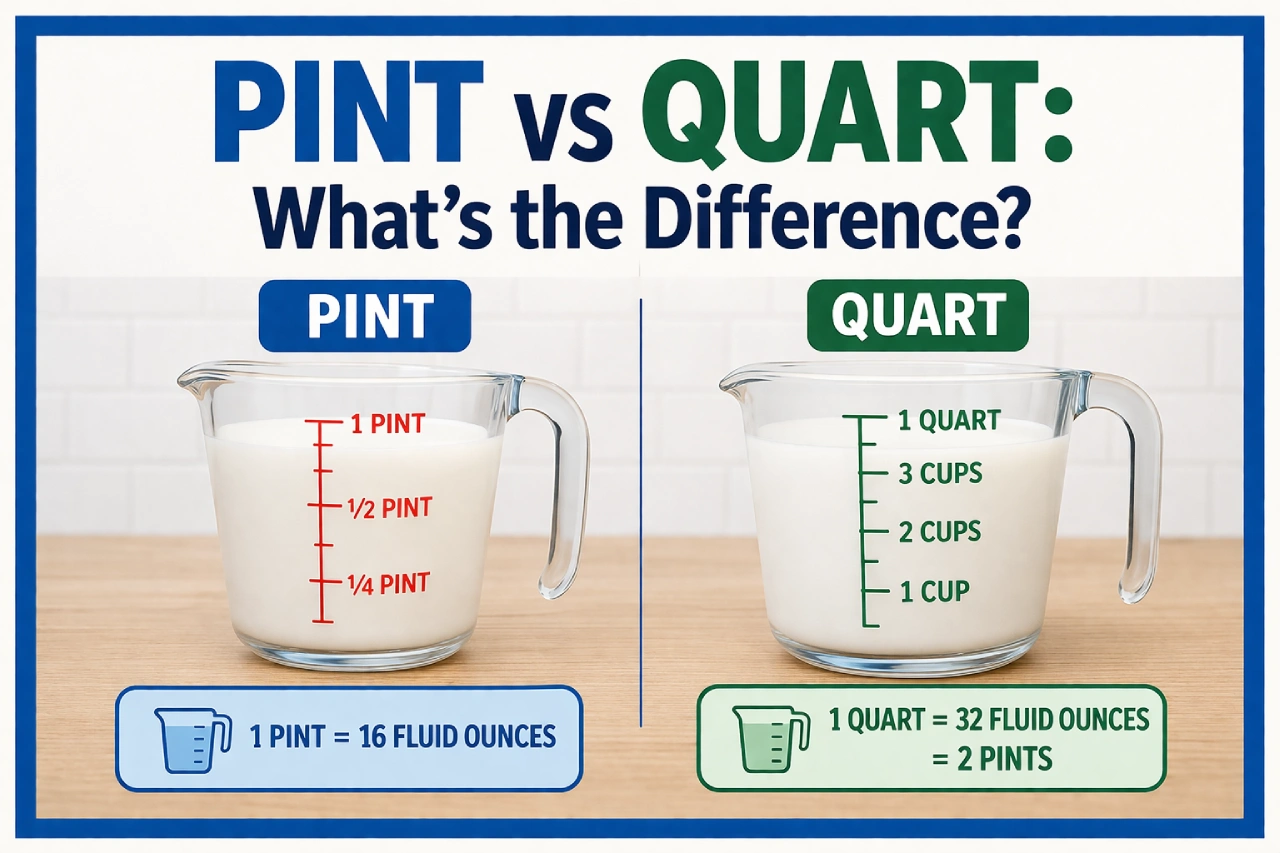
1 quart = 2 pints.
That means a quart is exactly twice the size of a pint. Both units are used to measure liquid and dry volume in the U.S. customary measurement system, and they appear frequently in cooking, grocery packaging, and beverage servings.
For example:
- A container labeled 1 quart holds 2 pints.
- A pint of ice cream is half the size of a quart of ice cream.
- Many soups and liquids are sold in quart containers.
Although the relationship between the two units is simple, people often confuse them when measuring ingredients or interpreting recipes.
In this guide, we’ll explain the difference between pints and quarts, show how they convert, explore their use in cooking and food packaging, and clarify how these measurements fit into the larger U.S. volume system.
What Is a Pint?
A pint (pt) is a unit of volume used in the U.S. customary system. It is commonly used to measure liquids and sometimes dry ingredients.
In the United States:
1 pint = 16 fluid ounces
Pints are frequently used for:
- Ice cream containers
- Milk and cream cartons
- Berries and small produce containers
- Beer servings
- Liquid ingredients in cooking
For example:
- A typical ice cream container might hold 1 pint.
- Fresh strawberries at the grocery store are often sold by the pint.
- Craft beers are often served in pint glasses.
Because pints are relatively small, they are useful for measuring moderate quantities of liquid or food.
What Is a Quart?
A quart (qt) is another unit of volume in the U.S. customary measurement system.
In the United States:
1 quart = 32 fluid ounces
Since a pint equals 16 ounces, a quart naturally equals two pints.
Quarts are commonly used for measuring:
- Milk cartons
- Soup containers
- Cooking ingredients
- Oil and other liquids
- Large beverage containers
For example:
- Many milk cartons are sold in quart sizes.
- Homemade soup is often stored in quart containers.
- A quart jar is a common size for canning food.
Because quarts hold more liquid than pints, they are typically used for larger quantities.
The Basic Relationship: Pint vs Quart
Pint vs Quart Converter
Convert pints to quarts or quarts to pints instantly with this simple volume converter.
1 pint = 0.5 quart
The most important relationship between these units is simple:
1 quart = 2 pints
This means:
- 1 pint = 0.5 quart
- 2 pints = 1 quart
This conversion is widely used in cooking and food preparation.
Example
If a recipe requires 1 quart of milk, you can use:
2 pints of milk
Both measurements represent the same volume.
Pint vs Quart Conversion Table
Here’s a quick reference chart.
| Measurement | Equivalent |
|---|---|
| 1 pint | 16 fluid ounces |
| 2 pints | 1 quart |
| 1 quart | 32 fluid ounces |
| 4 quarts | 1 gallon |
This hierarchy helps visualize how the units fit together.
Where Pints and Quarts Fit in the U.S. Volume System
Pints and quarts are part of a larger system of measurements.
The hierarchy looks like this:
- 1 cup = 8 fluid ounces
- 2 cups = 1 pint
- 2 pints = 1 quart
- 4 quarts = 1 gallon
Understanding this structure makes conversions much easier.
Example Conversion
If you have 1 gallon of milk, that equals:
- 4 quarts
- 8 pints
This relationship is especially useful in cooking and grocery shopping.
Pint vs Quart in Cooking
In cooking, recipes often use both pints and quarts depending on the quantity needed.
When Pints Are Used
Pints are commonly used for smaller amounts of liquid.
Examples include:
- Cream
- Berries
- Ice cream
- Small soup portions
A recipe might say:
“Add 1 pint of heavy cream.”
When Quarts Are Used
Quarts are used for larger quantities.
Examples include:
- Soup
- Broth
- Milk
- Stock
For example:
“Simmer the ingredients in 1 quart of chicken broth.”
Using the appropriate unit makes recipes easier to follow.
Pint vs Quart in Food Packaging
Many food products are sold using these measurements.
Pint Containers
Common pint-sized items include:
- Ice cream
- Fresh berries
- Sour cream
- Heavy cream
These containers typically hold 16 ounces.
Quart Containers
Quart-sized items include:
- Milk
- Yogurt
- Soup
- Cooking oil
These containers hold 32 ounces.
Recognizing the difference helps shoppers compare product sizes.
Liquid vs Dry Pints and Quarts
One important detail is that the U.S. measurement system distinguishes between liquid and dry measurements.
Liquid Pint
A U.S. liquid pint equals:
16 fluid ounces
Dry Pint
A dry pint is slightly different because it measures volume for dry goods such as berries.
For example:
A pint of blueberries may not weigh the same as a pint of liquid.
Similarly, dry quarts can differ slightly from liquid quarts.
For cooking and beverages, however, people usually mean liquid measurements.
Pint vs Quart in the United States vs the United Kingdom
Another point of confusion is that pints differ between countries.
U.S. Pint
1 U.S. pint = 16 fluid ounces
UK Pint
1 UK pint = 20 fluid ounces
This means a UK pint is larger than a U.S. pint.
However, the quart measurement is used primarily in the United States, while the UK often uses liters.
Real-World Examples of Pint vs Quart
Let’s look at practical situations where these units appear.
Ice Cream
Ice cream often comes in pint containers, which hold about 16 ounces.
A quart of ice cream would hold twice that amount.
Milk
Milk may be sold in several sizes:
- Pint
- Quart
- Half gallon
- Gallon
A quart of milk equals two pint containers.
Soup Storage
When cooking soup, many people store leftovers in quart containers, which hold about 32 ounces.
This size is ideal for a single large serving or two smaller servings.
Why Understanding the Difference Matters
Knowing the difference between pints and quarts helps avoid mistakes in:
Cooking
Using the wrong measurement can affect the balance of ingredients.
Grocery Shopping
Understanding container sizes helps compare product value.
Food Storage
Choosing the right container prevents spills and waste.
Simple conversions make everyday tasks easier.
Tips for Remembering Pint vs Quart
Here are a few helpful tricks.
First, remember the rhyme:
“Two pints make a quart.”
Second, remember the fluid ounces:
- Pint = 16 oz
- Quart = 32 oz
Third, think of doubling:
A quart simply doubles a pint.
These shortcuts help recall the conversion instantly.
Frequently Asked Questions (FAQs)
Is a quart bigger than a pint?
Yes.
1 quart equals 2 pints, so a quart is twice as large.
How many pints are in a quart?
2 pints = 1 quart
How many ounces are in a pint?
A U.S. pint equals 16 fluid ounces.
How many ounces are in a quart?
A quart equals 32 fluid ounces.
How many quarts are in a gallon?
4 quarts = 1 gallon
Is a pint always the same size worldwide?
No. The UK pint is larger than the U.S. pint.
What is a pint used for?
Pints are commonly used for ice cream, berries, and beverages.
What is a quart used for?
Quarts are often used for milk, soups, and larger liquid quantities.
How many cups are in a pint?
2 cups = 1 pint
How many cups are in a quart?
4 cups = 1 quart
Final Thoughts
The difference between pints and quarts is simple once you understand the relationship between the two units.
The key rule to remember is:
1 quart = 2 pints
This means a quart always holds twice as much volume as a pint.
Both measurements play an important role in cooking, food packaging, and everyday household tasks.
Once you remember the basic hierarchy—cups, pints, quarts, and gallons—you’ll be able to convert between these units quickly and confidently.
And the next time you see a recipe calling for a quart of broth or a pint of cream, you’ll instantly know how those measurements compare.
Leave a Reply