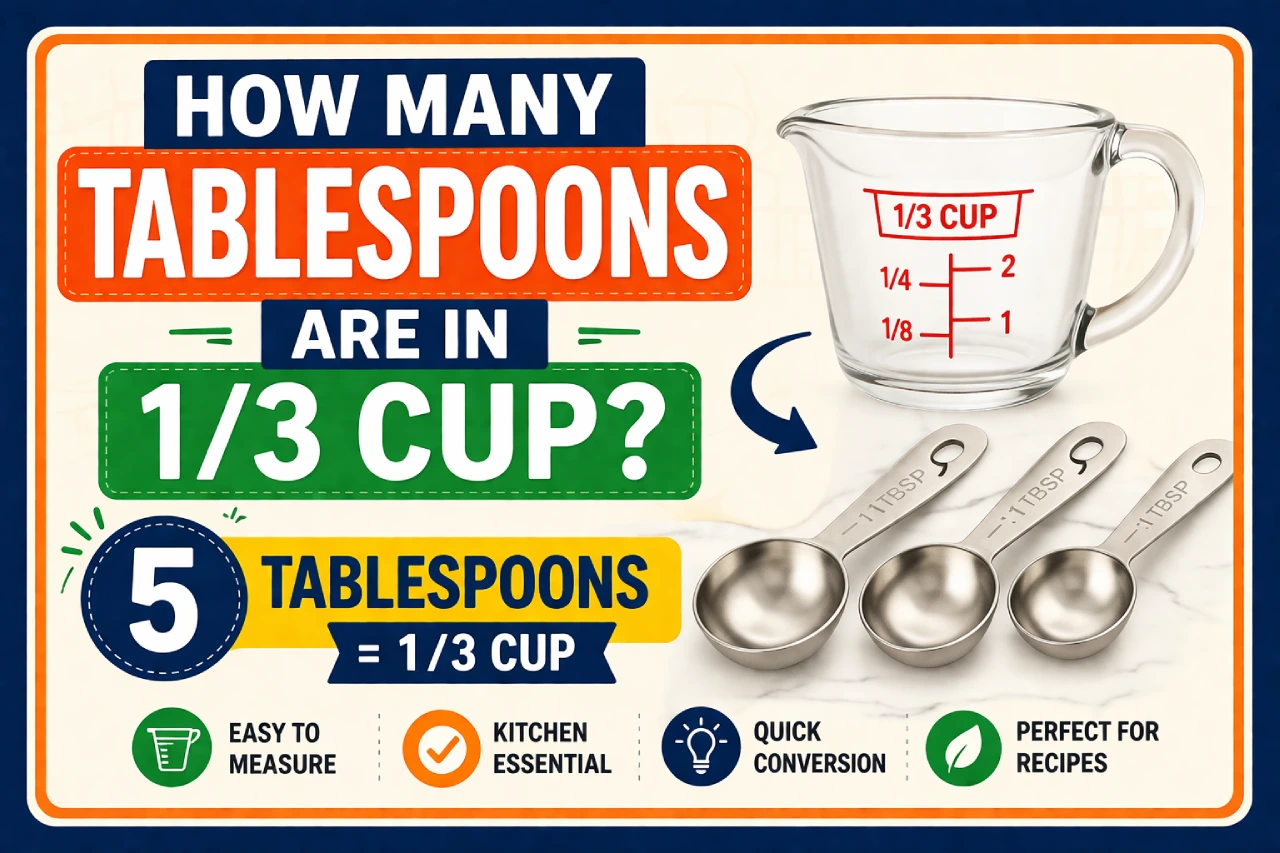
If you want the quick answer:
1/3 cup = 5 tablespoons + 1 teaspoon (or about 5.33 tablespoons)
That’s the exact conversion used in U.S. cooking. Most recipes will either use 5 tablespoons + 1 teaspoon for accuracy or round slightly depending on the situation.
But if you’ve ever found yourself without a 1/3 cup measuring tool—or just want to understand how these conversions work—this guide will walk you through everything clearly and practically.
Understanding the Basics of Cup and Tablespoon Measurements
In the U.S. measurement system:
- 1 cup = 16 tablespoons
- 1 tablespoon = 3 teaspoons
So when you’re converting 1/3 cup, you’re essentially dividing 16 tablespoons into thirds.
The Formula to Convert Cups to Tablespoons
Cups to Tablespoons Converter
Enter a value in cups to quickly convert it into tablespoons. In U.S. measurements, 1 cup = 16 tablespoons.
The relationship is simple:
tablespoons=cups×16
Now apply it to 1/3 cup:
(1/3) × 16 = 5.33 tablespoons
Since we don’t typically measure in decimals in the kitchen, we convert the decimal:
0.33 tablespoon ≈ 1 teaspoon
So the final result becomes:
👉 1/3 cup = 5 tablespoons + 1 teaspoon
Why Is It 5 Tablespoons + 1 Teaspoon?
Because:
- 0.33 tablespoon × 3 teaspoons = ~1 teaspoon
This gives you a practical, easy-to-measure equivalent without needing decimals.
Quick Reference Conversion
Here’s the simplest way to remember it:
- 1/3 cup = 5 tbsp + 1 tsp
- OR ≈ 5.33 tablespoons
Both are correct—the first is just more kitchen-friendly.
When Do You Need This Conversion?
This is one of the most common kitchen conversions.
1. Missing Measuring Cups
If you don’t have a 1/3 cup, tablespoons can save the day.
2. Scaling Recipes
When doubling or halving recipes, conversions become essential.
3. Precision Cooking
Some ingredients require more accurate measurement than others.
4. Baking
Baking especially benefits from precise conversions.
Tablespoons vs Cups: Key Differences You Should Know
Understanding the difference helps avoid mistakes.
| Feature | Cup | Tablespoon |
|---|---|---|
| Size | Larger unit | Smaller unit |
| 1 cup equals | 16 tablespoons | — |
| Precision | Less precise | More precise |
| Common use | Liquids, bulk ingredients | Small quantities |
Simple Way to Think About It
- Cups = big measurements
- Tablespoons = detailed measurements
So converting to tablespoons gives you more control.
Step-by-Step Conversion Method
Here’s how you can convert any cup value to tablespoons:
- Take the number of cups
- Multiply by 16
- Convert decimals into teaspoons if needed
Example
1/3 cup:
Step 1: 1/3 × 16 = 5.33
Step 2: 0.33 × 3 = ~1 teaspoon
Final: 5 tbsp + 1 tsp
Common Cooking Example
Let’s say a recipe calls for 1/3 cup of oil, but you only have a tablespoon.
Instead of guessing:
👉 Use 5 tablespoons + 1 teaspoon
Now your recipe stays accurate, and your dish turns out as expected.
Conversion Table for Similar Measurements
| Cups | Tablespoons |
|---|---|
| 1/4 cup | 4 tbsp |
| 1/3 cup | 5 tbsp + 1 tsp |
| 1/2 cup | 8 tbsp |
| 1 cup | 16 tbsp |
This table is extremely useful in the kitchen.
Liquid vs Dry Ingredients: Does It Matter?
The conversion stays the same for both liquid and dry ingredients when using volume measurements.
However:
- Liquids are easier to measure accurately
- Dry ingredients may require leveling for precision
Common Mistakes to Avoid
1. Ignoring the Extra Teaspoon
Many people round 1/3 cup to 5 tablespoons—but that loses accuracy.
2. Confusing Tablespoons and Teaspoons
Remember:
- 1 tablespoon = 3 teaspoons
3. Using Heaping Measurements
Always use level tablespoons unless specified.
4. Mixing Measurement Systems
Stick to U.S. measurements unless converting fully.
Quick Shortcut Tip
👉 Remember this phrase:
“One-third cup is five and one teaspoon”
It’s simple, memorable, and accurate.
Why Precision Matters (Especially in Baking)
In cooking, small differences might not matter much.
But in baking:
- Too much liquid = runny batter
- Too little = dry texture
That extra teaspoon can make a difference.
Real-Life Scenario You’ll Relate To
You’re halfway through baking cookies, and the recipe calls for 1/3 cup sugar.
But your 1/3 cup measure is missing.
Instead of guessing:
👉 You measure 5 tablespoons + 1 teaspoon
Result? Perfect cookies—no compromise.
Frequently Asked Questions (FAQs)
1. How many tablespoons are in 1/3 cup?
5 tablespoons + 1 teaspoon
2. Is 1/3 cup exactly 5 tablespoons?
No, it’s slightly more—about 5.33 tablespoons
3. Why add 1 teaspoon?
Because 0.33 tablespoon equals about 1 teaspoon.
4. Can I round to 5 tablespoons?
Yes, but it reduces accuracy slightly.
5. How many teaspoons are in 1/3 cup?
16 teaspoons
6. What is the formula to convert cups to tablespoons?
tablespoons = cups × 16
7. Does this work for all ingredients?
Yes, for volume-based measurements.
8. Is this conversion used in baking?
Yes, very commonly.
9. What if I only have teaspoons?
1/3 cup = 16 teaspoons
10. Is this conversion the same worldwide?
No, cup sizes vary slightly in different countries.
11. Why do U.S. recipes use cups?
It’s part of the customary measurement system.
12. Is precision important for this conversion?
Yes, especially in baking.
Final Thoughts
So, how many tablespoons are in 1/3 cup?
👉 5 tablespoons + 1 teaspoon
It’s a small detail—but one that can make a big difference in your cooking.
Once you understand how these measurements connect, you won’t need to rely on guesswork again.
Now here’s a simple question for you:
The next time you’re in the kitchen without a 1/3 cup, will you guess—or measure it perfectly with tablespoons?
Leave a Reply