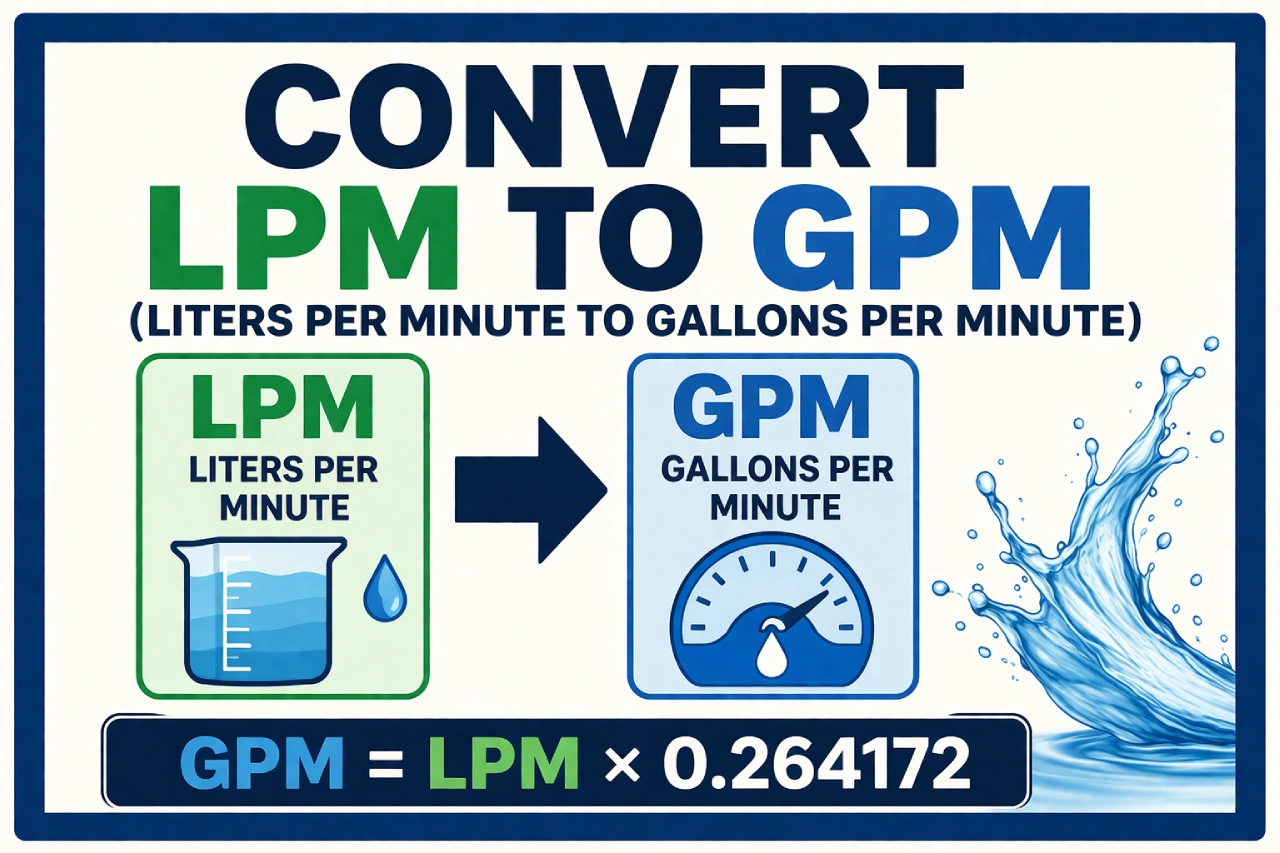
If you’re searching for the quick answer, here it is:
1 LPM (liter per minute) ≈ 0.26417 GPM (gallons per minute).
So to convert LPM to GPM, you simply multiply:
GPM = LPM × 0.26417
This conversion is extremely common in plumbing, pumps, irrigation systems, filtration equipment, and industrial fluid systems—especially when comparing international metric measurements with U.S. flow-rate standards.
But understanding the conversion is more than memorizing a number. Once you know how liters and gallons relate, you’ll be able to convert any flow rate quickly and confidently.
In this guide, we’ll walk through the formula, practical examples, quick conversion tables, and real-world applications where LPM-to-GPM conversions are used every day.
What Is LPM?
LPM stands for liters per minute, a metric unit used to measure flow rate—the amount of liquid moving through a system over time.
Specifically:
1 LPM means one liter of fluid flows every minute.
Because it’s part of the metric system, LPM is widely used in:
- Medical oxygen systems
- Laboratory equipment
- Water filtration systems
- Industrial machinery
- Scientific measurements
For example:
- Oxygen therapy devices may deliver 2–10 LPM
- Water filters may operate around 5–20 LPM
- Industrial pumps may move hundreds of LPM
LPM works well in metric countries, but in the United States, flow rate is usually measured in GPM.
What Is GPM?
GPM stands for gallons per minute, a unit commonly used in the United States to measure the rate of liquid flow.
One gallon in the U.S. system equals:
1 gallon = 3.78541 liters
So when we say a pump moves 10 GPM, that means 10 gallons of fluid flow through the system every minute.
GPM is widely used in:
- Plumbing systems
- Irrigation systems
- Fire protection systems
- Water pumps
- HVAC cooling systems
Because international equipment often uses metric units, converting LPM to GPM becomes necessary when comparing specifications.
LPM to GPM Conversion Formula
LPM to GPM Converter
Enter a value in Liters per Minute (LPM) to convert it into Gallons per Minute (GPM).
The standard conversion formula is:
GPM = LPM × 0.26417
This factor comes from the relationship between liters and gallons.
Since:
1 liter = 0.26417 gallons
The flow rate conversion becomes straightforward.
Reverse Conversion
To convert GPM back to LPM:
LPM = GPM × 3.78541
Quick LPM to GPM Conversion Table
Here’s a quick reference table to make conversions easier.
| LPM | GPM |
|---|---|
| 1 LPM | 0.264 GPM |
| 5 LPM | 1.32 GPM |
| 10 LPM | 2.64 GPM |
| 20 LPM | 5.28 GPM |
| 30 LPM | 7.93 GPM |
| 50 LPM | 13.21 GPM |
| 100 LPM | 26.42 GPM |
This table helps you estimate flow rates quickly without doing calculations every time.
Step-by-Step Conversion Examples
Let’s walk through a few practical examples.
Example 1: Convert 10 LPM to GPM
10 × 0.26417 = 2.64 GPM
So a system flowing at 10 LPM delivers about 2.64 gallons per minute.
Example 2: Convert 25 LPM to GPM
25 × 0.26417 = 6.60 GPM
Example 3: Convert 40 LPM to GPM
40 × 0.26417 = 10.57 GPM
Once you memorize the 0.264 factor, these conversions become quick mental math.
Real-World Applications of LPM to GPM Conversion
Water Pumps
Pump manufacturers around the world use different units.
European or Asian pumps may list flow rates in LPM, while U.S. systems expect GPM.
Understanding the conversion allows engineers and technicians to compare pump specifications easily.
Irrigation Systems
Sprinkler systems are often designed using GPM in the U.S., but many irrigation components list flow rates in LPM.
Converting between the two ensures:
- Proper water distribution
- Correct pipe sizing
- Balanced pressure across the system
Medical Oxygen Systems
Oxygen flow in hospitals is typically measured in liters per minute.
However, some medical equipment used in the U.S. may reference gallons per minute, requiring accurate conversions.
Water Filtration and RO Systems
Filtration systems often use international specifications.
For example:
A filter rated at 15 LPM delivers roughly 3.96 GPM.
Understanding this helps homeowners compare filtration capacity when shopping for equipment.
Fire Protection Systems
Fire suppression systems rely heavily on GPM measurements, but international components may use LPM.
Correct conversion ensures the system meets safety requirements.
Why Accurate Flow Rate Conversion Matters
Flow rate determines how effectively a system moves fluid.
Incorrect conversions can lead to:
- Undersized pumps
- Poor water pressure
- Inefficient irrigation
- Equipment damage
For example, choosing a pump rated at 5 GPM instead of the required 5 LPM equivalent could drastically change system performance.
This is why engineers always verify flow units before designing a system.
Common Mistakes When Converting LPM to GPM
Confusing Liters with Gallons
A liter is significantly smaller than a gallon.
Remember:
1 gallon ≈ 3.785 liters
Using the Wrong Conversion Factor
Always use 0.26417 when converting LPM to GPM.
Ignoring Unit Systems
Many product manuals mix metric and U.S. units.
Always confirm whether a specification uses liters per minute or gallons per minute.
LPM vs GPM vs Other Flow Units
Flow rate can be expressed in several units.
| Unit | Meaning |
|---|---|
| LPM | Liters per minute |
| GPM | Gallons per minute |
| LPS | Liters per second |
| CFM | Cubic feet per minute |
| m³/h | Cubic meters per hour |
Each unit is used in different industries.
However, LPM and GPM remain the most common units for water systems.
Tips for Quick Mental Conversion
Here are a few tricks that make conversions easier.
First, remember the key number:
0.264
This makes mental math faster.
For example:
10 LPM ≈ 2.6 GPM
20 LPM ≈ 5.3 GPM
50 LPM ≈ 13 GPM
Another trick is to remember the reverse relationship:
1 GPM ≈ 3.785 LPM
Once you memorize these numbers, converting becomes almost automatic.
Frequently Asked Questions (FAQs)
1. How do you convert LPM to GPM?
Multiply liters per minute by 0.26417.
Example:
10 LPM × 0.26417 = 2.64 GPM
2. How many GPM is 1 LPM?
1 LPM equals approximately 0.264 GPM.
3. How many LPM is 1 GPM?
1 GPM equals about 3.785 LPM.
4. What is 20 LPM in GPM?
20 × 0.26417 = 5.28 GPM
5. Why are two different units used for flow rate?
Metric countries use liters, while the United States commonly uses gallons.
6. Which unit is more common in plumbing?
In the United States, GPM is more common.
7. Is LPM used in pumps?
Yes. Many international pump manufacturers specify flow in liters per minute.
8. What is the easiest way to remember the conversion?
Just remember:
LPM × 0.264 = GPM
9. Is LPM metric or imperial?
LPM is part of the metric system.
10. Can flow rate affect pump performance?
Yes. Incorrect flow rate can cause inefficient operation or equipment failure.
Final Thoughts
At first glance, converting LPM to GPM might seem like a simple math problem. But in real-world systems—especially pumps, irrigation, filtration, and plumbing—accurate flow-rate conversion plays a crucial role in system performance.
Once you remember the core relationship 1 LPM ≈ 0.264 GPM, converting between metric and U.S. units becomes quick and intuitive.
Whether you’re comparing pump specifications, designing an irrigation system, or choosing filtration equipment, mastering this conversion ensures everything flows exactly as expected.
So here’s a practical question for you:
Are you converting LPM to GPM for a pump system, a plumbing project, or just comparing equipment specifications?
Leave a Reply