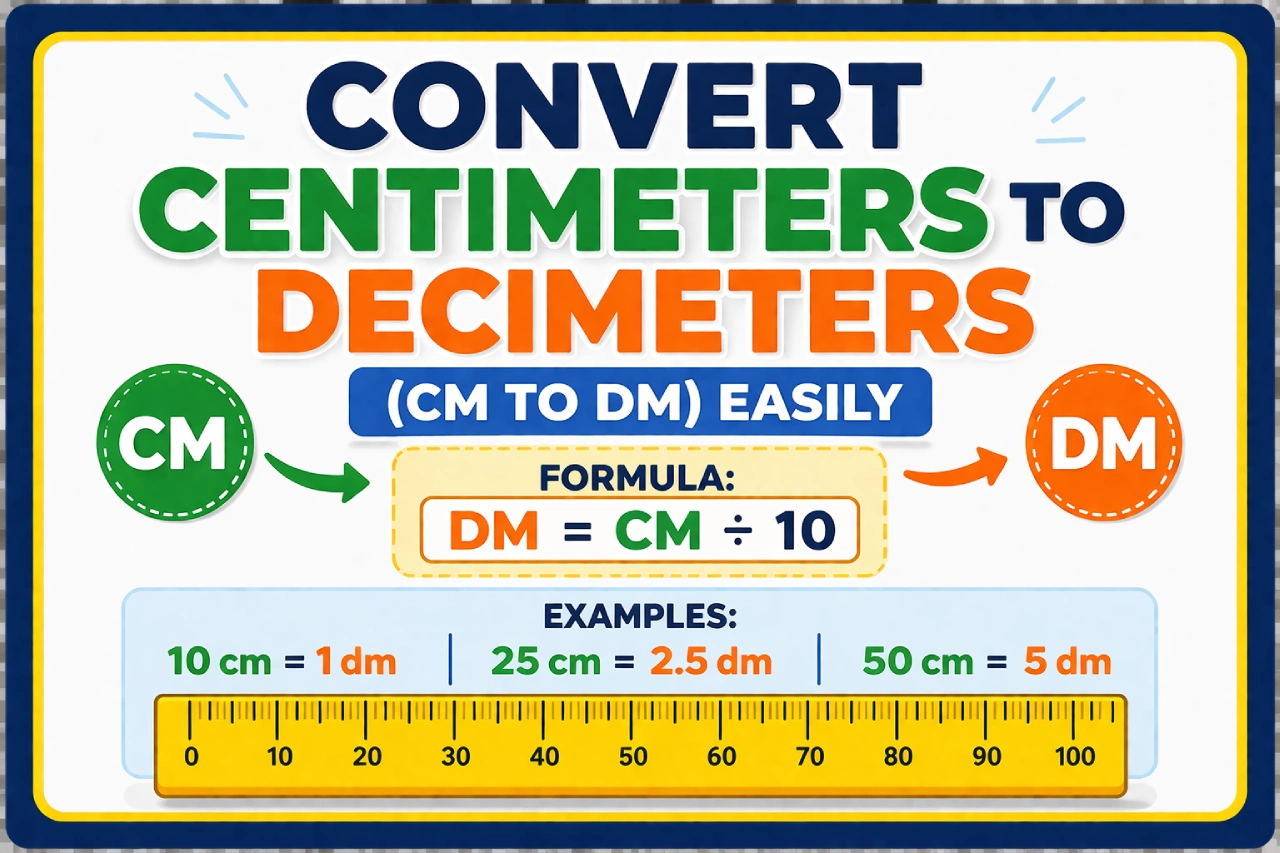
If you’re looking for the quick answer:
1 centimeter (cm) = 0.1 decimeters (dm)
—or—
10 centimeters = 1 decimeter
So to convert cm to dm, simply divide the centimeter value by 10.
For example:
- 20 cm = 2 dm
- 50 cm = 5 dm
- 100 cm = 10 dm
This conversion is simple once you understand how metric prefixes work. In fact, the relationship between centimeters and decimeters is built directly into the structure of the metric system.
In this guide, we’ll explore how the conversion works, why it’s so easy, practical examples, and real-world situations where converting centimeters to decimeters can be useful.
CM to DM Conversion Formula
CM to DM Converter
Enter a value in centimeters to convert it into decimeters instantly.
The standard formula is:
dm = cm ÷ 10
Or alternatively:
dm = cm × 0.1
Reverse Conversion
To convert dm to cm:
cm = dm × 10
Because the metric system is base-10, these conversions are quick and intuitive.
Understanding Metric Prefixes
The metric system is designed around powers of ten, which makes conversions extremely straightforward.
Here are some common metric units related to meters:
| Unit | Symbol | Relation to Meter |
|---|---|---|
| Kilometer | km | 1,000 meters |
| Meter | m | 1 meter |
| Decimeter | dm | 0.1 meters |
| Centimeter | cm | 0.01 meters |
| Millimeter | mm | 0.001 meters |
Looking at this table, you can see that:
1 dm = 10 cm
That’s why converting centimeters to decimeters is as simple as dividing by ten.
Quick CM to DM Conversion Table
Here’s a helpful reference chart.
| Centimeters (cm) | Decimeters (dm) |
|---|---|
| 1 cm | 0.1 dm |
| 5 cm | 0.5 dm |
| 10 cm | 1 dm |
| 20 cm | 2 dm |
| 50 cm | 5 dm |
| 100 cm | 10 dm |
| 200 cm | 20 dm |
This chart makes it easy to estimate conversions quickly.
Step-by-Step Conversion Examples
Let’s go through a few examples to make the process crystal clear.
Example 1: Convert 25 cm to dm
25 ÷ 10 = 2.5 dm
Example 2: Convert 80 cm to dm
80 ÷ 10 = 8 dm
Example 3: Convert 135 cm to dm
135 ÷ 10 = 13.5 dm
Example 4: Convert 4 dm to cm
4 × 10 = 40 cm
Once you understand the pattern, conversions become almost automatic.
Why the Metric System Makes Conversion Easy
One of the greatest strengths of the metric system is its base-10 structure.
Unlike the U.S. customary system—where conversions can involve numbers like 12, 3, or 5280—the metric system uses powers of ten.
That means converting units usually involves simply moving the decimal point.
For example:
- cm → dm → m → km
Each step moves the decimal by one position.
This design makes the system particularly useful for science, engineering, and global standardization.
Real-World Applications
Although centimeters are more common in daily life, decimeters still appear in several practical situations.
Education and Mathematics
Many school math problems use decimeters to help students understand metric relationships.
Learning cm-to-dm conversions builds familiarity with metric prefixes.
Engineering and Technical Drawings
Some engineering diagrams use decimeters to simplify measurements.
For example:
Instead of writing 120 cm, an engineer might write 12 dm.
Scientific Calculations
In science, unit consistency is critical.
Scientists sometimes use decimeters when dealing with volume calculations because:
1 cubic decimeter = 1 liter
This relationship is extremely useful in chemistry and physics.
Design and Architecture
Certain architectural or technical models may express measurements in decimeters for easier scaling.
Common Mistakes When Converting CM to DM
Forgetting to Divide by 10
The most common mistake is multiplying instead of dividing.
Remember:
cm → dm = divide by 10
Confusing Decimeters with Millimeters
These units sound similar but are very different.
- 1 dm = 10 cm
- 1 cm = 10 mm
Mixing them up leads to major errors.
Misplacing the Decimal Point
Because conversions involve decimals, placing the decimal incorrectly can change the value significantly.
Always double-check your units and calculations.
CM vs DM vs Meters
Understanding the relationship between these units helps make conversions easier.
| Unit | Value |
|---|---|
| 1 meter | 10 dm |
| 1 meter | 100 cm |
| 1 dm | 10 cm |
So:
1 meter = 10 dm = 100 cm
This hierarchy makes it easy to move between units.
Tips for Quick Mental Conversion
Here are a few tricks that make conversions easier.
First, remember the core rule:
10 cm = 1 dm
Second, when converting cm to dm, move the decimal one place to the left.
For example:
- 75 cm → 7.5 dm
- 140 cm → 14 dm
Third, keep the metric ladder in mind:
km → m → dm → cm → mm
Moving down multiplies by 10, and moving up divides by 10.
Frequently Asked Questions (FAQs)
1. How do you convert cm to dm?
Divide the centimeter value by 10.
Example:
50 cm ÷ 10 = 5 dm
2. How many centimeters are in a decimeter?
There are 10 centimeters in 1 decimeter.
3. What is 100 cm in dm?
100 ÷ 10 = 10 dm
4. Why is the conversion so simple?
Because the metric system is based on powers of ten.
5. Is a decimeter bigger than a centimeter?
Yes.
1 dm = 10 cm, so a decimeter is larger.
6. Is dm commonly used?
Decimeters are less common in everyday life but still appear in education, science, and engineering.
7. What is 45 cm in dm?
45 ÷ 10 = 4.5 dm
8. How many dm are in 1 meter?
There are 10 dm in 1 meter.
9. What is the easiest way to remember the conversion?
Just remember:
10 cm = 1 dm
10. Can cm and dm be used interchangeably?
No. They represent different scales of measurement.
Final Thoughts
Converting centimeters to decimeters is one of the simplest conversions in the entire metric system. Once you remember the basic rule—divide by 10—the process becomes almost effortless.
The beauty of the metric system is that it keeps everything organized around powers of ten, making unit conversions intuitive and predictable.
Whether you’re solving a math problem, reading a technical diagram, or working with metric measurements, understanding how centimeters relate to decimeters gives you a deeper appreciation for how elegantly the metric system works.
Now here’s a quick question for you:
When you measure something in centimeters, do you ever mentally convert it into meters or decimeters to visualize the scale better?
Leave a Reply