Here’s the quick answer most people are searching for:
1 ton of cooling = 12,000 BTU per hour (BTU/h)
So if you want to convert:
- BTU to tons → divide by 12,000
- Tons to BTU → multiply by 12,000
Simple on the surface—but once you start dealing with air conditioners, HVAC systems, or energy calculations, understanding why this conversion exists becomes incredibly important.
In this guide, I’ll walk you through everything you need to know about BTU to ton conversion, including formulas, examples, real-world applications, and how to choose the right AC size.
What Is a BTU?
A BTU (British Thermal Unit) is a measure of heat energy. Specifically, it represents the amount of heat needed to raise the temperature of one pound of water by one degree Fahrenheit.
In everyday use, BTUs are commonly used to measure:
- Heating systems
- Air conditioners
- Furnaces
- Energy output of appliances
For example:
- A small window AC might be 5,000 BTU
- A central AC system might be 36,000 BTU
The higher the BTU rating, the more heat the system can remove (or produce).
What Does “Ton” Mean in HVAC?
In HVAC terms, a ton doesn’t refer to weight—it refers to cooling capacity.
Historically, this comes from the amount of heat required to melt one ton of ice over 24 hours.
That’s where the key number comes from:
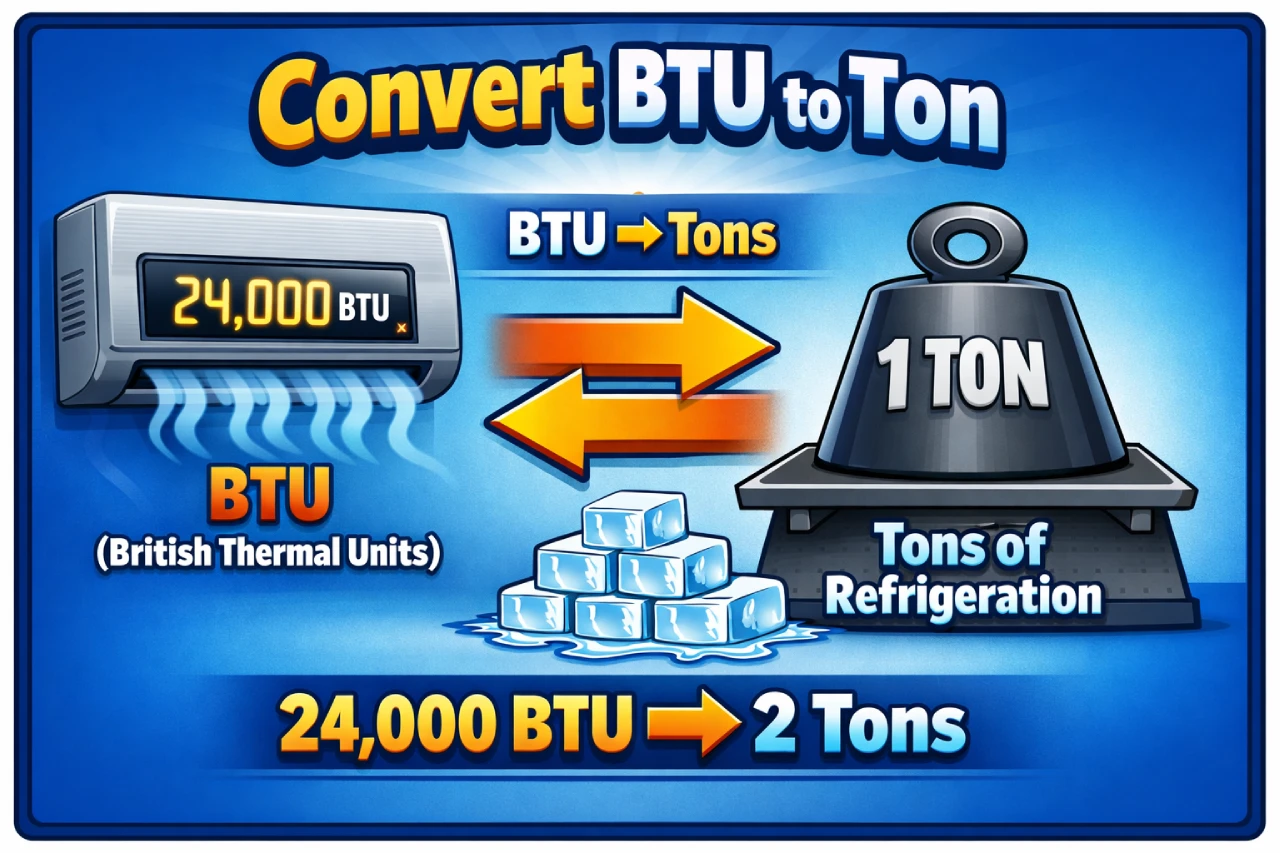
- 1 ton of cooling = 12,000 BTU per hour
So when someone says “a 2-ton AC,” they actually mean:
- 2 × 12,000 = 24,000 BTU/h
It’s a historical term, but it’s still widely used in modern HVAC systems.
BTU to Ton Conversion Formula
BTU to Ton Converter
Convert BTU/hr to refrigeration tons instantly.
Here’s the main formula:
Tons = BTU ÷ 12,000
And for reverse conversion:
BTU = Tons × 12,000
This is the only formula you really need.
Quick Conversion Table
Here’s a handy reference table:
| BTU (BTU/h) | Tons |
|---|---|
| 6,000 BTU | 0.5 ton |
| 12,000 BTU | 1 ton |
| 18,000 BTU | 1.5 ton |
| 24,000 BTU | 2 ton |
| 36,000 BTU | 3 ton |
| 48,000 BTU | 4 ton |
| 60,000 BTU | 5 ton |
This table is especially useful when comparing AC units.
Step-by-Step Conversion Examples
Let’s go through a few practical examples.
Example 1: Convert 24,000 BTU to Tons
24,000 ÷ 12,000 = 2 tons
Example 2: Convert 9,000 BTU to Tons
9,000 ÷ 12,000 = 0.75 ton
Example 3: Convert 3 Tons to BTU
3 × 12,000 = 36,000 BTU
Once you understand the 12,000 factor, everything becomes straightforward.
Why Is 12,000 BTU Equal to 1 Ton?
This comes from the physics of ice melting.
In the past, buildings were cooled using large blocks of ice. Engineers calculated how much heat was required to melt 1 ton (2,000 pounds) of ice over 24 hours.
That heat amount turned out to be:
- 288,000 BTU over 24 hours
- Divide by 24 hours → 12,000 BTU per hour
That’s how we got:
1 ton = 12,000 BTU/h
Even though technology has changed, the terminology stuck.
Real-World Applications
Air Conditioning Systems
This is where the conversion matters most.
When buying an AC, you’ll often see:
- Window units listed in BTUs
- Central systems listed in tons
Understanding the conversion helps you compare systems easily.
HVAC Design
Professionals use BTU and ton calculations to:
- Size cooling systems
- Estimate energy consumption
- Ensure efficient performance
Energy Efficiency
Choosing the correct tonnage ensures:
- Lower energy bills
- Better cooling performance
- Longer equipment lifespan
How to Choose the Right AC Size
This is where things get practical.
A common rule of thumb:
- 20 BTU per square foot
So for a 1,000 sq ft room:
- 1,000 × 20 = 20,000 BTU
- 20,000 ÷ 12,000 ≈ 1.67 tons
You’d typically choose a 1.5 to 2-ton unit.
General AC Size Guide
| Room Size (sq ft) | BTU Needed | Tons |
|---|---|---|
| 500 sq ft | 10,000 BTU | 0.8 ton |
| 1,000 sq ft | 20,000 BTU | 1.7 ton |
| 1,500 sq ft | 30,000 BTU | 2.5 ton |
| 2,000 sq ft | 40,000 BTU | 3.3 ton |
These are estimates—factors like insulation, sunlight, and ceiling height also matter.
Common Mistakes to Avoid
Confusing Tons with Weight
In HVAC:
- “Ton” = cooling capacity
- Not physical weight
Oversizing or Undersizing AC Units
- Too small → struggles to cool
- Too large → cycles on/off too frequently
Both reduce efficiency.
Ignoring BTU Ratings
Always check BTU values when comparing units. Tons alone may not give the full picture.
BTU vs Ton vs kW
You may also see kilowatts (kW) used.
Here’s how they compare:
- 1 ton ≈ 3.517 kW
- 1 kW ≈ 3,412 BTU/h
These conversions are useful for international comparisons or energy calculations.
Tips for Accurate Conversion
- Always remember: 12,000 BTU = 1 ton
- Use a calculator for non-round numbers
- Double-check units (BTU vs BTU/h)
- Round appropriately when selecting AC units
If you’re buying an AC, it’s better to slightly round up—but not excessively.
Frequently Asked Questions (FAQs)
1. How many BTU are in 1 ton?
There are exactly 12,000 BTU per hour in 1 ton of cooling.
2. How do you convert BTU to tons?
Divide the BTU value by 12,000.
Example: 24,000 ÷ 12,000 = 2 tons.
3. What is 18,000 BTU in tons?
18,000 ÷ 12,000 = 1.5 tons
4. Is a higher BTU better?
Not always. Higher BTU means more cooling power, but too much can reduce efficiency and comfort.
5. Why is AC measured in tons?
The term comes from the historical method of cooling using ice, where 1 ton of ice melting equals 12,000 BTU/h.
6. How many tons is a 36,000 BTU AC?
36,000 ÷ 12,000 = 3 tons
7. What size AC do I need for my home?
It depends on square footage, insulation, and climate, but a general estimate is 20 BTU per square foot.
8. Can I use BTU instead of tons?
Yes. BTU gives a more precise measurement, while tons are often used for convenience.
9. What happens if my AC is too big?
It may cool too quickly without removing humidity, leading to discomfort and inefficiency.
10. What happens if my AC is too small?
It will run continuously and struggle to cool the space properly.
Final Thoughts
The BTU to ton conversion is one of those concepts that looks technical at first—but once you understand the core rule (12,000 BTU = 1 ton), everything falls into place.
Whether you're buying an air conditioner, comparing HVAC systems, or just trying to make sense of energy ratings, this conversion gives you clarity and confidence.
Personally, I’ve found that once you start thinking in tons and BTUs interchangeably, choosing the right system becomes much easier—and you avoid costly mistakes.
Now here’s a simple question for you:
Are you trying to calculate cooling for a specific room, or just making sense of AC ratings before a purchase?