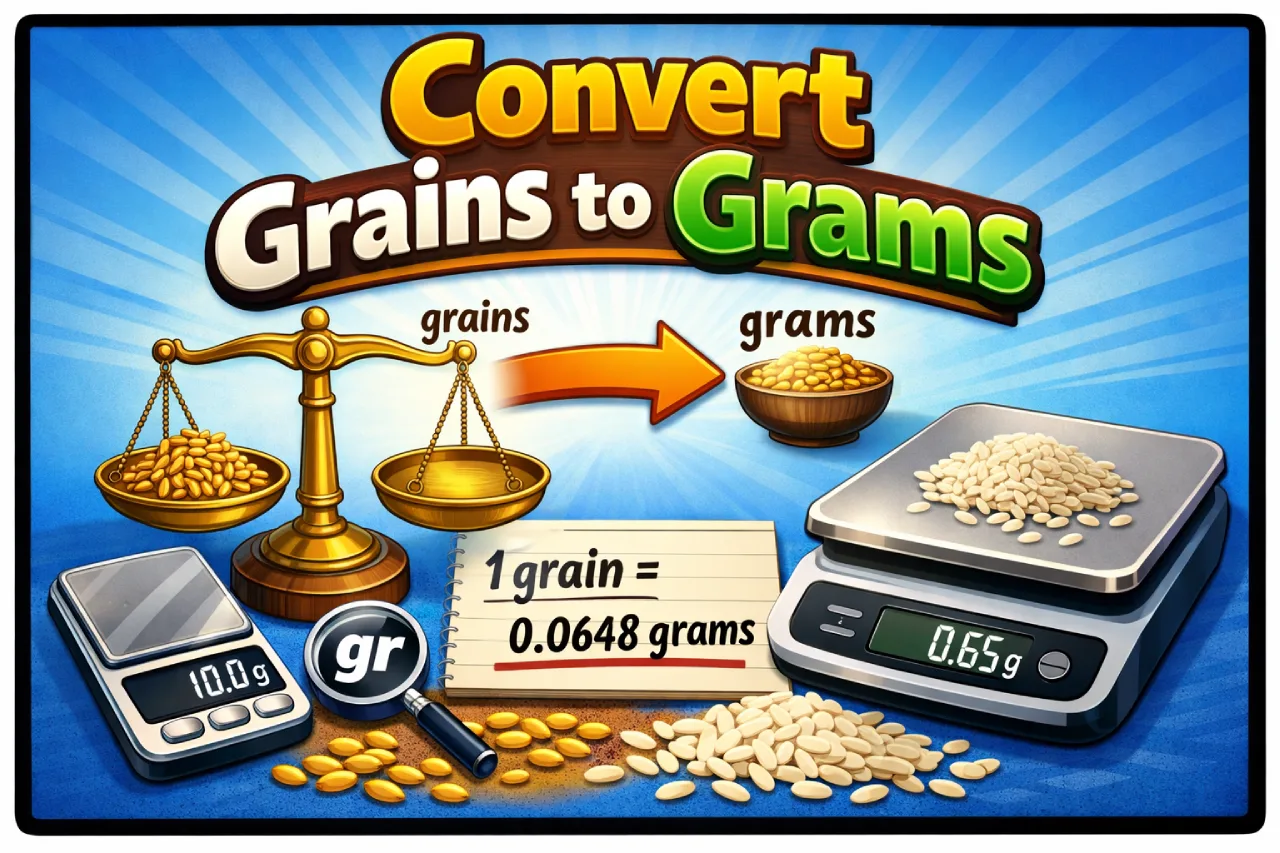
If you’re looking for a quick answer, here it is:
1 grain (gr) = 0.0648 grams (g)
So, to convert grains to grams, simply:
Grams = Grains × 0.0648
That’s the key formula. But if you want to understand where this unit comes from, how to use it correctly, and why it still matters today, this guide will walk you through everything in a clear, practical way.
What Is a Grain?
A grain is one of the oldest units of mass still in use today.
Historically, it was based on the weight of a single grain of barley. Over time, it became standardized and is now defined precisely as:
1 grain = 64.79891 milligrams = 0.06479891 grams
What Is a Gram?
A gram (g) is a metric unit of mass used worldwide.
It’s part of the International System of Units (SI) and is commonly used for:
- Food and nutrition
- Scientific measurements
- Everyday weighing
Compared to grains, grams are much more standardized and easier to work with in modern contexts.
The Grain to Gram Conversion Formula
Grain to Gram Converter
Enter a value in grains to instantly convert it into grams.
Here’s the exact formula:
Grams = Grains × 0.0648
If you need more precision:
Grams = Grains × 0.06479891
For most everyday purposes, 0.0648 is accurate enough.
Step-by-Step Conversion Examples
Let’s make this practical.
Example 1: Convert 10 grains to grams
10 × 0.0648 = 0.648 grams
Example 2: Convert 50 grains to grams
50 × 0.0648 = 3.24 grams
Example 3: Convert 100 grains to grams
100 × 0.0648 = 6.48 grams
Once you try a few, the pattern becomes easy to remember.
Quick Conversion Table
Here’s a handy reference chart:
| Grains (gr) | Grams (g) |
|---|---|
| 1 gr | 0.0648 g |
| 5 gr | 0.324 g |
| 10 gr | 0.648 g |
| 20 gr | 1.296 g |
| 50 gr | 3.24 g |
| 100 gr | 6.48 g |
This table is useful for quick estimates without a calculator.
Why the Grain Unit Still Matters
You might be wondering—why use grains at all?
Ammunition Measurements
In the U.S., bullet weights are almost always measured in grains.
For example:
- A 55-grain bullet = about 3.56 grams
- A 124-grain bullet = about 8.04 grams
Understanding this conversion helps you compare ammunition specifications more easily.
Pharmaceuticals (Historical and Occasional Use)
Some older prescriptions and dosage systems still reference grains.
For example:
- 1 grain of aspirin ≈ 64.8 mg
Although modern medicine mostly uses milligrams, grains still appear occasionally.
Nutritional Supplements
Certain supplements—especially imported or older formulations—may list dosages in grains.
Grain vs Gram: Key Differences
Here’s a simple comparison:
| Unit | System | Value |
|---|---|---|
| Grain | Imperial/Traditional | 0.0648 g |
| Gram | Metric (SI) | Standard unit |
Grains are niche and historical, while grams are universal and widely used.
Converting Grams Back to Grains
Sometimes you’ll need to reverse the conversion.
Here’s the formula:
Grains = Grams ÷ 0.0648
Or:
Grains = Grams × 15.43
Examples:
- 1 gram × 15.43 = 15.43 grains
- 5 grams × 15.43 = 77.15 grains
This is especially useful when working with specifications given in grams but needing grain values.
Real-Life Example You Can Relate To
Let’s say you’re comparing two bullet weights:
- 100 grains
- 6.5 grams
Convert 100 grains:
100 × 0.0648 = 6.48 grams
Now you can see they’re almost the same.
This kind of comparison is much easier once you understand the conversion.
Mental Math Trick
Here’s a quick trick I use:
- Multiply grains by 0.065 (slightly rounded)
Example:
20 grains × 0.065 ≈ 1.3 grams
It’s not exact, but it’s close enough for quick estimates.
Common Mistakes to Avoid
Using the Wrong Conversion Factor
Always use:
1 grain = 0.0648 grams
Not 0.06 or 0.07 unless estimating.
Confusing Grains with Grams
They sound similar but represent very different values.
Over-Rounding Too Early
Round your final answer, not your intermediate steps.
Ignoring Context
Make sure you know whether the measurement is in grains or grams—especially in technical fields.
Why Precision Matters
In some situations, small differences can matter a lot.
Ammunition
Even slight variations in bullet weight can affect performance and accuracy.
Medicine
Dosage errors—even small ones—can have serious consequences.
Science and Engineering
Accurate measurements are essential for reliable results.
In these cases, always use the precise conversion factor.
Grain to Gram vs Milligrams
It’s often helpful to connect grains to milligrams as well.
- 1 grain = 64.8 mg
- 1 gram = 1,000 mg
So:
- 1 grain ≈ 0.065 grams
- 15.43 grains ≈ 1 gram
This relationship helps you move between units more easily.
If you want a deeper look at measurement standards, you can explore this resource from the National Institute of Standards and Technology (NIST), which explains SI units in detail.
Practical Use Case: Medication Example
Let’s say an older prescription says:
Take 2 grains of a medication
Convert:
2 × 0.0648 = 0.1296 grams
Or:
0.1296 grams = 129.6 mg
Now you understand the dosage in modern units.
Frequently Asked Questions (FAQs)
How many grams are in 1 grain?
There are 0.0648 grams in 1 grain.
What is the formula to convert grains to grams?
Grams = Grains × 0.0648
How many grams is 10 grains?
10 grains = 0.648 grams
How many grams is 100 grains?
100 grains = 6.48 grams
How many grains are in 1 gram?
1 gram ≈ 15.43 grains
Why is the grain unit still used?
It’s commonly used in ammunition, older medical systems, and some supplements.
Is a grain bigger than a gram?
No. A grain is much smaller than a gram.
How accurate is the 0.0648 conversion factor?
It’s very accurate for most uses. The exact value is 0.06479891 grams.
Can I round the conversion?
Yes, for quick estimates you can use 0.065.
Where is grain used most today?
Primarily in ammunition and occasionally in pharmaceuticals.
Final Thoughts
So, how do you convert grain to gram?
The key takeaway is simple:
1 grain = 0.0648 grams
Once you know that, everything becomes straightforward. Whether you’re working with ammunition, medication, or technical data, this conversion helps you bridge the gap between traditional and metric systems.
And after a few calculations, you’ll start doing it almost automatically—no calculator needed.
Leave a Reply