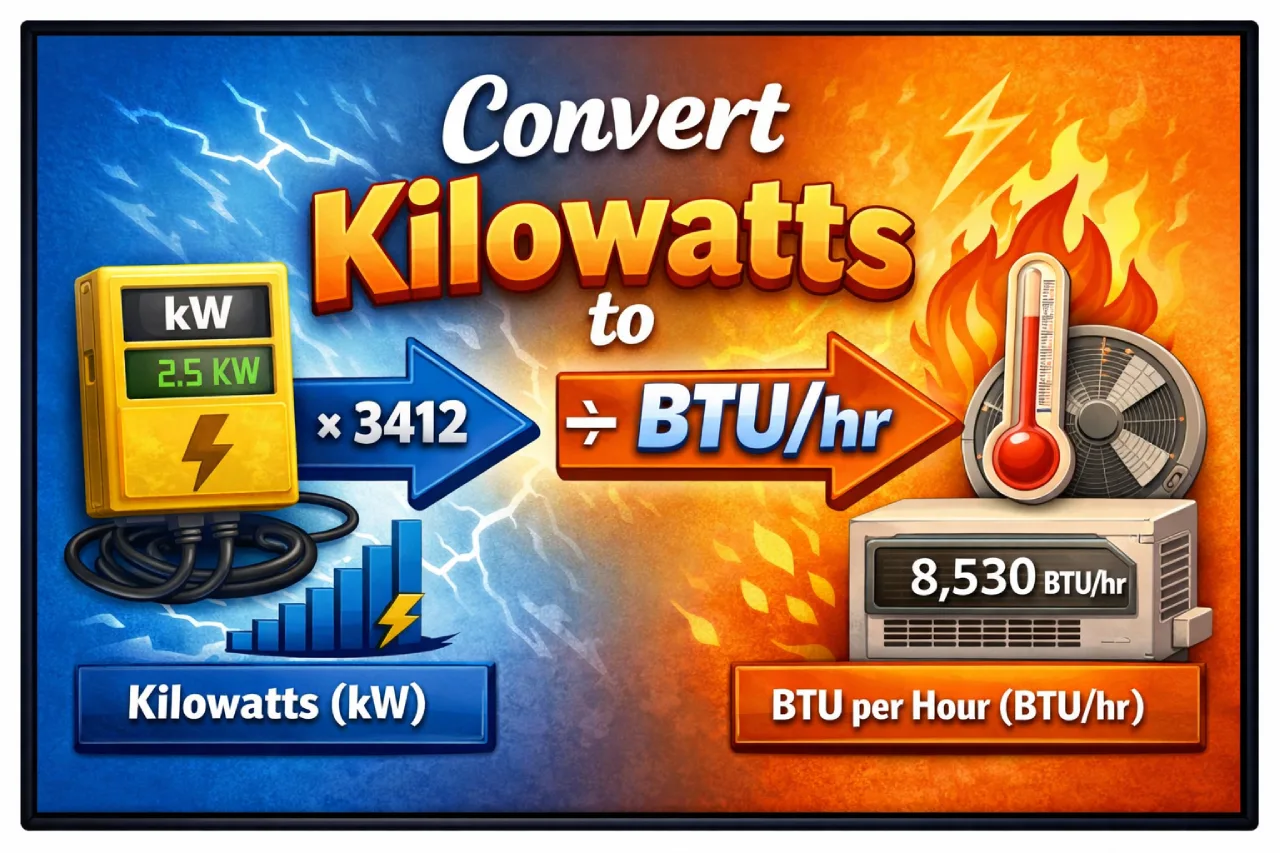
If you’re looking for a quick answer, here it is:
1 kilowatt (kW) = 3,412.14 Btu/hr
So, to convert kilowatts to Btu per hour, simply:
Btu/hr = kW × 3,412.14
That’s the key formula. But if you want to understand what these units mean, when to use them, and how to apply this conversion in real-world situations like HVAC systems and energy calculations, this guide will walk you through everything clearly.
What Is a Kilowatt (kW)?
A kilowatt (kW) is a unit of power in the metric system. It measures how much energy is used or produced per second.
- 1 kilowatt = 1,000 watts
- Commonly used for electrical systems, appliances, and power consumption
For example:
- A space heater might use 1.5 kW
- A home air conditioner might use 3–5 kW
Kilowatts are standard in engineering, electricity billing, and energy systems.
What Is Btu/hr?
Btu/hr (British Thermal Units per hour) measures heat energy transfer.
- 1 Btu = the amount of heat needed to raise the temperature of 1 pound of water by 1°F
- Btu/hr tells you how much heat is being added or removed per hour
This unit is widely used in the U.S. for:
- Heating systems
- Air conditioning (HVAC)
- Furnaces and boilers
For example:
- A small window AC unit might be 5,000 Btu/hr
- A central HVAC system might be 36,000 Btu/hr
Why Convert kW to Btu/hr?
This conversion is especially important when you’re dealing with electrical power vs heating or cooling capacity.
Here are common scenarios:
HVAC Systems
Air conditioners and heaters are rated in Btu/hr, but their power consumption is often listed in kW.
Understanding the conversion helps you compare performance and efficiency.
Energy Calculations
If you’re calculating energy usage across systems that use different units, you’ll need to convert between kW and Btu/hr.
Equipment Comparison
Some manufacturers use metric units (kW), while others use imperial units (Btu/hr). Conversion helps you compare apples to apples.
The Conversion Formula Explained
Kilowatts to Btu/hr
Enter kilowatts and instantly convert to Btu per hour.
Here’s the formula again:
Btu/hr = kW × 3,412.14
This number comes from the relationship between electrical energy and heat energy.
If you need to reverse the conversion:
kW = Btu/hr ÷ 3,412.14
Step-by-Step Examples
Let’s make this practical.
Example 1: Convert 1 kW to Btu/hr
1 × 3,412.14 = 3,412.14 Btu/hr
Example 2: Convert 3 kW to Btu/hr
3 × 3,412.14 = 10,236.42 Btu/hr
Example 3: Convert 5 kW to Btu/hr
5 × 3,412.14 = 17,060.7 Btu/hr
These are common values you might see when comparing HVAC systems.
Quick Conversion Table
Here’s a handy reference chart:
| Kilowatts (kW) | Btu/hr |
|---|---|
| 1 kW | 3,412 Btu/hr |
| 2 kW | 6,824 Btu/hr |
| 3 kW | 10,236 Btu/hr |
| 5 kW | 17,061 Btu/hr |
| 10 kW | 34,121 Btu/hr |
This table is useful when you need quick estimates.
Real-Life Example: Air Conditioner Sizing
Let’s say you’re choosing an air conditioner.
You see two specs:
- Unit A: 3.5 kW
- Unit B: 12,000 Btu/hr
Convert Unit A:
3.5 × 3,412.14 = 11,942.49 Btu/hr
Now you can see that both units are almost the same in cooling capacity.
This makes it much easier to compare options.
kW vs Btu/hr: What’s the Difference?
Here’s a simple way to understand it:
- kW = electrical power input
- Btu/hr = heat output or removal
They measure different aspects of energy, but they’re directly related.
Energy Efficiency and COP
When working with HVAC systems, you’ll often encounter efficiency ratings like COP (Coefficient of Performance).
COP tells you how efficiently a system converts electrical energy (kW) into heating or cooling (Btu/hr).
For example:
- A system using 1 kW might produce more than 3,412 Btu/hr due to efficiency gains
This is why real-world systems don’t always match the basic conversion exactly.
Quick Mental Math Trick
Here’s a simple way to estimate:
- Multiply kW by 3,400 instead of 3,412
Example:
4 kW × 3,400 ≈ 13,600 Btu/hr
It’s not exact, but it’s close enough for quick calculations.
Converting Btu/hr Back to kW
If you have Btu/hr and want kW:
kW = Btu/hr ÷ 3,412.14
Example:
12,000 Btu/hr ÷ 3,412.14 ≈ 3.52 kW
This is commonly used when evaluating air conditioners.
Common Mistakes to Avoid
Using the Wrong Conversion Factor
Always use:
1 kW = 3,412.14 Btu/hr
Not 3,000 or 3,500 unless estimating.
Confusing Energy and Power
- kW and Btu/hr both measure power, not total energy
- Don’t confuse them with kWh or total Btu
Ignoring Efficiency
Real systems may perform differently due to efficiency ratings.
Rounding Too Early
Round your final answer, not intermediate steps.
Practical Use Case: Heating System
Let’s say you’re installing a heater rated at:
10 kW
Convert:
10 × 3,412.14 = 34,121.4 Btu/hr
Now you know its heating capacity in a unit commonly used in the U.S.
Why This Conversion Matters
Understanding this conversion helps you:
- Choose the right HVAC system
- Compare products from different regions
- Estimate energy usage
- Avoid costly sizing mistakes
In my experience, this is one of the most useful conversions when dealing with home systems.
When Precision Matters
In some cases, accuracy is critical:
HVAC Design
Incorrect sizing can lead to inefficient heating or cooling.
Engineering Applications
Precise calculations are essential for system performance.
Energy Audits
Accurate conversions help evaluate efficiency and cost.
In these situations, always use the exact factor.
Frequently Asked Questions (FAQs)
How many Btu/hr is 1 kW?
1 kW = 3,412.14 Btu/hr
What is the formula to convert kW to Btu/hr?
Btu/hr = kW × 3,412.14
How many Btu/hr is 3.5 kW?
3.5 × 3,412.14 = 11,942.49 Btu/hr
How many kW is 12,000 Btu/hr?
12,000 ÷ 3,412.14 ≈ 3.52 kW
Why is this conversion important?
It helps compare electrical power with heating or cooling capacity.
Is kW the same as Btu/hr?
No, but they measure the same concept (power) in different units.
Can I round 3,412 to 3,400?
Yes, for quick estimates.
What’s the easiest way to estimate quickly?
Multiply kW by 3,400.
Does efficiency affect this conversion?
Yes. Real systems may produce more or less output depending on efficiency.
Where is Btu/hr commonly used?
In the U.S., especially for HVAC systems.
Final Thoughts
So, how do you convert kilowatts to Btu/hr?
The key takeaway is simple:
Multiply kW by 3,412.14
Once you understand this relationship, you can easily move between metric and imperial systems—especially when dealing with heating and cooling systems.
Whether you’re choosing an air conditioner, evaluating a heater, or comparing energy systems, this conversion gives you the clarity you need to make smarter decisions.
And after a few uses, you’ll start estimating it in your head without even thinking.
Leave a Reply