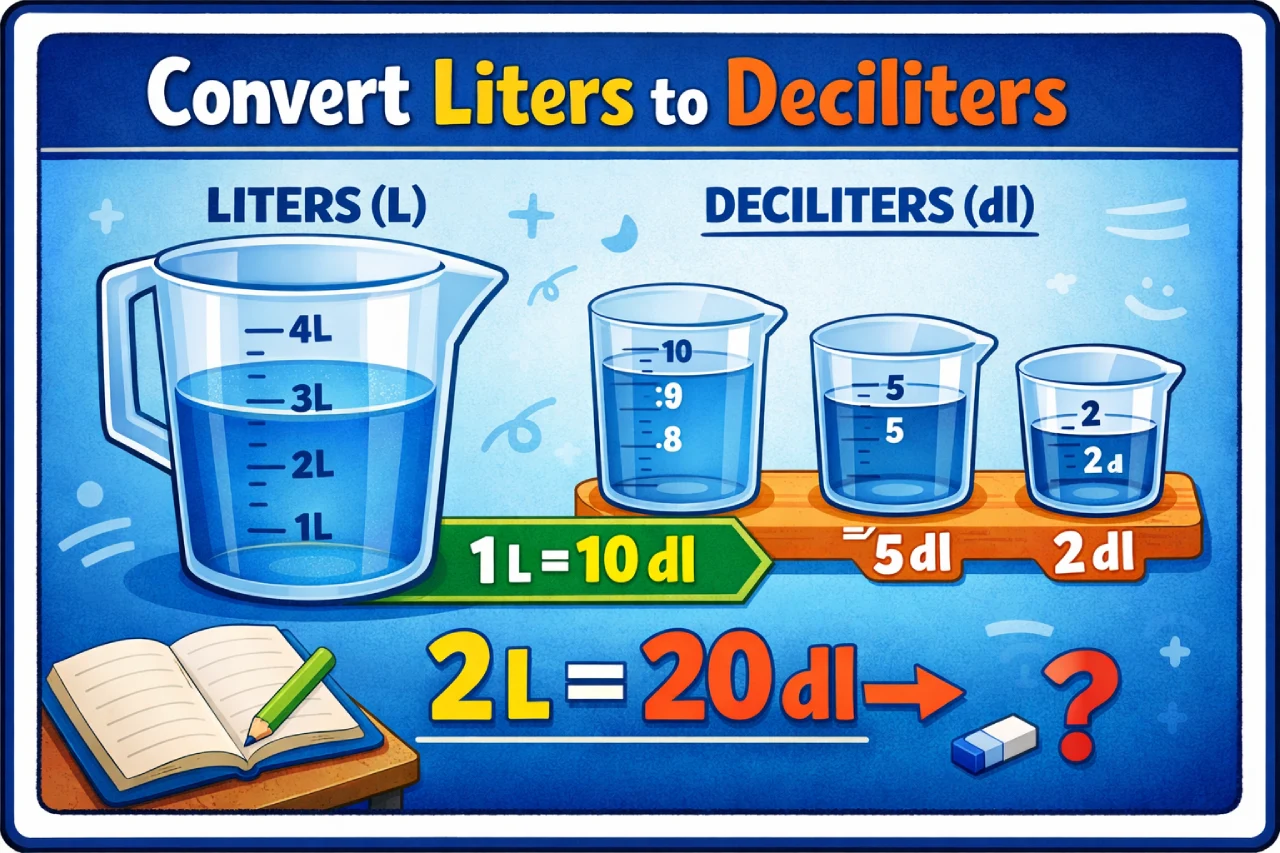
If you’re looking for a quick answer, here it is:
1 liter (L) = 10 deciliters (dL)
So, to convert liters to deciliters, simply:
Multiply liters by 10
That’s the entire formula. But if you want to understand why this works—and how to use it confidently in real-life situations—this guide will walk you through everything step by step.
What Are Liters and Deciliters?
Both liters (L) and deciliters (dL) belong to the metric system, which is used worldwide for measuring volume.
A liter is a standard unit of volume commonly used for:
- Beverages (like soda bottles)
- Cooking measurements
- Scientific and medical applications
A deciliter is a smaller unit. The prefix “deci-” means one-tenth, so:
- 1 deciliter = 0.1 liter
- 10 deciliters = 1 liter
In simple terms, deciliters break a liter into smaller, more precise portions.
The L to dL Conversion Formula
Liters to Deciliters
Enter liters below to convert into deciliters.
Here’s the formula you’ll use every time:
dL = L × 10
That means:
- 1 L = 10 dL
- 2 L = 20 dL
- 5 L = 50 dL
It’s one of the easiest conversions in the metric system because everything is based on powers of 10.
Step-by-Step Examples
Let’s make this practical.
Example 1: Convert 3 liters to deciliters
3 × 10 = 30 dL
Example 2: Convert 7.5 liters to deciliters
7.5 × 10 = 75 dL
Example 3: Convert 0.8 liters to deciliters
0.8 × 10 = 8 dL
Once you try a few examples, you’ll see how straightforward it is.
Quick Conversion Table
Here’s a handy table for quick reference:
| Liters (L) | Deciliters (dL) |
|---|---|
| 0.5 L | 5 dL |
| 1 L | 10 dL |
| 2 L | 20 dL |
| 5 L | 50 dL |
| 10 L | 100 dL |
| 20 L | 200 dL |
This is especially useful when you need quick answers without doing calculations.
Why This Conversion Is So Easy
The metric system is built on base 10, which makes conversions incredibly simple.
Each step up or down the scale is just a factor of 10.
For example:
- 1 liter = 10 deciliters
- 1 liter = 100 centiliters
- 1 liter = 1,000 milliliters
This consistency is what makes metric conversions much easier than imperial ones.
Real-Life Uses of Liters to Deciliters
You might be surprised how often this conversion shows up.
Cooking and Baking
Some recipes—especially European ones—use deciliters instead of cups or milliliters.
For example:
- 2 dL of milk = 0.2 liters
- 5 dL of water = 0.5 liters
Understanding this conversion helps you follow recipes accurately.
Medical and Laboratory Measurements
Deciliters are commonly used in medical tests.
For example, blood sugar levels are often measured in mg/dL (milligrams per deciliter).
Knowing what a deciliter represents helps you understand these values better.
Beverage Measurements
Some drink containers or nutrition labels use liters, while others may use deciliters or milliliters.
Converting between them helps you compare quantities easily.
Mental Math Trick
One of the easiest tricks I use:
Just move the decimal point one place to the right.
Example:
- 1.2 L → 12 dL
- 0.7 L → 7 dL
- 3.45 L → 34.5 dL
That’s it—no calculator needed.
Converting dL Back to L
Sometimes you’ll need to reverse the conversion.
Here’s the formula:
L = dL ÷ 10
Example:
- 50 dL ÷ 10 = 5 L
- 8 dL ÷ 10 = 0.8 L
Or simply:
Move the decimal one place to the left
Common Mistakes to Avoid
Even though this conversion is simple, a few mistakes still happen.
Confusing dL with mL
- 1 dL = 100 mL
- Don’t mix them up
Moving the Decimal the Wrong Way
- Liters → dL = move right
- dL → liters = move left
Overthinking It
This is a base-10 conversion. Keep it simple.
Comparing dL with Other Units
Understanding where deciliters fit can make things clearer.
- 1 L = 10 dL
- 1 dL = 100 mL
- 1 L = 1,000 mL
So:
- 5 dL = 500 mL
- 2 dL = 200 mL
This helps when switching between different metric units.
Practical Example: Cooking Scenario
Let’s say a recipe calls for 3 dL of milk, but your measuring jug shows liters.
You convert:
3 dL ÷ 10 = 0.3 L
Now you know exactly how much to pour.
This kind of quick conversion saves time and prevents mistakes in the kitchen.
Why the Metric System Works So Well
One thing I’ve always appreciated about the metric system is its simplicity.
Unlike imperial units (where conversions can be messy), metric units follow a consistent pattern.
That’s why conversions like L to dL are so straightforward.
When Precision Matters
In some situations, accuracy is critical.
Medical Use
Blood test results often use dL. A small mistake in conversion could lead to misinterpretation.
Scientific Experiments
Exact measurements are essential for valid results.
Professional Cooking
Precision can affect taste and consistency.
In these cases, always double-check your conversions.
Frequently Asked Questions (FAQs)
How many deciliters are in 1 liter?
There are 10 deciliters in 1 liter.
What is the formula to convert L to dL?
dL = L × 10
How do you convert liters to deciliters quickly?
Multiply by 10 or move the decimal one place to the right.
What is 2 liters in deciliters?
2 liters = 20 dL
What is 0.5 liters in deciliters?
0.5 liters = 5 dL
Is a deciliter bigger than a liter?
No. A deciliter is smaller.
1 dL = 0.1 L
How many dL are in 5 liters?
5 liters = 50 dL
How do you convert dL back to liters?
Divide by 10 or move the decimal one place to the left.
Why is the metric system easier to use?
Because it’s based on powers of 10, making conversions simple and consistent.
Where are deciliters commonly used?
In cooking, medical measurements, and scientific applications.
Final Thoughts
Converting liters to deciliters is one of the simplest calculations you’ll ever do.
The key takeaway is:
1 liter = 10 deciliters
Once you remember that, everything else becomes easy. Just multiply by 10 (or move the decimal point), and you’re done.
Whether you’re cooking, studying, or working in a lab, this conversion is quick, reliable, and easy to apply in everyday situations.
And once you’ve used it a few times, you won’t even need to think about it—it’ll just come naturally.
Leave a Reply