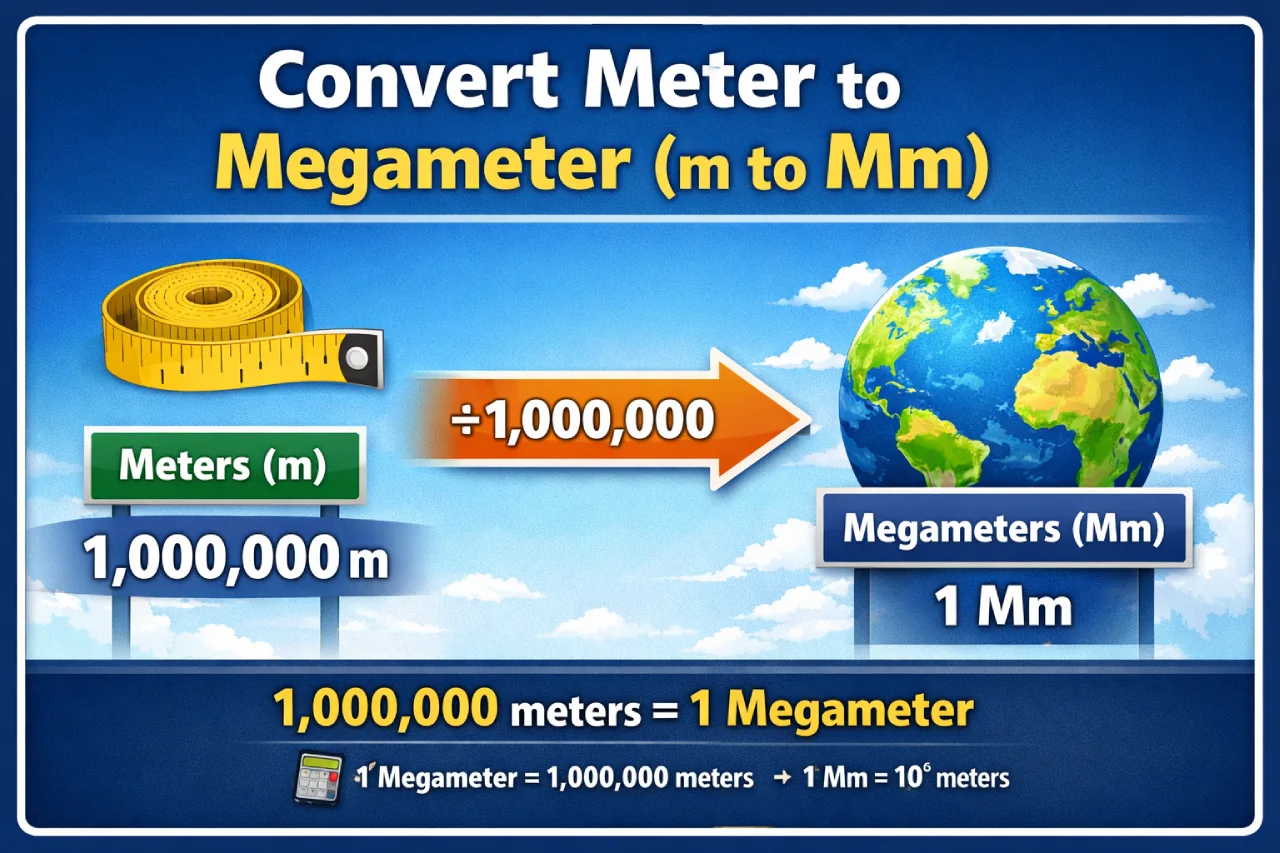
Here’s the quick answer you’re probably looking for:
1 meter (m) equals 0.000001 megameters (Mm)
—or—
1 megameter (Mm) equals 1,000,000 meters (m)
Simple, right? But understanding why this conversion works—and how to use it effectively—can save you time and prevent mistakes, especially in scientific, engineering, or large-scale measurement contexts.
In this guide, I’ll walk you through everything you need to know about converting meters to megameters, including the formula, examples, practical uses, and common pitfalls.
Meter to Megameter Conversion Formula
Meter to Megameter Converter
Enter a value in meters to instantly convert it into megameters.
The conversion is straightforward:
Megameters = Meters ÷ 1,000,000
Or in decimal form:
Megameters = Meters × 0.000001
To convert back:
Meters = Megameters × 1,000,000
Once you understand that “mega” means one million, everything becomes intuitive.
Quick Conversion Table
Here’s a quick reference for common values:
| Meters (m) | Megameters (Mm) |
|---|---|
| 1 m | 0.000001 Mm |
| 100 m | 0.0001 Mm |
| 1,000 m | 0.001 Mm |
| 10,000 m | 0.01 Mm |
| 100,000 m | 0.1 Mm |
| 1,000,000 m | 1 Mm |
| 10,000,000 m | 10 Mm |
This table makes it easy to estimate conversions without a calculator.
Step-by-Step Conversion Examples
Let’s walk through some practical examples.
Example 1: Convert 500,000 meters to megameters
500,000 ÷ 1,000,000 = 0.5 Mm
Example 2: Convert 2,500,000 meters to megameters
2,500,000 ÷ 1,000,000 = 2.5 Mm
Example 3: Convert 0.75 megameters to meters
0.75 × 1,000,000 = 750,000 meters
Once you see the pattern, conversions become quick and effortless.
Why Use Megameters Instead of Meters?
You might be wondering: why not just stick with meters?
The answer is simplicity at scale.
Imagine writing:
- 12,742,000 meters
Versus:
- 12.742 megameters
The second version is cleaner, easier to read, and less error-prone—especially in scientific work.
Key Advantages:
- Reduces large numbers
- Improves readability
- Aligns with scientific notation
- Makes calculations easier
Real-World Applications
Megameters aren’t commonly used in daily life, but they shine in specific fields.
Astronomy and Space Science
Distances between planetary features are often expressed in megameters.
For example:
- Earth’s radius ≈ 6.37 Mm
- Moon’s distance from Earth ≈ 384 Mm
Using megameters keeps numbers manageable.
Geology and Earth Sciences
Large-scale geological formations, such as tectonic plate movements or Earth’s layers, can be measured in megameters.
Engineering and Large Infrastructure
In massive engineering projects—like pipelines, tunnels, or global mapping—megameters can simplify large-scale calculations.
Scientific Research
Scientists often use SI prefixes (like mega, giga, nano) to maintain consistency across measurements.
Common Mistakes to Avoid
Even though the conversion is simple, a few common mistakes can cause confusion.
Forgetting the “Million Factor”
The biggest mistake is not remembering that:
- 1 megameter = 1,000,000 meters
Missing this can throw off your calculations completely.
Misplacing Decimal Points
Since you’re dividing by a large number, it’s easy to shift the decimal incorrectly.
Tip: Count six places to the left when converting meters to megameters.
Confusing Megameters with Kilometers
- 1 kilometer = 1,000 meters
- 1 megameter = 1,000,000 meters
That’s a huge difference.
Meter vs Megameter vs Kilometer
Let’s compare these units for clarity:
| Unit | Value in Meters |
|---|---|
| 1 meter | 1 m |
| 1 kilometer | 1,000 m |
| 1 megameter | 1,000,000 m |
Think of it as levels:
- Meter → everyday distances
- Kilometer → travel distances
- Megameter → planetary-scale distances
Tips for Quick Mental Conversion
Here are a few tricks I personally use:
- Move the decimal 6 places left (meters → megameters)
- Move the decimal 6 places right (megameters → meters)
- Remember: Mega = Million
For example:
- 3,000,000 m → 3 Mm
- 0.002 Mm → 2,000 m
Once you internalize this, you won’t even need a calculator.
Frequently Asked Questions (FAQs)
1. How many meters are in 1 megameter?
There are exactly 1,000,000 meters in 1 megameter.
2. How do you convert meters to megameters?
Divide the number of meters by 1,000,000 or multiply by 0.000001.
3. What is 1 meter in megameters?
1 meter = 0.000001 megameters.
4. Why is the unit called megameter?
The prefix “mega-” means one million in the metric system, so a megameter represents one million meters.
5. Is megameter commonly used?
Not in everyday life, but it’s used in scientific, geological, and astronomical contexts.
6. How many kilometers are in a megameter?
1 megameter = 1,000 kilometers.
7. What is 500,000 meters in megameters?
500,000 meters = 0.5 megameters.
8. How do you convert megameters back to meters?
Multiply the megameter value by 1,000,000.
9. What is the symbol for megameter?
The symbol is Mm (capital M for mega, lowercase m for meter).
10. What’s the easiest way to remember the conversion?
Just remember: Mega = Million.
Final Thoughts
At first glance, converting meters to megameters might seem like something only scientists care about—but it’s actually a great example of how the metric system scales beautifully.
Once you understand that “mega” simply means one million, the conversion becomes second nature. Whether you’re dealing with scientific data, large distances, or just expanding your knowledge, this is one of those concepts that’s both simple and powerful.
Now here’s a simple question for you:
When you think about massive distances—like the size of Earth or space itself—does using megameters make those numbers feel easier to understand?
Leave a Reply