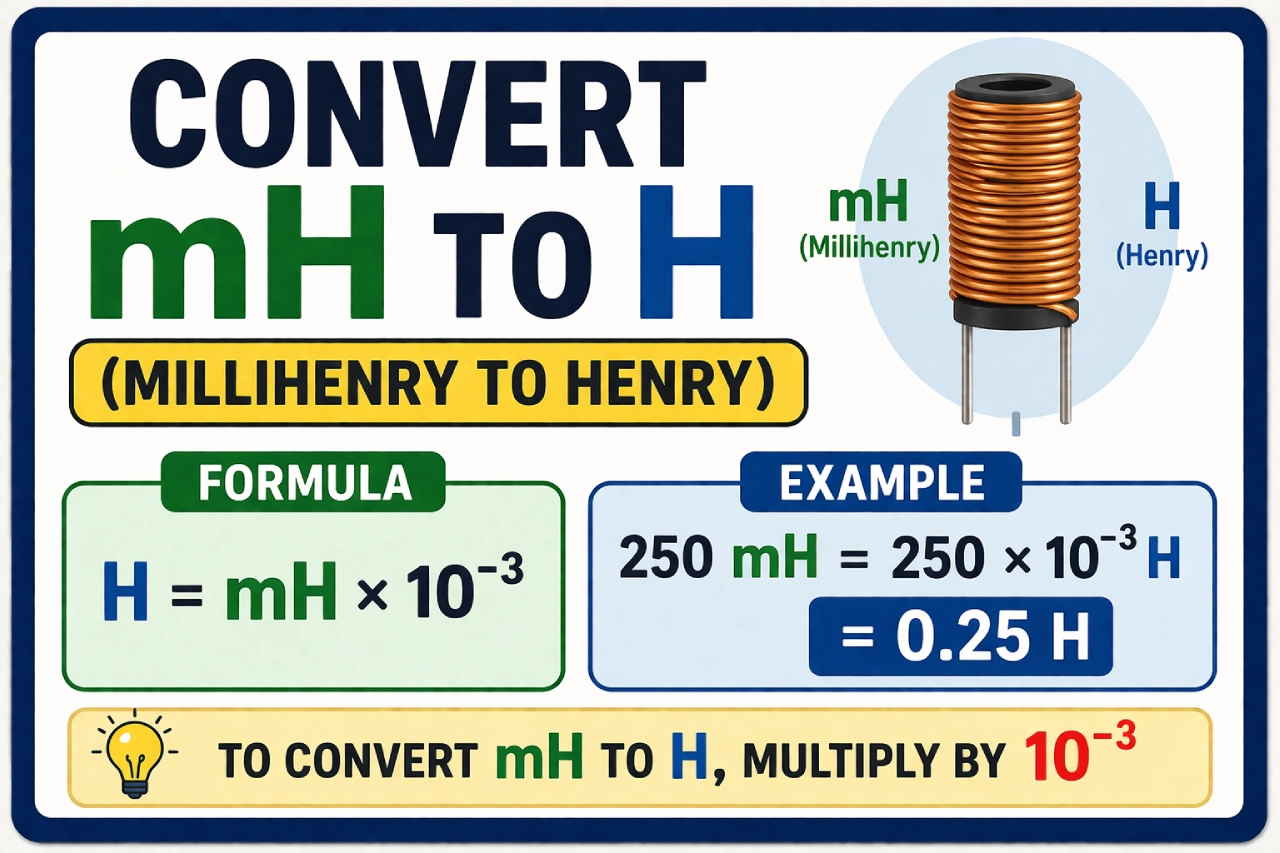
If you’re looking for the quick answer:
1 mH (millihenry) = 0.001 H (henry)
So to convert millihenries (mH) to henries (H), simply divide by 1,000.
For example:
- 100 mH = 0.1 H
- 500 mH = 0.5 H
- 1,000 mH = 1 H
This conversion is common in electronics, electrical engineering, and circuit design, where inductance values are frequently expressed in millihenries rather than henries.
In this guide, we’ll explain what millihenries and henries are, how the conversion works, when engineers use these units, and how to convert between them quickly and accurately.
What Is a Henry (H)?
A henry (H) is the standard SI unit of inductance.
Inductance measures how strongly an electrical component—usually a coil or inductor—resists changes in electric current.
In simple terms, inductance describes how well a component can store energy in a magnetic field when current flows through it.
The unit is named after Joseph Henry, an American scientist who made important contributions to electromagnetism.
In practical terms:
1 henry represents a large amount of inductance, which is why most electronic circuits use smaller units like millihenries or microhenries.
Inductors with values close to 1 H are usually found in:
- Power supplies
- Transformers
- Industrial electrical equipment
Most everyday electronic devices use much smaller values.
What Is a Millihenry (mH)?
A millihenry (mH) is a smaller unit of inductance.
The prefix “milli” means one thousandth (1/1,000).
So:
1 mH = 0.001 H
Millihenries are commonly used in electronics because most inductors in circuits have values smaller than one henry.
Typical examples include:
- Audio crossover inductors
- Power filtering circuits
- Motor control circuits
- Switching power supplies
You might see components labeled like:
- 10 mH
- 47 mH
- 100 mH
These are common inductance values used in electronic designs.
Understanding Metric Prefixes
The metric system uses prefixes to represent multiples or fractions of units.
Here are some common prefixes used with henries:
| Prefix | Symbol | Value |
|---|---|---|
| Micro | µ | 0.000001 H |
| Milli | m | 0.001 H |
| Base unit | H | 1 H |
| Kilo | k | 1,000 H |
Because inductance values vary widely, engineers often switch between these prefixes.
For example:
- 1 H = 1,000 mH
- 1 mH = 1,000 µH
Understanding these relationships makes conversions easier.
mH to H Conversion Formula
Millihenry to Henry Converter
Enter a value in millihenries (mH) to convert it into henries (H).
To convert millihenry to henry, divide the value by 1000.
The conversion formula is straightforward.
H = mH ÷ 1,000
Alternatively:
H = mH × 0.001
Reverse Conversion
To convert henries to millihenries:
mH = H × 1,000
Step-by-Step Conversion Examples
Let’s walk through a few examples.
Example 1: Convert 500 mH to H
500 ÷ 1,000 = 0.5 H
Example 2: Convert 250 mH to H
250 ÷ 1,000 = 0.25 H
Example 3: Convert 2 H to mH
2 × 1,000 = 2,000 mH
Once you know the 1,000 relationship, conversions become very easy.
Quick mH to H Conversion Table
Here’s a helpful reference chart.
| Millihenries (mH) | Henries (H) |
|---|---|
| 1 mH | 0.001 H |
| 10 mH | 0.01 H |
| 50 mH | 0.05 H |
| 100 mH | 0.1 H |
| 250 mH | 0.25 H |
| 500 mH | 0.5 H |
| 1,000 mH | 1 H |
This table makes it easy to estimate conversions quickly.
Why Engineers Use Millihenries Instead of Henries
Because the henry is a large unit, most practical circuits involve much smaller values.
For example:
A coil in an audio crossover might measure 3.3 mH.
If we wrote this in henries, it would be:
0.0033 H
Using millihenries keeps the numbers easier to read and work with.
That’s why electronic component labels almost always use:
- mH (millihenry)
- µH (microhenry)
instead of henries.
Real-World Applications of Inductance
Inductance plays an important role in many electrical systems.
Power Supply Filtering
Inductors smooth electrical signals by filtering noise and stabilizing voltage.
Transformers
Transformers rely on inductance to transfer electrical energy between circuits.
Audio Systems
Audio crossover networks use inductors to split sound frequencies between speakers.
Motor Control
Electric motors and motor drivers depend on inductance to regulate current flow.
Wireless Charging
Inductive coupling—used in wireless charging—relies heavily on inductance principles.
Understanding inductance units helps engineers design these systems efficiently.
The Physics Behind Inductance
Inductance is based on electromagnetic principles.
When current flows through a wire coil, it creates a magnetic field.
If the current changes, the magnetic field changes as well.
According to Faraday’s Law of Electromagnetic Induction, a changing magnetic field produces an opposing voltage.
This effect is called inductive reactance.
The henry measures how strong this effect is.
mH vs µH vs H
Engineers often work with several inductance units.
| Unit | Value |
|---|---|
| 1 H | 1 henry |
| 1 mH | 0.001 H |
| 1 µH | 0.000001 H |
Typical applications include:
- Power circuits → millihenries
- RF circuits → microhenries
- Industrial coils → henries
Knowing the relationships between these units helps avoid conversion mistakes.
Common Mistakes When Converting mH to H
Even simple conversions can lead to errors.
Forgetting to Divide by 1,000
The most common mistake is multiplying instead of dividing.
Remember:
mH → H = divide by 1,000
Confusing mH with µH
These units differ significantly.
- 1 mH = 1,000 µH
Misreading Component Labels
Electronic components often label inductance values using abbreviations.
For example:
- 4m7 may represent 4.7 mH
Always confirm the unit.
Tips for Quick Conversion
Here are some quick tricks.
First, remember the core relationship:
1 H = 1,000 mH
Second, move the decimal point three places left when converting mH to H.
For example:
- 100 mH → 0.1 H
- 250 mH → 0.25 H
Third, always double-check the units on circuit diagrams.
These habits prevent calculation errors.
Frequently Asked Questions (FAQs)
What is 1 mH in H?
1 mH = 0.001 H
How do you convert mH to H?
Divide the millihenry value by 1,000.
How many mH are in 1 H?
1 H = 1,000 mH
What is 500 mH in henries?
500 ÷ 1,000 = 0.5 H
Why are millihenries used in electronics?
Most inductors have values smaller than one henry, so millihenries are more practical.
Is mH larger than µH?
Yes.
1 mH = 1,000 µH
What does inductance measure?
Inductance measures a component’s ability to store energy in a magnetic field.
Where are inductors used?
Inductors appear in power supplies, transformers, audio systems, and electronic circuits.
What is the easiest way to remember the conversion?
Just remember:
1 H = 1,000 mH
Is inductance important in electrical engineering?
Yes. Inductance is essential for controlling current, filtering signals, and transferring energy.
Final Thoughts
Converting millihenries (mH) to henries (H) is a simple but important skill for anyone working with electronics or electrical engineering.
Because the henry is such a large unit, most real-world inductors use millihenries or microhenries instead.
Once you remember the key relationship—divide by 1,000—the conversion becomes effortless.
Understanding these units also helps you better interpret circuit diagrams, component labels, and electrical specifications.
Here’s a thought to leave you with:
The next time you see a coil labeled 47 mH, will you automatically recognize that it equals 0.047 H?
Leave a Reply