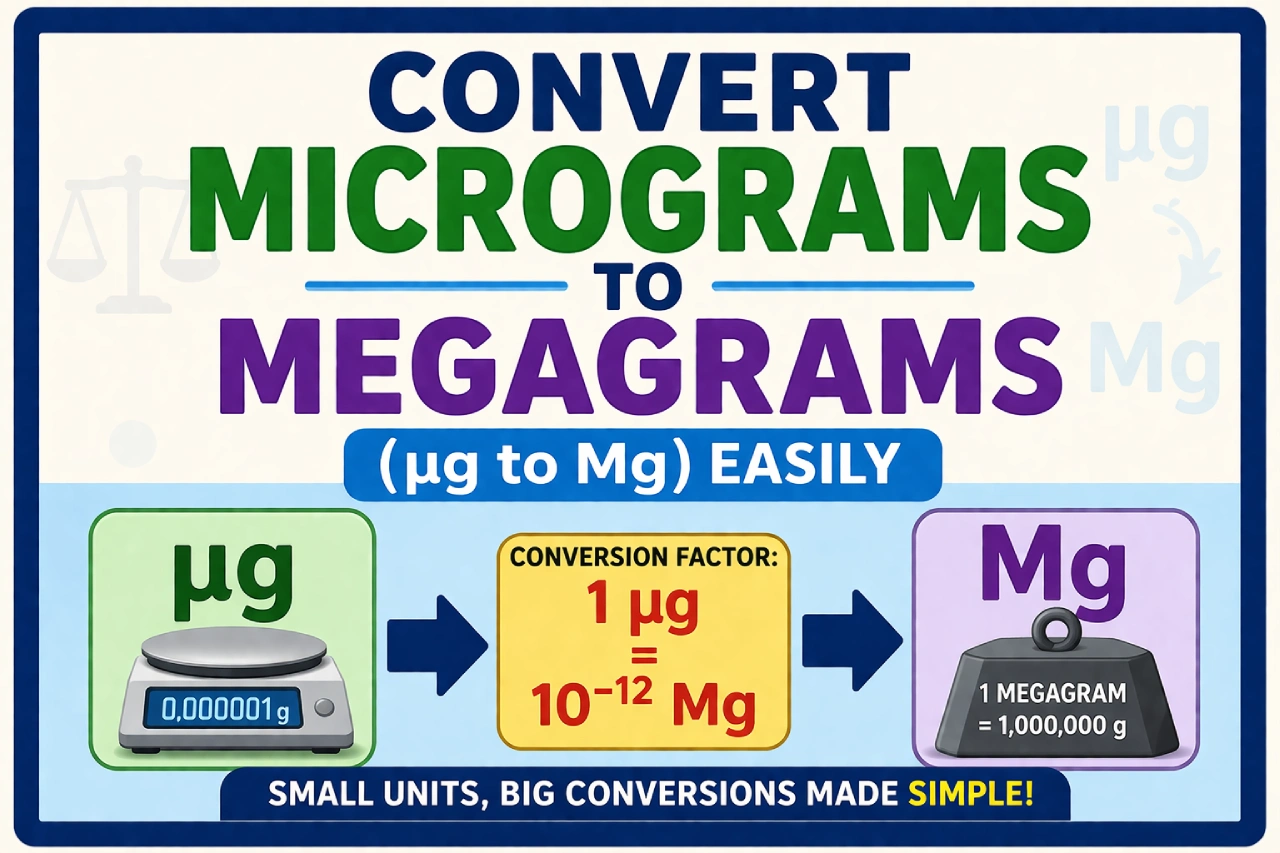
Here’s the quick answer most people are looking for:
1 microgram (µg) = 0.000000000001 megagrams (Mg)
—or—
1 megagram (Mg) = 1,000,000,000,000 micrograms (10¹² µg)
That’s a huge difference in scale. In fact, converting micrograms to megagrams means jumping across twelve powers of ten in the metric system.
This conversion isn’t something most people use every day, but it’s extremely useful in fields like environmental science, pharmaceuticals, chemistry, and large-scale industrial measurements where very small and very large units sometimes need to be compared.
In this guide, we’ll break down the relationship between micrograms and megagrams, explain the formula, show practical examples, and explore how the metric system makes these conversions surprisingly simple once you understand the prefixes.
Micrograms to Megagrams Conversion Formula
Micrograms to Megagrams Converter
Enter a value in micrograms (µg) to instantly convert it into megagrams (Mg).
The conversion formula is:
Megagrams = Micrograms ÷ 1,000,000,000,000
Or written using scientific notation:
Megagrams = Micrograms × 10⁻¹²
This is because:
1 Mg = 1,000,000,000,000 µg
Reverse Conversion
To convert megagrams to micrograms:
Micrograms = Megagrams × 1,000,000,000,000
Understanding Metric Prefixes
To understand the conversion between micrograms and megagrams, it helps to visualize the metric scale.
Here are some key units around grams:
| Prefix | Symbol | Value |
|---|---|---|
| Micro | µ | 10⁻⁶ |
| Milli | m | 10⁻³ |
| Gram | g | 10⁰ |
| Kilo | k | 10³ |
| Mega | M | 10⁶ |
Micro is six steps below grams, while mega is six steps above grams.
That means moving from micrograms to megagrams crosses twelve orders of magnitude.
Quick Conversion Table
Here’s a reference table for common values.
| Micrograms (µg) | Megagrams (Mg) |
|---|---|
| 1 µg | 0.000000000001 Mg |
| 1,000 µg | 0.000000001 Mg |
| 1,000,000 µg | 0.000001 Mg |
| 1,000,000,000 µg | 0.001 Mg |
| 1,000,000,000,000 µg | 1 Mg |
This shows just how massive the scale difference is between the two units.
Step-by-Step Conversion Examples
Let’s look at some practical examples.
Example 1: Convert 1,000,000 µg to Mg
1,000,000 ÷ 1,000,000,000,000
= 0.000001 Mg
Example 2: Convert 5,000,000,000 µg to Mg
5,000,000,000 ÷ 1,000,000,000,000
= 0.005 Mg
Example 3: Convert 2 Mg to Micrograms
2 × 1,000,000,000,000
= 2,000,000,000,000 µg
These conversions look intimidating at first, but once you understand the powers of ten, they become much easier.
Why Such Large Conversion Differences Exist
The metric system is designed to handle measurements across extremely different scales.
For example:
- A pharmaceutical dose might be 50 micrograms
- A cargo shipment might weigh 10 megagrams
Using prefixes allows scientists and engineers to work with numbers that remain manageable instead of writing long strings of zeros.
Imagine writing:
10,000,000,000,000 grams
Instead of simply saying:
10 Mg
That’s the beauty of the metric system.
Real-World Applications
Environmental Science
Environmental scientists often work with both very small and very large quantities.
For example:
Air pollutants might be measured in micrograms, while total emissions from an industry could be reported in megagrams.
Pharmaceutical Manufacturing
Drug production involves extremely precise microgram measurements, but manufacturing output may be measured in tons or megagrams.
Industrial Production
Industries such as mining, agriculture, and manufacturing measure raw materials in megagrams.
However, trace impurities within those materials might be measured in micrograms.
Scientific Research
Large research studies sometimes convert between extremely small and extremely large units when analyzing data.
This makes understanding these conversions valuable in scientific work.
Common Mistakes in Unit Conversion
Confusing Micrograms with Milligrams
These units are very different.
- 1 milligram = 1,000 micrograms
- 1 microgram = 0.001 milligrams
Always double-check the prefix.
Misplacing Decimal Points
Because conversions involve many zeros, it’s easy to move the decimal incorrectly.
Scientific notation helps prevent mistakes.
Ignoring Metric Prefixes
The prefixes themselves provide the conversion information.
Once you know:
- micro = 10⁻⁶
- mega = 10⁶
You can derive the relationship instantly.
Tips for Easier Conversion
Here are a few strategies that make these conversions easier.
First, remember that the difference between micro and mega is 12 powers of ten.
Second, write values using scientific notation to avoid long numbers.
Third, always check the units carefully when reading scientific data.
These habits make metric conversions much more manageable.
Frequently Asked Questions (FAQs)
1. How many micrograms are in one megagram?
There are 1,000,000,000,000 micrograms in 1 megagram.
2. How do you convert micrograms to megagrams?
Divide the microgram value by 1,000,000,000,000.
3. What is 1 µg in megagrams?
1 microgram equals 0.000000000001 megagrams.
4. What is a megagram equal to?
A megagram equals 1,000 kilograms, which is the same as one metric ton.
5. Why are micrograms used?
Micrograms are used to measure extremely small quantities, especially in medicine and chemistry.
6. Why are megagrams used?
Megagrams measure large masses, particularly in industry and environmental data.
7. Is a megagram the same as a metric ton?
Yes. 1 megagram equals 1 metric ton.
8. How many grams are in a microgram?
1 microgram equals 0.000001 grams.
9. How many grams are in a megagram?
1 megagram equals 1,000,000 grams.
10. What is the easiest way to remember the conversion?
Remember that micro to mega equals a difference of 12 powers of ten.
Final Thoughts
At first glance, converting micrograms to megagrams may look intimidating because the numbers span such dramatically different scales. But once you understand how metric prefixes work, the conversion becomes logical.
The metric system was designed to make scientific measurements consistent and scalable—from microscopic quantities measured in micrograms to massive industrial weights measured in megagrams.
Once you recognize that micro = 10⁻⁶ and mega = 10⁶, the twelve-power difference explains everything.
So here’s a question worth thinking about:
When you see measurements ranging from micrograms to megagrams, does it change how you appreciate the incredible range that the metric system can handle?
Leave a Reply