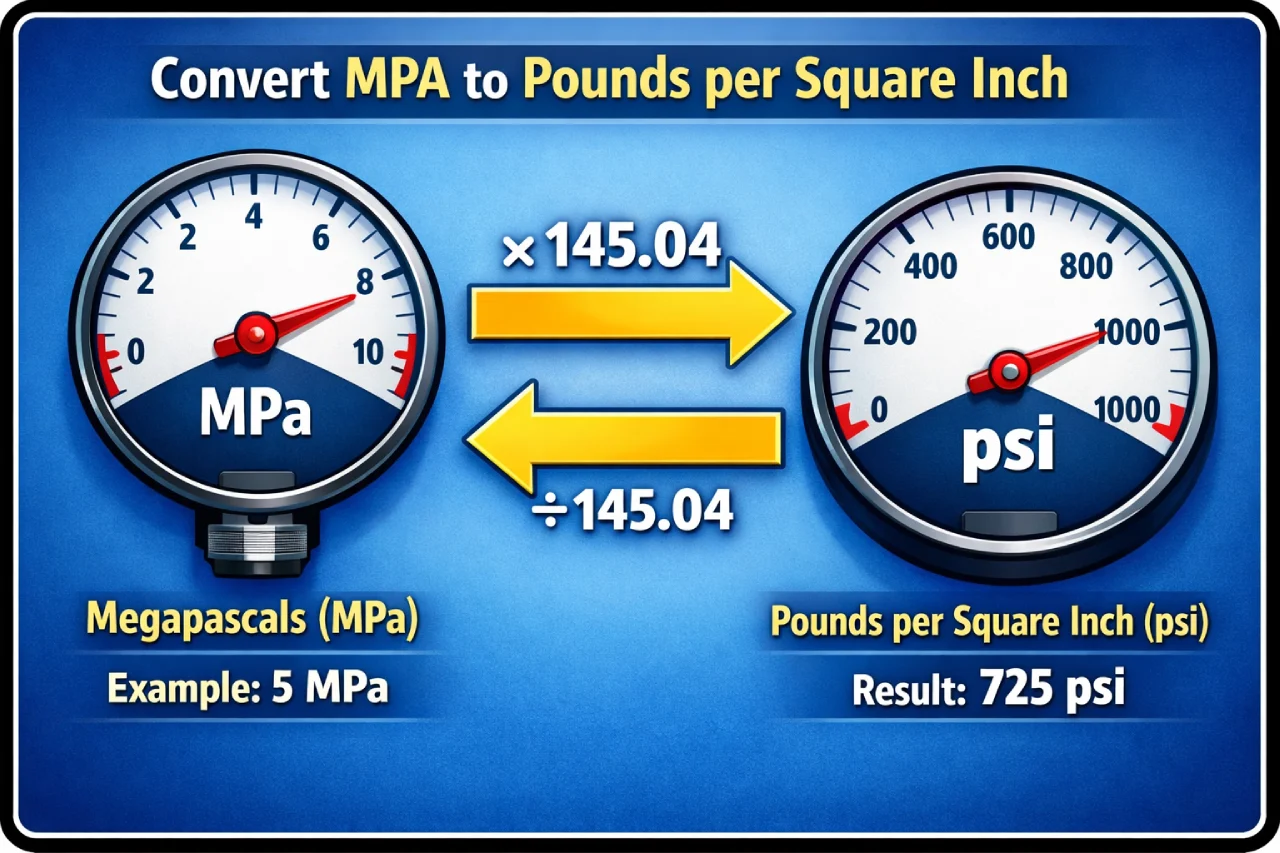
If you’re looking for a quick answer, here it is:
1 MPa (megapascal) = 145.038 PSI (pounds per square inch)
So, to convert MPa to PSI, simply:
PSI = MPa × 145.038
That’s the key formula. But if you want to fully understand what these units mean, where they’re used, and how to apply this conversion in real-world situations like engineering, construction, and pressure systems, this guide will walk you through everything step by step.
What Is MPa (Megapascal)?
A megapascal (MPa) is a metric unit of pressure or stress.
- 1 MPa = 1,000,000 pascals (Pa)
- It belongs to the International System of Units (SI)
MPa is commonly used in:
- Structural engineering
- Concrete strength ratings
- Mechanical systems
- Material science
For example:
- Concrete strength: 20–40 MPa
- Steel strength: 250–500 MPa
It’s widely used globally, especially outside the United States.
What Is PSI (Pounds per Square Inch)?
PSI (pounds per square inch) is an imperial unit of pressure.
- It measures force applied over an area
- Commonly used in the United States
You’ll see PSI in:
- Tire pressure (e.g., 32 PSI)
- Hydraulic systems
- Air compressors
- Plumbing systems
It’s one of the most familiar pressure units in everyday American life.
Why Convert MPa to PSI?
This conversion is essential when working across different systems.
Engineering and Construction
International designs often use MPa, while U.S. standards use PSI.
Equipment Specifications
Manufacturers may list pressure ratings in different units.
Material Testing
Understanding both units ensures accurate comparisons and safety.
In practice, if you’re dealing with global specifications, this conversion becomes incredibly useful.
The Conversion Formula Explained
MPa to PSI Converter
Enter a value in megapascals (MPa) to instantly convert it into pounds per square inch (PSI).
Here’s the formula again:
PSI = MPa × 145.038
This conversion factor comes from the relationship between pascals and pounds per square inch.
If you need to reverse the conversion:
MPa = PSI ÷ 145.038
Step-by-Step Examples
Let’s make this practical.
Example 1: Convert 1 MPa to PSI
1 × 145.038 = 145.038 PSI
Example 2: Convert 5 MPa to PSI
5 × 145.038 = 725.19 PSI
Example 3: Convert 10 MPa to PSI
10 × 145.038 = 1,450.38 PSI
Example 4: Convert 30 MPa to PSI
30 × 145.038 = 4,351.14 PSI
These are common values used in engineering and construction.
Quick Conversion Table
Here’s a handy reference:
| MPa | PSI |
|---|---|
| 1 MPa | 145 PSI |
| 2 MPa | 290 PSI |
| 5 MPa | 725 PSI |
| 10 MPa | 1,450 PSI |
| 20 MPa | 2,901 PSI |
| 30 MPa | 4,351 PSI |
| 40 MPa | 5,802 PSI |
This table is great for quick estimates without a calculator.
Real-Life Example: Concrete Strength
Let’s say you’re working with concrete rated at:
25 MPa
Convert:
25 × 145.038 = 3,625.95 PSI
Now you can understand the strength in U.S. terms, which is often how contractors and suppliers communicate.
MPa vs PSI: What’s the Difference?
Here’s a simple way to think about it:
- MPa = metric unit (SI system)
- PSI = imperial unit (U.S. system)
Both measure pressure or stress, just in different systems.
Mental Math Trick
Here’s a quick shortcut:
- Multiply MPa by 145 instead of 145.038
Example:
10 MPa × 145 ≈ 1,450 PSI
It’s very close and works well for quick estimates.
Converting PSI Back to MPa
To reverse the calculation:
MPa = PSI ÷ 145.038
Example:
3,000 PSI ÷ 145.038 ≈ 20.68 MPa
This is useful when working with U.S.-based equipment or specifications.
Practical Use Case: Tire Pressure vs Engineering Pressure
You’ve probably seen PSI in tire pressure, but MPa is used for larger-scale systems.
For example:
- Car tire: ~30–35 PSI
- Industrial system: several MPa
Understanding the conversion helps you relate small-scale and large-scale pressures.
Common Mistakes to Avoid
Using the Wrong Conversion Factor
Always use:
1 MPa = 145.038 PSI
Confusing PSI with KSI
- PSI = pounds per square inch
- KSI = 1,000 PSI
Rounding Too Early
Keep precision until the final step.
Mixing Units
Always convert before combining values in calculations.
MPa, PSI, and KSI Relationship
It helps to see how these units connect:
- 1 MPa = 145.038 PSI
- 1 KSI = 1,000 PSI
So:
- 1 MPa = 0.145 KSI
This gives you a complete picture of pressure units.
Why Precision Matters
In many fields, accuracy is critical.
Engineering Design
Incorrect pressure values can lead to system failure.
Construction
Material strength must meet exact specifications.
Industrial Systems
Pressure errors can damage equipment or create safety risks.
In these cases, always use the exact conversion factor.
Real-World Comparison
Let’s compare a few values:
- 20 MPa concrete ≈ 2,901 PSI
- 30 MPa concrete ≈ 4,351 PSI
- 40 MPa concrete ≈ 5,802 PSI
These comparisons help you quickly interpret material strength.
When You’ll Use This Conversion
You’ll encounter MPa to PSI conversion in:
- Structural engineering
- Civil construction
- Mechanical systems
- Pressure testing
It’s especially useful when working with international standards.
Frequently Asked Questions (FAQs)
How many PSI is 1 MPa?
1 MPa = 145.038 PSI
What is the formula to convert MPa to PSI?
PSI = MPa × 145.038
How many PSI is 10 MPa?
10 × 145.038 = 1,450.38 PSI
How many MPa is 1,000 PSI?
1,000 ÷ 145.038 ≈ 6.89 MPa
What is the difference between MPa and PSI?
MPa is metric, while PSI is an imperial unit.
Is MPa the same as PSI?
No, but they measure the same concept (pressure) in different systems.
Can I round 145.038 to 145?
Yes, for quick estimates.
Where is MPa commonly used?
In engineering and construction worldwide.
Where is PSI commonly used?
In the United States for pressure systems.
Why is PSI more common in the U.S.?
Because it’s part of the imperial measurement system.
Final Thoughts
So, how do you convert MPa to pounds per square inch?
The key takeaway is simple:
Multiply MPa by 145.038
Once you understand this relationship, you can easily move between metric and U.S. units—especially in engineering, construction, and everyday applications like pressure systems.
After a few calculations, you’ll start estimating it effortlessly—and that’s when you know you’ve truly mastered it.
Leave a Reply