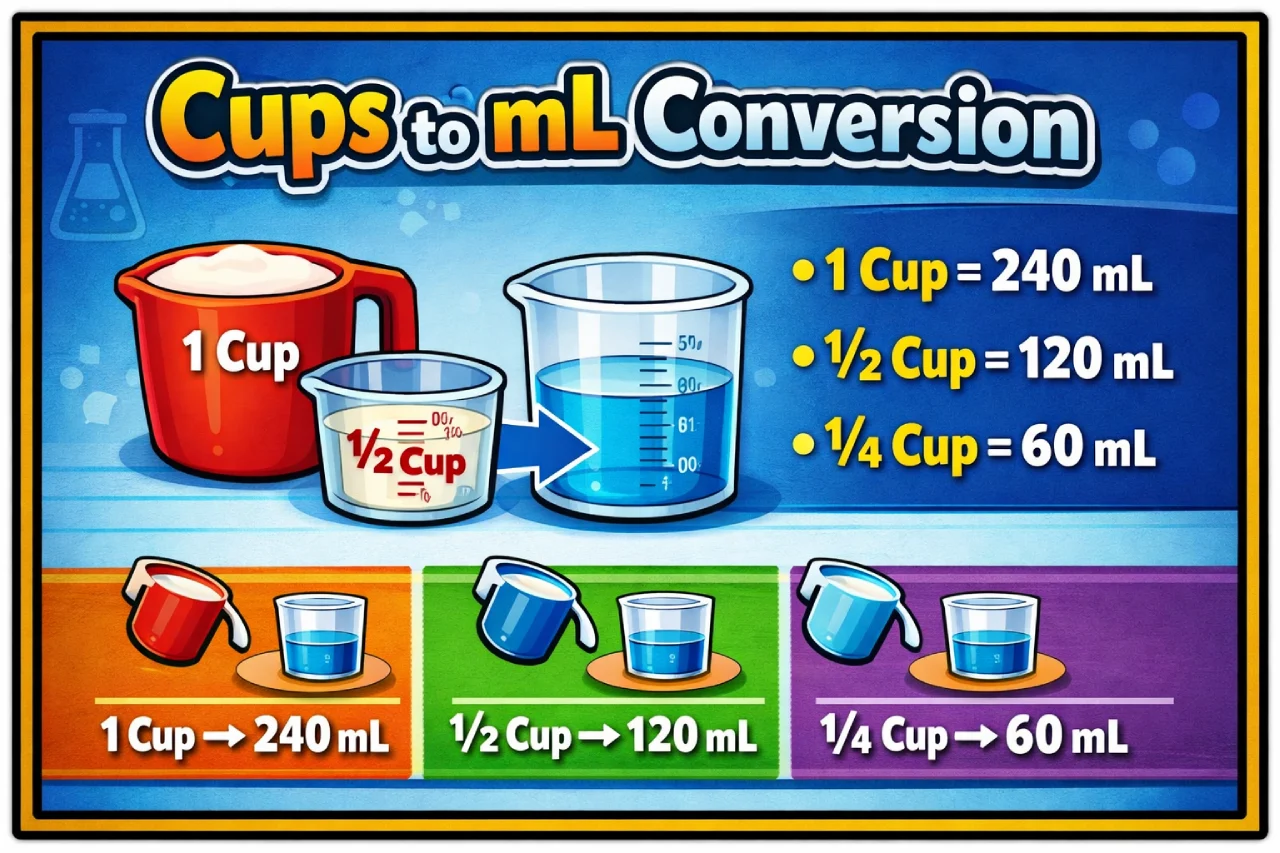
If you’re looking for a quick answer, here it is:
1 U.S. cup = 236.588 mL (milliliters)
For everyday use, most people round it to:
1 cup ≈ 240 mL
So, to convert cups to milliliters:
mL = cups × 236.588
That’s the core formula. But if you want to avoid common mistakes (especially when following recipes), understand different cup systems, and convert confidently in real-life situations, this guide will walk you through everything step by step.
What Is a Cup?
A cup is a unit of volume commonly used in cooking, especially in the United States.
It’s part of the U.S. customary system and is widely used for measuring:
- Liquids (milk, water, oil)
- Dry ingredients (flour, sugar, rice)
In the U.S.:
1 cup = 8 fluid ounces
This is important because it ties into other kitchen measurements.
What Is a Milliliter (mL)?
A milliliter (mL) is a metric unit of volume.
- 1 mL = one-thousandth of a liter
- It’s used worldwide in cooking, science, and medicine
Unlike cups, milliliters are part of a standardized system, which makes them more precise.
The Cups to mL Conversion Formula
Cups to mL Converter
Here’s the exact formula:
mL = cups × 236.588
For quick calculations, you can round it:
mL = cups × 240
Both are useful, depending on how precise you need to be.
Step-by-Step Examples
Let’s make this practical.
Example 1: Convert 1 cup to mL
1 × 236.588 = 236.588 mL
Rounded: 240 mL
Example 2: Convert 2 cups to mL
2 × 236.588 = 473.176 mL
Rounded: 480 mL
Example 3: Convert ½ cup to mL
0.5 × 236.588 = 118.294 mL
Rounded: 120 mL
Example 4: Convert ¼ cup to mL
0.25 × 236.588 = 59.147 mL
Rounded: 60 mL
These are some of the most commonly used measurements in recipes.
Quick Conversion Table
Here’s a handy reference you can use in the kitchen:
| Cups | Milliliters (mL) |
|---|---|
| ¼ cup | 59 mL |
| ½ cup | 118 mL |
| 1 cup | 237 mL |
| 2 cups | 473 mL |
| 3 cups | 710 mL |
| 4 cups | 946 mL |
This table is perfect for quick conversions without a calculator.
Why Precision Matters in Cooking
You might wonder: does it really matter if you use 236 mL or 240 mL?
When It Doesn’t Matter
For recipes like:
- Soups
- Stews
- Sauces
A small difference won’t affect the outcome much.
When It Does Matter
For baking:
- Cakes
- Bread
- Pastries
Even small measurement differences can change texture and consistency.
In these cases, it’s better to use the exact value or a kitchen scale.
U.S. Cups vs Metric Cups (Important Difference)
This is one of the most common sources of confusion.
U.S. Cup
- 1 cup = 236.588 mL
Metric Cup (used in countries like Australia)
- 1 cup = 250 mL
That’s a noticeable difference.
So if you’re following an international recipe, always check which system is being used.
Cups vs mL for Dry vs Liquid Ingredients
Here’s something many people overlook.
Liquid Ingredients
- Cups and mL measure volume
- Conversion is straightforward
Dry Ingredients
- Cups measure volume
- Weight can vary depending on the ingredient
For example:
- 1 cup of flour ≠ 1 cup of sugar (in weight)
That’s why professional bakers often prefer grams instead of cups.
Real-Life Example: Cooking Scenario
Let’s say a recipe calls for:
2 cups of milk
Convert:
2 × 236.588 = 473.176 mL
You can safely use:
473 mL or 480 mL
Now you can follow the recipe even if your measuring tools are in metric units.
Mental Math Trick
Here’s a simple trick I use:
- Multiply cups by 240
Example:
3 cups × 240 = 720 mL
It’s quick, easy, and accurate enough for most situations.
Converting mL Back to Cups
Sometimes you’ll need to reverse the calculation.
Here’s the formula:
Cups = mL ÷ 236.588
Example:
500 mL ÷ 236.588 ≈ 2.11 cups
For quick estimates:
Cups = mL ÷ 240
Common Mistakes to Avoid
Confusing U.S. and Metric Cups
Always check which system the recipe uses.
Over-Rounding Too Early
Round at the end, not during calculations.
Using the Wrong Tools
A coffee mug is not a standard cup.
Ignoring Ingredient Type
Dry and liquid ingredients behave differently.
Practical Use Case: Baking Recipe
Let’s say you’re baking a cake and the recipe says:
1.5 cups of flour
Convert:
1.5 × 236.588 = 354.882 mL
Rounded:
355 mL
This ensures accuracy, which is critical for baking success.
Why Many Recipes Still Use Cups
Even though metric units are more precise, cups are still widely used because:
- They’re simple and familiar
- No scale is required
- Faster for home cooking
In my experience, cups are great for convenience, while mL (or grams) are better for precision.
When to Use mL Instead of Cups
You should prefer mL when:
- Following international recipes
- Measuring liquids precisely
- Working in professional kitchens
- Conducting experiments or precise cooking
Frequently Asked Questions (FAQs)
How many mL are in 1 cup?
1 U.S. cup = 236.588 mL
Rounded: 240 mL
What is the formula to convert cups to mL?
mL = cups × 236.588
How many mL is 2 cups?
2 cups = 473.176 mL
How many mL is ½ cup?
½ cup = 118.294 mL
Is 1 cup equal to 250 mL?
Not in the U.S.
250 mL is a metric cup, not a U.S. cup.
Can I round 236.588 to 240?
Yes, for most recipes.
How many cups is 500 mL?
500 ÷ 236.588 ≈ 2.11 cups
Why do recipes use cups instead of mL?
Because cups are simpler and more familiar for home cooks.
Are cups accurate for baking?
They can be, but grams or mL are more precise.
What’s the easiest way to estimate?
Multiply cups by 240.
Final Thoughts
So, how do you convert cups to milliliters?
The key takeaway is simple:
1 cup = 236.588 mL (≈ 240 mL)
Once you remember that, converting between cups and mL becomes effortless. Whether you’re following a recipe, scaling ingredients, or working with international measurements, this conversion helps you stay accurate and confident.
And after a few uses, you’ll start doing it in your head without even thinking.
Leave a Reply