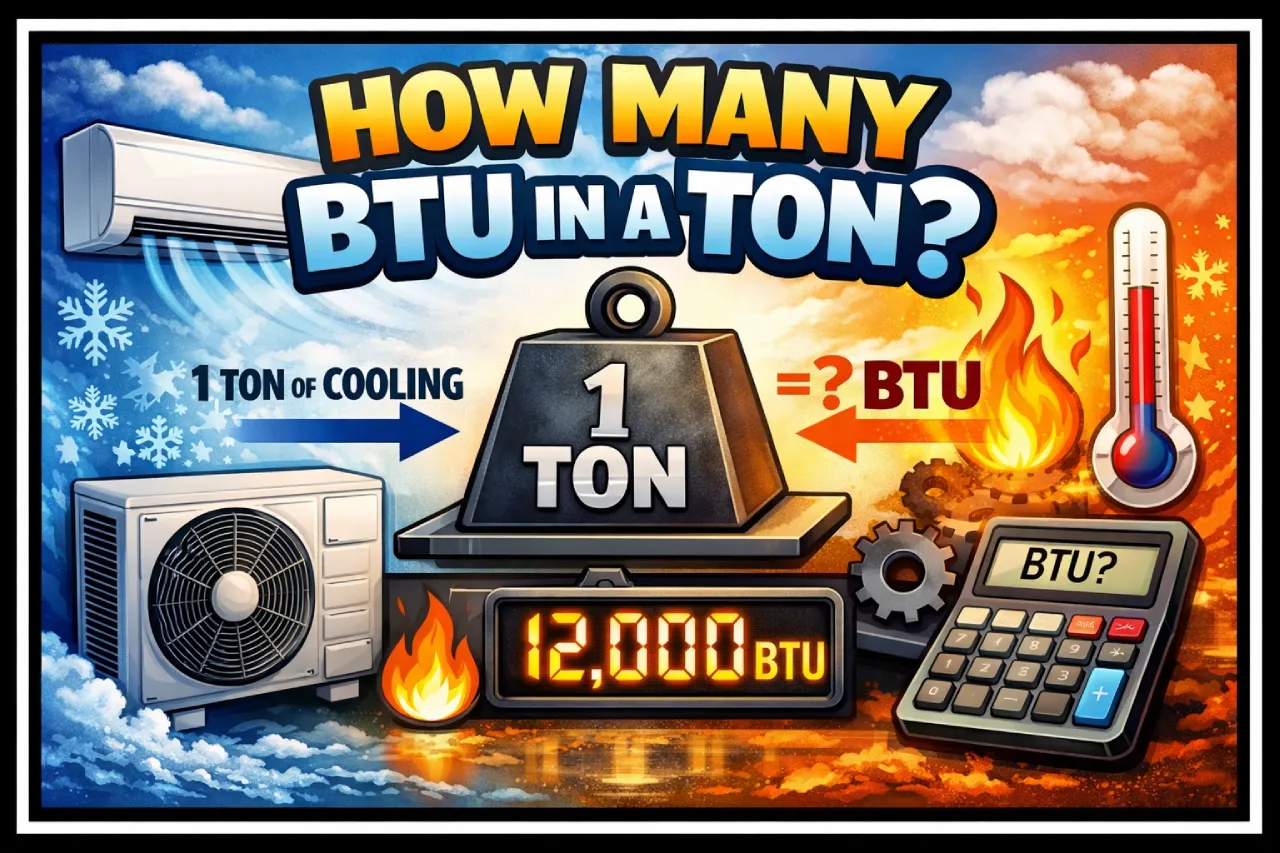
If you want the quick answer:
1 ton of cooling equals 12,000 BTUs per hour (BTU/h).
This means that an air conditioner rated at 1 ton can remove 12,000 British Thermal Units of heat per hour from a space. Larger HVAC systems scale up from there. For example:
- 2 tons = 24,000 BTU/h
- 3 tons = 36,000 BTU/h
- 5 tons = 60,000 BTU/h
This conversion is extremely important in HVAC (Heating, Ventilation, and Air Conditioning) systems because cooling capacity is often described in tons, while heating and energy measurements are commonly expressed in BTUs.
In this guide, we’ll explore where this conversion comes from, how to calculate it, how it’s used in real-world air conditioning systems, and why understanding BTUs and tons helps you choose the right cooling equipment.
What Is a BTU?
A BTU (British Thermal Unit) is a unit of heat energy.
Specifically, it represents the amount of heat needed to raise the temperature of one pound of water by one degree Fahrenheit.
In practical terms, BTUs measure how much heat energy is being transferred.
BTUs are widely used in the United States to describe the heating or cooling capacity of systems such as:
- Air conditioners
- Furnaces
- Heat pumps
- Water heaters
- Gas appliances
For example:
- A small window AC unit may be 5,000 BTU/h
- A medium room AC might be 12,000 BTU/h
- A central air system may exceed 36,000 BTU/h
The higher the BTU rating, the more heat a system can remove or produce.
What Does “Ton” Mean in Air Conditioning?
The word “ton” in air conditioning does not refer to weight. Instead, it describes the cooling capacity of an HVAC system.
The term originates from an older method of cooling buildings using blocks of ice.
Before modern air conditioning, buildings were cooled by storing large quantities of ice. Engineers calculated the cooling power based on how much heat it would take to melt one ton of ice over a 24-hour period.
That heat amount equals:
288,000 BTUs over 24 hours
When we divide that by the number of hours in a day:
288,000 ÷ 24 = 12,000 BTU per hour
So the cooling capacity required to melt one ton of ice in 24 hours became the standard measurement.
That’s why:
1 ton of cooling = 12,000 BTU/h
This historical definition is still used today in modern HVAC systems.
BTU to Ton Conversion Formula
BTU to Ton Converter
Convert BTU/hr to refrigeration tons instantly.
The relationship between BTUs and tons is simple.
Converting Tons to BTUs
BTU/h = Tons × 12,000
Example:
3 tons × 12,000 = 36,000 BTU/h
Converting BTUs to Tons
Tons = BTU/h ÷ 12,000
Example:
24,000 BTU/h ÷ 12,000 = 2 tons
This formula allows engineers and homeowners to quickly determine the cooling capacity of a system.
Quick BTU-to-Ton Conversion Table
Here’s a quick reference chart showing common air conditioner sizes.
| Tons | BTU per Hour |
|---|---|
| 0.5 ton | 6,000 BTU |
| 1 ton | 12,000 BTU |
| 1.5 tons | 18,000 BTU |
| 2 tons | 24,000 BTU |
| 3 tons | 36,000 BTU |
| 4 tons | 48,000 BTU |
| 5 tons | 60,000 BTU |
Most residential central air systems fall between 2 and 5 tons.
Why HVAC Systems Use Tons Instead of BTUs
While BTUs measure energy directly, tons make it easier to describe cooling capacity in larger systems.
Imagine describing a large HVAC unit as:
48,000 BTU per hour
Instead, it’s simpler to say:
4-ton air conditioner
This shorthand is widely used in the HVAC industry because it’s easier to communicate.
Choosing the Right AC Size
Understanding tons and BTUs helps determine the correct air conditioner size for your home.
A common rule of thumb is:
20 BTU per square foot of living space
For example:
| Home Size | Estimated Cooling Capacity |
|---|---|
| 600 sq ft | 12,000 BTU (1 ton) |
| 1,200 sq ft | 24,000 BTU (2 tons) |
| 1,800 sq ft | 36,000 BTU (3 tons) |
| 2,400 sq ft | 48,000 BTU (4 tons) |
However, other factors affect cooling needs, including:
- Ceiling height
- Insulation quality
- Climate
- Sun exposure
- Number of windows
Because of these variables, HVAC professionals often perform a detailed Manual J load calculation before selecting a system.
Real-World Examples of Cooling Capacity
Let’s look at some practical examples.
Window Air Conditioners
Window AC units usually range from:
- 5,000 BTU to 15,000 BTU
That’s roughly 0.4 to 1.25 tons.
Central Air Conditioning Systems
Most residential central AC systems range between:
- 2 to 5 tons
Which equals:
- 24,000 to 60,000 BTU/h
Commercial HVAC Systems
Large commercial buildings may require systems rated at:
- 10 tons or more
These systems can exceed 120,000 BTU per hour.
Why Proper Sizing Matters
Choosing the correct AC size is extremely important.
If the System Is Too Small
An undersized unit will:
- Run continuously
- Struggle to cool the space
- Wear out faster
- Increase electricity costs
If the System Is Too Large
An oversized system can:
- Cycle on and off too frequently
- Fail to remove humidity properly
- Waste energy
A properly sized system ensures comfort, efficiency, and long equipment life.
BTUs, Tons, and Energy Efficiency
Cooling capacity is only one part of HVAC performance.
Energy efficiency ratings also matter.
Common efficiency metrics include:
- SEER (Seasonal Energy Efficiency Ratio)
- EER (Energy Efficiency Ratio)
Higher ratings indicate better efficiency and lower operating costs.
Tons vs BTUs vs Kilowatts
Some HVAC systems use kilowatts (kW) instead of BTUs.
Here’s how they compare:
| Unit | Equivalent |
|---|---|
| 1 ton | 12,000 BTU/h |
| 1 ton | 3.517 kW |
| 1 kW | 3,412 BTU/h |
These conversions are useful when comparing international equipment specifications.
Common Misconceptions About Tons in HVAC
A few misunderstandings often arise.
Tons Do Not Refer to Weight
The “ton” measurement describes cooling capacity, not the physical weight of the equipment.
More Tons Is Not Always Better
A larger system does not necessarily cool better. Proper sizing matters more than maximum capacity.
BTUs Measure Energy, Not Temperature
BTUs measure heat transfer, not how cold air will feel.
Tips for Understanding HVAC Ratings
Here are a few simple tips.
First, remember the key relationship:
1 ton = 12,000 BTU per hour
Second, compare systems using both tonnage and efficiency ratings.
Third, consult HVAC professionals when selecting a system for your home.
These steps help ensure optimal performance and energy savings.
Frequently Asked Questions (FAQs)
How many BTUs are in one ton?
1 ton equals 12,000 BTU per hour.
Why is AC capacity measured in tons?
The term comes from the amount of heat required to melt one ton of ice in 24 hours.
How many BTUs are in a 2-ton AC?
2 × 12,000 = 24,000 BTU per hour
What size AC unit is best for a 2,000-square-foot home?
Typically around 3 to 4 tons, depending on insulation and climate.
How many BTUs are in a 3-ton system?
3 × 12,000 = 36,000 BTU per hour
Is higher BTU always better?
No. Oversized systems can reduce efficiency and comfort.
What is the difference between BTU and tonnage?
BTU measures energy directly, while tons represent a standardized cooling capacity.
Can BTUs be converted to kilowatts?
Yes. 1 kW ≈ 3,412 BTU per hour.
Why are window AC units rated in BTUs instead of tons?
Because smaller units are easier to describe using BTU measurements.
Is tonnage used for heating systems?
Yes, but heating equipment is more commonly rated directly in BTUs.
Final Thoughts
The relationship between tons and BTUs may seem confusing at first, but it becomes simple once you understand the key rule:
1 ton of cooling equals 12,000 BTU per hour.
This measurement originated from the cooling power of melting ice, yet it remains the standard way to describe modern air conditioning systems.
Whether you’re comparing HVAC units, calculating cooling capacity, or selecting a new air conditioner, understanding how BTUs relate to tons makes it easier to interpret system specifications.
Once you remember that every ton equals 12,000 BTU, you’ll be able to estimate cooling capacities quickly and confidently.
Here’s something to think about the next time you adjust your thermostat:
Your air conditioner isn’t just blowing cold air—it’s removing thousands of BTUs of heat every hour to keep your home comfortable.
Leave a Reply