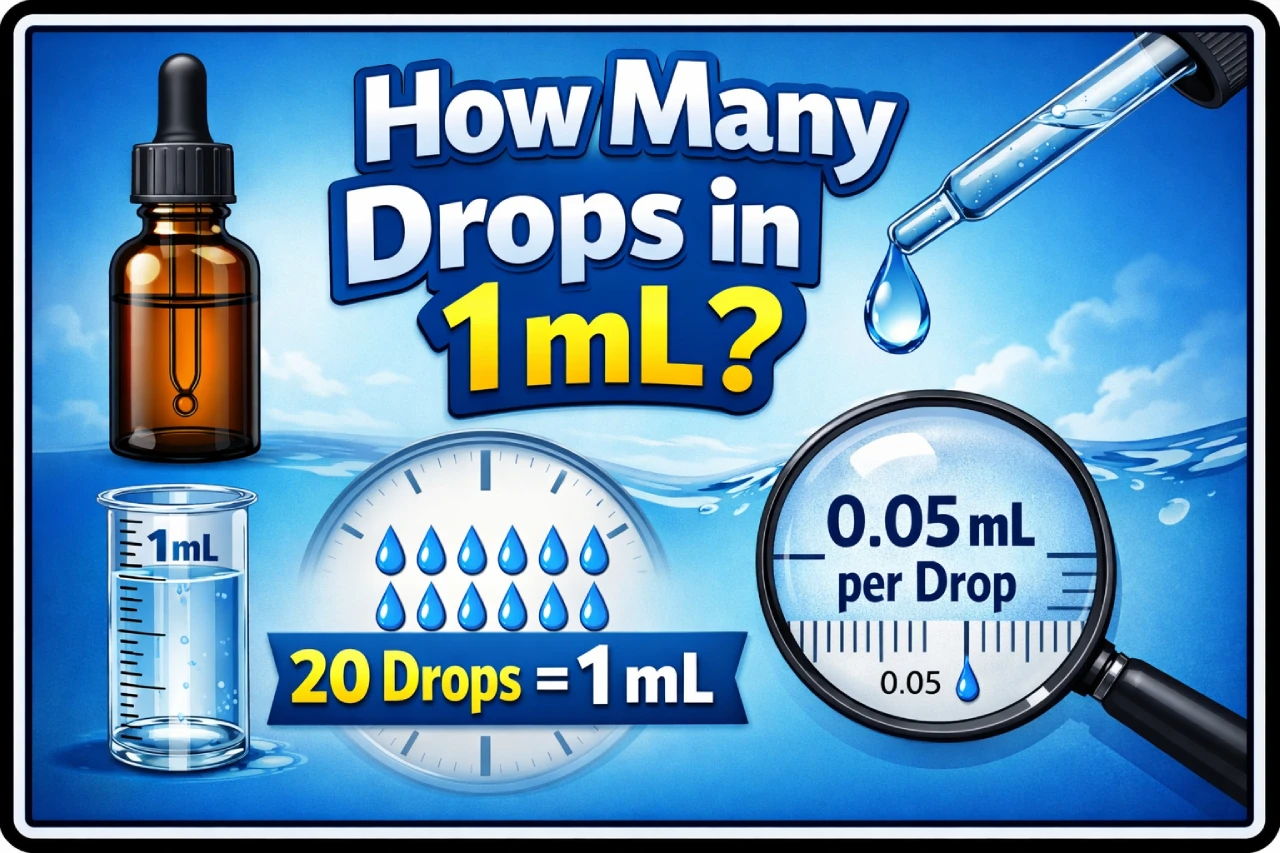
If you’re looking for a quick answer, here it is:
1 mL (milliliter) ≈ 20 drops
That’s the most commonly used standard—especially in medicine and pharmacy.
But here’s the important part:
The exact number of drops in 1 mL can vary depending on the liquid and the dropper.
In some cases, 1 mL could be anywhere from 15 to 25 drops.
So while 20 drops per mL is the standard guideline, it’s not always exact. Let’s break this down so you understand when it applies—and when it doesn’t.
What Is a Drop (gtt) and Why It Varies
A “drop” is actually not a fixed unit of measurement.
In medical terms, a drop is written as gtt (from the Latin gutta, meaning drop). But the size of a drop depends on several factors:
- The liquid’s thickness (viscosity)
- The dropper design
- Surface tension
- Temperature
Because of these variables, a drop of water is not always the same as a drop of oil or medicine.
That’s why we use a standard average for practical use.
The Standard Conversion:
mL to Drops Converter
Enter a value in milliliters to convert it into drops.
In most medical and pharmaceutical settings:
1 mL = 20 drops (gtt)
This standard is widely accepted and used for:
- Liquid medications
- IV drip calculations (with standard droppers)
- Basic dosage estimates
If you’re following general instructions and no other specification is given, this is the value you should use.
Why 20 Drops per mL Became the Standard
The “20 drops = 1 mL” rule comes from standardized droppers used in medicine.
Pharmaceutical droppers are designed so that:
- Each drop is roughly 0.05 mL
- 20 drops × 0.05 mL = 1 mL
This creates consistency in dosing, which is critical for safety.
However, not all droppers follow this standard—especially household or cosmetic droppers.
When the Number of Drops Changes
Here’s where things get interesting.
1. Type of Liquid
Different liquids form different drop sizes.
- Water: ~20 drops per mL
- Alcohol: ~25 drops per mL (smaller drops)
- Oil: ~15–20 drops per mL (larger drops)
Thicker liquids tend to form larger drops, meaning fewer drops per mL.
2. Dropper Design
Not all droppers are created equal.
- Medical droppers are calibrated
- Cosmetic droppers vary widely
- Essential oil droppers often produce larger drops
This can significantly change the number of drops.
3. Surface Tension
Liquids with higher surface tension form larger drops.
For example:
- Water forms medium-sized drops
- Oil forms larger drops
- Alcohol forms smaller drops
4. Temperature
Warmer liquids flow more easily and may produce smaller drops.
While this effect is small, it can still influence measurements in precise situations.
Quick Reference Table
Here’s a helpful comparison:
| Liquid Type | Drops per 1 mL (Approx.) |
|---|---|
| Water | 20 drops |
| Alcohol | 20–25 drops |
| Oil | 15–20 drops |
| Medicine (standard dropper) | 20 drops |
Use this table as a general guide, but always follow specific instructions when available.
Real-Life Uses of mL to Drops Conversion
This conversion shows up more often than you might think.
Medication Dosage
Many liquid medications are measured in drops.
For example:
- 1 mL dose = about 20 drops
- 0.5 mL = about 10 drops
This is especially common for:
- Eye drops
- Infant medications
- Herbal tinctures
Essential Oils
If you’ve ever used essential oils, you’ve probably seen instructions like:
“Add 5–10 drops.”
Understanding how drops relate to mL helps you measure more accurately.
IV Drip Calculations
In healthcare settings, drops are used to calculate IV flow rates.
Different IV sets use different drop factors, such as:
- 10 gtt/mL
- 15 gtt/mL
- 20 gtt/mL
This is why precision matters in medical environments.
Converting mL to Drops (Simple Formula)
Here’s the basic formula:
Drops = mL × 20
Examples:
- 1 mL = 20 drops
- 2 mL = 40 drops
- 0.25 mL = 5 drops
If you’re using the standard assumption, this formula works perfectly.
Converting Drops Back to mL
To reverse the calculation:
mL = Drops ÷ 20
Examples:
- 40 drops ÷ 20 = 2 mL
- 10 drops ÷ 20 = 0.5 mL
This is useful when instructions are given in drops but your measuring tool uses mL.
Practical Example You Can Relate To
Let’s say you’re giving a child a liquid supplement.
The instruction says:
Give 0.5 mL
You don’t have a measuring syringe, but you have a dropper.
Using the standard:
0.5 × 20 = 10 drops
Now you know exactly how to measure it.
Why You Should Be Careful with Drops
While drops are convenient, they are not always precise.
When Accuracy Matters
In situations like:
- Prescription medication
- Infant dosing
- Medical treatments
You should always use:
- A calibrated syringe
- A proper measuring device
Drops are best used for rough or general measurements.
Common Mistakes to Avoid
Assuming All Drops Are Equal
Different droppers produce different drop sizes.
Ignoring Liquid Type
Oil, water, and alcohol behave differently.
Using Household Droppers for Medication
These are not always calibrated and can lead to incorrect dosing.
Not Checking Instructions
Always follow product-specific guidelines when available.
Pro Tip: Use a Syringe for Accuracy
If precision matters, skip the guesswork.
A 1 mL syringe is far more accurate than counting drops.
In my experience, this is especially important for:
- Kids’ medicine
- Supplements
- Medical treatments
Drops are convenient—but not always reliable.
Why This Conversion Still Matters
Even with modern measuring tools, knowing how drops relate to mL is useful for:
- Quick estimates
- Emergency situations
- Understanding instructions
It’s one of those small pieces of knowledge that can make a big difference.
Frequently Asked Questions (FAQs)
How many drops are in 1 mL?
On average, 1 mL equals 20 drops.
Is 1 mL always 20 drops?
No. It can vary between 15 and 25 drops, depending on the liquid and dropper.
What is the formula to convert mL to drops?
Drops = mL × 20
How many drops are in 0.5 mL?
0.5 mL = 10 drops
How many mL is 10 drops?
10 drops ÷ 20 = 0.5 mL
Why does the number of drops vary?
Because of differences in:
- Liquid viscosity
- Dropper design
- Surface tension
Are drops accurate for measuring medicine?
Not always. For accuracy, use a measuring syringe.
How many drops are in 1 mL of oil?
Typically 15–20 drops, depending on thickness.
What does “gtt” mean?
“gtt” stands for drops, from the Latin word gutta.
What’s the safest way to measure small liquid amounts?
Use a calibrated syringe or measuring tool instead of relying on drops.
Final Thoughts
So, how many drops are in 1 mL?
The standard answer is:
1 mL ≈ 20 drops
But the real answer is slightly more nuanced—it depends on the liquid, the dropper, and the situation.
For everyday use, 20 drops per mL works perfectly. But when accuracy matters, always rely on proper measuring tools.
Once you understand this, you’ll never second-guess drop measurements again.
Leave a Reply