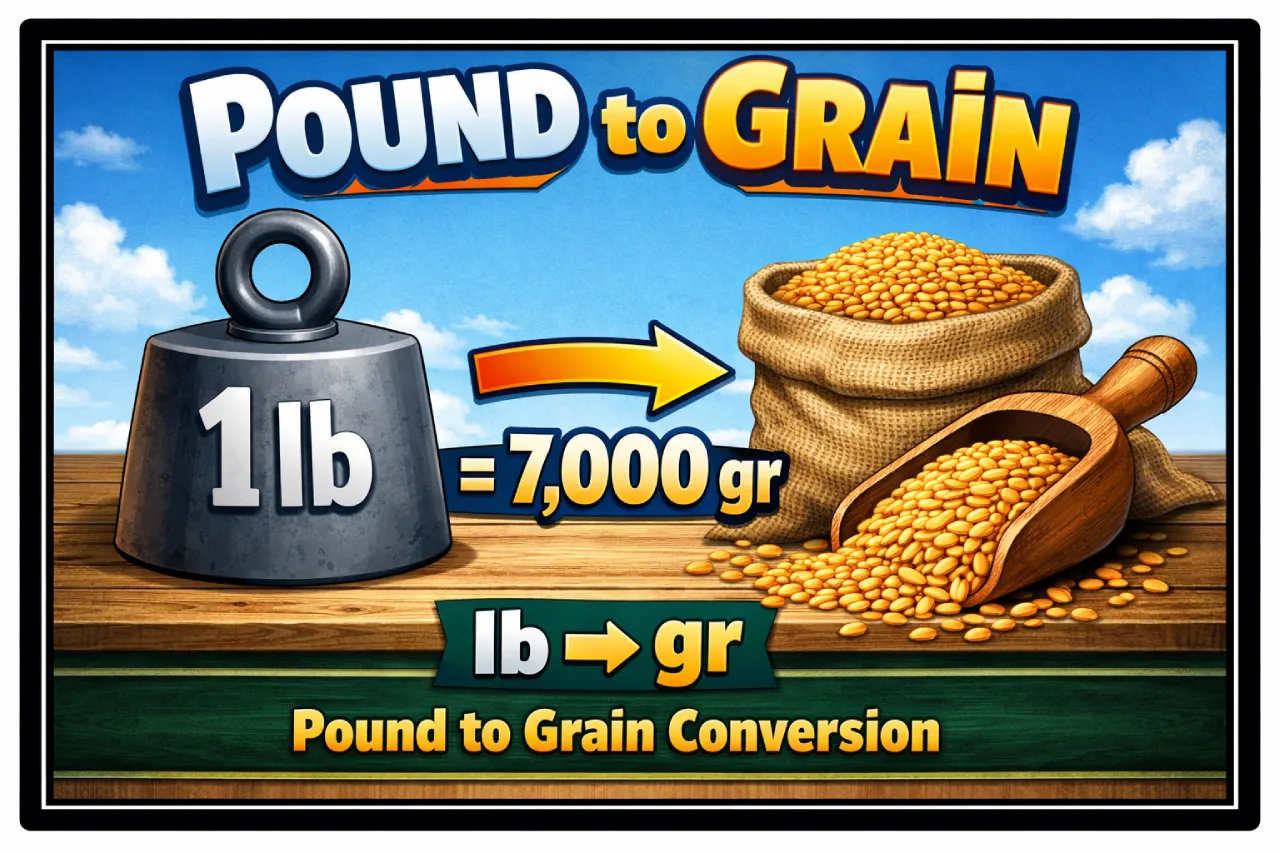
If you’re looking for a quick answer:
1 pound (lb) equals exactly 7,000 grains (gr).
That’s the simple conversion. But if you want to understand why this relationship exists, how to use it accurately, and where it actually matters in real life, this guide will walk you through everything step by step.
Whether you’re working in ballistics, reloading ammunition, or just curious about measurement systems, this is one of those conversions that’s simple—but surprisingly important.
What Is a Pound?
A pound (lb) is a standard unit of weight in the U.S. customary system and is widely used across the United States.
You’ll encounter pounds in everyday life when measuring:
- Body weight
- Food and groceries
- Shipping packages
- Construction materials
That last conversion—pounds to grains—is especially useful in precision-based fields.
What Is a Grain?
A grain (gr) is one of the smallest traditional units of mass still used today. Historically, it was based on the weight of a single grain of barley.
Today, it’s standardized and primarily used in specialized fields such as:
- Ammunition and firearms
- Archery
- Medicine (historically)
- Precious metals (occasionally)
Because grains are so small, they allow for extremely precise measurements—something that’s critical in technical applications.
Pound to Grain Conversion Formula
Pound to Grain Converter
Enter a weight in pounds below to instantly convert it into grains.
Here’s the core formula you need:
Grains = Pounds × 7000
And for the reverse:
Pounds = Grains ÷ 7000
That’s it. Once you remember the 7,000 multiplier, you can convert any value quickly and accurately.
Quick Conversion Table
| Pounds (lb) | Grains (gr) |
|---|---|
| 0.1 lb | 700 gr |
| 0.25 lb | 1,750 gr |
| 0.5 lb | 3,500 gr |
| 1 lb | 7,000 gr |
| 2 lb | 14,000 gr |
| 5 lb | 35,000 gr |
| 10 lb | 70,000 gr |
This table is helpful when you need quick estimates without calculating each time.
Step-by-Step Conversion Examples
Example 1: Convert 2 Pounds to Grains
2 × 7,000 = 14,000 grains
Example 2: Convert 0.75 Pounds to Grains
0.75 × 7,000 = 5,250 grains
Example 3: Convert 21,000 Grains to Pounds
21,000 ÷ 7,000 = 3 pounds
Once you practice a few times, the process becomes automatic.
Why Are Grains Still Used Today?
Even though grains may seem outdated, they remain highly relevant in specific industries.
Ammunition and Ballistics
Bullet weights are almost always measured in grains. For example:
- 9mm bullet: 115 grains
- .45 ACP bullet: 230 grains
Small differences in grain weight can affect performance, recoil, and accuracy.
Archery
Arrow weights are also measured in grains. Even a slight variation can impact:
- Speed
- Trajectory
- Penetration
Medicine (Historical Use)
Grains were once widely used in prescriptions. While modern medicine uses milligrams, you may still see references in older contexts.
Precious Metals
Grains are sometimes used to measure very small quantities of gold or silver.
Common Mistakes to Avoid
Confusing Grains with Grams
This is one of the most common errors:
- 1 grain = 0.0648 grams
They are not interchangeable.
Using the Wrong Conversion Factor
Always remember:
- 1 pound = 7,000 grains, not 1,000
Mixing Measurement Systems
Switching between metric and imperial units without proper conversion can lead to inaccurate results.
Practical Use Cases
Reloading Ammunition
If you’re working with gunpowder:
- 1 pound = 7,000 grains
- If each round uses 5 grains → 1,400 rounds per pound
That’s a real-world example where this conversion directly matters.
Precision Engineering
In specialized fields, grains are used when ultra-fine measurements are required.
Scientific Applications
Though less common today, grains may still appear in niche calculations or legacy systems.
Tips for Accurate Conversions
- Always remember the 7,000 multiplier
- Use a calculator for decimal values
- Double-check your units (grains vs grams)
- Keep a quick reference table handy
Accuracy matters—especially in technical applications.
Frequently Asked Questions (FAQs)
1. How many grains are in 1 pound?
There are exactly 7,000 grains in 1 pound. This is a fixed and standardized conversion.
2. How do you convert pounds to grains quickly?
Simply multiply the number of pounds by 7,000.
For example: 3 lb × 7,000 = 21,000 grains.
3. How many grains are in half a pound?
Half a pound (0.5 lb) equals:
0.5 × 7,000 = 3,500 grains
4. What is 1 grain equal to in grams?
1 grain = 0.0648 grams.
This is useful when converting between imperial and metric systems.
5. Why is the grain unit still used today?
Grains are still used because they allow for high precision, especially in:
- Ammunition
- Archery
- Scientific measurements
6. Is grain the same as gram?
No. They are completely different units:
- 1 grain = 0.0648 grams
- 1 gram ≈ 15.43 grains
7. How many grains are in 1 ounce?
There are 437.5 grains in 1 ounce.
8. How many pounds is 10,000 grains?
10,000 ÷ 7,000 = 1.43 pounds (approx.)
9. Where is pound-to-grain conversion most commonly used?
It’s most commonly used in:
- Firearms and ammunition
- Archery
- Historical medicine
10. Why does 1 pound equal exactly 7,000 grains?
This comes from the historical development of the avoirdupois system, where units were standardized for consistency across trade and measurement.
Final Thoughts
At first glance, converting pounds to grains might seem like a niche calculation—but it’s actually a cornerstone in several precision-driven fields.
Once you lock in the key rule—1 pound equals 7,000 grains—everything else becomes straightforward. Whether you’re working with ballistics, studying measurement systems, or just expanding your knowledge, this is one of those conversions that’s both simple and powerful.
Now here’s a simple question for you:
Will you use this conversion for practical work, or is it one of those fascinating facts you’re glad to finally understand?
Leave a Reply