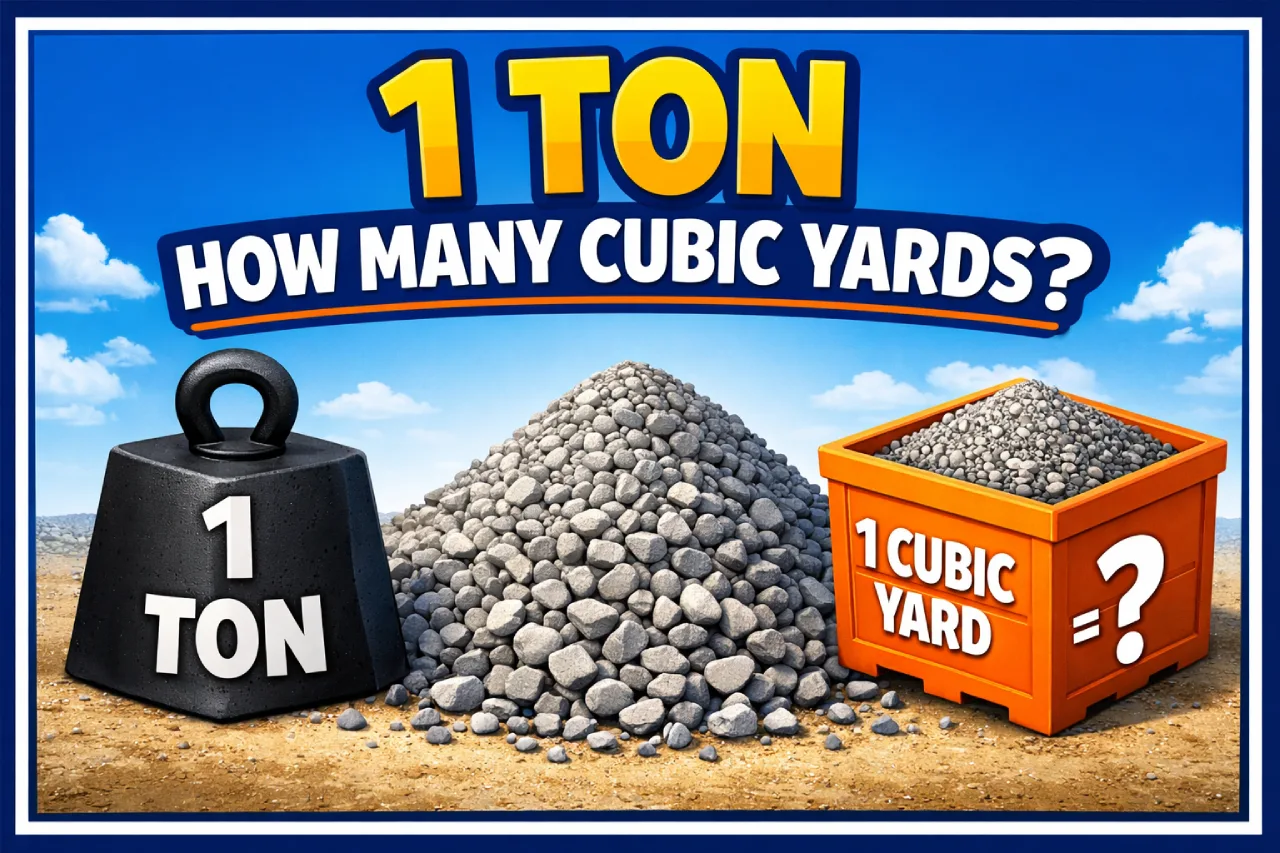
If you’re looking for a quick answer, here it is:
1 ton is NOT equal to a fixed number of cubic yards.
Why? Because:
- A ton measures weight (2,000 pounds)
- A cubic yard measures volume (3 ft × 3 ft × 3 ft)
To convert between them, you must know the density of the material.
That said, here are common real-world estimates:
- 1 ton of gravel ≈ 0.67 cubic yards
- 1 ton of sand ≈ 0.74 cubic yards
- 1 ton of topsoil ≈ 0.75 cubic yards
- 1 ton of mulch ≈ 2.5–3.5 cubic yards
Now let’s break this down so you can confidently calculate it for any material.
Why There’s No Single Answer
This is the biggest point most articles miss.
You can’t directly convert tons to cubic yards because they measure different things:
- Weight (tons) depends on how heavy something is
- Volume (cubic yards) depends on how much space it takes up
The missing piece is density, which tells you how much a material weighs per cubic yard.
Think about it this way:
A cubic yard of rocks is heavy.
A cubic yard of mulch is light.
Same volume, completely different weight.
That’s why the answer changes depending on what you’re working with.
The Simple Formula You Need
Tons to Cubic Yards
Convert tons into cubic yards by selecting a material density or entering your own.
Here’s the only formula you need to remember:
Cubic Yards = Tons ÷ (Tons per Cubic Yard)
This works for any material—as long as you know its density.
For example:
If gravel weighs 1.5 tons per cubic yard, then:
1 ton ÷ 1.5 = 0.67 cubic yards
That’s your answer.
Common Materials and Their Conversions
Let’s look at the most common materials used in construction and landscaping.
Gravel
- Average density: 1.4–1.7 tons per cubic yard
- Conversion:
1 ton ≈ 0.59–0.71 cubic yards
Most people use:
1 ton of gravel ≈ 0.67 cubic yards
Sand
- Average density: 1.3–1.5 tons per cubic yard
- Conversion:
1 ton ≈ 0.67–0.77 cubic yards
Typical estimate:
1 ton of sand ≈ 0.74 cubic yards
Topsoil
- Average density: 1.2–1.4 tons per cubic yard
- Conversion:
1 ton ≈ 0.71–0.83 cubic yards
Common estimate:
1 ton of topsoil ≈ 0.75 cubic yards
Concrete (Crushed or Dry)
- Average density: ~2 tons per cubic yard
- Conversion:
1 ton ≈ 0.5 cubic yards
Heavier material = less volume per ton.
Mulch
- Average density: 0.2–0.4 tons per cubic yard
- Conversion:
1 ton ≈ 2.5–5 cubic yards
Light material = much more volume.
Quick Conversion Table
Here’s a simple reference chart:
| Material | Tons per Cubic Yard | 1 Ton Equals |
|---|---|---|
| Gravel | 1.5 | 0.67 yd³ |
| Sand | 1.35 | 0.74 yd³ |
| Topsoil | 1.3 | 0.77 yd³ |
| Concrete | 2.0 | 0.50 yd³ |
| Mulch | 0.3 | 3.33 yd³ |
These are averages, but they’re accurate enough for most real-world projects.
Real-Life Example: Gravel Calculation
Let’s say you’re ordering gravel for a driveway.
You’re told you need 1 ton of gravel.
Using the average density:
1 ÷ 1.5 = 0.67 cubic yards
So, 1 ton of gravel gives you about two-thirds of a cubic yard.
If you need more coverage, you’ll need more tons.
Why Density Changes the Answer
Density isn’t always the same. It can vary due to several factors.
Moisture
Wet materials weigh more.
For example, wet sand is heavier than dry sand, which means:
- Fewer cubic yards per ton when wet
Compaction
Loose material takes up more space than compacted material.
Once compacted, the same material becomes denser.
Material Type
Even within the same category (like gravel), different sizes and compositions change the density.
That’s why it’s always best to:
- Ask your supplier for exact density
- Or use industry averages with a small buffer
Tons vs Cubic Yards: When to Use Each
Tons (Weight)
Used when:
- Buying materials by weight
- Transporting materials (truck limits are weight-based)
Cubic Yards (Volume)
Used when:
- Measuring coverage area
- Planning landscaping or construction
In my experience, contractors often think in cubic yards, while suppliers may quote in tons.
Quick Estimation Rules
If you don’t know the exact density, here are simple rules that work surprisingly well:
- Heavy materials (gravel, concrete):
1 ton ≈ 0.5–0.7 cubic yards - Medium materials (sand, soil):
1 ton ≈ 0.7–0.8 cubic yards - Light materials (mulch):
1 ton ≈ 2–4 cubic yards
These are perfect for quick planning.
Common Mistakes to Avoid
Assuming a Fixed Conversion
There is no universal answer. Always consider the material.
Ignoring Moisture
Wet materials can significantly change weight and calculations.
Not Ordering Extra
Always add 5–10% extra to avoid running short.
Confusing Units
Cubic yards (volume) are not the same as square yards (area).
Practical Example: Landscaping Project
Let’s say you’re working on a garden bed and plan to use topsoil.
You have:
- 1 ton of topsoil
- Density: 1.3 tons per cubic yard
Calculation:
1 ÷ 1.3 = 0.77 cubic yards
So, 1 ton of topsoil gives you about 0.77 cubic yards.
That helps you estimate how much area you can cover.
Converting the Other Way (Yards to Tons)
Sometimes you’ll need to reverse the calculation.
Tons = Cubic Yards × Density
Example:
1 cubic yard of gravel × 1.5 = 1.5 tons
Knowing both directions makes your planning much easier.
Why This Conversion Matters
Getting this wrong can lead to:
- Ordering too much (wasting money)
- Ordering too little (delays and extra delivery costs)
- Miscalculating project coverage
Whether you’re building a driveway, laying a patio, or landscaping a yard, understanding this conversion saves time, money, and frustration.
Frequently Asked Questions (FAQs)
How many cubic yards is 1 ton?
It depends on the material. For example:
- Gravel: ~0.67 cubic yards
- Sand: ~0.74 cubic yards
- Mulch: 2.5–3.5 cubic yards
What is the formula to convert tons to cubic yards?
Cubic Yards = Tons ÷ Density (tons per cubic yard)
Is 1 ton equal to 1 cubic yard?
No. They measure different things:
- Ton = weight
- Cubic yard = volume
How many cubic yards is 1 ton of gravel?
About 0.67 cubic yards, depending on density.
How many cubic yards is 1 ton of sand?
About 0.74 cubic yards, depending on moisture and type.
Why does the number change for different materials?
Because each material has a different density.
How can I estimate quickly without exact data?
Use rough averages:
- Gravel: 0.67 yd³
- Sand/soil: 0.75 yd³
- Mulch: 3 yd³
Should I always order extra material?
Yes. Add 5–10% extra to avoid shortages.
How do I get exact density values?
Ask your supplier or check product specifications.
What’s the biggest mistake people make?
Assuming there’s a fixed conversion between tons and cubic yards.
Final Thoughts
So, 1 ton equals how many cubic yards?
The honest answer is: it depends on the material.
Once you understand the relationship between weight, volume, and density, the confusion disappears. With a simple formula and a few common estimates, you can calculate conversions quickly and accurately.
And after a few projects, you won’t even need a calculator—you’ll just know.
Leave a Reply