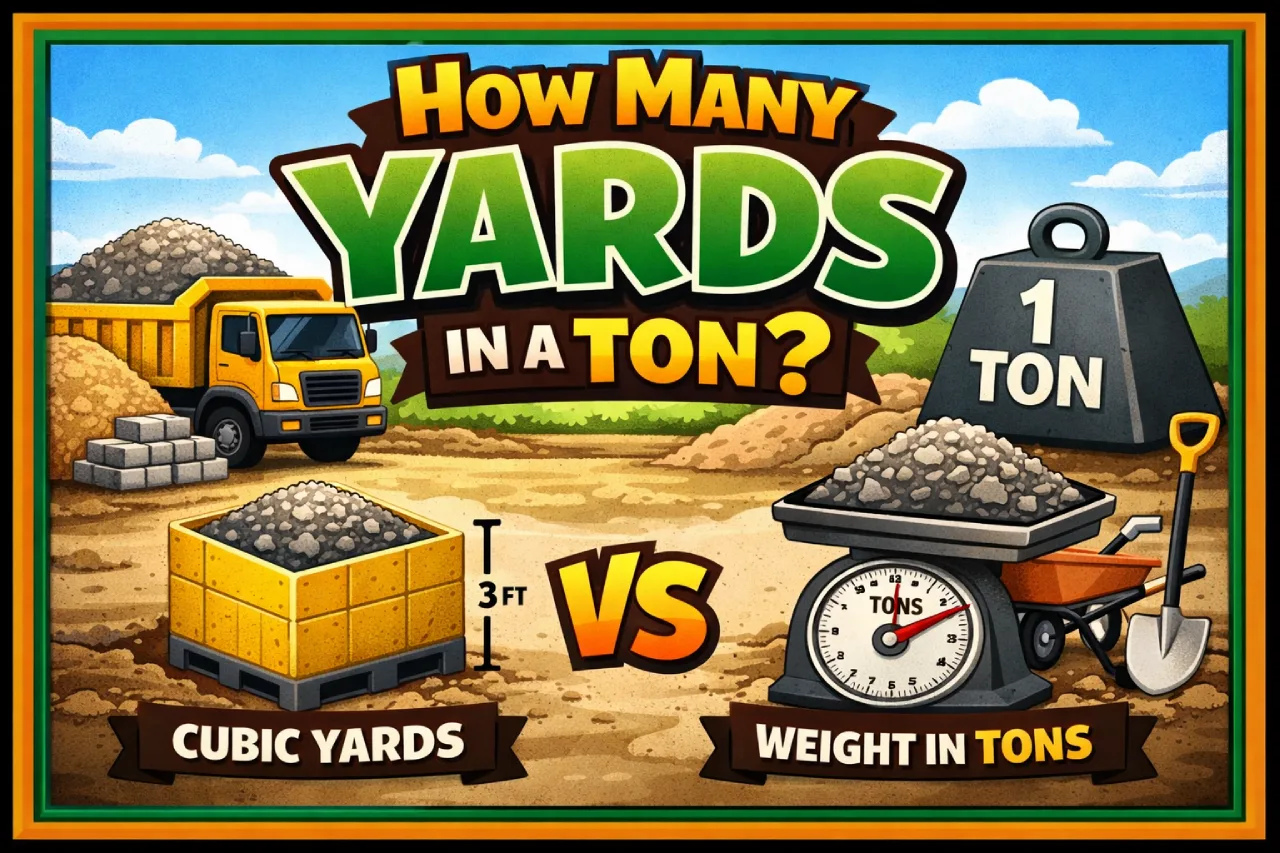
If you’re looking for a quick answer, here it is:
There is no fixed number of yards in a ton.
That’s because yards measure volume (cubic yards) and tons measure weight. To convert between them, you must know the density of the material you’re dealing with.
In simple terms:
Cubic Yards = Tons ÷ Density (tons per cubic yard)
Once you understand that, everything else becomes much easier. Let’s break it down in a practical, real-world way so you can confidently convert tons to yards for gravel, soil, sand, concrete, and more.
Why You Can’t Directly Convert Tons to Yards
This is where most people get confused.
A ton is a unit of weight (2,000 pounds in the U.S.), while a cubic yard measures volume (a 3 ft × 3 ft × 3 ft space).
The missing link is density, which tells you how heavy a material is per unit of volume.
For example:
- A cubic yard of feathers weighs almost nothing
- A cubic yard of gravel can weigh over a ton
Same volume, completely different weight.
That’s why the answer depends entirely on the material.
The Basic Formula You Need
Yards to Tons Converter
Convert cubic yards to tons using the material’s density. Since different materials weigh differently, select a preset or enter a custom value.
Tons = Cubic Yards × Tons per Cubic Yard
Here’s the formula you’ll use every time:
Cubic Yards = Tons ÷ (Tons per Cubic Yard)
So if a material weighs 1.5 tons per cubic yard, then:
1 ton ÷ 1.5 = 0.67 cubic yards
This formula works for any material—as long as you know its density.
Common Conversions by Material
Let’s look at real-world examples. These are approximate averages used in construction and landscaping.
Gravel
- Density: ~1.4 to 1.7 tons per cubic yard
- 1 ton ≈ 0.59 to 0.71 cubic yards
A commonly used average:
1 ton of gravel ≈ 0.67 cubic yards
Sand
- Density: ~1.3 to 1.5 tons per cubic yard
- 1 ton ≈ 0.67 to 0.77 cubic yards
Average:
1 ton of sand ≈ 0.74 cubic yards
Topsoil
- Density: ~1.2 to 1.4 tons per cubic yard
- 1 ton ≈ 0.71 to 0.83 cubic yards
Average:
1 ton of topsoil ≈ 0.75 cubic yards
Concrete (Crushed or Dry)
- Density: ~2.0 tons per cubic yard
- 1 ton ≈ 0.5 cubic yards
Concrete is heavier than most materials, so you get less volume per ton.
Mulch
- Density: ~0.2 to 0.4 tons per cubic yard
- 1 ton ≈ 2.5 to 5 cubic yards
Mulch is light, so a ton covers a much larger volume.
Quick Reference Table
Here’s a simple table you can use for quick estimates:
| Material | Tons per Cubic Yard | 1 Ton Equals (Cubic Yards) |
|---|---|---|
| Gravel | 1.5 | 0.67 yd³ |
| Sand | 1.35 | 0.74 yd³ |
| Topsoil | 1.3 | 0.77 yd³ |
| Concrete | 2.0 | 0.50 yd³ |
| Mulch | 0.3 | 3.33 yd³ |
These values are averages, but they’re accurate enough for most projects.
Real-Life Example: Ordering Gravel
Let’s say you need 3 tons of gravel for a driveway.
Using the average:
3 tons ÷ 1.5 = 2 cubic yards
So you’d need about 2 cubic yards of gravel.
This is why suppliers often ask whether you want your order in tons or cubic yards—it affects pricing and delivery.
Why Density Changes Everything
Density isn’t fixed. It can vary based on:
Moisture Content
Wet sand is heavier than dry sand. That changes the tons-per-yard value.
Compaction
Loose soil takes up more space than compacted soil. Once packed, the same material weighs more per cubic yard.
Material Type
Even within gravel, sizes and compositions vary, affecting density.
Because of this, it’s always a good idea to:
- Ask your supplier for their specific density
- Add a small buffer (5–10%) to your estimate
Tons vs Cubic Yards: When Each Is Used
Tons (Weight)
Used when:
- Buying bulk materials by weight
- Transporting materials (truck loads are weight-limited)
Cubic Yards (Volume)
Used when:
- Measuring coverage area
- Planning landscaping or construction projects
In my experience, contractors often think in cubic yards, while suppliers may quote in tons.
How to Estimate Without Exact Density
If you don’t know the exact density, here’s a quick rule of thumb:
- Heavy materials (gravel, concrete): 1 ton ≈ 0.5–0.7 cubic yards
- Medium materials (sand, soil): 1 ton ≈ 0.7–0.8 cubic yards
- Light materials (mulch): 1 ton ≈ 2–4 cubic yards
These estimates are surprisingly reliable for quick planning.
Common Mistakes to Avoid
Assuming a Fixed Conversion
There is no universal conversion between tons and yards. Always check the material.
Ignoring Moisture
Wet materials weigh more. This can throw off your calculations.
Not Ordering Extra
Running short can delay your project. It’s usually smart to order 5–10% extra.
Mixing Units
Don’t confuse square yards (area) with cubic yards (volume). They are completely different.
Practical Scenario: Landscaping Project
Let’s say you’re covering a garden bed and need:
- 2 tons of topsoil
- Density: 1.3 tons per cubic yard
Calculation:
2 ÷ 1.3 = 1.54 cubic yards
You’d round up and order about 1.6 cubic yards.
That small rounding ensures you don’t run out mid-project.
Tons to Yards vs Yards to Tons
You might also need to reverse the calculation.
Tons to Yards
Cubic Yards = Tons ÷ Density
Yards to Tons
Tons = Cubic Yards × Density
Example:
2 cubic yards of gravel × 1.5 = 3 tons
Understanding both directions gives you full control over your estimates.
Why This Matters More Than You Think
Getting this conversion wrong can lead to:
- Overpaying for materials
- Running short during a project
- Delivery issues (trucks overloaded or underfilled)
Whether you’re working on a driveway, garden, or construction site, knowing how tons and yards relate can save both time and money.
Frequently Asked Questions (FAQs)
How many yards are in a ton?
There is no fixed answer. It depends on the material’s density. For example, 1 ton of gravel is about 0.67 cubic yards, while 1 ton of mulch can be over 3 cubic yards.
What is the formula to convert tons to cubic yards?
Cubic Yards = Tons ÷ (Tons per Cubic Yard)
How many cubic yards is 1 ton of gravel?
On average, 1 ton of gravel ≈ 0.67 cubic yards.
How many cubic yards is 1 ton of sand?
Typically, 1 ton of sand ≈ 0.74 cubic yards, depending on moisture and type.
Is a ton the same as a cubic yard?
No. A ton measures weight, while a cubic yard measures volume. They are different types of units.
How do I know the density of a material?
You can:
- Ask your supplier
- Check product specifications
- Use industry averages (as shown in this guide)
Why does moisture affect the conversion?
Water adds weight, increasing the tons per cubic yard. Wet materials are heavier than dry ones.
How many yards is 2 tons of gravel?
Using the average (1.5 tons per cubic yard):
2 ÷ 1.5 = 1.33 cubic yards
Should I order extra material?
Yes. It’s recommended to order 5–10% extra to account for waste, compaction, or errors.
What’s the easiest way to estimate quickly?
Use rough averages:
- Gravel: 1 ton ≈ 0.67 yards
- Sand/soil: 1 ton ≈ 0.75 yards
- Mulch: 1 ton ≈ 3 yards
Final Thoughts
So, how many yards are in a ton?
The honest answer is: it depends on the material.
Once you understand that tons measure weight and cubic yards measure volume, the confusion disappears. All you need is the material’s density, and you can convert confidently using a simple formula.
From gravel driveways to garden beds, this knowledge helps you plan smarter, avoid costly mistakes, and get exactly the amount of material you need.
And next time someone asks, “How many yards are in a ton?”—you’ll know the real answer isn’t just a number. It’s a concept.
Leave a Reply