Category: Convert Tools

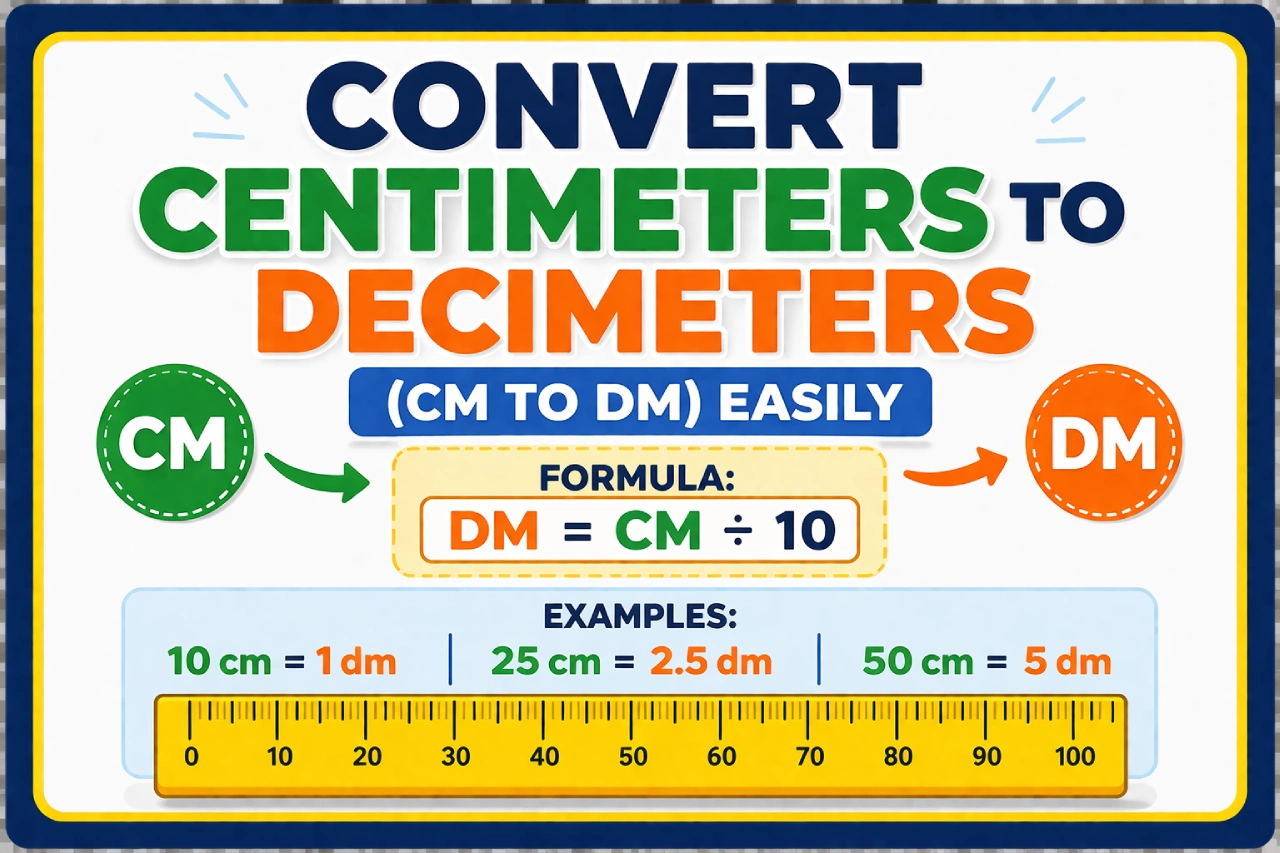
  • Convert Centimeters to Decimeters (CM to DM) Easily

    Convert Centimeters to Decimeters (CM to DM) Easily

    If you’re looking for the quick answer:

    1 centimeter (cm) = 0.1 decimeters (dm)
    —or—
    10 centimeters = 1 decimeter

    So to convert cm to dm, simply divide the centimeter value by 10.

    For example:

    • 20 cm = 2 dm
    • 50 cm = 5 dm
    • 100 cm = 10 dm

    This conversion is simple once you understand how metric prefixes work. In fact, the relationship between centimeters and decimeters is built directly into the structure of the metric system.

    In this guide, we’ll explore how the conversion works, why it’s so easy, practical examples, and real-world situations where converting centimeters to decimeters can be useful.

    CM to DM Conversion Formula

    CM to DM Converter

    CM to DM Converter

    Enter a value in centimeters to convert it into decimeters instantly.

    Your result will appear here
    Formula: DM = CM ÷ 10

    The standard formula is:

    dm = cm ÷ 10

    Or alternatively:

    dm = cm × 0.1

    Reverse Conversion

    To convert dm to cm:

    cm = dm × 10

    Because the metric system is base-10, these conversions are quick and intuitive.

    Understanding Metric Prefixes

    The metric system is designed around powers of ten, which makes conversions extremely straightforward.

    Here are some common metric units related to meters:

    UnitSymbolRelation to Meter
    Kilometerkm1,000 meters
    Meterm1 meter
    Decimeterdm0.1 meters
    Centimetercm0.01 meters
    Millimetermm0.001 meters

    Looking at this table, you can see that:

    1 dm = 10 cm

    That’s why converting centimeters to decimeters is as simple as dividing by ten.

    Quick CM to DM Conversion Table

    Here’s a helpful reference chart.

    Centimeters (cm)Decimeters (dm)
    1 cm0.1 dm
    5 cm0.5 dm
    10 cm1 dm
    20 cm2 dm
    50 cm5 dm
    100 cm10 dm
    200 cm20 dm

    This chart makes it easy to estimate conversions quickly.

    Step-by-Step Conversion Examples

    Let’s go through a few examples to make the process crystal clear.

    Example 1: Convert 25 cm to dm

    25 ÷ 10 = 2.5 dm

    Example 2: Convert 80 cm to dm

    80 ÷ 10 = 8 dm

    Example 3: Convert 135 cm to dm

    135 ÷ 10 = 13.5 dm

    Example 4: Convert 4 dm to cm

    4 × 10 = 40 cm

    Once you understand the pattern, conversions become almost automatic.

    Why the Metric System Makes Conversion Easy

    One of the greatest strengths of the metric system is its base-10 structure.

    Unlike the U.S. customary system—where conversions can involve numbers like 12, 3, or 5280—the metric system uses powers of ten.

    That means converting units usually involves simply moving the decimal point.

    For example:

    • cm → dm → m → km

    Each step moves the decimal by one position.

    This design makes the system particularly useful for science, engineering, and global standardization.

    Real-World Applications

    Although centimeters are more common in daily life, decimeters still appear in several practical situations.

    Education and Mathematics

    Many school math problems use decimeters to help students understand metric relationships.

    Learning cm-to-dm conversions builds familiarity with metric prefixes.

    Engineering and Technical Drawings

    Some engineering diagrams use decimeters to simplify measurements.

    For example:

    Instead of writing 120 cm, an engineer might write 12 dm.

    Scientific Calculations

    In science, unit consistency is critical.

    Scientists sometimes use decimeters when dealing with volume calculations because:

    1 cubic decimeter = 1 liter

    This relationship is extremely useful in chemistry and physics.

    Design and Architecture

    Certain architectural or technical models may express measurements in decimeters for easier scaling.

    Common Mistakes When Converting CM to DM

    Forgetting to Divide by 10

    The most common mistake is multiplying instead of dividing.

    Remember:

    cm → dm = divide by 10

    Confusing Decimeters with Millimeters

    These units sound similar but are very different.

    • 1 dm = 10 cm
    • 1 cm = 10 mm

    Mixing them up leads to major errors.

    Misplacing the Decimal Point

    Because conversions involve decimals, placing the decimal incorrectly can change the value significantly.

    Always double-check your units and calculations.

    CM vs DM vs Meters

    Understanding the relationship between these units helps make conversions easier.

    UnitValue
    1 meter10 dm
    1 meter100 cm
    1 dm10 cm

    So:

    1 meter = 10 dm = 100 cm

    This hierarchy makes it easy to move between units.

    Tips for Quick Mental Conversion

    Here are a few tricks that make conversions easier.

    First, remember the core rule:

    10 cm = 1 dm

    Second, when converting cm to dm, move the decimal one place to the left.

    For example:

    • 75 cm → 7.5 dm
    • 140 cm → 14 dm

    Third, keep the metric ladder in mind:

    km → m → dm → cm → mm

    Moving down multiplies by 10, and moving up divides by 10.

    Frequently Asked Questions (FAQs)

    1. How do you convert cm to dm?

    Divide the centimeter value by 10.

    Example:
    50 cm ÷ 10 = 5 dm

    2. How many centimeters are in a decimeter?

    There are 10 centimeters in 1 decimeter.

    3. What is 100 cm in dm?

    100 ÷ 10 = 10 dm

    4. Why is the conversion so simple?

    Because the metric system is based on powers of ten.

    5. Is a decimeter bigger than a centimeter?

    Yes.
    1 dm = 10 cm, so a decimeter is larger.

    6. Is dm commonly used?

    Decimeters are less common in everyday life but still appear in education, science, and engineering.

    7. What is 45 cm in dm?

    45 ÷ 10 = 4.5 dm

    8. How many dm are in 1 meter?

    There are 10 dm in 1 meter.

    9. What is the easiest way to remember the conversion?

    Just remember:

    10 cm = 1 dm

    10. Can cm and dm be used interchangeably?

    No. They represent different scales of measurement.

    Final Thoughts

    Converting centimeters to decimeters is one of the simplest conversions in the entire metric system. Once you remember the basic rule—divide by 10—the process becomes almost effortless.

    The beauty of the metric system is that it keeps everything organized around powers of ten, making unit conversions intuitive and predictable.

    Whether you’re solving a math problem, reading a technical diagram, or working with metric measurements, understanding how centimeters relate to decimeters gives you a deeper appreciation for how elegantly the metric system works.

    Now here’s a quick question for you:
    When you measure something in centimeters, do you ever mentally convert it into meters or decimeters to visualize the scale better?
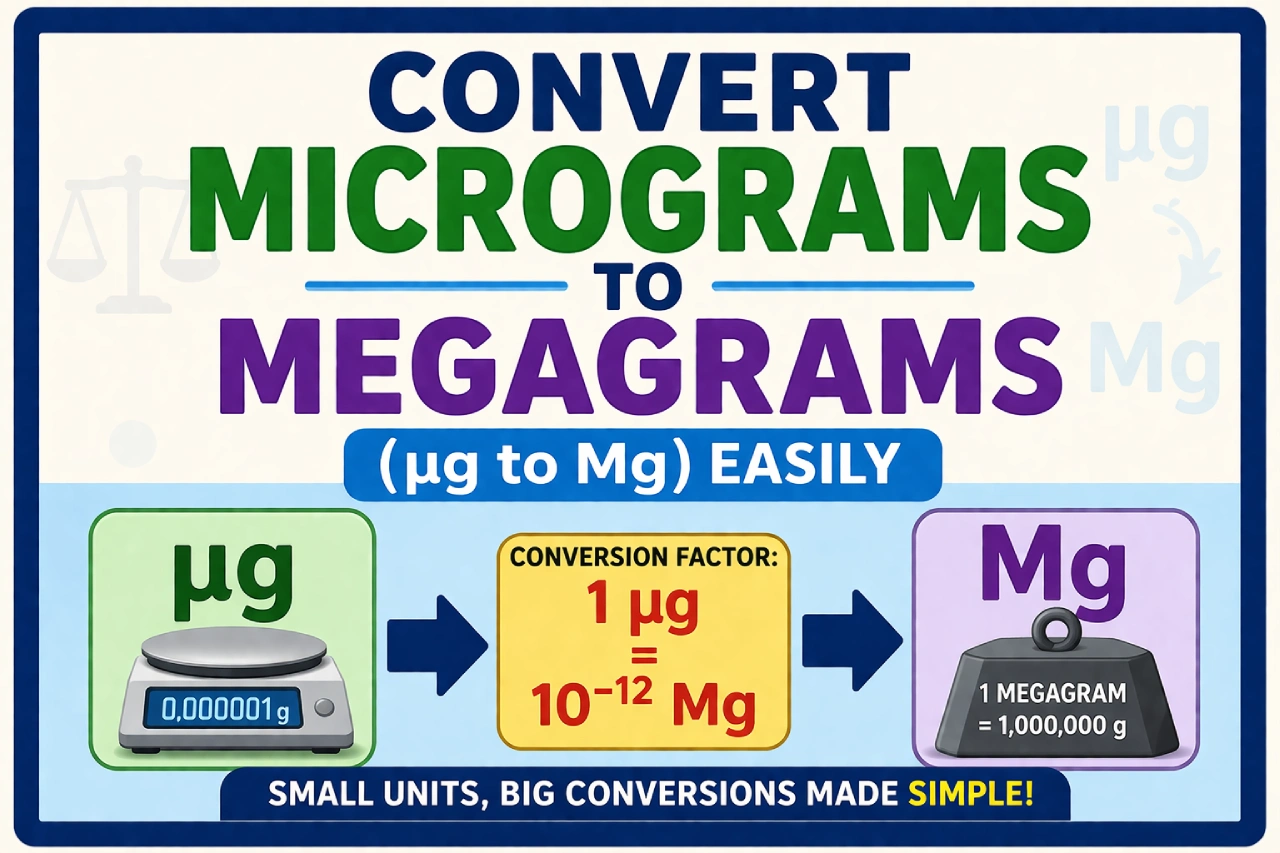
  • Convert Micrograms to Megagrams (µg to Mg) Easily

    Convert Micrograms to Megagrams (µg to Mg) Easily

    Here’s the quick answer most people are looking for:

    1 microgram (µg) = 0.000000000001 megagrams (Mg)
    —or—
    1 megagram (Mg) = 1,000,000,000,000 micrograms (10¹² µg)

    That’s a huge difference in scale. In fact, converting micrograms to megagrams means jumping across twelve powers of ten in the metric system.

    This conversion isn’t something most people use every day, but it’s extremely useful in fields like environmental science, pharmaceuticals, chemistry, and large-scale industrial measurements where very small and very large units sometimes need to be compared.

    In this guide, we’ll break down the relationship between micrograms and megagrams, explain the formula, show practical examples, and explore how the metric system makes these conversions surprisingly simple once you understand the prefixes.

    Micrograms to Megagrams Conversion Formula

    Micrograms to Megagrams Converter

    Micrograms to Megagrams Converter

    Enter a value in micrograms (µg) to instantly convert it into megagrams (Mg).

    Your result will appear here
    Formula: Megagrams = Micrograms × 1×10⁻¹²

    The conversion formula is:

    Megagrams = Micrograms ÷ 1,000,000,000,000

    Or written using scientific notation:

    Megagrams = Micrograms × 10⁻¹²

    This is because:

    1 Mg = 1,000,000,000,000 µg

    Reverse Conversion

    To convert megagrams to micrograms:

    Micrograms = Megagrams × 1,000,000,000,000

    Understanding Metric Prefixes

    To understand the conversion between micrograms and megagrams, it helps to visualize the metric scale.

    Here are some key units around grams:

    PrefixSymbolValue
    Microµ10⁻⁶
    Millim10⁻³
    Gramg10⁰
    Kilok10³
    MegaM10⁶

    Micro is six steps below grams, while mega is six steps above grams.

    That means moving from micrograms to megagrams crosses twelve orders of magnitude.

    Quick Conversion Table

    Here’s a reference table for common values.

    Micrograms (µg)Megagrams (Mg)
    1 µg0.000000000001 Mg
    1,000 µg0.000000001 Mg
    1,000,000 µg0.000001 Mg
    1,000,000,000 µg0.001 Mg
    1,000,000,000,000 µg1 Mg

    This shows just how massive the scale difference is between the two units.

    Step-by-Step Conversion Examples

    Let’s look at some practical examples.

    Example 1: Convert 1,000,000 µg to Mg

    1,000,000 ÷ 1,000,000,000,000
    = 0.000001 Mg

    Example 2: Convert 5,000,000,000 µg to Mg

    5,000,000,000 ÷ 1,000,000,000,000
    = 0.005 Mg

    Example 3: Convert 2 Mg to Micrograms

    2 × 1,000,000,000,000
    = 2,000,000,000,000 µg

    These conversions look intimidating at first, but once you understand the powers of ten, they become much easier.

    Why Such Large Conversion Differences Exist

    The metric system is designed to handle measurements across extremely different scales.

    For example:

    • A pharmaceutical dose might be 50 micrograms
    • A cargo shipment might weigh 10 megagrams

    Using prefixes allows scientists and engineers to work with numbers that remain manageable instead of writing long strings of zeros.

    Imagine writing:

    10,000,000,000,000 grams

    Instead of simply saying:

    10 Mg

    That’s the beauty of the metric system.

    Real-World Applications

    Environmental Science

    Environmental scientists often work with both very small and very large quantities.

    For example:

    Air pollutants might be measured in micrograms, while total emissions from an industry could be reported in megagrams.

    Pharmaceutical Manufacturing

    Drug production involves extremely precise microgram measurements, but manufacturing output may be measured in tons or megagrams.

    Industrial Production

    Industries such as mining, agriculture, and manufacturing measure raw materials in megagrams.

    However, trace impurities within those materials might be measured in micrograms.

    Scientific Research

    Large research studies sometimes convert between extremely small and extremely large units when analyzing data.

    This makes understanding these conversions valuable in scientific work.

    Common Mistakes in Unit Conversion

    Confusing Micrograms with Milligrams

    These units are very different.

    • 1 milligram = 1,000 micrograms
    • 1 microgram = 0.001 milligrams

    Always double-check the prefix.

    Misplacing Decimal Points

    Because conversions involve many zeros, it’s easy to move the decimal incorrectly.

    Scientific notation helps prevent mistakes.

    Ignoring Metric Prefixes

    The prefixes themselves provide the conversion information.

    Once you know:

    • micro = 10⁻⁶
    • mega = 10⁶

    You can derive the relationship instantly.

    Tips for Easier Conversion

    Here are a few strategies that make these conversions easier.

    First, remember that the difference between micro and mega is 12 powers of ten.

    Second, write values using scientific notation to avoid long numbers.

    Third, always check the units carefully when reading scientific data.

    These habits make metric conversions much more manageable.

    Frequently Asked Questions (FAQs)

    1. How many micrograms are in one megagram?

    There are 1,000,000,000,000 micrograms in 1 megagram.

    2. How do you convert micrograms to megagrams?

    Divide the microgram value by 1,000,000,000,000.

    3. What is 1 µg in megagrams?

    1 microgram equals 0.000000000001 megagrams.

    4. What is a megagram equal to?

    A megagram equals 1,000 kilograms, which is the same as one metric ton.

    5. Why are micrograms used?

    Micrograms are used to measure extremely small quantities, especially in medicine and chemistry.

    6. Why are megagrams used?

    Megagrams measure large masses, particularly in industry and environmental data.

    7. Is a megagram the same as a metric ton?

    Yes. 1 megagram equals 1 metric ton.

    8. How many grams are in a microgram?

    1 microgram equals 0.000001 grams.

    9. How many grams are in a megagram?

    1 megagram equals 1,000,000 grams.

    10. What is the easiest way to remember the conversion?

    Remember that micro to mega equals a difference of 12 powers of ten.

    Final Thoughts

    At first glance, converting micrograms to megagrams may look intimidating because the numbers span such dramatically different scales. But once you understand how metric prefixes work, the conversion becomes logical.

    The metric system was designed to make scientific measurements consistent and scalable—from microscopic quantities measured in micrograms to massive industrial weights measured in megagrams.

    Once you recognize that micro = 10⁻⁶ and mega = 10⁶, the twelve-power difference explains everything.

    So here’s a question worth thinking about:
    When you see measurements ranging from micrograms to megagrams, does it change how you appreciate the incredible range that the metric system can handle?

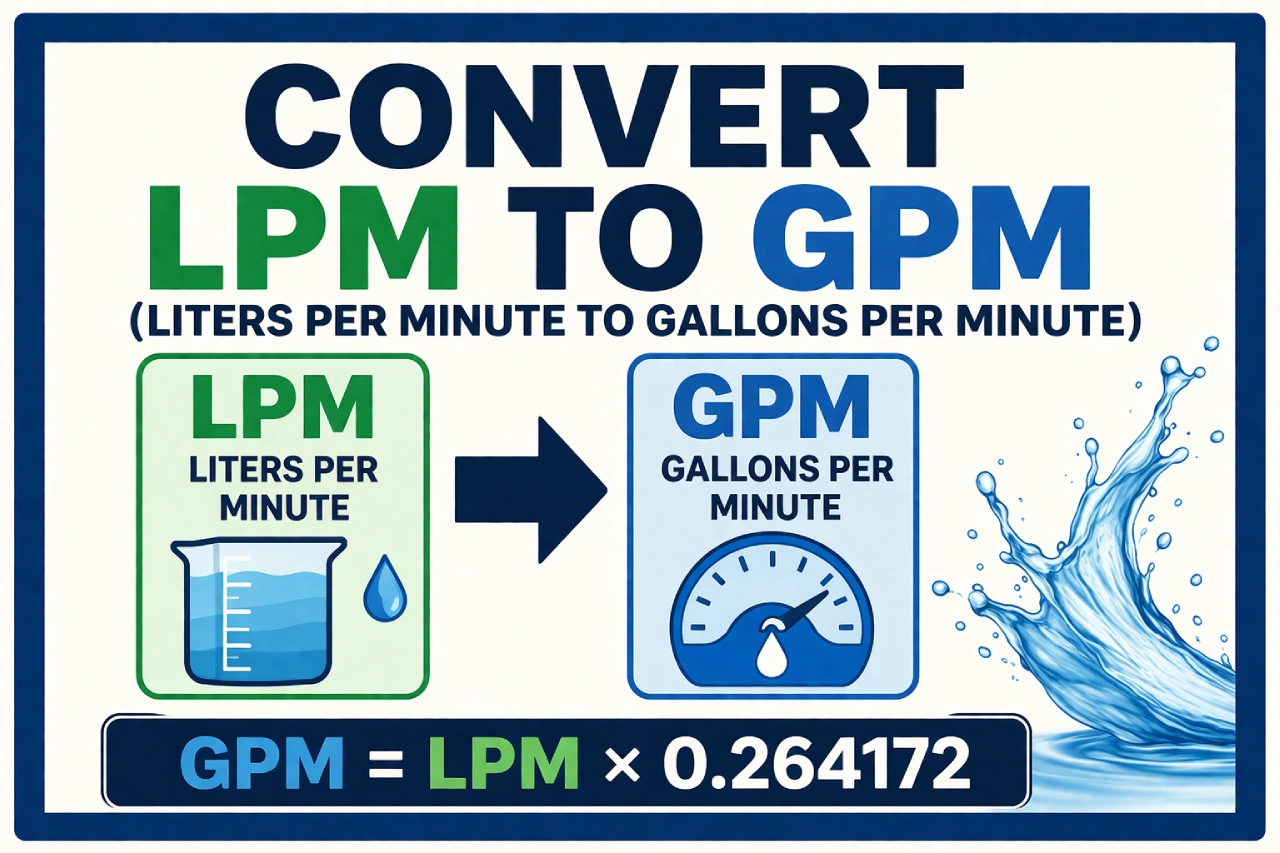
  • Convert LPM to GPM (Liters per Minute to Gallons per Minute)

    Convert LPM to GPM (Liters per Minute to Gallons per Minute)

    If you’re searching for the quick answer, here it is:

    1 LPM (liter per minute) ≈ 0.26417 GPM (gallons per minute).

    So to convert LPM to GPM, you simply multiply:

    GPM = LPM × 0.26417

    This conversion is extremely common in plumbing, pumps, irrigation systems, filtration equipment, and industrial fluid systems—especially when comparing international metric measurements with U.S. flow-rate standards.

    But understanding the conversion is more than memorizing a number. Once you know how liters and gallons relate, you’ll be able to convert any flow rate quickly and confidently.

    In this guide, we’ll walk through the formula, practical examples, quick conversion tables, and real-world applications where LPM-to-GPM conversions are used every day.

    What Is LPM?

    LPM stands for liters per minute, a metric unit used to measure flow rate—the amount of liquid moving through a system over time.

    Specifically:

    1 LPM means one liter of fluid flows every minute.

    Because it’s part of the metric system, LPM is widely used in:

    • Medical oxygen systems
    • Laboratory equipment
    • Water filtration systems
    • Industrial machinery
    • Scientific measurements

    For example:

    • Oxygen therapy devices may deliver 2–10 LPM
    • Water filters may operate around 5–20 LPM
    • Industrial pumps may move hundreds of LPM

    LPM works well in metric countries, but in the United States, flow rate is usually measured in GPM.

    What Is GPM?

    GPM stands for gallons per minute, a unit commonly used in the United States to measure the rate of liquid flow.

    One gallon in the U.S. system equals:

    1 gallon = 3.78541 liters

    So when we say a pump moves 10 GPM, that means 10 gallons of fluid flow through the system every minute.

    GPM is widely used in:

    • Plumbing systems
    • Irrigation systems
    • Fire protection systems
    • Water pumps
    • HVAC cooling systems

    Because international equipment often uses metric units, converting LPM to GPM becomes necessary when comparing specifications.

    LPM to GPM Conversion Formula

    LPM to GPM Converter

    LPM to GPM Converter

    Enter a value in Liters per Minute (LPM) to convert it into Gallons per Minute (GPM).

    Your result will appear here
    Formula: GPM = LPM × 0.264172

    The standard conversion formula is:

    GPM = LPM × 0.26417

    This factor comes from the relationship between liters and gallons.

    Since:

    1 liter = 0.26417 gallons

    The flow rate conversion becomes straightforward.

    Reverse Conversion

    To convert GPM back to LPM:

    LPM = GPM × 3.78541

    Quick LPM to GPM Conversion Table

    Here’s a quick reference table to make conversions easier.

    LPMGPM
    1 LPM0.264 GPM
    5 LPM1.32 GPM
    10 LPM2.64 GPM
    20 LPM5.28 GPM
    30 LPM7.93 GPM
    50 LPM13.21 GPM
    100 LPM26.42 GPM

    This table helps you estimate flow rates quickly without doing calculations every time.

    Step-by-Step Conversion Examples

    Let’s walk through a few practical examples.

    Example 1: Convert 10 LPM to GPM

    10 × 0.26417 = 2.64 GPM

    So a system flowing at 10 LPM delivers about 2.64 gallons per minute.

    Example 2: Convert 25 LPM to GPM

    25 × 0.26417 = 6.60 GPM

    Example 3: Convert 40 LPM to GPM

    40 × 0.26417 = 10.57 GPM

    Once you memorize the 0.264 factor, these conversions become quick mental math.

    Real-World Applications of LPM to GPM Conversion

    Water Pumps

    Pump manufacturers around the world use different units.

    European or Asian pumps may list flow rates in LPM, while U.S. systems expect GPM.

    Understanding the conversion allows engineers and technicians to compare pump specifications easily.

    Irrigation Systems

    Sprinkler systems are often designed using GPM in the U.S., but many irrigation components list flow rates in LPM.

    Converting between the two ensures:

    • Proper water distribution
    • Correct pipe sizing
    • Balanced pressure across the system

    Medical Oxygen Systems

    Oxygen flow in hospitals is typically measured in liters per minute.

    However, some medical equipment used in the U.S. may reference gallons per minute, requiring accurate conversions.

    Water Filtration and RO Systems

    Filtration systems often use international specifications.

    For example:

    A filter rated at 15 LPM delivers roughly 3.96 GPM.

    Understanding this helps homeowners compare filtration capacity when shopping for equipment.

    Fire Protection Systems

    Fire suppression systems rely heavily on GPM measurements, but international components may use LPM.

    Correct conversion ensures the system meets safety requirements.

    Why Accurate Flow Rate Conversion Matters

    Flow rate determines how effectively a system moves fluid.

    Incorrect conversions can lead to:

    • Undersized pumps
    • Poor water pressure
    • Inefficient irrigation
    • Equipment damage

    For example, choosing a pump rated at 5 GPM instead of the required 5 LPM equivalent could drastically change system performance.

    This is why engineers always verify flow units before designing a system.

    Common Mistakes When Converting LPM to GPM

    Confusing Liters with Gallons

    A liter is significantly smaller than a gallon.

    Remember:

    1 gallon ≈ 3.785 liters

    Using the Wrong Conversion Factor

    Always use 0.26417 when converting LPM to GPM.

    Ignoring Unit Systems

    Many product manuals mix metric and U.S. units.

    Always confirm whether a specification uses liters per minute or gallons per minute.

    LPM vs GPM vs Other Flow Units

    Flow rate can be expressed in several units.

    UnitMeaning
    LPMLiters per minute
    GPMGallons per minute
    LPSLiters per second
    CFMCubic feet per minute
    m³/hCubic meters per hour

    Each unit is used in different industries.

    However, LPM and GPM remain the most common units for water systems.

    Tips for Quick Mental Conversion

    Here are a few tricks that make conversions easier.

    First, remember the key number:

    0.264

    This makes mental math faster.

    For example:

    10 LPM ≈ 2.6 GPM
    20 LPM ≈ 5.3 GPM
    50 LPM ≈ 13 GPM

    Another trick is to remember the reverse relationship:

    1 GPM ≈ 3.785 LPM

    Once you memorize these numbers, converting becomes almost automatic.

    Frequently Asked Questions (FAQs)

    1. How do you convert LPM to GPM?

    Multiply liters per minute by 0.26417.

    Example:
    10 LPM × 0.26417 = 2.64 GPM

    2. How many GPM is 1 LPM?

    1 LPM equals approximately 0.264 GPM.

    3. How many LPM is 1 GPM?

    1 GPM equals about 3.785 LPM.

    4. What is 20 LPM in GPM?

    20 × 0.26417 = 5.28 GPM

    5. Why are two different units used for flow rate?

    Metric countries use liters, while the United States commonly uses gallons.

    6. Which unit is more common in plumbing?

    In the United States, GPM is more common.

    7. Is LPM used in pumps?

    Yes. Many international pump manufacturers specify flow in liters per minute.

    8. What is the easiest way to remember the conversion?

    Just remember:

    LPM × 0.264 = GPM

    9. Is LPM metric or imperial?

    LPM is part of the metric system.

    10. Can flow rate affect pump performance?

    Yes. Incorrect flow rate can cause inefficient operation or equipment failure.

    Final Thoughts

    At first glance, converting LPM to GPM might seem like a simple math problem. But in real-world systems—especially pumps, irrigation, filtration, and plumbing—accurate flow-rate conversion plays a crucial role in system performance.

    Once you remember the core relationship 1 LPM ≈ 0.264 GPM, converting between metric and U.S. units becomes quick and intuitive.

    Whether you’re comparing pump specifications, designing an irrigation system, or choosing filtration equipment, mastering this conversion ensures everything flows exactly as expected.

    So here’s a practical question for you:
    Are you converting LPM to GPM for a pump system, a plumbing project, or just comparing equipment specifications?

  • Convert PSI to Feet of Head (PSI to Ft Head) Easily

    Convert PSI to Feet of Head (PSI to Ft Head) Easily

    If you’re looking for the quick answer:
    1 PSI equals approximately 2.31 feet of head (for water).

    So if you want to convert pressure in PSI to feet of head, you simply multiply:

    Feet of head = PSI × 2.31

    This conversion is extremely common in plumbing, pump systems, irrigation design, and hydraulic engineering. But understanding why the number 2.31 appears—and when it applies—is just as important as knowing the formula.

    In this guide, you’ll learn how PSI relates to feet of head, how to perform the conversion step by step, and how this calculation is used in real-world systems like pumps and water supply networks.

    What Is PSI?

    PSI stands for pounds per square inch, a unit used to measure pressure.

    Specifically, it represents the amount of force applied to one square inch of area.

    You’ll see PSI used in many applications, including:

    • Water pressure in plumbing systems
    • Tire pressure in vehicles
    • Hydraulic equipment
    • Pump and pipe systems

    For example:

    • Typical home water pressure: 40–60 PSI
    • Car tire pressure: 30–35 PSI
    • Industrial hydraulic systems: often much higher

    While PSI measures pressure directly, engineers often convert this pressure into head when dealing with fluids.

    What Is “Feet of Head”?

    Feet of head is a way of expressing pressure in terms of the height of a fluid column.

    Instead of saying a pump produces a certain PSI, engineers often say it produces a certain number of feet of head.

    Why?

    Because pumps move fluids vertically. Thinking in terms of height makes system design easier.

    For example:

    • A pump rated at 100 feet of head can theoretically lift water 100 feet vertically.

    Head measurements are commonly used in:

    • Pump design
    • Irrigation systems
    • Water treatment plants
    • Fire protection systems

    PSI to Feet of Head Conversion Formula

    PSI to Feet of Head Converter

    PSI to Feet of Head Converter

    Enter pressure in PSI to instantly convert it into feet of head.

    Your result will appear here
    Formula: Feet of Head = PSI × 2.31

    The standard formula is simple:

    Feet of head = PSI × 2.31

    To convert the other way:

    PSI = Feet of head ÷ 2.31

    These formulas work for water-based systems, which is why they are widely used in plumbing and pump calculations.

    Why 1 PSI Equals 2.31 Feet of Head

    This conversion comes from the physics of water pressure.

    A column of water creates pressure due to its weight. The relationship between pressure and height can be derived from fluid mechanics.

    For fresh water at standard conditions, the relationship becomes:

    1 PSI ≈ 2.31 feet of water head

    This means that every PSI of pressure can support a column of water about 2.31 feet tall.

    Important note: this value assumes water at normal temperature. Other fluids will produce different values.

    Quick PSI to Feet of Head Conversion Table

    Here’s a quick reference table that engineers and technicians often use.

    PSIFeet of Head
    1 PSI2.31 ft
    5 PSI11.55 ft
    10 PSI23.1 ft
    20 PSI46.2 ft
    30 PSI69.3 ft
    40 PSI92.4 ft
    50 PSI115.5 ft
    60 PSI138.6 ft
    100 PSI231 ft

    This table makes it easy to estimate head values quickly.

    Step-by-Step Conversion Examples

    Let’s go through some real examples.

    Example 1: Convert 10 PSI to Feet of Head

    10 × 2.31 = 23.1 ft head

    This means a pressure of 10 PSI can support a water column about 23.1 feet tall.

    Example 2: Convert 40 PSI to Feet of Head

    40 × 2.31 = 92.4 ft head

    This is typical of residential water systems.

    Example 3: Convert 115 Feet of Head to PSI

    115 ÷ 2.31 = 49.8 PSI

    This type of calculation is often used when sizing pumps.

    Real-World Applications

    Pump Selection

    Pump manufacturers often list pump performance using head instead of pressure.

    For example:

    A pump might be rated for:

    • 120 ft head at 40 GPM

    To understand the pressure equivalent:

    120 ÷ 2.31 ≈ 52 PSI

    This helps engineers match pumps to system requirements.

    Water Distribution Systems

    Municipal water systems use head calculations to determine:

    • Pump placement
    • Pipe sizing
    • Pressure zones

    Understanding PSI-to-head conversion ensures proper pressure at homes and businesses.

    Irrigation Systems

    Irrigation designers convert pressure to head to ensure:

    • Proper sprinkler operation
    • Even water distribution
    • Correct pump sizing

    Fire Protection Systems

    Fire pumps and hydrant systems often use head calculations to ensure adequate pressure for firefighting equipment.

    PSI vs Head vs Pressure

    These terms are related but not identical.

    MeasurementMeaning
    PSIPressure per square inch
    HeadHeight of fluid column
    PressureForce exerted by fluid

    Head provides a more intuitive understanding of pump performance in fluid systems.

    Factors That Affect Head Calculations

    While the 2.31 factor works for water, several variables can change the relationship.

    Fluid Density

    Different liquids weigh more or less than water.

    For example:

    • Oil produces lower pressure for the same height
    • Saltwater produces slightly higher pressure

    This means the PSI-to-head factor changes depending on fluid density.

    Temperature

    Water density changes slightly with temperature, which can affect precise calculations.

    Gravity

    The conversion assumes standard Earth gravity. In most engineering work, this assumption is perfectly acceptable.

    Head Loss in Pipe Systems

    When designing fluid systems, engineers must also consider head loss.

    Head loss occurs due to:

    • Pipe friction
    • Valves and fittings
    • Changes in pipe direction

    Even if a pump produces 100 ft of head, friction losses may reduce usable pressure.

    Tips for Accurate PSI to Head Calculations

    Here are a few practical tips I always keep in mind when working with these conversions.

    First, remember the 2.31 rule for water systems.

    Second, always confirm whether a pump specification lists total dynamic head (TDH) instead of simple head.

    Third, consider friction losses in real systems—especially long pipelines.

    Finally, double-check units. Confusing PSI with PSIG or PSIA can lead to incorrect results.

    Frequently Asked Questions (FAQs)

    1. How many feet of head are in 1 PSI?

    For water systems, 1 PSI equals approximately 2.31 feet of head.

    2. How do you convert PSI to feet of head?

    Multiply PSI by 2.31.

    Example:
    20 PSI × 2.31 = 46.2 feet of head

    3. How many PSI is 100 feet of head?

    100 ÷ 2.31 ≈ 43.3 PSI

    4. Why do engineers use feet of head instead of PSI?

    Head represents fluid height, which makes pump and hydraulic system calculations easier.

    5. Does the 2.31 conversion apply to all fluids?

    No. The factor applies to water. Other fluids require density adjustments.

    6. What is the PSI equivalent of 50 feet of head?

    50 ÷ 2.31 ≈ 21.6 PSI

    7. What is head pressure in pumps?

    Head pressure refers to the maximum height a pump can push fluid.

    8. What is total dynamic head (TDH)?

    TDH is the total resistance a pump must overcome, including elevation changes and friction losses.

    9. Is feet of head the same as pressure?

    They represent the same physical concept but in different forms—height versus force per area.

    10. What is the easiest way to remember the conversion?

    Just remember:
    1 PSI ≈ 2.31 feet of head (for water).

    Final Thoughts

    Once you understand the relationship between PSI and feet of head, many aspects of fluid systems suddenly become clearer.

    Pump specifications, plumbing pressure, irrigation design—all of these rely on the same underlying principle: pressure can be expressed as the height of a fluid column.

    And thanks to the simple rule 1 PSI ≈ 2.31 ft head, converting between the two becomes quick and intuitive.

    Now here’s a practical question for you:
    Are you calculating pressure for a pump system, a plumbing setup, or an irrigation design?

  • Convert BTU to Ton (BTU to Tons) Easily with Formula

    Convert BTU to Ton (BTU to Tons) Easily with Formula

    Here’s the quick answer most people are searching for:
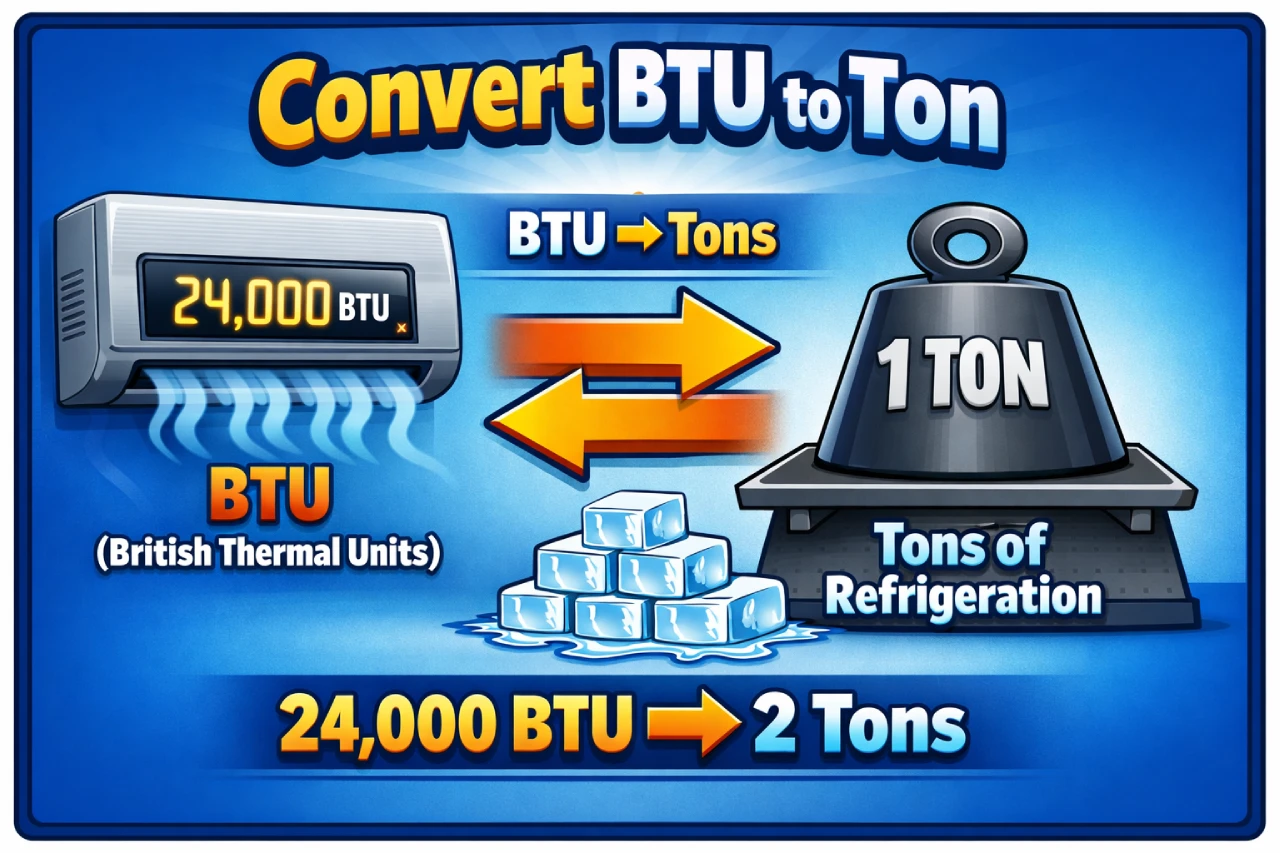
    1 ton of cooling = 12,000 BTU per hour (BTU/h)

    So if you want to convert:

    • BTU to tons → divide by 12,000
    • Tons to BTU → multiply by 12,000

    Simple on the surface—but once you start dealing with air conditioners, HVAC systems, or energy calculations, understanding why this conversion exists becomes incredibly important.

    In this guide, I’ll walk you through everything you need to know about BTU to ton conversion, including formulas, examples, real-world applications, and how to choose the right AC size.

    What Is a BTU?

    A BTU (British Thermal Unit) is a measure of heat energy. Specifically, it represents the amount of heat needed to raise the temperature of one pound of water by one degree Fahrenheit.

    In everyday use, BTUs are commonly used to measure:

    • Heating systems
    • Air conditioners
    • Furnaces
    • Energy output of appliances

    For example:

    • A small window AC might be 5,000 BTU
    • A central AC system might be 36,000 BTU

    The higher the BTU rating, the more heat the system can remove (or produce).

    What Does “Ton” Mean in HVAC?

    In HVAC terms, a ton doesn’t refer to weight—it refers to cooling capacity.

    Historically, this comes from the amount of heat required to melt one ton of ice over 24 hours.

    That’s where the key number comes from:

    • 1 ton of cooling = 12,000 BTU per hour

    So when someone says “a 2-ton AC,” they actually mean:

    • 2 × 12,000 = 24,000 BTU/h

    It’s a historical term, but it’s still widely used in modern HVAC systems.

    BTU to Ton Conversion Formula

    BTU to Ton Converter

    BTU to Ton Converter

    Convert BTU/hr to refrigeration tons instantly.

    Result will appear here
    Formula: Ton = BTU ÷ 12,000

    Here’s the main formula:

    Tons = BTU ÷ 12,000

    And for reverse conversion:

    BTU = Tons × 12,000

    This is the only formula you really need.

    Quick Conversion Table

    Here’s a handy reference table:

    BTU (BTU/h)Tons
    6,000 BTU0.5 ton
    12,000 BTU1 ton
    18,000 BTU1.5 ton
    24,000 BTU2 ton
    36,000 BTU3 ton
    48,000 BTU4 ton
    60,000 BTU5 ton

    This table is especially useful when comparing AC units.

    Step-by-Step Conversion Examples

    Let’s go through a few practical examples.

    Example 1: Convert 24,000 BTU to Tons

    24,000 ÷ 12,000 = 2 tons

    Example 2: Convert 9,000 BTU to Tons

    9,000 ÷ 12,000 = 0.75 ton

    Example 3: Convert 3 Tons to BTU

    3 × 12,000 = 36,000 BTU

    Once you understand the 12,000 factor, everything becomes straightforward.

    Why Is 12,000 BTU Equal to 1 Ton?

    This comes from the physics of ice melting.

    In the past, buildings were cooled using large blocks of ice. Engineers calculated how much heat was required to melt 1 ton (2,000 pounds) of ice over 24 hours.

    That heat amount turned out to be:

    • 288,000 BTU over 24 hours
    • Divide by 24 hours → 12,000 BTU per hour

    That’s how we got:
    1 ton = 12,000 BTU/h

    Even though technology has changed, the terminology stuck.

    Real-World Applications

    Air Conditioning Systems

    This is where the conversion matters most.

    When buying an AC, you’ll often see:

    • Window units listed in BTUs
    • Central systems listed in tons

    Understanding the conversion helps you compare systems easily.

    HVAC Design

    Professionals use BTU and ton calculations to:

    • Size cooling systems
    • Estimate energy consumption
    • Ensure efficient performance

    Energy Efficiency

    Choosing the correct tonnage ensures:

    • Lower energy bills
    • Better cooling performance
    • Longer equipment lifespan

    How to Choose the Right AC Size

    This is where things get practical.

    A common rule of thumb:

    • 20 BTU per square foot

    So for a 1,000 sq ft room:

    • 1,000 × 20 = 20,000 BTU
    • 20,000 ÷ 12,000 ≈ 1.67 tons

    You’d typically choose a 1.5 to 2-ton unit.

    General AC Size Guide

    Room Size (sq ft)BTU NeededTons
    500 sq ft10,000 BTU0.8 ton
    1,000 sq ft20,000 BTU1.7 ton
    1,500 sq ft30,000 BTU2.5 ton
    2,000 sq ft40,000 BTU3.3 ton

    These are estimates—factors like insulation, sunlight, and ceiling height also matter.

    Common Mistakes to Avoid

    Confusing Tons with Weight

    In HVAC:

    • “Ton” = cooling capacity
    • Not physical weight

    Oversizing or Undersizing AC Units

    • Too small → struggles to cool
    • Too large → cycles on/off too frequently

    Both reduce efficiency.

    Ignoring BTU Ratings

    Always check BTU values when comparing units. Tons alone may not give the full picture.

    BTU vs Ton vs kW

    You may also see kilowatts (kW) used.

    Here’s how they compare:

    • 1 ton ≈ 3.517 kW
    • 1 kW ≈ 3,412 BTU/h

    These conversions are useful for international comparisons or energy calculations.

    Tips for Accurate Conversion

    • Always remember: 12,000 BTU = 1 ton
    • Use a calculator for non-round numbers
    • Double-check units (BTU vs BTU/h)
    • Round appropriately when selecting AC units

    If you’re buying an AC, it’s better to slightly round up—but not excessively.

    Frequently Asked Questions (FAQs)

    1. How many BTU are in 1 ton?

    There are exactly 12,000 BTU per hour in 1 ton of cooling.

    2. How do you convert BTU to tons?

    Divide the BTU value by 12,000.
    Example: 24,000 ÷ 12,000 = 2 tons.

    3. What is 18,000 BTU in tons?

    18,000 ÷ 12,000 = 1.5 tons

    4. Is a higher BTU better?

    Not always. Higher BTU means more cooling power, but too much can reduce efficiency and comfort.

    5. Why is AC measured in tons?

    The term comes from the historical method of cooling using ice, where 1 ton of ice melting equals 12,000 BTU/h.

    6. How many tons is a 36,000 BTU AC?

    36,000 ÷ 12,000 = 3 tons

    7. What size AC do I need for my home?

    It depends on square footage, insulation, and climate, but a general estimate is 20 BTU per square foot.

    8. Can I use BTU instead of tons?

    Yes. BTU gives a more precise measurement, while tons are often used for convenience.

    9. What happens if my AC is too big?

    It may cool too quickly without removing humidity, leading to discomfort and inefficiency.

    10. What happens if my AC is too small?

    It will run continuously and struggle to cool the space properly.

    Final Thoughts

    The BTU to ton conversion is one of those concepts that looks technical at first—but once you understand the core rule (12,000 BTU = 1 ton), everything falls into place.

    Whether you're buying an air conditioner, comparing HVAC systems, or just trying to make sense of energy ratings, this conversion gives you clarity and confidence.

    Personally, I’ve found that once you start thinking in tons and BTUs interchangeably, choosing the right system becomes much easier—and you avoid costly mistakes.

    Now here’s a simple question for you:
    Are you trying to calculate cooling for a specific room, or just making sense of AC ratings before a purchase?

  • Convert Meter to Megameter (m to Mm) Easily with Formula

    Convert Meter to Megameter (m to Mm) Easily with Formula

    Here’s the quick answer you’re probably looking for:
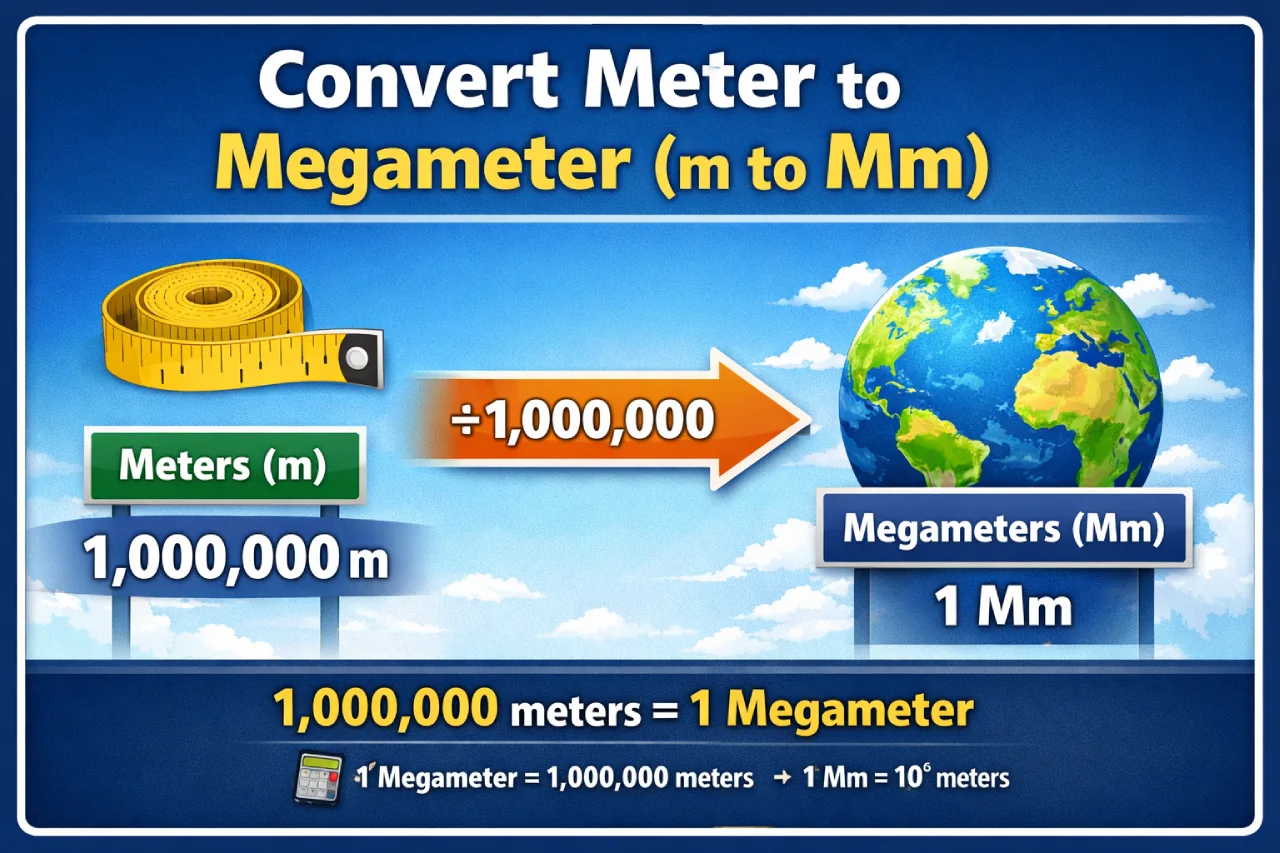
    1 meter (m) equals 0.000001 megameters (Mm)
    —or—
    1 megameter (Mm) equals 1,000,000 meters (m)

    Simple, right? But understanding why this conversion works—and how to use it effectively—can save you time and prevent mistakes, especially in scientific, engineering, or large-scale measurement contexts.

    In this guide, I’ll walk you through everything you need to know about converting meters to megameters, including the formula, examples, practical uses, and common pitfalls.

    Meter to Megameter Conversion Formula

    Meter to Megameter Converter

    Meter to Megameter Converter

    Enter a value in meters to instantly convert it into megameters.

    Result will appear here
    1 megameter = 1,000,000 meters

    The conversion is straightforward:

    Megameters = Meters ÷ 1,000,000

    Or in decimal form:

    Megameters = Meters × 0.000001

    To convert back:

    Meters = Megameters × 1,000,000

    Once you understand that “mega” means one million, everything becomes intuitive.

    Quick Conversion Table

    Here’s a quick reference for common values:

    Meters (m)Megameters (Mm)
    1 m0.000001 Mm
    100 m0.0001 Mm
    1,000 m0.001 Mm
    10,000 m0.01 Mm
    100,000 m0.1 Mm
    1,000,000 m1 Mm
    10,000,000 m10 Mm

    This table makes it easy to estimate conversions without a calculator.

    Step-by-Step Conversion Examples

    Let’s walk through some practical examples.

    Example 1: Convert 500,000 meters to megameters

    500,000 ÷ 1,000,000 = 0.5 Mm

    Example 2: Convert 2,500,000 meters to megameters

    2,500,000 ÷ 1,000,000 = 2.5 Mm

    Example 3: Convert 0.75 megameters to meters

    0.75 × 1,000,000 = 750,000 meters

    Once you see the pattern, conversions become quick and effortless.

    Why Use Megameters Instead of Meters?

    You might be wondering: why not just stick with meters?

    The answer is simplicity at scale.

    Imagine writing:

    • 12,742,000 meters

    Versus:

    • 12.742 megameters

    The second version is cleaner, easier to read, and less error-prone—especially in scientific work.

    Key Advantages:

    • Reduces large numbers
    • Improves readability
    • Aligns with scientific notation
    • Makes calculations easier

    Real-World Applications

    Megameters aren’t commonly used in daily life, but they shine in specific fields.

    Astronomy and Space Science

    Distances between planetary features are often expressed in megameters.

    For example:

    • Earth’s radius ≈ 6.37 Mm
    • Moon’s distance from Earth ≈ 384 Mm

    Using megameters keeps numbers manageable.

    Geology and Earth Sciences

    Large-scale geological formations, such as tectonic plate movements or Earth’s layers, can be measured in megameters.

    Engineering and Large Infrastructure

    In massive engineering projects—like pipelines, tunnels, or global mapping—megameters can simplify large-scale calculations.

    Scientific Research

    Scientists often use SI prefixes (like mega, giga, nano) to maintain consistency across measurements.

    Common Mistakes to Avoid

    Even though the conversion is simple, a few common mistakes can cause confusion.

    Forgetting the “Million Factor”

    The biggest mistake is not remembering that:

    • 1 megameter = 1,000,000 meters

    Missing this can throw off your calculations completely.

    Misplacing Decimal Points

    Since you’re dividing by a large number, it’s easy to shift the decimal incorrectly.

    Tip: Count six places to the left when converting meters to megameters.

    Confusing Megameters with Kilometers

    • 1 kilometer = 1,000 meters
    • 1 megameter = 1,000,000 meters

    That’s a huge difference.

    Meter vs Megameter vs Kilometer

    Let’s compare these units for clarity:

    UnitValue in Meters
    1 meter1 m
    1 kilometer1,000 m
    1 megameter1,000,000 m

    Think of it as levels:

    • Meter → everyday distances
    • Kilometer → travel distances
    • Megameter → planetary-scale distances

    Tips for Quick Mental Conversion

    Here are a few tricks I personally use:

    • Move the decimal 6 places left (meters → megameters)
    • Move the decimal 6 places right (megameters → meters)
    • Remember: Mega = Million

    For example:

    • 3,000,000 m → 3 Mm
    • 0.002 Mm → 2,000 m

    Once you internalize this, you won’t even need a calculator.

    Frequently Asked Questions (FAQs)

    1. How many meters are in 1 megameter?

    There are exactly 1,000,000 meters in 1 megameter.

    2. How do you convert meters to megameters?

    Divide the number of meters by 1,000,000 or multiply by 0.000001.

    3. What is 1 meter in megameters?

    1 meter = 0.000001 megameters.

    4. Why is the unit called megameter?

    The prefix “mega-” means one million in the metric system, so a megameter represents one million meters.

    5. Is megameter commonly used?

    Not in everyday life, but it’s used in scientific, geological, and astronomical contexts.

    6. How many kilometers are in a megameter?

    1 megameter = 1,000 kilometers.

    7. What is 500,000 meters in megameters?

    500,000 meters = 0.5 megameters.

    8. How do you convert megameters back to meters?

    Multiply the megameter value by 1,000,000.

    9. What is the symbol for megameter?

    The symbol is Mm (capital M for mega, lowercase m for meter).

    10. What’s the easiest way to remember the conversion?

    Just remember: Mega = Million.

    Final Thoughts

    At first glance, converting meters to megameters might seem like something only scientists care about—but it’s actually a great example of how the metric system scales beautifully.

    Once you understand that “mega” simply means one million, the conversion becomes second nature. Whether you’re dealing with scientific data, large distances, or just expanding your knowledge, this is one of those concepts that’s both simple and powerful.

    Now here’s a simple question for you:
    When you think about massive distances—like the size of Earth or space itself—does using megameters make those numbers feel easier to understand?

  • Pound to Grain (lb to gr) Conversion Guide with Examples

    Pound to Grain (lb to gr) Conversion Guide with Examples

    If you’re looking for a quick answer:
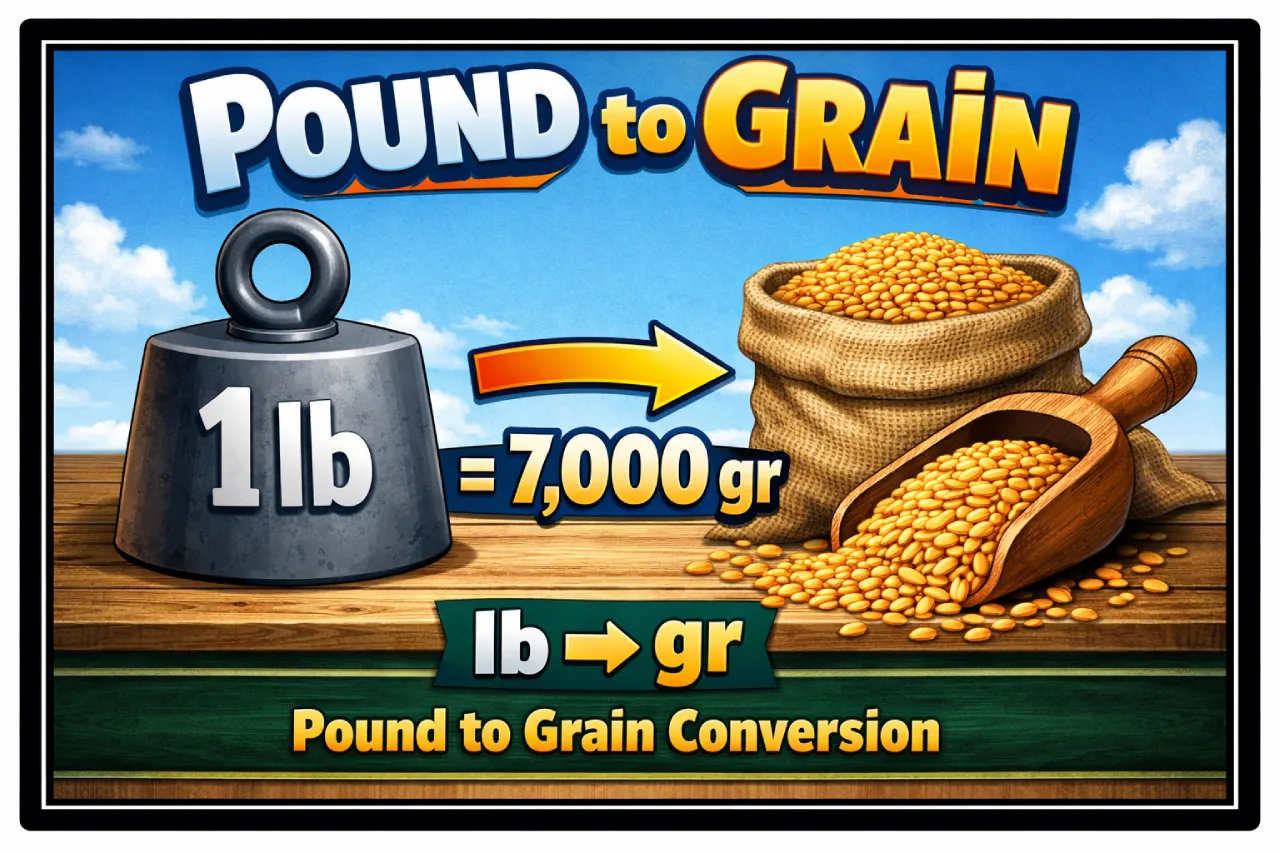
    1 pound (lb) equals exactly 7,000 grains (gr).

    That’s the simple conversion. But if you want to understand why this relationship exists, how to use it accurately, and where it actually matters in real life, this guide will walk you through everything step by step.

    Whether you’re working in ballistics, reloading ammunition, or just curious about measurement systems, this is one of those conversions that’s simple—but surprisingly important.

    What Is a Pound?

    A pound (lb) is a standard unit of weight in the U.S. customary system and is widely used across the United States.

    You’ll encounter pounds in everyday life when measuring:

    • Body weight
    • Food and groceries
    • Shipping packages
    • Construction materials

    That last conversion—pounds to grains—is especially useful in precision-based fields.

    What Is a Grain?

    A grain (gr) is one of the smallest traditional units of mass still used today. Historically, it was based on the weight of a single grain of barley.

    Today, it’s standardized and primarily used in specialized fields such as:

    • Ammunition and firearms
    • Archery
    • Medicine (historically)
    • Precious metals (occasionally)

    Because grains are so small, they allow for extremely precise measurements—something that’s critical in technical applications.

    Pound to Grain Conversion Formula

    Pound to Grain Converter

    Pound to Grain Converter

    Enter a weight in pounds below to instantly convert it into grains.

    Your result will appear here
    1 pound = 7,000 grains

    Here’s the core formula you need:

    Grains = Pounds × 7000

    And for the reverse:

    Pounds = Grains ÷ 7000

    That’s it. Once you remember the 7,000 multiplier, you can convert any value quickly and accurately.

    Quick Conversion Table

    Pounds (lb)Grains (gr)
    0.1 lb700 gr
    0.25 lb1,750 gr
    0.5 lb3,500 gr
    1 lb7,000 gr
    2 lb14,000 gr
    5 lb35,000 gr
    10 lb70,000 gr

    This table is helpful when you need quick estimates without calculating each time.

    Step-by-Step Conversion Examples

    Example 1: Convert 2 Pounds to Grains

    2 × 7,000 = 14,000 grains

    Example 2: Convert 0.75 Pounds to Grains

    0.75 × 7,000 = 5,250 grains

    Example 3: Convert 21,000 Grains to Pounds

    21,000 ÷ 7,000 = 3 pounds

    Once you practice a few times, the process becomes automatic.

    Why Are Grains Still Used Today?

    Even though grains may seem outdated, they remain highly relevant in specific industries.

    Ammunition and Ballistics

    Bullet weights are almost always measured in grains. For example:

    • 9mm bullet: 115 grains
    • .45 ACP bullet: 230 grains

    Small differences in grain weight can affect performance, recoil, and accuracy.

    Archery

    Arrow weights are also measured in grains. Even a slight variation can impact:

    • Speed
    • Trajectory
    • Penetration

    Medicine (Historical Use)

    Grains were once widely used in prescriptions. While modern medicine uses milligrams, you may still see references in older contexts.

    Precious Metals

    Grains are sometimes used to measure very small quantities of gold or silver.

    Common Mistakes to Avoid

    Confusing Grains with Grams

    This is one of the most common errors:

    • 1 grain = 0.0648 grams
      They are not interchangeable.

    Using the Wrong Conversion Factor

    Always remember:

    • 1 pound = 7,000 grains, not 1,000

    Mixing Measurement Systems

    Switching between metric and imperial units without proper conversion can lead to inaccurate results.

    Practical Use Cases

    Reloading Ammunition

    If you’re working with gunpowder:

    • 1 pound = 7,000 grains
    • If each round uses 5 grains → 1,400 rounds per pound

    That’s a real-world example where this conversion directly matters.

    Precision Engineering

    In specialized fields, grains are used when ultra-fine measurements are required.

    Scientific Applications

    Though less common today, grains may still appear in niche calculations or legacy systems.

    Tips for Accurate Conversions

    • Always remember the 7,000 multiplier
    • Use a calculator for decimal values
    • Double-check your units (grains vs grams)
    • Keep a quick reference table handy

    Accuracy matters—especially in technical applications.

    Frequently Asked Questions (FAQs)

    1. How many grains are in 1 pound?

    There are exactly 7,000 grains in 1 pound. This is a fixed and standardized conversion.

    2. How do you convert pounds to grains quickly?

    Simply multiply the number of pounds by 7,000.
    For example: 3 lb × 7,000 = 21,000 grains.

    3. How many grains are in half a pound?

    Half a pound (0.5 lb) equals:
    0.5 × 7,000 = 3,500 grains

    4. What is 1 grain equal to in grams?

    1 grain = 0.0648 grams.
    This is useful when converting between imperial and metric systems.

    5. Why is the grain unit still used today?

    Grains are still used because they allow for high precision, especially in:

    • Ammunition
    • Archery
    • Scientific measurements

    6. Is grain the same as gram?

    No. They are completely different units:

    • 1 grain = 0.0648 grams
    • 1 gram ≈ 15.43 grains

    7. How many grains are in 1 ounce?

    There are 437.5 grains in 1 ounce.

    8. How many pounds is 10,000 grains?

    10,000 ÷ 7,000 = 1.43 pounds (approx.)

    9. Where is pound-to-grain conversion most commonly used?

    It’s most commonly used in:

    • Firearms and ammunition
    • Archery
    • Historical medicine

    10. Why does 1 pound equal exactly 7,000 grains?

    This comes from the historical development of the avoirdupois system, where units were standardized for consistency across trade and measurement.

    Final Thoughts

    At first glance, converting pounds to grains might seem like a niche calculation—but it’s actually a cornerstone in several precision-driven fields.

    Once you lock in the key rule—1 pound equals 7,000 grains—everything else becomes straightforward. Whether you’re working with ballistics, studying measurement systems, or just expanding your knowledge, this is one of those conversions that’s both simple and powerful.

    Now here’s a simple question for you:
    Will you use this conversion for practical work, or is it one of those fascinating facts you’re glad to finally understand?

  • Cups to mL Conversion (1 Cup = How Many mL?)

    Cups to mL Conversion (1 Cup = How Many mL?)

    If you’re looking for a quick answer, here it is:

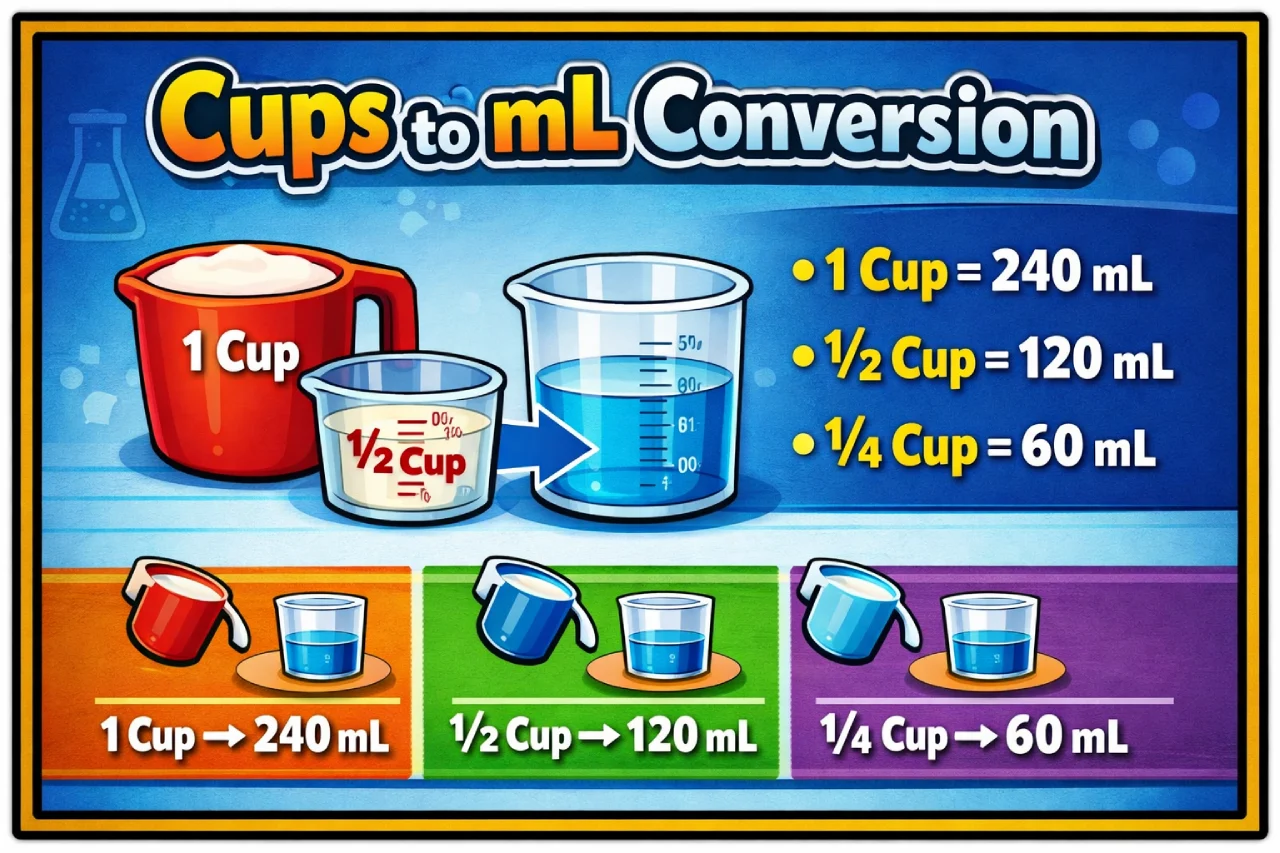
    1 U.S. cup = 236.588 mL (milliliters)

    For everyday use, most people round it to:

    1 cup ≈ 240 mL

    So, to convert cups to milliliters:

    mL = cups × 236.588

    That’s the core formula. But if you want to avoid common mistakes (especially when following recipes), understand different cup systems, and convert confidently in real-life situations, this guide will walk you through everything step by step.

    What Is a Cup?

    A cup is a unit of volume commonly used in cooking, especially in the United States.

    It’s part of the U.S. customary system and is widely used for measuring:

    • Liquids (milk, water, oil)
    • Dry ingredients (flour, sugar, rice)

    In the U.S.:

    1 cup = 8 fluid ounces

    This is important because it ties into other kitchen measurements.

    What Is a Milliliter (mL)?

    A milliliter (mL) is a metric unit of volume.

    • 1 mL = one-thousandth of a liter
    • It’s used worldwide in cooking, science, and medicine

    Unlike cups, milliliters are part of a standardized system, which makes them more precise.

    The Cups to mL Conversion Formula

    Cups to mL Converter

    Cups to mL Converter

    Result will appear here
    1 US cup = 236.588 mL

    Here’s the exact formula:

    mL = cups × 236.588

    For quick calculations, you can round it:

    mL = cups × 240

    Both are useful, depending on how precise you need to be.

    Step-by-Step Examples

    Let’s make this practical.

    Example 1: Convert 1 cup to mL

    1 × 236.588 = 236.588 mL
    Rounded: 240 mL

    Example 2: Convert 2 cups to mL

    2 × 236.588 = 473.176 mL
    Rounded: 480 mL

    Example 3: Convert ½ cup to mL

    0.5 × 236.588 = 118.294 mL
    Rounded: 120 mL

    Example 4: Convert ¼ cup to mL

    0.25 × 236.588 = 59.147 mL
    Rounded: 60 mL

    These are some of the most commonly used measurements in recipes.

    Quick Conversion Table

    Here’s a handy reference you can use in the kitchen:

    CupsMilliliters (mL)
    ¼ cup59 mL
    ½ cup118 mL
    1 cup237 mL
    2 cups473 mL
    3 cups710 mL
    4 cups946 mL

    This table is perfect for quick conversions without a calculator.

    Why Precision Matters in Cooking

    You might wonder: does it really matter if you use 236 mL or 240 mL?

    When It Doesn’t Matter

    For recipes like:

    • Soups
    • Stews
    • Sauces

    A small difference won’t affect the outcome much.

    When It Does Matter

    For baking:

    • Cakes
    • Bread
    • Pastries

    Even small measurement differences can change texture and consistency.

    In these cases, it’s better to use the exact value or a kitchen scale.

    U.S. Cups vs Metric Cups (Important Difference)

    This is one of the most common sources of confusion.

    U.S. Cup

    • 1 cup = 236.588 mL

    Metric Cup (used in countries like Australia)

    • 1 cup = 250 mL

    That’s a noticeable difference.

    So if you’re following an international recipe, always check which system is being used.

    Cups vs mL for Dry vs Liquid Ingredients

    Here’s something many people overlook.

    Liquid Ingredients

    • Cups and mL measure volume
    • Conversion is straightforward

    Dry Ingredients

    • Cups measure volume
    • Weight can vary depending on the ingredient

    For example:

    • 1 cup of flour ≠ 1 cup of sugar (in weight)

    That’s why professional bakers often prefer grams instead of cups.

    Real-Life Example: Cooking Scenario

    Let’s say a recipe calls for:

    2 cups of milk

    Convert:

    2 × 236.588 = 473.176 mL

    You can safely use:

    473 mL or 480 mL

    Now you can follow the recipe even if your measuring tools are in metric units.

    Mental Math Trick

    Here’s a simple trick I use:

    • Multiply cups by 240

    Example:

    3 cups × 240 = 720 mL

    It’s quick, easy, and accurate enough for most situations.

    Converting mL Back to Cups

    Sometimes you’ll need to reverse the calculation.

    Here’s the formula:

    Cups = mL ÷ 236.588

    Example:

    500 mL ÷ 236.588 ≈ 2.11 cups

    For quick estimates:

    Cups = mL ÷ 240

    Common Mistakes to Avoid

    Confusing U.S. and Metric Cups

    Always check which system the recipe uses.

    Over-Rounding Too Early

    Round at the end, not during calculations.

    Using the Wrong Tools

    A coffee mug is not a standard cup.

    Ignoring Ingredient Type

    Dry and liquid ingredients behave differently.

    Practical Use Case: Baking Recipe

    Let’s say you’re baking a cake and the recipe says:

    1.5 cups of flour

    Convert:

    1.5 × 236.588 = 354.882 mL

    Rounded:

    355 mL

    This ensures accuracy, which is critical for baking success.

    Why Many Recipes Still Use Cups

    Even though metric units are more precise, cups are still widely used because:

    • They’re simple and familiar
    • No scale is required
    • Faster for home cooking

    In my experience, cups are great for convenience, while mL (or grams) are better for precision.

    When to Use mL Instead of Cups

    You should prefer mL when:

    • Following international recipes
    • Measuring liquids precisely
    • Working in professional kitchens
    • Conducting experiments or precise cooking

    Frequently Asked Questions (FAQs)

    How many mL are in 1 cup?

    1 U.S. cup = 236.588 mL
    Rounded: 240 mL

    What is the formula to convert cups to mL?

    mL = cups × 236.588

    How many mL is 2 cups?

    2 cups = 473.176 mL

    How many mL is ½ cup?

    ½ cup = 118.294 mL

    Is 1 cup equal to 250 mL?

    Not in the U.S.
    250 mL is a metric cup, not a U.S. cup.

    Can I round 236.588 to 240?

    Yes, for most recipes.

    How many cups is 500 mL?

    500 ÷ 236.588 ≈ 2.11 cups

    Why do recipes use cups instead of mL?

    Because cups are simpler and more familiar for home cooks.

    Are cups accurate for baking?

    They can be, but grams or mL are more precise.

    What’s the easiest way to estimate?

    Multiply cups by 240.

    Final Thoughts

    So, how do you convert cups to milliliters?

    The key takeaway is simple:

    1 cup = 236.588 mL (≈ 240 mL)

    Once you remember that, converting between cups and mL becomes effortless. Whether you’re following a recipe, scaling ingredients, or working with international measurements, this conversion helps you stay accurate and confident.

    And after a few uses, you’ll start doing it in your head without even thinking.

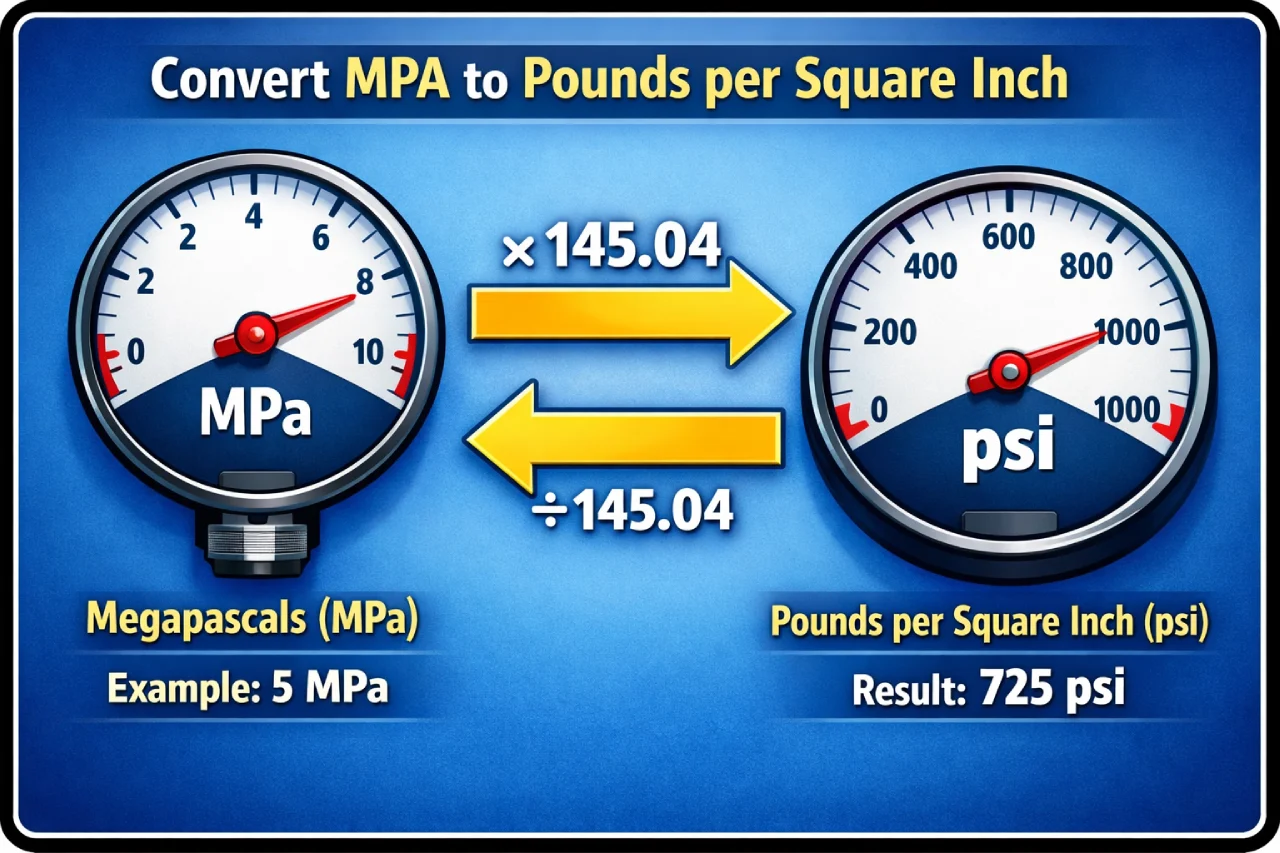
  • Convert MPA to Pounds per Square Inch (Easy Guide)

    Convert MPA to Pounds per Square Inch (Easy Guide)

    If you’re looking for a quick answer, here it is:

    1 MPa (megapascal) = 145.038 PSI (pounds per square inch)

    So, to convert MPa to PSI, simply:

    PSI = MPa × 145.038

    That’s the key formula. But if you want to fully understand what these units mean, where they’re used, and how to apply this conversion in real-world situations like engineering, construction, and pressure systems, this guide will walk you through everything step by step.

    What Is MPa (Megapascal)?

    A megapascal (MPa) is a metric unit of pressure or stress.

    • 1 MPa = 1,000,000 pascals (Pa)
    • It belongs to the International System of Units (SI)

    MPa is commonly used in:

    • Structural engineering
    • Concrete strength ratings
    • Mechanical systems
    • Material science

    For example:

    • Concrete strength: 20–40 MPa
    • Steel strength: 250–500 MPa

    It’s widely used globally, especially outside the United States.

    What Is PSI (Pounds per Square Inch)?

    PSI (pounds per square inch) is an imperial unit of pressure.

    • It measures force applied over an area
    • Commonly used in the United States

    You’ll see PSI in:

    • Tire pressure (e.g., 32 PSI)
    • Hydraulic systems
    • Air compressors
    • Plumbing systems

    It’s one of the most familiar pressure units in everyday American life.

    Why Convert MPa to PSI?

    This conversion is essential when working across different systems.

    Engineering and Construction

    International designs often use MPa, while U.S. standards use PSI.

    Equipment Specifications

    Manufacturers may list pressure ratings in different units.

    Material Testing

    Understanding both units ensures accurate comparisons and safety.

    In practice, if you’re dealing with global specifications, this conversion becomes incredibly useful.

    The Conversion Formula Explained

    MPa to PSI Converter

    MPa to PSI Converter

    Enter a value in megapascals (MPa) to instantly convert it into pounds per square inch (PSI).

    Result will appear here
    Formula: 1 MPa = 145.0377 PSI

    Here’s the formula again:

    PSI = MPa × 145.038

    This conversion factor comes from the relationship between pascals and pounds per square inch.

    If you need to reverse the conversion:

    MPa = PSI ÷ 145.038

    Step-by-Step Examples

    Let’s make this practical.

    Example 1: Convert 1 MPa to PSI

    1 × 145.038 = 145.038 PSI

    Example 2: Convert 5 MPa to PSI

    5 × 145.038 = 725.19 PSI

    Example 3: Convert 10 MPa to PSI

    10 × 145.038 = 1,450.38 PSI

    Example 4: Convert 30 MPa to PSI

    30 × 145.038 = 4,351.14 PSI

    These are common values used in engineering and construction.

    Quick Conversion Table

    Here’s a handy reference:

    MPaPSI
    1 MPa145 PSI
    2 MPa290 PSI
    5 MPa725 PSI
    10 MPa1,450 PSI
    20 MPa2,901 PSI
    30 MPa4,351 PSI
    40 MPa5,802 PSI

    This table is great for quick estimates without a calculator.

    Real-Life Example: Concrete Strength

    Let’s say you’re working with concrete rated at:

    25 MPa

    Convert:

    25 × 145.038 = 3,625.95 PSI

    Now you can understand the strength in U.S. terms, which is often how contractors and suppliers communicate.

    MPa vs PSI: What’s the Difference?

    Here’s a simple way to think about it:

    • MPa = metric unit (SI system)
    • PSI = imperial unit (U.S. system)

    Both measure pressure or stress, just in different systems.

    Mental Math Trick

    Here’s a quick shortcut:

    • Multiply MPa by 145 instead of 145.038

    Example:

    10 MPa × 145 ≈ 1,450 PSI

    It’s very close and works well for quick estimates.

    Converting PSI Back to MPa

    To reverse the calculation:

    MPa = PSI ÷ 145.038

    Example:

    3,000 PSI ÷ 145.038 ≈ 20.68 MPa

    This is useful when working with U.S.-based equipment or specifications.

    Practical Use Case: Tire Pressure vs Engineering Pressure

    You’ve probably seen PSI in tire pressure, but MPa is used for larger-scale systems.

    For example:

    • Car tire: ~30–35 PSI
    • Industrial system: several MPa

    Understanding the conversion helps you relate small-scale and large-scale pressures.

    Common Mistakes to Avoid

    Using the Wrong Conversion Factor

    Always use:

    1 MPa = 145.038 PSI

    Confusing PSI with KSI

    • PSI = pounds per square inch
    • KSI = 1,000 PSI

    Rounding Too Early

    Keep precision until the final step.

    Mixing Units

    Always convert before combining values in calculations.

    MPa, PSI, and KSI Relationship

    It helps to see how these units connect:

    • 1 MPa = 145.038 PSI
    • 1 KSI = 1,000 PSI

    So:

    • 1 MPa = 0.145 KSI

    This gives you a complete picture of pressure units.

    Why Precision Matters

    In many fields, accuracy is critical.

    Engineering Design

    Incorrect pressure values can lead to system failure.

    Construction

    Material strength must meet exact specifications.

    Industrial Systems

    Pressure errors can damage equipment or create safety risks.

    In these cases, always use the exact conversion factor.

    Real-World Comparison

    Let’s compare a few values:

    • 20 MPa concrete ≈ 2,901 PSI
    • 30 MPa concrete ≈ 4,351 PSI
    • 40 MPa concrete ≈ 5,802 PSI

    These comparisons help you quickly interpret material strength.

    When You’ll Use This Conversion

    You’ll encounter MPa to PSI conversion in:

    • Structural engineering
    • Civil construction
    • Mechanical systems
    • Pressure testing

    It’s especially useful when working with international standards.

    Frequently Asked Questions (FAQs)

    How many PSI is 1 MPa?

    1 MPa = 145.038 PSI

    What is the formula to convert MPa to PSI?

    PSI = MPa × 145.038

    How many PSI is 10 MPa?

    10 × 145.038 = 1,450.38 PSI

    How many MPa is 1,000 PSI?

    1,000 ÷ 145.038 ≈ 6.89 MPa

    What is the difference between MPa and PSI?

    MPa is metric, while PSI is an imperial unit.

    Is MPa the same as PSI?

    No, but they measure the same concept (pressure) in different systems.

    Can I round 145.038 to 145?

    Yes, for quick estimates.

    Where is MPa commonly used?

    In engineering and construction worldwide.

    Where is PSI commonly used?

    In the United States for pressure systems.

    Why is PSI more common in the U.S.?

    Because it’s part of the imperial measurement system.

    Final Thoughts

    So, how do you convert MPa to pounds per square inch?

    The key takeaway is simple:

    Multiply MPa by 145.038

    Once you understand this relationship, you can easily move between metric and U.S. units—especially in engineering, construction, and everyday applications like pressure systems.

    After a few calculations, you’ll start estimating it effortlessly—and that’s when you know you’ve truly mastered it.

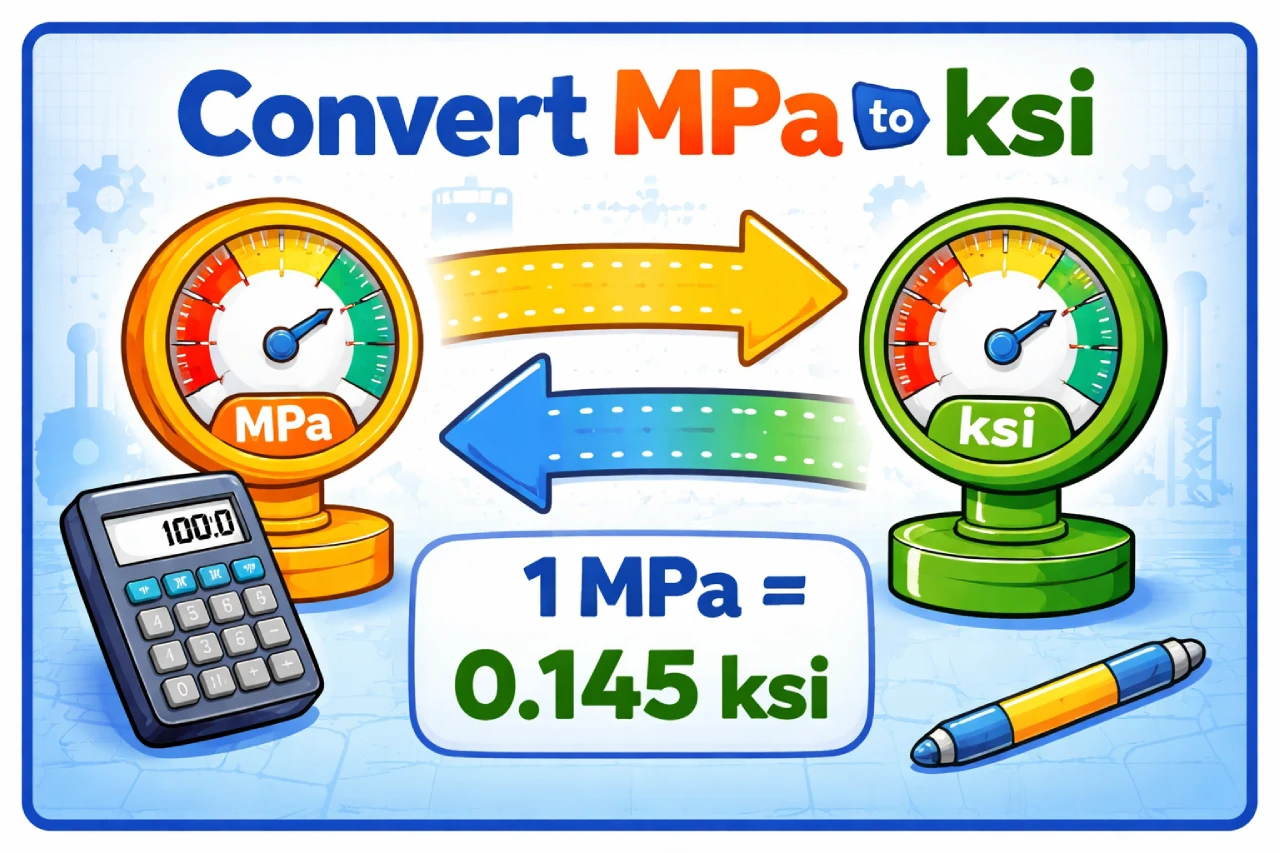
  • Convert MPA to KSI (Easy Formula + Quick Table)

    Convert MPA to KSI (Easy Formula + Quick Table)

    If you’re looking for a quick answer, here it is:

    1 MPa (megapascal) = 0.145038 KSI

    So, to convert MPa to KSI, simply:

    KSI = MPa × 0.145038

    That’s the core formula. But if you want to understand what these units mean, where they’re used, and how to apply this conversion in real-world scenarios like engineering, construction, and material strength analysis, this guide will walk you through everything clearly.

    What Is MPa (Megapascal)?

    A megapascal (MPa) is a metric unit of pressure or stress.

    • 1 MPa = 1,000,000 pascals (Pa)
    • It’s part of the International System of Units (SI)

    MPa is widely used in:

    • Structural engineering
    • Material science
    • Concrete strength ratings
    • Mechanical systems

    For example:

    • Concrete strength: 20–40 MPa
    • Steel yield strength: 250–500 MPa

    It’s a standard unit in most countries outside the U.S.

    What Is KSI?

    KSI (kips per square inch) is a unit of stress commonly used in the United States.

    • 1 kip = 1,000 pounds-force (lbf)
    • 1 KSI = 1,000 psi (pounds per square inch)

    KSI is often used in:

    • Structural steel design
    • Engineering calculations in the U.S.
    • Material strength specifications

    For example:

    • Structural steel yield strength: ~36 KSI
    • High-strength steel: 50–100 KSI

    Why Convert MPa to KSI?

    This conversion is essential when working across different systems.

    Engineering Projects

    International designs may use MPa, while U.S. standards use KSI.

    Material Specifications

    Manufacturers may list strength values in either unit.

    Construction and Structural Analysis

    Understanding both units ensures accurate calculations and comparisons.

    In my experience, this conversion becomes second nature if you work with both metric and imperial systems.

    The Conversion Formula Explained

    MPa to KSI Converter

    MPa to KSI Converter

    Enter pressure in megapascals (MPa) to convert it into ksi.

    Result will appear here
    Conversion Formula:
    1 MPa = 0.145038 KSI

    Here’s the formula again:

    KSI = MPa × 0.145038

    This conversion factor comes from the relationship between pascals and pounds per square inch.

    If you need to reverse the conversion:

    MPa = KSI ÷ 0.145038

    Step-by-Step Examples

    Let’s make this practical.

    Example 1: Convert 10 MPa to KSI

    10 × 0.145038 = 1.45038 KSI

    Example 2: Convert 25 MPa to KSI

    25 × 0.145038 = 3.62595 KSI

    Example 3: Convert 40 MPa to KSI

    40 × 0.145038 = 5.80152 KSI

    These are common values used in construction and engineering.

    Quick Conversion Table

    Here’s a handy reference chart:

    MPaKSI
    1 MPa0.145 KSI
    5 MPa0.725 KSI
    10 MPa1.45 KSI
    20 MPa2.90 KSI
    30 MPa4.35 KSI
    40 MPa5.80 KSI
    50 MPa7.25 KSI

    This table is useful for quick estimates.

    Real-Life Example: Concrete Strength

    Let’s say you’re working with concrete rated at:

    30 MPa

    Convert:

    30 × 0.145038 = 4.35 KSI

    Now you can interpret that strength in U.S. engineering terms.

    MPa vs KSI: What’s the Difference?

    Here’s a simple way to understand it:

    • MPa = metric unit (SI system)
    • KSI = imperial unit (U.S. system)

    Both measure stress or pressure, but they belong to different measurement systems.

    Mental Math Trick

    Here’s a quick trick for estimating:

    • Multiply MPa by 0.145

    Example:

    20 MPa × 0.145 ≈ 2.9 KSI

    It’s very close to the exact value.

    Converting KSI Back to MPa

    To reverse the calculation:

    MPa = KSI ÷ 0.145038

    Example:

    5 KSI ÷ 0.145038 ≈ 34.47 MPa

    This is useful when working with U.S.-based specifications.

    Common Mistakes to Avoid

    Using the Wrong Conversion Factor

    Always use:

    1 MPa = 0.145038 KSI

    Confusing PSI and KSI

    • PSI = pounds per square inch
    • KSI = 1,000 PSI

    Rounding Too Early

    Keep precision until the final step.

    Mixing Units

    Avoid combining MPa and PSI/KSI without converting properly.

    Practical Use Case: Steel Strength

    Let’s say a steel grade has a yield strength of:

    250 MPa

    Convert:

    250 × 0.145038 = 36.26 KSI

    This aligns with common structural steel values in the U.S.

    Why Precision Matters

    In engineering, small errors can have big consequences.

    Structural Design

    Incorrect conversions can affect safety and stability.

    Material Selection

    Choosing the wrong strength rating can lead to failure.

    Compliance and Standards

    Different regions use different units, so accurate conversion is essential.

    MPa, PSI, and KSI Relationship

    It’s helpful to understand how these units connect:

    • 1 MPa = 145.038 PSI
    • 1 KSI = 1,000 PSI

    So:

    • 1 MPa = 0.145038 KSI

    This relationship ties everything together.

    Real-World Comparison

    Let’s compare a few values:

    • 20 MPa concrete ≈ 2.9 KSI
    • 40 MPa concrete ≈ 5.8 KSI
    • 250 MPa steel ≈ 36.26 KSI

    These conversions help you quickly interpret material strength.

    When You’ll Use This Conversion

    You’ll encounter MPa to KSI conversion in:

    • Structural engineering
    • Civil construction
    • Mechanical design
    • Material testing

    It’s especially useful when working with international specifications.

    Frequently Asked Questions (FAQs)

    How many KSI is 1 MPa?

    1 MPa = 0.145038 KSI

    What is the formula to convert MPa to KSI?

    KSI = MPa × 0.145038

    How many KSI is 30 MPa?

    30 × 0.145038 = 4.35 KSI

    How many MPa is 1 KSI?

    1 ÷ 0.145038 ≈ 6.895 MPa

    What is the difference between MPa and KSI?

    MPa is metric, while KSI is an imperial unit.

    Is MPa the same as PSI?

    No, but:
    1 MPa = 145.038 PSI

    Why is KSI used instead of PSI?

    KSI simplifies large values by grouping them into thousands of PSI.

    Can I round 0.145038 to 0.145?

    Yes, for quick estimates.

    Where is MPa commonly used?

    In most countries for engineering and material strength.

    Where is KSI commonly used?

    Primarily in the United States.

    Final Thoughts

    So, how do you convert MPa to KSI?

    The key takeaway is simple:

    Multiply MPa by 0.145038

    Once you understand this relationship, you can easily switch between metric and U.S. units—especially in engineering and construction contexts.

    Whether you’re working with concrete, steel, or structural designs, this conversion helps you make accurate, confident decisions.

    And after a few calculations, you’ll find yourself estimating it effortlessly.