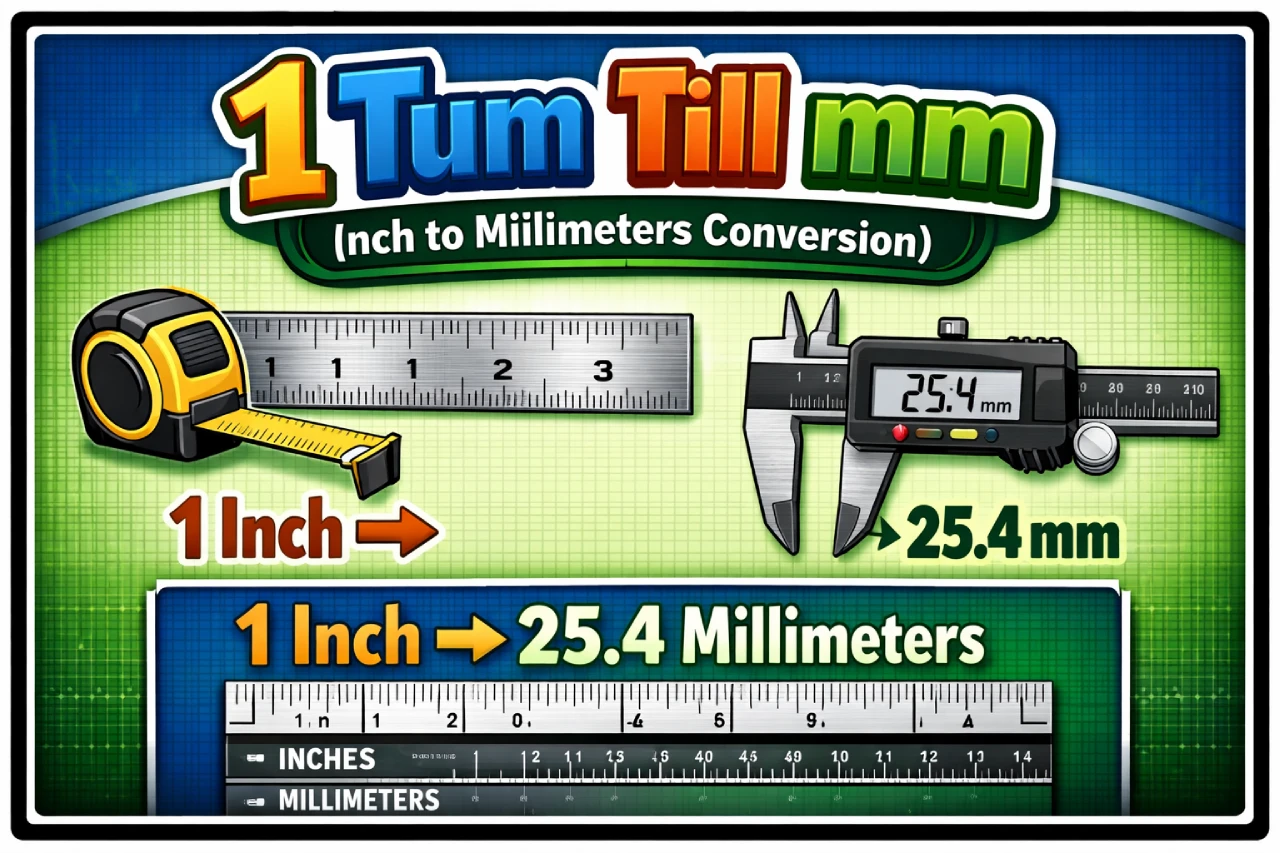
If you’re searching for the quick answer:
1 tum = 25.4 mm
In Swedish, the word “tum” means inch, so the phrase “1 tum till mm” simply means converting 1 inch to millimeters.
This conversion is extremely common when measurements move between the imperial system (inches)—commonly used in the United States—and the metric system (millimeters), which is used in most other parts of the world.
For example, product dimensions, engineering drawings, screen sizes, and mechanical parts are often listed in inches, but international specifications may require measurements in millimeters.
In this guide, we’ll explain exactly how the conversion works, why 1 inch equals 25.4 millimeters, and how to convert inches to millimeters quickly and accurately in real-world situations.
Understanding the Term “Tum”
The term “tum” is used in several European languages, including Swedish and sometimes German, to represent an inch.
Historically, the word comes from the idea of measuring using the width of a thumb, which was roughly equivalent to the length of an inch.
Although modern measurement systems are standardized, the word “tum” still appears in measurement contexts such as:
- Construction measurements
- Hardware dimensions
- Plumbing and piping specifications
- Screen sizes
- Tool measurements
When someone asks for “1 tum till mm”, they’re simply asking:
How many millimeters are in 1 inch?
The answer is always the same:
1 inch (1 tum) = 25.4 millimeters
What Is an Inch?
An inch is a unit of length in the U.S. customary system, which is widely used in the United States and in some industries worldwide.
Inches are commonly used for measuring:
- Television and computer screens
- Furniture dimensions
- Construction materials
- Tools and hardware
- Height measurements
For example:
- A typical laptop screen might measure 15 inches
- A ruler is often 12 inches long
- A smartphone might be 6–7 inches tall
Inches are part of a larger measurement system that includes feet and yards.
Key relationships include:
- 12 inches = 1 foot
- 36 inches = 1 yard
What Is a Millimeter?
A millimeter (mm) is a unit of length in the metric system, which is used globally for science, engineering, and everyday measurements in most countries.
The prefix “milli” means one thousandth, so:
1 millimeter = 0.001 meters
Millimeters are commonly used when precision is required, such as in:
- Mechanical engineering
- Manufacturing
- Electronics design
- Construction measurements
- Automotive specifications
For example:
- The thickness of a credit card is about 0.76 mm
- A smartphone may be 7–9 mm thick
- A mechanical component might be measured to the nearest millimeter
Because millimeters are small units, they allow for very accurate measurements.
Why 1 Inch Equals 25.4 Millimeters
The relationship between inches and millimeters was standardized internationally in 1959.
At that time, several countries—including the United States and the United Kingdom—agreed to define the inch exactly as:
1 inch = 25.4 millimeters
This standardization ensures that measurements are consistent worldwide.
Before this agreement, slight variations existed between measurement systems.
Today, the value 25.4 mm per inch is universally accepted.
Conversion Formula: Inches to Millimeters
Inches to Millimeters
Enter a value in inches to instantly convert it into millimeters.
The conversion formula is straightforward.
Millimeters = Inches × 25.4
This means every inch contains exactly 25.4 millimeters.
Example Conversion
If we convert 1 inch (1 tum):
1 × 25.4 = 25.4 mm
So:
1 tum = 25.4 mm
Step-by-Step Conversion Example
Let’s walk through the process clearly.
Step 1: Start with the inch value
1 inch
Step 2: Multiply by the conversion factor
1 × 25.4
Step 3: Calculate the result
= 25.4 mm
Final Result
1 inch (1 tum) equals exactly 25.4 millimeters.
Quick Inches-to-Millimeters Conversion Table
Here’s a helpful chart for common conversions.
| Inches | Millimeters |
|---|---|
| 1 in | 25.4 mm |
| 2 in | 50.8 mm |
| 3 in | 76.2 mm |
| 5 in | 127 mm |
| 10 in | 254 mm |
| 20 in | 508 mm |
Tables like this make it easier to estimate conversions quickly.
Visualizing 25.4 Millimeters
Understanding measurements becomes easier when we compare them to familiar objects.
Coin Thickness
A stack of a few coins may measure around 25 mm, which is close to one inch.
Small Mechanical Parts
Many bolts and screws are measured in millimeters, and a 25 mm bolt is roughly one inch long.
Electronics Components
Electronic connectors and hardware often use millimeter measurements for precise design specifications.
Why Convert Inches to Millimeters?
There are several situations where converting inches to millimeters becomes necessary.
International Product Specifications
Many products manufactured globally list dimensions in millimeters rather than inches.
Engineering and Manufacturing
Engineers frequently work with metric units when designing mechanical parts.
Construction and DIY Projects
International building materials may use metric measurements.
Automotive Repairs
Car parts from international manufacturers often list specifications in millimeters.
Understanding how to convert inches to millimeters helps avoid measurement errors.
Inches vs Millimeters: Key Differences
Although both units measure length, they belong to different measurement systems.
| Unit | Measurement System | Equivalent |
|---|---|---|
| Inch | U.S. customary system | 25.4 mm |
| Millimeter | Metric system | 0.001 meter |
Because millimeters are smaller units, measurements expressed in millimeters often produce larger numbers.
Converting Millimeters Back to Inches
Sometimes the reverse conversion is needed.
The formula becomes:
Inches = Millimeters ÷ 25.4
Example
25.4 ÷ 25.4 = 1 inch
This confirms the original relationship.
Common Mistakes in Inch-to-Millimeter Conversion
Even simple conversions can cause confusion.
Using the Wrong Conversion Factor
Always remember:
1 inch = 25.4 mm
Confusing Centimeters with Millimeters
Remember:
- 1 cm = 10 mm
Rounding Too Early
Because the conversion factor is exact, it’s best to use 25.4 rather than rounding to 25.
Tips for Quick Mental Conversion
Here are a few useful tricks.
First, remember the key rule:
1 inch ≈ 25 mm
Second, multiply inches by 25 for a quick estimate.
Example:
2 inches × 25 ≈ 50 mm
The exact value is 50.8 mm, which is close.
Third, remember that:
10 inches ≈ 254 mm
This benchmark helps estimate larger conversions.
Real-World Examples of Inch-to-Millimeter Conversion
Screen Sizes
Television screens are measured in inches internationally, but some technical specifications use millimeters.
Construction Tools
Drill bits and screws may use millimeter sizes even in projects measured in inches.
Mechanical Engineering
Parts produced internationally often use metric measurements.
Understanding both units ensures compatibility across systems.
Frequently Asked Questions (FAQs)
How many millimeters are in 1 tum?
1 tum equals exactly 25.4 millimeters.
What does “tum” mean?
“Tum” is the Swedish word for inch.
How do you convert inches to millimeters?
Multiply the number of inches by 25.4.
Why is 25.4 used in the formula?
Because the inch was internationally defined as exactly 25.4 mm in 1959.
How many centimeters are in 1 inch?
1 inch = 2.54 cm
Is an inch bigger than a millimeter?
Yes.
One inch equals 25.4 millimeters, so it is much larger.
Why do some countries use millimeters instead of inches?
Most countries use the metric system, which is the international measurement standard.
Can calculators convert inches to millimeters automatically?
Yes. Most scientific calculators and measurement apps support unit conversions.
What is the easiest way to estimate inches to millimeters?
Multiply the inch value by 25 for a quick estimate.
Is the conversion exact?
Yes. 1 inch = 25.4 millimeters exactly.
Final Thoughts
The conversion between inches and millimeters is one of the most commonly used measurement relationships in the world.
Once you remember the key rule:
1 inch (1 tum) = 25.4 millimeters
you can quickly convert between these units in engineering, construction, manufacturing, or everyday measurements.
Because the metric system is used internationally while inches remain common in the United States, understanding this conversion makes it much easier to interpret measurements across different systems.
So the next time someone asks “1 tum till mm?”, you’ll know instantly:
1 tum = 25.4 mm.
Leave a Reply