If you’re looking for the quick answer:
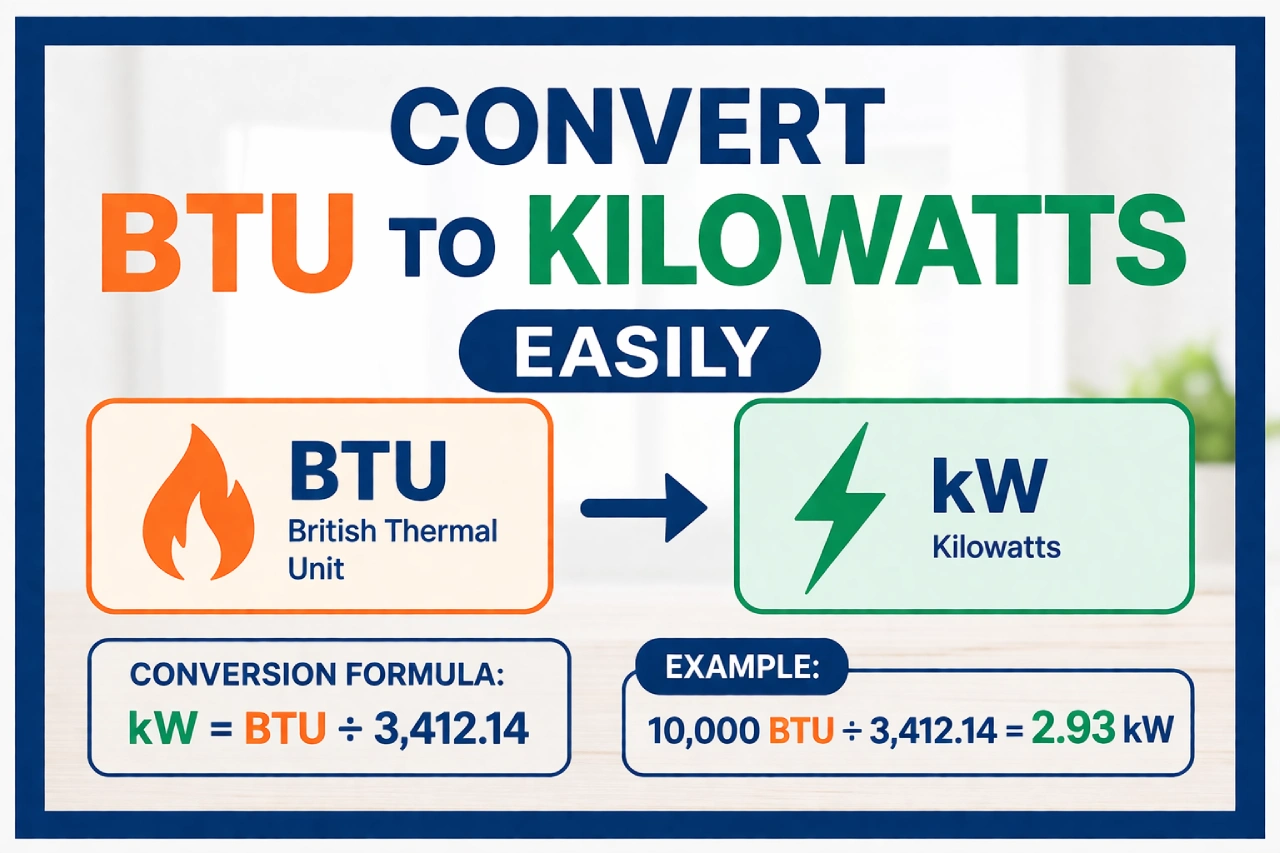
1 BTU per hour (BTU/h) = 0.000293071 kilowatts (kW).
That means if you want to convert BTU to kW, you simply multiply the BTU value by 0.000293071.
For example:
- 10,000 BTU/h ≈ 2.93 kW
- 12,000 BTU/h ≈ 3.52 kW
- 24,000 BTU/h ≈ 7.03 kW
This conversion is extremely common in HVAC systems, heating equipment, power ratings, and energy efficiency calculations. In the United States, heating and cooling systems are usually rated in BTUs, while most other parts of the world measure energy output in kilowatts.
In this guide, we’ll explain exactly how BTU-to-kW conversion works, show the formula step by step, and explore real-world applications such as air conditioners, heaters, and energy systems.
Understanding BTU
What Is a BTU?
A BTU (British Thermal Unit) is a unit of heat energy used primarily in the United States.
One BTU represents the amount of heat needed to raise the temperature of one pound of water by one degree Fahrenheit.
Although this definition may sound technical, BTUs are commonly used to measure the heating or cooling capacity of appliances such as:
- Air conditioners
- Furnaces
- Heat pumps
- Water heaters
- Gas grills
For example:
- A small window air conditioner may produce 5,000 BTU/h.
- A medium home air conditioner might deliver 12,000 BTU/h.
- A central HVAC system may exceed 36,000 BTU/h.
The “per hour” part (BTU/h) indicates the rate at which heat energy is transferred.
Understanding Kilowatts (kW)
What Is a Kilowatt?
A kilowatt (kW) is a unit of power in the International System of Units (SI).
One kilowatt equals:
1 kW = 1,000 watts
Watts measure how quickly energy is transferred or used.
Kilowatts are widely used to describe:
- Electrical power output
- Generator capacity
- Heating systems
- Industrial machinery
- Renewable energy systems
For example:
- A typical electric heater may use 1.5 kW.
- A household microwave might use 1 kW.
- A residential solar panel system could produce 5–10 kW.
Because kilowatts are part of the international metric system, they are widely used worldwide.
The BTU to kW Conversion Formula
BTU to Kilowatts
Enter the BTU value below to convert it into kilowatts instantly.
The key relationship between these units is:
1 BTU/h = 0.000293071 kW
This value comes from converting thermal energy into electrical power units.
Conversion Formula
kW = BTU/h × 0.000293071
This formula allows you to convert any BTU value into kilowatts.
Step-by-Step Conversion Example
Let’s convert 12,000 BTU/h to kilowatts, which is a common HVAC rating.
Step 1: Start with the BTU value
12,000 BTU/h
Step 2: Multiply by the conversion factor
12,000 × 0.000293071
Step 3: Calculate the result
= 3.51685 kW
Final Result
12,000 BTU/h ≈ 3.52 kW
This is the cooling capacity of a 1-ton air conditioner.
Quick BTU-to-kW Conversion Table
Here’s a helpful chart for common values.
| BTU/h | kW |
|---|---|
| 5,000 | 1.47 kW |
| 10,000 | 2.93 kW |
| 12,000 | 3.52 kW |
| 18,000 | 5.27 kW |
| 24,000 | 7.03 kW |
| 36,000 | 10.55 kW |
| 60,000 | 17.58 kW |
This table is useful for quickly estimating conversions.
Why BTU and kW Are Used in Different Systems
The difference between BTUs and kilowatts mainly comes from historical measurement systems.
The United States traditionally used imperial units, including BTUs, to measure heat energy.
Most other countries adopted the metric system, where energy and power are measured using watts and kilowatts.
As global trade and engineering collaboration increased, conversions between these units became essential.
BTU vs kW in HVAC Systems
One of the most common places you’ll see this conversion is in air conditioning systems.
Example: Air Conditioner Ratings
A typical air conditioner rating might look like this:
- 12,000 BTU/h (cooling capacity)
Converted to kilowatts:
12,000 BTU/h ≈ 3.52 kW
This helps engineers and technicians compare HVAC equipment internationally.
Tons of Cooling
In HVAC systems, cooling capacity is often measured in tons.
1 ton of cooling equals:
12,000 BTU/h
Which equals:
3.52 kW
So:
| Tons | BTU/h | kW |
|---|---|---|
| 1 ton | 12,000 | 3.52 |
| 2 tons | 24,000 | 7.03 |
| 3 tons | 36,000 | 10.55 |
Understanding this relationship helps when selecting HVAC equipment.
Converting kW Back to BTU
Sometimes the reverse conversion is needed.
The formula becomes:
BTU/h = kW × 3412.14
Example:
3.52 kW × 3412.14 ≈ 12,000 BTU/h
This confirms the earlier conversion.
Real-World Examples of BTU to kW Conversion
Home Heating Systems
A gas furnace rated at 80,000 BTU/h produces:
80,000 × 0.000293071 ≈ 23.45 kW
Electric Heater
A 2 kW electric heater produces approximately:
2 × 3412 = 6,824 BTU/h
Industrial Boilers
Large industrial boilers may produce hundreds of thousands of BTUs per hour, which converts to large kilowatt outputs.
Understanding these conversions helps engineers design and compare systems more effectively.
Common Mistakes in BTU-to-kW Conversion
Even simple conversions can lead to mistakes if the wrong factors are used.
Forgetting the “Per Hour”
BTUs used in HVAC are usually BTU per hour (BTU/h), not just BTU.
Using the Wrong Conversion Factor
Always remember:
1 BTU/h = 0.000293071 kW
Rounding Too Early
Rounding intermediate calculations can slightly affect accuracy.
Tips for Quick Mental Conversion
Here are some useful shortcuts.
First, remember the approximate rule:
1,000 BTU/h ≈ 0.293 kW
Second, remember a common HVAC benchmark:
12,000 BTU/h ≈ 3.5 kW
Third, remember the reverse rule:
1 kW ≈ 3,412 BTU/h
These simple benchmarks help estimate conversions quickly.
Frequently Asked Questions (FAQs)
What is 1 BTU in kilowatts?
1 BTU/h = 0.000293071 kW.
How many BTUs are in 1 kW?
1 kW ≈ 3,412 BTU per hour.
What is 12,000 BTU in kW?
12,000 BTU/h ≈ 3.52 kW.
Why are air conditioners rated in BTUs?
Because HVAC systems traditionally measure heat removal capacity using BTUs.
Why are kilowatts used internationally?
Kilowatts are part of the metric SI system, which is the global standard.
What is 24,000 BTU in kW?
24,000 × 0.000293071 ≈ 7.03 kW.
What is the easiest way to estimate BTU to kW?
Divide the BTU value by 3,412.
What is 5,000 BTU in kW?
5,000 × 0.000293071 ≈ 1.47 kW.
Are BTU and watts measuring the same thing?
Yes. Both measure energy transfer, but in different unit systems.
Why do HVAC technicians convert BTU to kW?
Because electrical equipment and international systems often use kilowatts.
Final Thoughts
Converting BTU to kilowatts becomes simple once you understand the key relationship between these units.
The most important rule to remember is:
1 BTU per hour = 0.000293071 kW
This means that systems rated in BTUs—such as air conditioners, furnaces, and heaters—can easily be compared with international equipment rated in kilowatts.
Understanding this conversion is particularly helpful when selecting HVAC systems, comparing energy efficiency, or interpreting international equipment specifications.
Once you remember the simple benchmarks—12,000 BTU/h equals about 3.5 kW and 1 kW equals about 3,412 BTU/h—you can perform quick conversions with confidence.
And the next time you see a heating or cooling system rated in BTUs, you’ll know exactly how much power that represents in kilowatts.
Leave a Reply