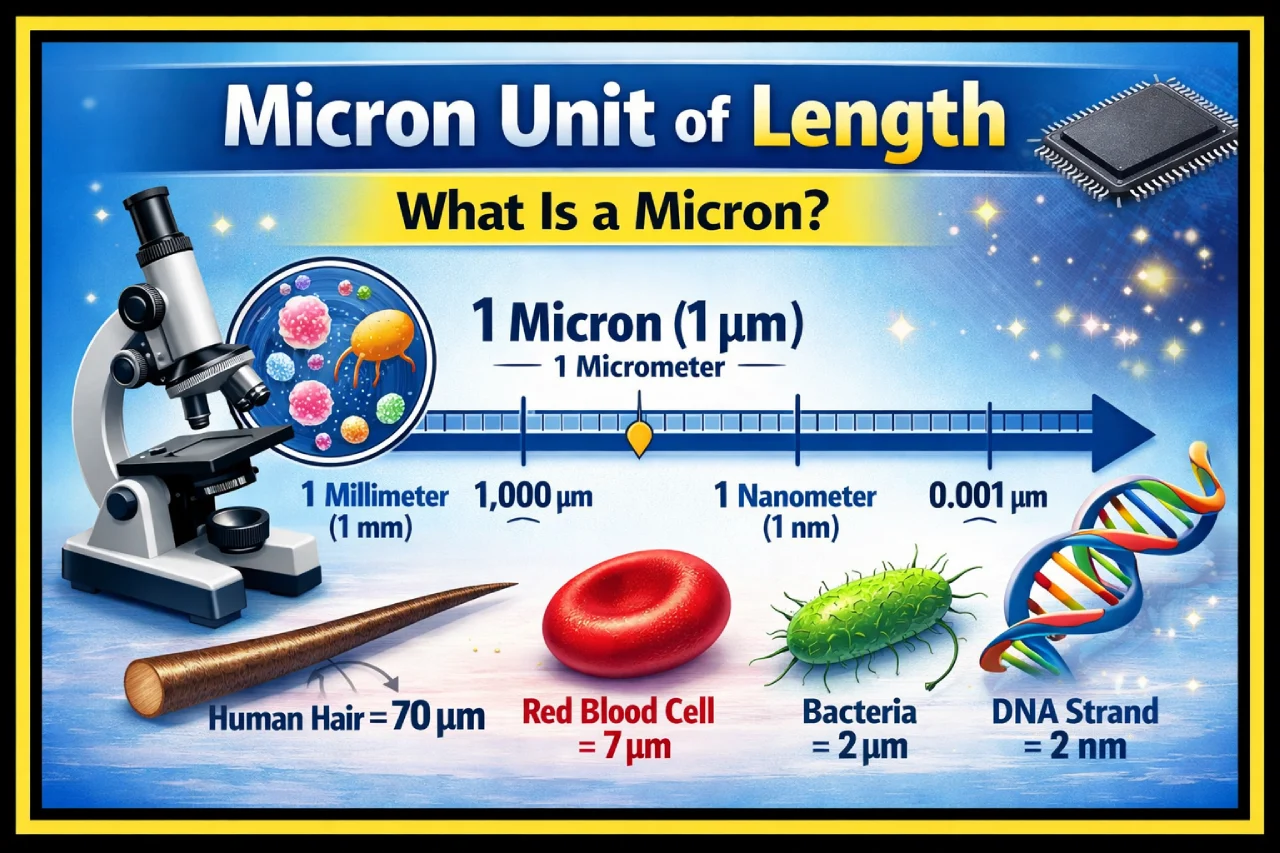
If you’re looking for the quick answer:
A micron is equal to one micrometer, which is 1/1,000,000 of a meter (10⁻⁶ meters).
In simple terms:
1 micron (µm) = 0.001 millimeters = 0.00003937 inches
The term “micron” is commonly used in industries like manufacturing, filtration, medicine, and electronics to describe extremely small measurements—far smaller than what we can see with the naked eye.
In this guide, we’ll break down exactly what a micron is, how it compares to other units, where it’s used, and how to visualize something so incredibly tiny.
What Is a Micron?
A micron is another name for a micrometer (µm), which is a standard unit of length in the metric system.
Official Definition
1 micron = 1 micrometer = 10⁻⁶ meters
That means:
- 1 meter = 1,000,000 microns
- 1 millimeter = 1,000 microns
Although “micron” is not the official SI term anymore, it is still widely used in practical applications because it’s easy to say and remember.
Why Is It Called a Micron?
The word “micron” comes from the Greek word “mikros,” meaning small.
The official SI unit is micrometer, but “micron” continues to be used in:
- Manufacturing
- Engineering
- Filtration systems
- Industrial applications
Both terms refer to the same measurement.
Micron Conversion to Other Units
Understanding how a micron compares to other units helps put its size into perspective.
Basic Conversions
- 1 micron = 0.001 millimeters (mm)
- 1 micron = 0.0001 centimeters (cm)
- 1 micron = 0.00003937 inches (in)
- 1 micron = 1,000 nanometers (nm)
Conversion Table
| Unit | Equivalent to 1 Micron |
|---|---|
| Millimeters | 0.001 mm |
| Centimeters | 0.0001 cm |
| Inches | 0.00003937 in |
| Nanometers | 1,000 nm |
These values show just how small a micron really is.
Visualizing a Micron
A micron is so small that it’s difficult to imagine without comparisons.
Real-World Comparisons
- A human hair is about 70 microns thick
- A red blood cell is about 6–8 microns wide
- A bacterium is typically 1–5 microns long
- A grain of dust may be around 10–50 microns
To put it simply:
👉 You cannot see a single micron with the naked eye.
Micron vs Millimeter vs Nanometer
Micron vs Millimeter vs Nanometer Converter
1 millimeter = 1,000 microns
1 micron = 1,000 nanometers
1 millimeter = 1,000,000 nanometers
Let’s compare common small units of measurement.
| Unit | Size |
|---|---|
| Millimeter (mm) | 0.001 m |
| Micron (µm) | 0.000001 m |
| Nanometer (nm) | 0.000000001 m |
Key Takeaway
- 1 mm = 1,000 microns
- 1 micron = 1,000 nanometers
This shows how the micron sits between millimeters and nanometers.
Where Is the Micron Used?
The micron is essential in fields that require precision at a microscopic level.
1. Filtration Systems
Microns are widely used to measure filter effectiveness.
For example:
- A 10-micron filter removes larger particles
- A 1-micron filter captures much finer contaminants
- A 0.5-micron filter can remove bacteria
This is common in:
- Water purification
- Air filtration
- Industrial systems
2. Manufacturing and Engineering
Precision parts are often measured in microns.
For example:
- Machine tolerances may be within ±5 microns
- Surface finishes are measured in microns
3. Medicine and Biology
Microns are used to measure:
- Cells
- Bacteria
- Tissue structures
4. Electronics
In microchips and semiconductors:
- Circuit components are often measured in microns or smaller
5. Paint and Coating Thickness
Paint layers are often measured in microns.
For example:
- A car paint layer may be 100–200 microns thick
Why the Micron Matters
You might wonder why such a tiny unit is important.
The answer is precision.
When working with:
- Microelectronics
- Medical devices
- Filtration systems
- Scientific research
Even a difference of a few microns can significantly impact performance.
Converting Microns to Inches
In the United States, inches are often used instead of metric units.
Formula
Inches = Microns × 0.00003937
Example
100 microns × 0.00003937 = 0.003937 inches
This shows how small microns are compared to inches.
Converting Inches to Microns
Formula
Microns = Inches × 25,400
Example
1 inch × 25,400 = 25,400 microns
This helps when converting U.S. measurements into metric precision.
Common Micron Values in Daily Life
Here are some typical micron measurements you may encounter.
| Item | Size (Microns) |
|---|---|
| Human hair | 50–100 µm |
| Dust particle | 10–50 µm |
| Bacteria | 1–5 µm |
| Smoke particle | <1 µm |
These examples show how microns are used to describe extremely small objects.
Common Mistakes to Avoid
1. Confusing Microns with Millimeters
Remember:
- 1 mm = 1,000 microns
2. Misunderstanding Scale
Microns are microscopic—you can’t see them without magnification.
3. Using Incorrect Conversions
Always use accurate values:
- 1 micron = 0.00003937 inches
Tips to Remember Micron Conversions
Here are some quick tricks.
Trick 1: Think “One Millionth”
A micron is one-millionth of a meter.
Trick 2: Use Benchmarks
- 1 mm = 1,000 microns
- 1 inch = 25,400 microns
Trick 3: Visual Anchors
Think of a human hair (~70 microns) to understand scale.
Real-World Example
Let’s say you’re buying a water filter labeled 5 microns.
This means:
- It can trap particles larger than 5 microns
- It will remove most dust, pollen, and some bacteria
Understanding this helps you choose the right filter.
Frequently Asked Questions (FAQs)
What is a micron in simple terms?
A micron is a very small unit of length equal to one millionth of a meter.
Is a micron the same as a micrometer?
Yes.
They are the same unit.
How many microns are in a millimeter?
1,000 microns = 1 millimeter
How small is a micron?
It’s smaller than what the human eye can see.
How many microns are in an inch?
1 inch = 25,400 microns
Why is the micron important?
It allows precise measurement of extremely small objects.
What is 100 microns in inches?
100 × 0.00003937 ≈ 0.00394 inches
Is micron still used today?
Yes, especially in industrial and practical applications.
What is smaller than a micron?
A nanometer is smaller.
Can you see a micron?
No, it requires magnification.
Final Thoughts
The micron unit of length may be tiny, but its importance is enormous.
It plays a crucial role in:
- Science
- Engineering
- Medicine
- Manufacturing
The key takeaway is simple:
1 micron = one-millionth of a meter
Once you understand how small this unit is and where it’s used, you’ll start noticing it everywhere—from air filters to electronics and even medical research.
Now here’s a quick question for you:
Next time you see a “micron rating” on a filter or product, will you know exactly how small that measurement really is?
Leave a Reply