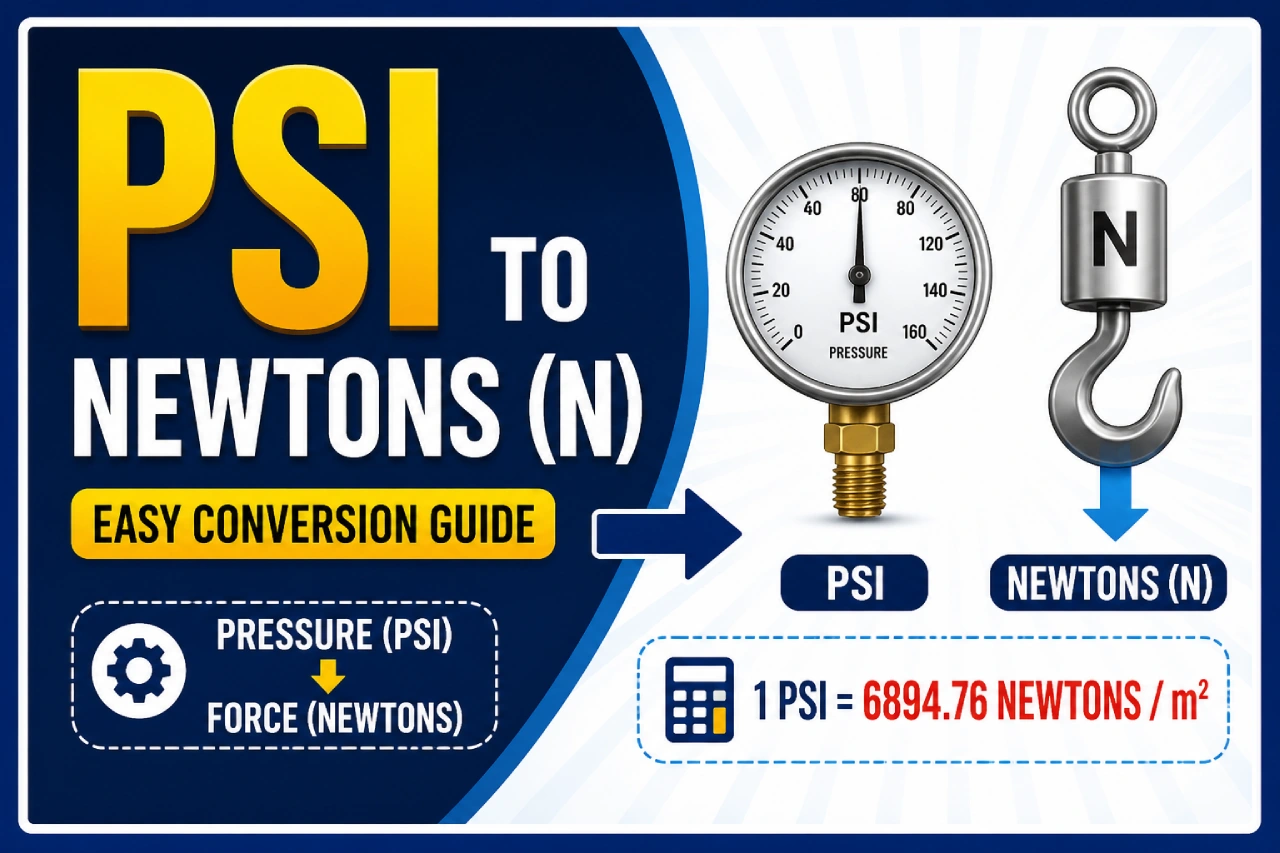
If you want a quick, direct answer:
You can’t convert PSI directly to newtons without knowing the area.
That’s because PSI (pounds per square inch) measures pressure, while newtons (N) measure force.
To convert PSI to newtons, you must use this relationship:
👉 Force (N) = Pressure (PSI) × Area (in²) × 4.44822
Once you know the area, the conversion becomes straightforward. Let’s break it down clearly.
What Does PSI to Newtons Mean?
Before jumping into formulas, it’s important to understand what you’re converting.
- PSI (pounds per square inch) = pressure
- Newton (N) = force
Pressure tells you how much force is applied over a specific area. Force tells you the total push or pull.
So when converting PSI to newtons, you’re essentially asking:
👉 “Given this pressure, how much total force is being applied over a surface?”
The Core Concept Behind the Conversion
This conversion is based on a fundamental physics principle:
Pressure = Force ÷ Area
Rearranging it gives:
F=P×A
Where:
- F = force (newtons)
- P = pressure
- A = area
This is why area is essential—you can’t calculate force without it.
The PSI to Newtons Formula
PSI to Newtons Converter
Use this PSI to Newtons calculator to convert pressure in pounds per square inch into force in newtons. Enter the PSI value and the surface area in square inches to get the result instantly.
Formula: Newtons = PSI × Area in in² × 4.44822
To convert PSI into newtons, you need to account for unit conversion:
- 1 pound-force (lbf) = 4.44822 newtons
- PSI = pounds per square inch
So the full formula becomes:
Force (N) = PSI × Area (in²) × 4.44822
Step-by-Step Conversion Method
Here’s a simple method you can follow every time:
- Identify the pressure in PSI
- Identify the area in square inches
- Multiply PSI × area
- Multiply the result by 4.44822
Example
Convert 50 PSI applied over 10 in² into newtons:
Step 1: 50 × 10 = 500
Step 2: 500 × 4.44822 = 2,224.11 N
Final Answer: 2,224.11 newtons
Quick Conversion Examples
Let’s look at a few more examples for clarity.
- 30 PSI over 5 in² → 667.23 N
- 100 PSI over 2 in² → 889.64 N
- 75 PSI over 8 in² → 2,668.93 N
Notice how the force changes depending on the area—even if PSI stays the same.
Why Area Matters So Much
This is where most confusion happens.
Imagine:
- Pressing your finger on a table → small area, low force
- Standing on the table → larger area, higher force
Even if the pressure is the same, the total force changes with area.
That’s why PSI alone isn’t enough.
PSI vs Newtons: Key Differences You Should Know
Understanding the difference helps avoid major mistakes.
| Feature | PSI | Newton (N) |
|---|---|---|
| What it measures | Pressure | Force |
| Depends on area? | Yes | No |
| Unit type | Derived pressure unit | SI force unit |
| Common use | Tire pressure, hydraulics | Physics, engineering |
Simple Way to Understand It
- PSI = how concentrated the force is
- Newton = total force applied
When Do You Convert PSI to Newtons?
This conversion shows up in many real-world situations.
Engineering and Design
Used to calculate load on surfaces and components.
Hydraulics
Helps determine force generated by hydraulic systems.
Automotive Applications
Tire pressure vs contact force calculations.
Manufacturing
Used in material stress and machine design.
Common Mistakes to Avoid
Even professionals sometimes get this wrong.
1. Ignoring Area
This is the biggest mistake. You cannot convert PSI to newtons without area.
2. Confusing PSI with Force
PSI is not force—it’s pressure.
3. Using Wrong Conversion Factor
Always use 4.44822 to convert pounds-force to newtons.
4. Mixing Units
Make sure area is in square inches, not cm² or m² (unless converted properly).
Shortcut Tip for Quick Estimates
If you need a rough estimate:
👉 Use 4.45 instead of 4.44822
This simplifies mental math without significant loss of accuracy.
PSI to Newtons vs Other Conversions
This conversion is slightly different from others because it involves two variables:
- Pressure (PSI)
- Area (in²)
Most conversions only involve one value, which is why this one feels trickier.
Real-Life Example You Can Relate To
Let’s say you have a hydraulic press applying 100 PSI over a surface of 20 square inches.
Force = 100 × 20 × 4.44822
Force = 8,896.44 N
That’s a significant amount of force—enough for heavy-duty applications.
Frequently Asked Questions (FAQs) About PSI to Newtons
1. Can you convert PSI directly to newtons?
No. You need the area to calculate force.
2. What is the formula for PSI to newtons?
Force (N) = PSI × Area (in²) × 4.44822
3. Why do I need area for this conversion?
Because pressure is force distributed over an area.
4. What is 1 PSI in newtons?
It depends on area.
For 1 in²: 1 PSI ≈ 4.44822 N
5. How many newtons is 100 PSI?
Depends on area.
Example: Over 1 in² → 444.82 N
6. What is the difference between PSI and newtons?
PSI measures pressure; newtons measure force.
7. Where is this conversion used?
Engineering, hydraulics, automotive systems, and manufacturing.
8. Can I use metric units instead?
Yes, but you’ll need to convert PSI to pascals first.
9. What happens if area increases?
Force increases proportionally.
10. Is PSI an SI unit?
No, PSI is not part of the SI system.
11. How do you convert PSI to pascals first?
1 PSI ≈ 6,894.76 Pa
12. Is this conversion important in real life?
Yes, especially in engineering and mechanical systems.
Final Thoughts
PSI to newtons isn’t a simple one-step conversion—and that’s exactly why understanding it matters.
Once you remember this core idea—force = pressure × area—everything becomes clear.
You stop memorizing formulas and start understanding how pressure actually turns into force in the real world.
Now here’s a simple question for you:
When you see a pressure value in PSI, do you picture the actual force behind it—or is it still just a number on a gauge?
Leave a Reply