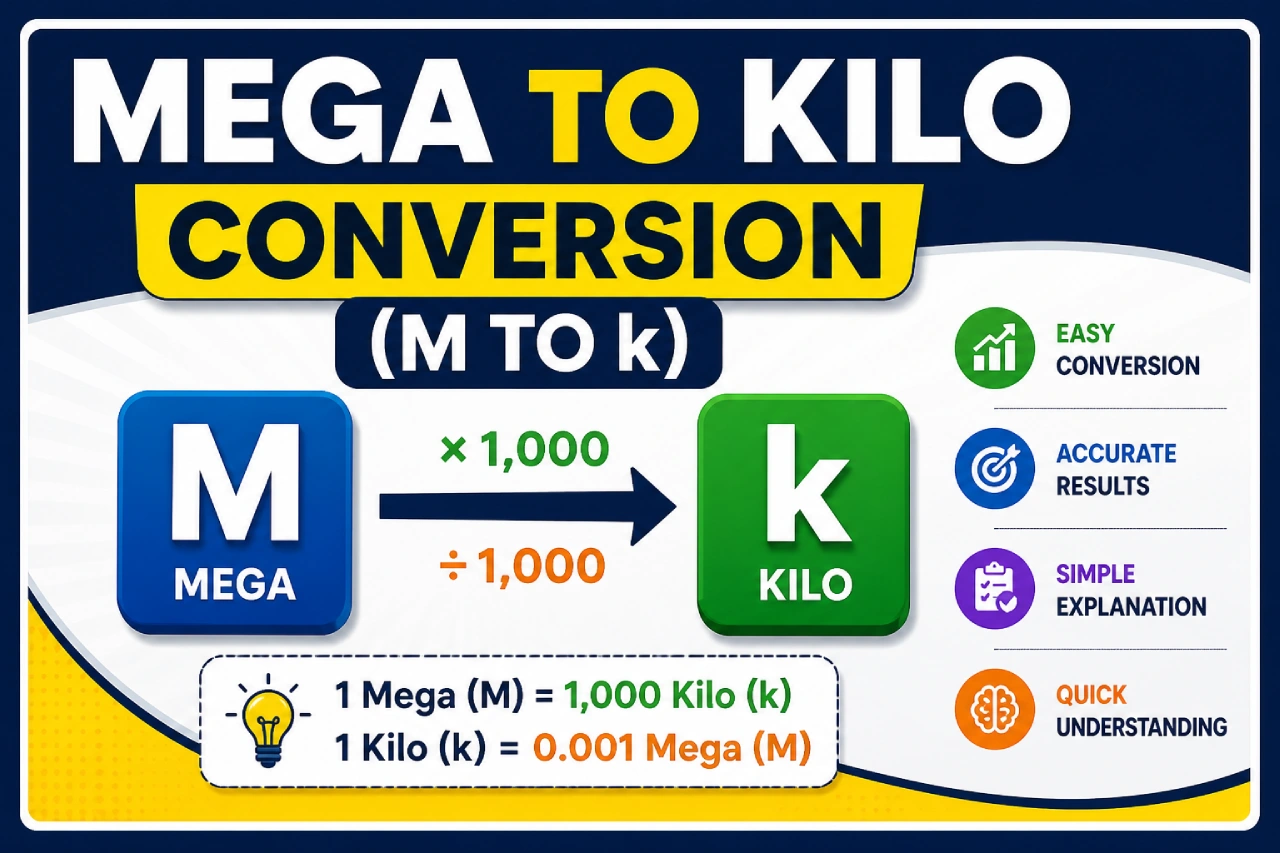
If you want a quick, direct answer:
1 mega (M) = 1,000 kilo (k)
So, to convert mega to kilo, simply multiply by 1,000.
That’s the short version. But if you’ve ever paused and wondered why this works, how it applies in real life, or where people often get confused, this guide will walk you through everything—clearly, practically, and without fluff.
What Does “Mega to Kilo” Mean?
Before we jump into numbers, let’s clarify what you’re converting.
Both mega and kilo are prefixes used in the International System of Units (SI). These prefixes tell you how big or small a quantity is.
- Kilo (k) = 1,000
- Mega (M) = 1,000,000
So when you convert from mega to kilo, you’re essentially converting from millions to thousands.
Think of it this way:
- Mega = million level
- Kilo = thousand level
The Conversion Formula
Mega to Kilo Converter
Enter a value in mega to instantly convert it into kilo.
Formula: 1 Mega = 1,000 Kilo
The relationship between mega and kilo is simple:
1 M=1000 k
Practical Formula
kilo = mega × 1,000
That’s all you need to remember.
Quick Conversion Examples
Let’s make it practical.
- 1 M → 1,000 k
- 2 M → 2,000 k
- 5 M → 5,000 k
- 10 M → 10,000 k
- 50 M → 50,000 k
Once you see the pattern, it becomes very intuitive.
Why Multiply by 1,000?
This comes from how the metric system is structured.
The metric system is based on powers of 10, which makes conversions incredibly simple compared to other systems.
- Kilo = 10³
- Mega = 10⁶
So:
10⁶ ÷ 10³ = 10³ = 1,000
That’s why converting from mega to kilo always involves multiplying by 1,000.
When Do You Use Mega to Kilo Conversion?
You’ll see this conversion in many real-world situations, often without realizing it.
1. Data Storage and Technology
- 1 megabyte (MB) = 1,000 kilobytes (KB) (in SI terms)
- Used in computing, file sizes, and internet speeds
2. Energy Measurements
- Megawatts (MW) to kilowatts (kW)
- Common in electricity and power plants
3. Distance and Measurements
- Megameters to kilometers (less common, but still valid)
4. Science and Engineering
- Used in physics, chemistry, and large-scale calculations
Mega vs Kilo: Key Differences You Should Know
This is where clarity really matters.
| Feature | Mega (M) | Kilo (k) |
|---|---|---|
| Value | 1,000,000 | 1,000 |
| Power of 10 | 10⁶ | 10³ |
| Scale | Million level | Thousand level |
| Common Use | Large quantities (power, data) | Everyday measurements |
Simple Way to Understand It
- Mega = 1 million units
- Kilo = 1 thousand units
So:
👉 Mega is always 1,000 times bigger than kilo
Step-by-Step Conversion Method
If you want a foolproof method:
- Take the value in mega
- Multiply it by 1,000
- Convert the unit to kilo
Example
Convert 7 M to kilo:
Step 1: 7 M
Step 2: 7 × 1,000 = 7,000
Step 3: Answer = 7,000 k
Common Mega to Kilo Conversion Table
| Mega (M) | Kilo (k) |
|---|---|
| 1 M | 1,000 k |
| 2 M | 2,000 k |
| 5 M | 5,000 k |
| 10 M | 10,000 k |
| 25 M | 25,000 k |
| 100 M | 100,000 k |
This is especially useful for quick reference.
Real-Life Applications
Let’s connect this to everyday use.
Energy Sector
Power plants are often rated in megawatts, but household appliances use kilowatts. Converting helps compare usage.
Internet & Data
Download speeds and file sizes often involve mega and kilo units.
Engineering
Large-scale measurements often require switching between these units for accuracy.
Education
Students frequently encounter these conversions in math and science.
Common Mistakes to Avoid
Even though the conversion is simple, people still slip up.
1. Confusing Mega with Million Directly
Some assume mega equals exactly a million in all contexts (especially in computing). While true in SI, computing sometimes uses binary values.
2. Dividing Instead of Multiplying
When converting down the scale (mega → kilo), you multiply—not divide.
3. Mixing Units Incorrectly
Always ensure you’re converting the correct unit type (e.g., watts to watts, bytes to bytes).
4. Ignoring Context
In computing, sometimes:
- 1 MB ≠ 1,000 KB (binary systems use 1,024)
Shortcut Tip for Quick Conversion
👉 Just add three zeros to the number.
Example:
- 8 M → 8,000 k
- 12 M → 12,000 k
It’s that simple.
Mega to Kilo vs Other Metric Conversions
Understanding this conversion helps you master others too:
- Giga → Mega
- Kilo → Milli
- Mega → Base unit
All follow the same power-of-10 structure, which makes the metric system so efficient.
Frequently Asked Questions (FAQs) About Mega to Kilo
1. How do you convert mega to kilo quickly?
Multiply the value in mega by 1,000.
Example: 3 M = 3,000 k
2. What is the formula for mega to kilo conversion?
kilo = mega × 1,000
3. Is 1 mega equal to 1,000 kilo?
Yes.
1 M = 1,000 k
4. Why do we multiply by 1,000?
Because mega (10⁶) is 1,000 times larger than kilo (10³).
5. Can I just add zeros when converting?
Yes. Add three zeros for quick conversion.
6. Where is mega to kilo conversion used?
In data storage, energy calculations, engineering, and scientific measurements.
7. What is 10 mega in kilo?
10 × 1,000 = 10,000 k
8. Does this conversion change in computing?
Sometimes. In binary systems:
1 MB = 1,024 KB (not 1,000)
9. What is the difference between mega and kilo?
Mega = million scale
Kilo = thousand scale
10. Is mega always bigger than kilo?
Yes. Mega is always 1,000 times larger than kilo.
11. How do you convert kilo back to mega?
Divide by 1,000:
Example: 5,000 k = 5 M
12. Is this part of the metric system?
Yes, both are standard SI prefixes.
Final Thoughts
Mega to kilo conversion is one of the simplest yet most useful conversions in the metric system. Once you understand that mega is 1,000 times bigger than kilo, everything else falls into place.
It’s quick, logical, and incredibly practical—whether you’re working with data, energy, or measurements.
Now here’s a simple question for you:
When you see a number in “mega,” do you instinctively feel how big it really is—or is it still just another number on the page?
Leave a Reply