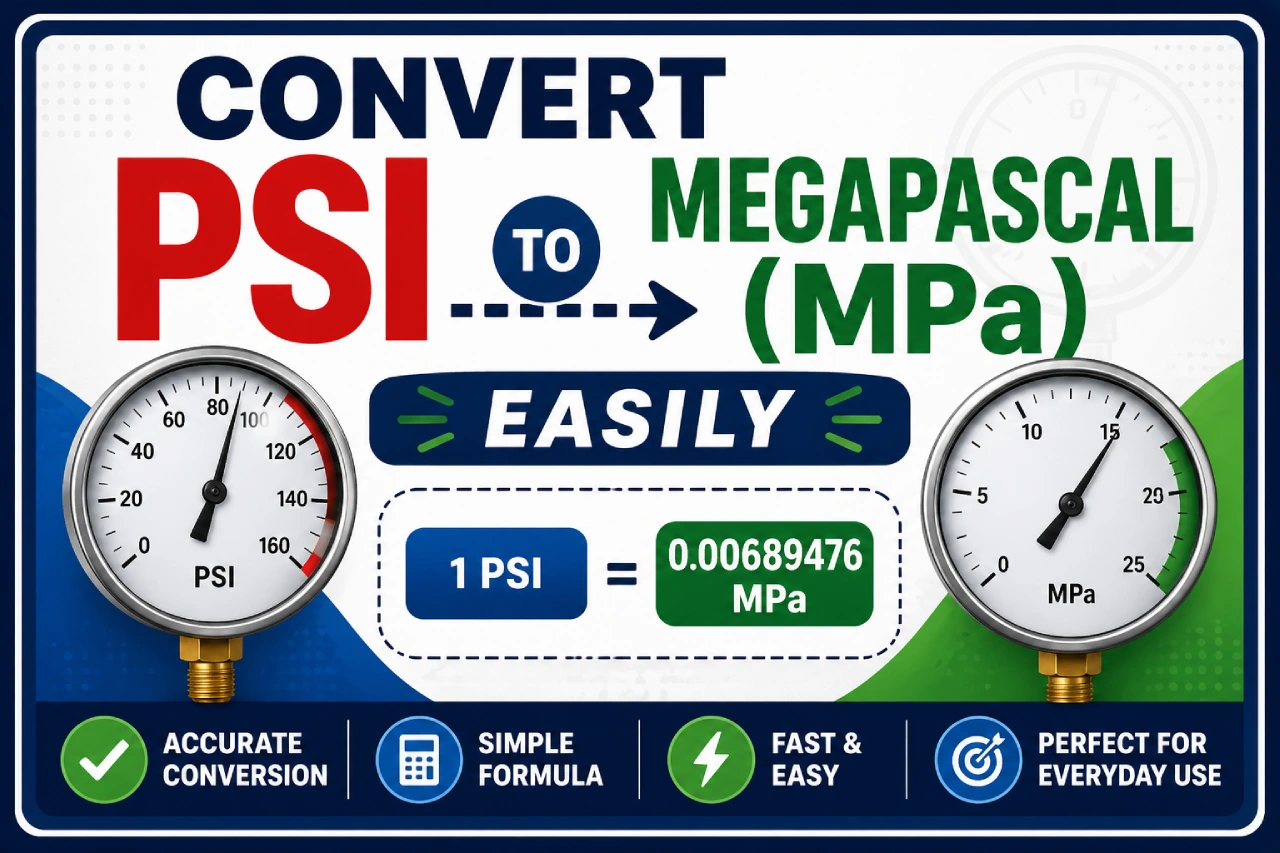
If you’re looking for the quick answer:
👉 1 PSI = 0.00689476 MPa
So, to convert PSI to megapascal (MPa):
👉 MPa = PSI × 0.00689476
For example:
- 100 PSI ≈ 0.689 MPa
- 500 PSI ≈ 3.447 MPa
- 1,000 PSI ≈ 6.895 MPa
This conversion is widely used in engineering, automotive systems, hydraulics, and industrial pressure measurements, especially when switching between U.S. and metric systems.
In this guide, we’ll break everything down clearly—what PSI and MPa mean, how to convert them, and how to use this conversion in real-world situations.
Understanding PSI and Megapascal
Before jumping into calculations, let’s understand the units.
What Is PSI?
PSI (pounds per square inch) is a unit of pressure used mainly in the United States.
Definition
👉 It measures how much force (in pounds) is applied to one square inch of area.
Common Uses
- Tire pressure
- Air compressors
- Gas systems
- Hydraulic equipment
Example:
- Car tires: 30–35 PSI
- Air compressors: 90–120 PSI
What Is Megapascal (MPa)?
A megapascal (MPa) is a metric unit of pressure.
Definition
👉 1 MPa = 1,000,000 pascals (Pa)
It’s part of the SI (International System of Units).
Common Uses
- Engineering materials
- Industrial systems
- Structural design
- Scientific calculations
Example:
- Concrete strength: 20–40 MPa
- Steel strength: 250+ MPa
Why Convert PSI to MPa?
You may need this conversion when:
- Working with international equipment
- Reading engineering specifications
- Comparing pressure values across systems
- Using scientific or SI-based measurements
Conversion Formula
PSI to Megapascal (MPa) Converter
Here’s the key formula:
👉 MPa = PSI × 0.00689476
Reverse Conversion
👉 PSI = MPa ÷ 0.00689476
These formulas are exact and widely accepted.
Step-by-Step Conversion Example
Let’s convert 250 PSI to MPa.
Step 1: Start with PSI
250 PSI
Step 2: Multiply by the conversion factor
250 × 0.00689476
Step 3: Calculate
= 1.72369 MPa
Final Answer
👉 250 PSI ≈ 1.72 MPa
Quick Conversion Table
Here’s a handy reference chart.
| PSI | MPa |
|---|---|
| 1 PSI | 0.006895 MPa |
| 10 PSI | 0.06895 MPa |
| 50 PSI | 0.3447 MPa |
| 100 PSI | 0.6895 MPa |
| 500 PSI | 3.447 MPa |
| 1,000 PSI | 6.895 MPa |
This helps you estimate values quickly.
Real-World Examples
Let’s make this practical.
Example 1: Tire Pressure
A car tire at 32 PSI:
32 × 0.00689476 ≈ 0.22 MPa
Example 2: Hydraulic System
A hydraulic system at 1,500 PSI:
1,500 × 0.00689476 ≈ 10.34 MPa
Example 3: Air Compressor
An air compressor at 100 PSI:
100 × 0.00689476 = 0.689 MPa
PSI vs MPa: Key Differences
| Unit | System | Typical Use |
|---|---|---|
| PSI | U.S. customary | Everyday pressure (tires, air) |
| MPa | Metric (SI) | Engineering and industrial use |
PSI is more common in daily U.S. use, while MPa is standard in technical fields worldwide.
Understanding the Relationship
Let’s simplify the relationship:
👉 1 MPa ≈ 145 PSI
This is useful for quick mental conversion.
Example
145 PSI ≈ 1 MPa
290 PSI ≈ 2 MPa
Converting MPa Back to PSI
Sometimes you need the reverse.
Formula
👉 PSI = MPa × 145.038
Example
2 MPa × 145.038 ≈ 290 PSI
Why MPa Is Used in Engineering
MPa is preferred because:
- It fits neatly into the metric system
- It handles large pressure values easily
- It’s standardized globally
Common Mistakes to Avoid
1. Using the Wrong Conversion Factor
Always use:
👉 0.00689476 for PSI → MPa
2. Confusing kPa and MPa
- 1 MPa = 1,000 kPa
3. Rounding Too Early
Keep precision until the final result.
Tips for Quick Mental Conversion
Here are some simple tricks.
Trick 1: Divide by 145
To convert PSI → MPa quickly:
100 PSI ÷ 145 ≈ 0.69 MPa
Trick 2: Multiply by 0.007
Close enough for quick estimates.
Trick 3: Use Benchmarks
- 100 PSI ≈ 0.69 MPa
- 1,000 PSI ≈ 6.9 MPa
Practical Applications
1. Automotive Industry
Used for:
- Tire pressure
- Engine systems
2. Construction
Material strength is measured in MPa.
3. Manufacturing
Machines operate under specific pressure limits.
4. Oil and Gas
Pressure measurements are critical for safety.
Frequently Asked Questions (FAQs)
What is 1 PSI in MPa?
👉 0.00689476 MPa
How do you convert PSI to MPa?
Multiply by 0.00689476.
What is 100 PSI in MPa?
👉 0.689 MPa
What is 1 MPa in PSI?
👉 145 PSI
Why is MPa used instead of PSI?
Because it’s part of the SI system.
Is PSI higher than MPa?
No, they measure the same thing in different units.
Can calculators convert PSI to MPa?
Yes, easily.
What is 500 PSI in MPa?
👉 3.447 MPa
Is MPa used worldwide?
Yes, especially in engineering and science.
What is the easiest way to estimate?
Divide PSI by 145.
Final Thoughts
Converting PSI to megapascal (MPa) is straightforward once you know the formula:
👉 MPa = PSI × 0.00689476
This conversion is essential when working between U.S. and metric systems, especially in engineering, automotive, and industrial applications.
The key takeaway is simple:
👉 1 PSI ≈ 0.0069 MPa
👉 1 MPa ≈ 145 PSI
Once you remember these, you can convert values quickly and confidently.
Now here’s a quick question for you:
Next time you see a pressure value in PSI, will you instantly know what it means in MPa?
Leave a Reply