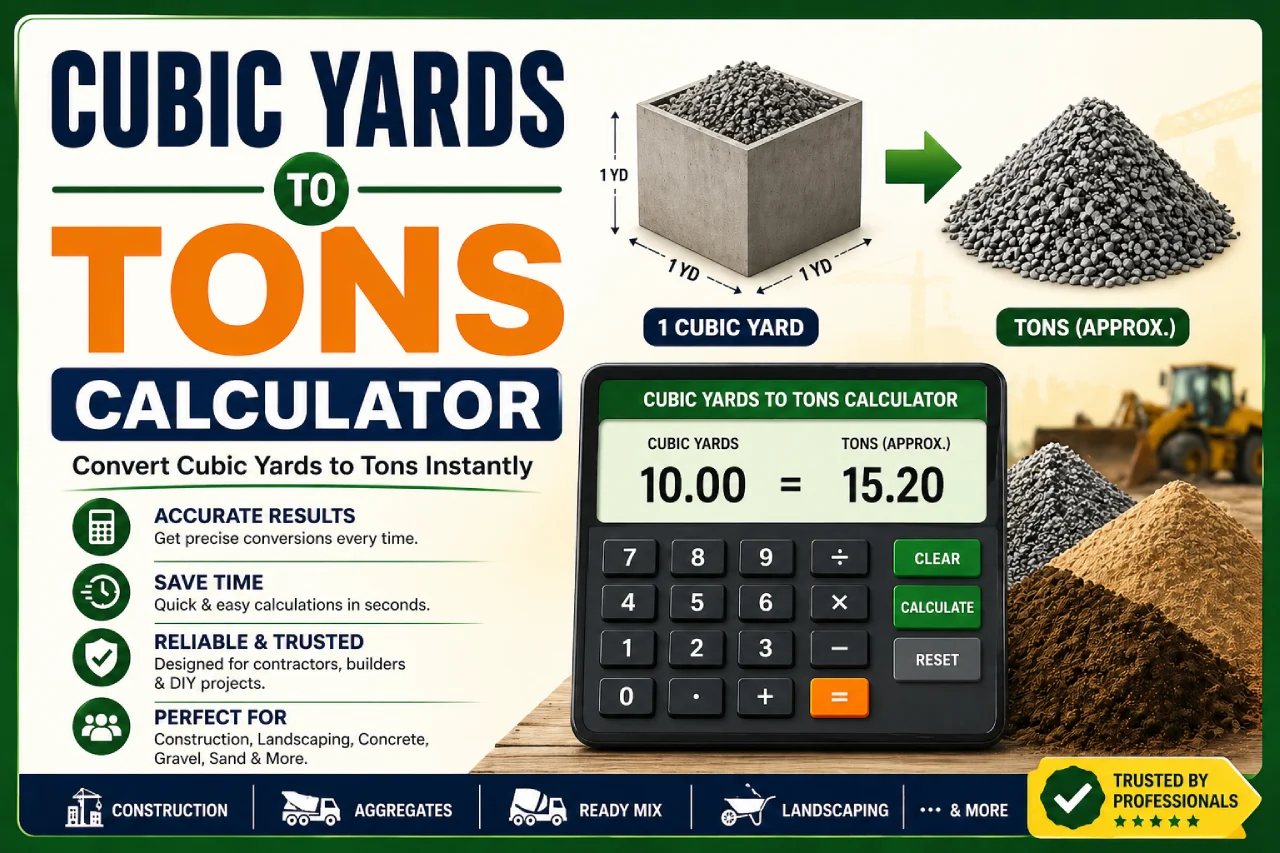
If you’re looking for the quick answer:
👉 Tons = Cubic Yards × Material Density
There is no single fixed conversion between cubic yards and tons because it depends on the material you’re measuring.
For example:
- 1 cubic yard of gravel ≈ 1.4–1.7 tons
- 1 cubic yard of sand ≈ 1.3–1.5 tons
- 1 cubic yard of topsoil ≈ 1.1–1.3 tons
So, a cubic yards to tons calculator works by multiplying the volume by the material’s density.
In this guide, you’ll learn exactly how to calculate it, understand material differences, and confidently estimate loads for construction, landscaping, and more.
What Is a Cubic Yard?
A cubic yard (yd³) is a unit of volume.
Definition
👉 1 cubic yard = 3 ft × 3 ft × 3 ft = 27 cubic feet
Common Uses
- Soil
- Gravel
- Sand
- Concrete
- Mulch
It tells you how much space a material occupies.
What Is a Ton?
A ton is a unit of weight.
In the U.S.
👉 1 ton = 2,000 pounds
Important Note
A cubic yard measures volume, while a ton measures weight.
That’s why conversion depends on density.
Why You Need a Cubic Yards to Tons Calculator
You can’t convert directly unless you know:
👉 What material you’re working with
Different materials have different densities.
For example:
- Gravel is heavier than mulch
- Sand is denser than topsoil
Conversion Formula
Cubic Yards to Tons Converter
Enter cubic yards and choose a material to estimate tons.
Here’s the key formula:
👉 Tons = Cubic Yards × Density (tons per cubic yard)
Common Material Densities
Here’s a practical reference chart.
| Material | Tons per Cubic Yard |
|---|---|
| Gravel | 1.4 – 1.7 |
| Sand | 1.3 – 1.5 |
| Topsoil | 1.1 – 1.3 |
| Mulch | 0.2 – 0.4 |
| Concrete | 2.0 – 2.4 |
| Asphalt | 2.0 – 2.2 |
These values are averages and may vary slightly.
Step-by-Step Example
Let’s calculate 5 cubic yards of gravel.
Step 1: Choose density
Gravel ≈ 1.5 tons per cubic yard
Step 2: Multiply
5 × 1.5 = 7.5 tons
👉 Final Answer: 5 yd³ gravel ≈ 7.5 tons
Another Example
Convert 10 cubic yards of sand.
Step 1: Density
Sand ≈ 1.4 tons/yd³
Step 2: Multiply
10 × 1.4 = 14 tons
👉 Final Answer: 10 yd³ sand ≈ 14 tons
Cubic Yards to Tons Calculator (Manual Method)
You can calculate it yourself in seconds.
Step 1
Identify the material
Step 2
Find its density
Step 3
Multiply:
👉 Volume × Density = Tons
That’s it.
Why Density Matters
Density is the key factor.
Definition
Density = weight per unit volume
Example
- 1 yd³ of feathers → very light
- 1 yd³ of concrete → very heavy
Same volume, completely different weight.
Real-Life Applications
This conversion is widely used in everyday projects.
1. Landscaping
When ordering:
- Soil
- Mulch
- Gravel
You need to know weight for delivery.
2. Construction
Used for:
- Concrete calculations
- Road building
- Foundation work
3. Truck Loading
Trucks have weight limits, not volume limits.
4. Budgeting
Materials are often priced per ton.
Quick Conversion Table
Here’s a general reference.
| Cubic Yards | Gravel (tons) | Sand (tons) |
|---|---|---|
| 1 yd³ | 1.5 | 1.4 |
| 2 yd³ | 3.0 | 2.8 |
| 5 yd³ | 7.5 | 7.0 |
| 10 yd³ | 15.0 | 14.0 |
Estimating Without Exact Density
Sometimes you don’t have exact values.
Use These Averages
- Gravel → 1.5 tons/yd³
- Sand → 1.4 tons/yd³
- Soil → 1.2 tons/yd³
These give reliable estimates.
Converting Tons Back to Cubic Yards
Sometimes you need the reverse.
Formula
👉 Cubic Yards = Tons ÷ Density
Example
10 tons of gravel:
10 ÷ 1.5 ≈ 6.67 yd³
Common Mistakes to Avoid
1. Assuming a Fixed Conversion
There is no universal conversion.
2. Ignoring Material Type
Always check the density.
3. Overloading Trucks
Weight matters more than volume for transport.
4. Using Rough Estimates for Precise Work
For critical projects, use exact density values.
Tips for Accurate Calculations
Tip 1: Ask Your Supplier
Suppliers often provide density values.
Tip 2: Add a Safety Margin
Order slightly more material to avoid shortages.
Tip 3: Use Consistent Units
Stick to cubic yards and tons.
Tip 4: Consider Moisture Content
Wet materials weigh more than dry ones.
Real-World Example: Driveway Project
Let’s say you’re building a gravel driveway.
Step 1: Volume
You need 8 cubic yards
Step 2: Density
Gravel ≈ 1.5 tons/yd³
Step 3: Calculate
8 × 1.5 = 12 tons
👉 You should order about 12 tons of gravel
Why Moisture Changes Weight
Water adds weight.
- Dry sand = lighter
- Wet sand = heavier
This can affect your final tonnage.
Frequently Asked Questions (FAQs)
How many tons are in 1 cubic yard?
It depends on the material.
What is the formula for cubic yards to tons?
👉 Tons = Cubic Yards × Density
How many tons is 3 cubic yards of gravel?
👉 About 4.5 tons
How many cubic yards is 1 ton?
Depends on the material.
Is sand heavier than gravel?
Not always—densities are similar.
How accurate are these conversions?
They are estimates unless exact density is known.
Can calculators do this automatically?
Yes, if density is provided.
Why is mulch so light?
Because it’s less dense.
How many tons is 10 cubic yards of soil?
👉 About 12 tons
Should I round up or down?
Always round up for safety.
Final Thoughts
A cubic yards to tons calculator is simple once you understand the concept:
👉 You’re converting volume into weight using density
The key takeaway:
👉 Tons = Cubic Yards × Material Density
There’s no one-size-fits-all answer—but with the right density, you can calculate anything accurately.
Whether you’re planning a landscaping project, ordering materials, or working in construction, this knowledge saves time, money, and effort.
Now here’s a quick question for you:
Next time you order materials, will you think in cubic yards—or calculate the exact tonnage first?
Leave a Reply