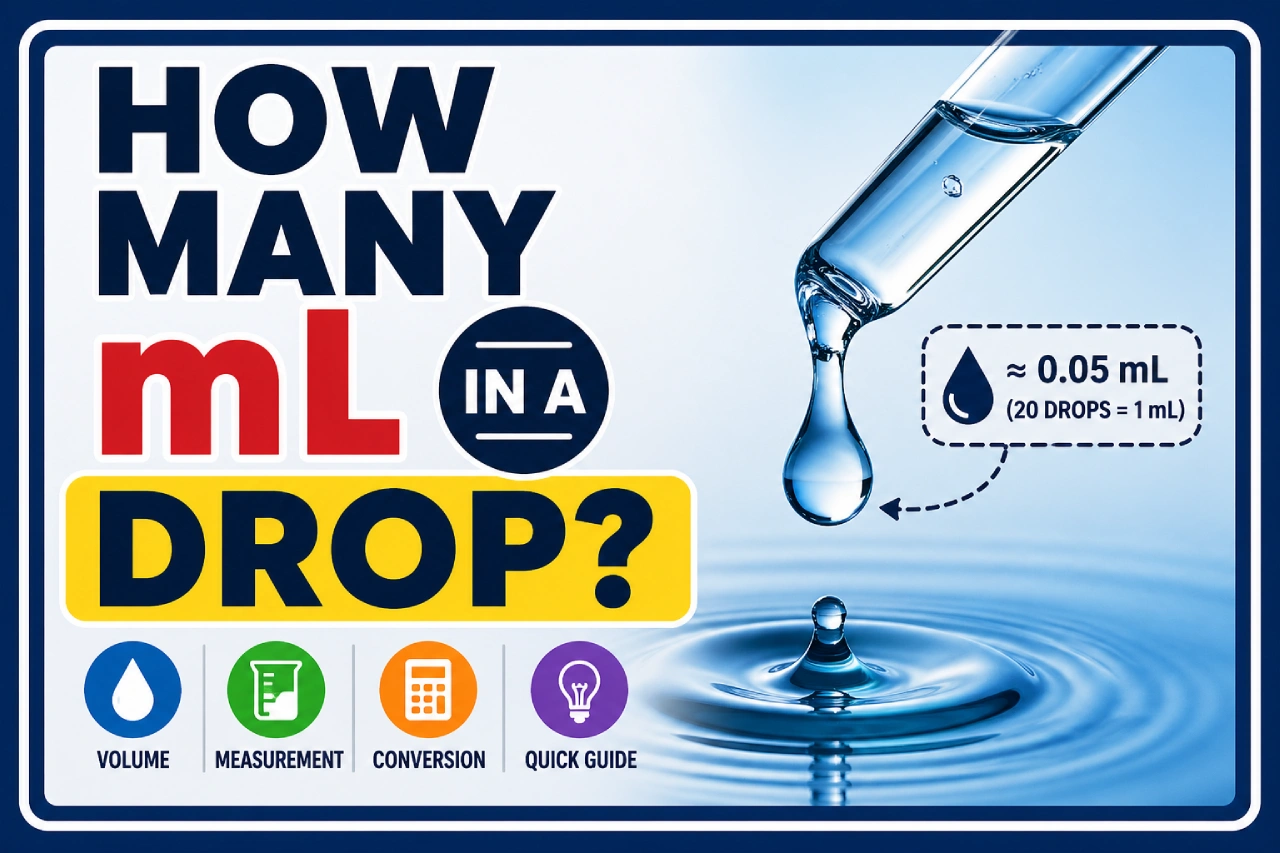
If you’re looking for the quick answer:
👉 1 drop ≈ 0.05 mL
👉 20 drops ≈ 1 mL
That’s the standard estimate used in many medical and pharmaceutical settings.
But here’s the important part:
👉 The exact volume of a drop can vary depending on the liquid, dropper, and conditions.
In this guide, we’ll break down everything you need to know—from standard conversions to real-world variations—so you can confidently work with drops and milliliters.
What Is a Drop?
A drop is a very small unit of volume, often used when dealing with liquids.
Why It’s Not a Fixed Unit
Unlike milliliters, a “drop” isn’t officially standardized across all uses.
Its size depends on:
- The liquid’s viscosity (thickness)
- Surface tension
- The dropper design
- Temperature
That’s why we use an approximate standard value.
Standard Drop-to-mL Conversion
Drop to mL Converter
Enter the number of drops below to convert drops into milliliters.
Note: A common estimate is 20 drops = 1 mL, meaning 1 drop is about 0.05 mL. Actual drop size can vary by liquid and dropper.
In medicine and pharmacy, a standard reference is used:
👉 1 drop = 0.05 mL
This leads to:
👉 20 drops = 1 mL
This value comes from standardized droppers used in healthcare.
Conversion Formula
Here’s the simple formula:
👉 mL = Number of Drops × 0.05
Reverse Formula
👉 Drops = mL × 20
Quick Conversion Table
Here’s a helpful reference.
| Drops | Milliliters (mL) |
|---|---|
| 1 drop | 0.05 mL |
| 5 drops | 0.25 mL |
| 10 drops | 0.5 mL |
| 20 drops | 1 mL |
| 50 drops | 2.5 mL |
| 100 drops | 5 mL |
This makes quick calculations easy.
Step-by-Step Example
Let’s convert 15 drops to mL.
Step 1: Use the formula
mL = Drops × 0.05
Step 2: Multiply
15 × 0.05 = 0.75 mL
👉 Final Answer: 15 drops = 0.75 mL
Why Does Drop Size Vary?
Here’s where things get interesting.
1. Type of Liquid
Different liquids behave differently.
- Water: standard reference
- Oil: thicker, larger drops
- Alcohol: thinner, smaller drops
2. Dropper Design
Not all droppers are equal.
- Medical droppers are calibrated
- Household droppers are not
3. Surface Tension
Liquids with higher surface tension form larger drops.
4. Temperature
Warmer liquids may produce smaller drops.
Medical and Pharmaceutical Standards
In healthcare, precision is critical.
Standard Medical Drop
👉 1 drop = 0.05 mL (20 drops per mL)
This standard is widely used in:
- Eye drops
- Oral medications
- IV drip calculations
Drops in Different Contexts
The meaning of a “drop” changes depending on where it’s used.
1. Eye Drops
Eye droppers are designed for accuracy.
👉 Typically close to 0.05 mL per drop
2. Essential Oils
Drops can vary widely.
👉 Often 0.03–0.05 mL per drop
3. IV Drip (Medical)
In IV systems:
- 10, 15, 20, or 60 drops per mL may be used depending on the set
So:
👉 Always check the drop factor
4. Household Droppers
These are less accurate.
👉 Drop size may vary significantly
Real-Life Examples
Let’s make this practical.
Example 1: Medication Dose
A prescription says:
👉 Take 10 drops
Using the standard:
10 × 0.05 = 0.5 mL
Example 2: Essential Oil Recipe
You add 30 drops:
30 × 0.05 = 1.5 mL
Example 3: IV Drip Calculation
If the drop factor is 20 drops/mL:
👉 40 drops = 2 mL
Drops vs Teaspoons and Tablespoons
Let’s compare drops to common kitchen units.
- 1 teaspoon = 5 mL
- 1 tablespoon = 15 mL
Using the standard:
👉 1 teaspoon ≈ 100 drops
👉 1 tablespoon ≈ 300 drops
Why This Conversion Matters
Understanding drops to mL is essential in many areas.
1. Medicine
Accurate dosing can be critical for safety.
2. Cooking and Flavoring
Drops are used for strong ingredients like extracts.
3. Aromatherapy
Essential oils are often measured in drops.
4. Science and Labs
Precise liquid measurements are required.
Common Mistakes to Avoid
1. Assuming All Drops Are Equal
Not all droppers produce the same size drops.
2. Ignoring Liquid Type
Oil and water behave differently.
3. Mixing Measurement Systems
Stick to consistent units when converting.
4. Over-Rounding
Small errors can matter when working with drops.
Tips for Accurate Measurement
Here are some practical tips.
Tip 1: Use a Calibrated Dropper
Medical droppers provide consistent results.
Tip 2: Count Carefully
Small quantities require precision.
Tip 3: Use mL for Accuracy
Whenever possible, measure in milliliters instead of drops.
Tip 4: Know Your Drop Factor
Especially important for IV systems.
Quick Mental Conversion Tricks
Here are some easy shortcuts.
Trick 1: Remember 20 Drops = 1 mL
This is the most useful rule.
Trick 2: Divide by 20
To convert drops → mL:
50 drops ÷ 20 = 2.5 mL
Trick 3: Multiply by 20
To convert mL → drops:
2 mL × 20 = 40 drops
Practice Problems
Try these yourself.
- 25 drops = ? mL
- 40 drops = ? mL
- 2 mL = ? drops
- 5 mL = ? drops
Answers
- 1.25 mL
- 2 mL
- 40 drops
- 100 drops
Frequently Asked Questions (FAQs)
How many mL is 1 drop?
👉 Approximately 0.05 mL
How many drops are in 1 mL?
👉 About 20 drops
Is drop size always the same?
No, it varies by liquid and dropper.
How many drops in 5 mL?
👉 About 100 drops
Can I rely on drops for medicine?
Yes, if using a calibrated dropper.
Why do oils have different drop sizes?
Because of viscosity and surface tension.
What is the safest way to measure?
Use a measuring syringe or mL scale.
Is 1 drop equal to 0.1 mL?
No, that’s too large. Standard is 0.05 mL.
What is a dropper?
A tool used to dispense small amounts of liquid.
Are drops used in cooking?
Yes, especially for strong flavors.
Final Thoughts
So, how many mL are in a drop?
👉 About 0.05 mL per drop (standard)
👉 20 drops = 1 mL
But remember:
👉 Drops are not perfectly consistent
Their size depends on the liquid and the dropper.
For everyday use, the 20 drops per mL rule works well. But for precise applications—like medicine—always rely on calibrated tools.
Now here’s a quick question for you:
Next time you measure liquid in drops, will you trust the dropper—or double-check with milliliters for accuracy?
Leave a Reply