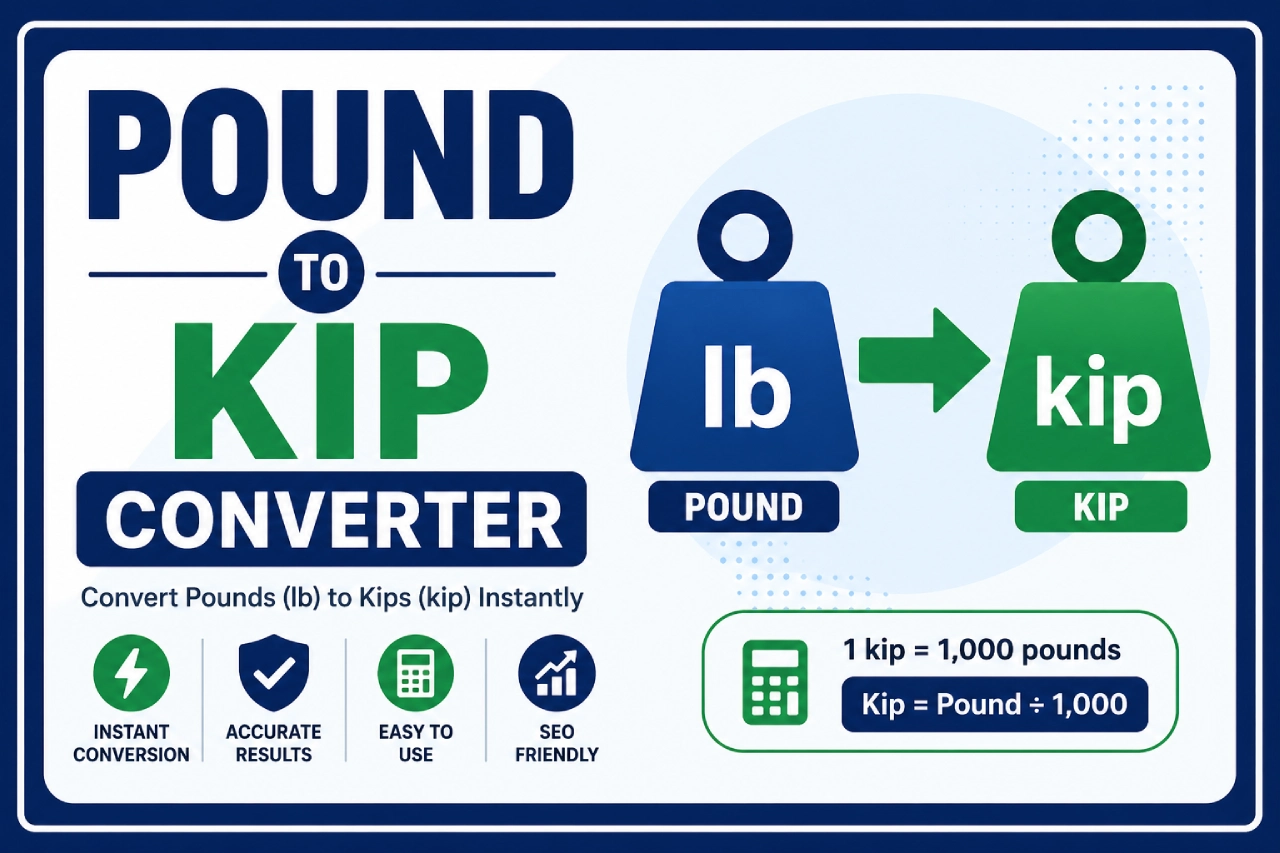
If you’re looking for the quick answer:
👉 1 kip = 1,000 pounds (lb)
👉 1 pound = 0.001 kip
So, to convert pounds to kips, simply divide by 1,000.
For example:
- 1,000 lb = 1 kip
- 5,000 lb = 5 kips
- 250 lb = 0.25 kip
This conversion is widely used in structural engineering, construction, and load calculations, where large force values are easier to express in kips rather than pounds.
In this guide, we’ll explain everything you need to know about converting pounds to kips, including formulas, examples, real-world applications, and tips for quick calculations.
What Is a Pound (lb)?
A pound (lb) is a unit of force or weight in the U.S. customary system.
Definition
👉 1 pound represents the force exerted by gravity on a mass of one pound at Earth’s surface.
Common Uses
- Body weight
- Shipping weights
- Everyday measurements
Example:
- A person might weigh 150–200 lb
- A package might weigh 20 lb
What Is a Kip?
A kip is a larger unit of force used mainly in engineering.
Definition
👉 1 kip = 1,000 pounds
The word “kip” comes from combining:
- k (kilo = 1,000)
- pound
So:
👉 kip = kilopound
Common Uses
- Structural engineering
- Load calculations
- Bridge design
- Construction projects
Example:
- A beam might تحمل 10 kips of load
- A column might support 50 kips
Pound to Kip Conversion Formula
Pound to Kip Converter
Enter a value in pounds to convert it into kips.
The conversion is simple.
Formula
👉 Kips = Pounds ÷ 1,000
Reverse Formula
👉 Pounds = Kips × 1,000
Step-by-Step Conversion Example
Let’s convert 7,500 pounds to kips.
Step 1: Start with pounds
7,500 lb
Step 2: Divide by 1,000
7,500 ÷ 1,000
Step 3: Calculate
= 7.5 kips
Final Answer
👉 7,500 lb = 7.5 kips
Quick Conversion Table
Here’s a handy reference chart.
| Pounds (lb) | Kips |
|---|---|
| 100 lb | 0.1 kip |
| 500 lb | 0.5 kip |
| 1,000 lb | 1 kip |
| 2,500 lb | 2.5 kips |
| 5,000 lb | 5 kips |
| 10,000 lb | 10 kips |
This makes conversions quick and easy.
Why Use Kips Instead of Pounds?
You might wonder why engineers prefer kips.
1. Simplicity
Large numbers are easier to handle.
Instead of:
👉 50,000 lb
You write:
👉 50 kips
2. Cleaner Calculations
Engineering formulas become simpler.
3. Standard Practice
Kips are widely used in:
- Structural engineering
- Civil engineering
- Load analysis
Real-World Applications
Understanding pound-to-kip conversion is essential in many fields.
1. Structural Engineering
Engineers use kips to measure:
- Load-bearing capacity
- Stress on beams
- Structural safety
2. Construction
Builders use kips to calculate:
- Material strength
- Load distribution
- Safety margins
3. Bridge Design
Loads on bridges are measured in kips.
4. Mechanical Engineering
Used in force and stress calculations.
Pounds vs Kips: Key Differences
| Unit | Size | Usage |
|---|---|---|
| Pound (lb) | Small | Everyday measurements |
| Kip | Large | Engineering calculations |
Both represent force—but kips simplify large values.
Converting Kips Back to Pounds
Sometimes you need to reverse the conversion.
Formula
👉 Pounds = Kips × 1,000
Example
8 kips × 1,000 = 8,000 lb
Understanding the Concept Visually
Think of it like this:
- 1 kip = a bundle of 1,000 pounds
- 5 kips = 5 bundles of 1,000 pounds
This makes it easier to visualize large forces.
Common Mistakes to Avoid
1. Forgetting the Conversion Factor
Always remember:
👉 1 kip = 1,000 lb
2. Mixing Units
Don’t confuse pounds (force) with pounds (mass).
3. Misplacing Decimal Points
Example:
- 250 lb = 0.25 kip, not 2.5 kips
Tips for Quick Mental Conversion
Here are some simple tricks.
Trick 1: Move the Decimal
Divide pounds by 1,000.
Example:
2,500 lb → 2.5 kips
Trick 2: Add Three Zeros
To convert back:
5 kips → 5,000 lb
Trick 3: Think in Thousands
Kips represent thousands of pounds.
Practical Examples
Example 1: Beam Load
A beam تحمل 12,000 lb:
👉 12,000 ÷ 1,000 = 12 kips
Example 2: Column Strength
A column supports 30 kips:
👉 30 × 1,000 = 30,000 lb
Example 3: Small Load
A load of 150 lb:
👉 150 ÷ 1,000 = 0.15 kip
Why This Conversion Matters
Understanding pound-to-kip conversion helps you:
- Read engineering drawings
- Interpret load calculations
- Avoid costly mistakes
- Communicate clearly in technical fields
Frequently Asked Questions (FAQs)
What is 1 pound in kips?
👉 0.001 kip
What is 1 kip in pounds?
👉 1,000 pounds
How do you convert pounds to kips?
Divide by 1,000.
What is 5,000 lb in kips?
👉 5 kips
Why are kips used?
To simplify large force values in engineering.
Is kip an SI unit?
No, it’s part of the U.S. customary system.
Can calculators convert lb to kip?
Yes, it’s a simple division.
What is 250 lb in kips?
👉 0.25 kip
Where are kips commonly used?
In structural and civil engineering.
Is kip the same as kilonewton?
No, they are different units.
Final Thoughts
Converting pounds to kips is one of the simplest conversions you’ll encounter.
The key rule is:
👉 Kips = Pounds ÷ 1,000
Once you understand that a kip represents 1,000 pounds, everything becomes straightforward.
Whether you’re working on construction projects, reading engineering specs, or studying structural design, this conversion is essential.
Now here’s a quick question for you:
Next time you see a load measured in kips, will you instantly know its value in pounds?
Leave a Reply