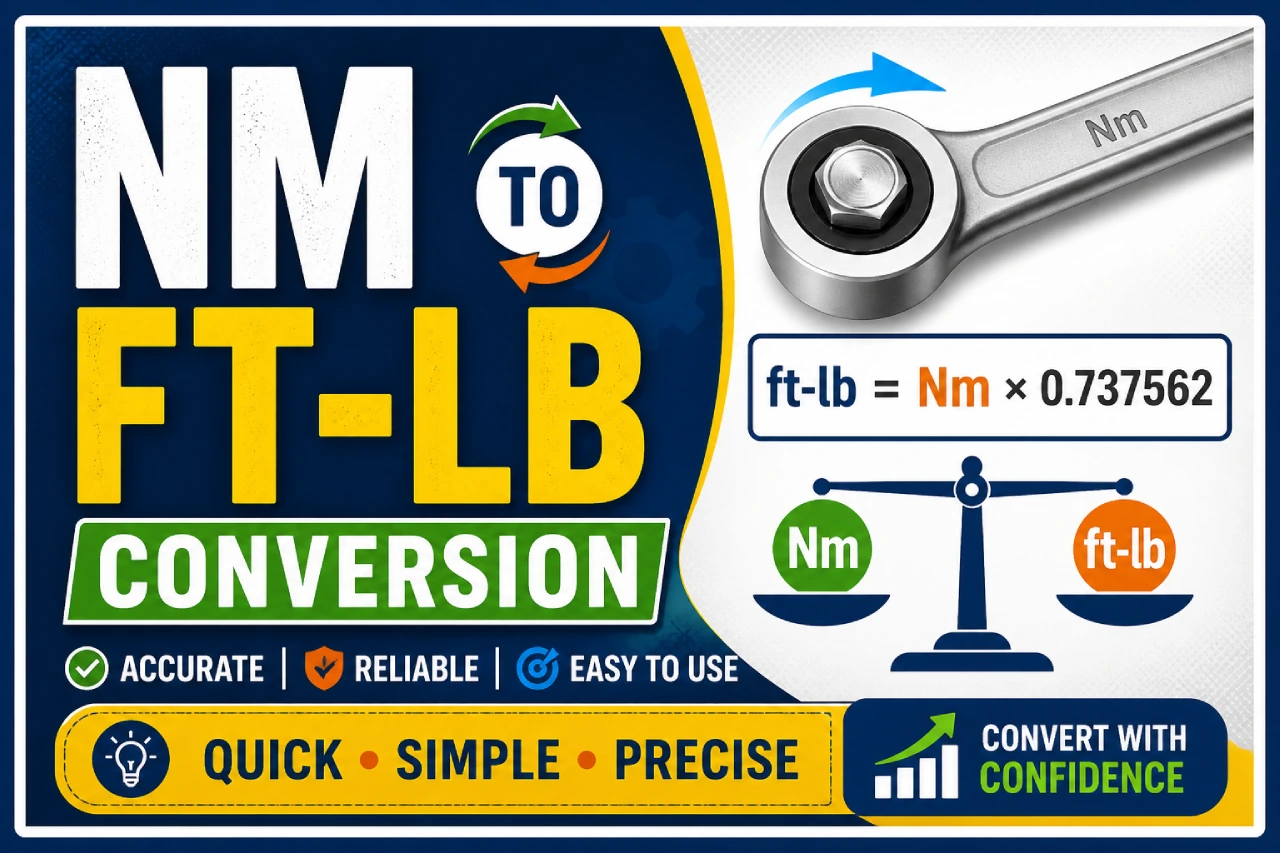
If you’re looking for the quick answer:
👉 1 Nm = 0.737562 ft-lb
👉 ft-lb = Nm × 0.737562
For example:
- 10 Nm ≈ 7.38 ft-lb
- 50 Nm ≈ 36.88 ft-lb
- 100 Nm ≈ 73.76 ft-lb
This conversion is widely used in automotive work, mechanical engineering, and torque measurements, especially when switching between metric (Nm) and U.S. customary units (ft-lb).
In this guide, we’ll break everything down clearly—so you not only know the formula but actually understand what it means and how to use it in real-world situations.
What Is Nm (Newton-Meter)?
A newton-meter (Nm) is a unit of torque in the metric system.
Definition
👉 Torque is the force applied at a distance from a pivot point.
👉 1 Nm = 1 newton of force applied at a distance of 1 meter
Common Uses
- Engine torque ratings
- Mechanical systems
- Engineering calculations
Example
- A car engine might produce 200–400 Nm of torque
What Is ft-lb (Foot-Pound)?
A foot-pound (ft-lb) is a unit of torque in the U.S. customary system.
Definition
👉 1 ft-lb = 1 pound of force applied at a distance of 1 foot
Common Uses
- Automotive torque specs
- Construction tools
- Machinery
Example
- Lug nuts on a car may require 80–100 ft-lb
Nm to ft-lb Conversion Formula
Nm to ft-lb Converter
Enter a value in Newton-meters to convert it into foot-pounds.
Here’s the key formula:
👉 ft-lb = Nm × 0.737562
Reverse Formula
👉 Nm = ft-lb × 1.35582
These are precise, widely accepted values.
Step-by-Step Conversion Example
Let’s convert 75 Nm to ft-lb.
Step 1: Start with Nm
75 Nm
Step 2: Multiply by conversion factor
75 × 0.737562
Step 3: Calculate
= 55.317 ft-lb
👉 Final Answer: 75 Nm ≈ 55.32 ft-lb
Quick Conversion Table
Here’s a handy reference chart.
| Nm | ft-lb |
|---|---|
| 1 Nm | 0.7376 ft-lb |
| 10 Nm | 7.38 ft-lb |
| 20 Nm | 14.75 ft-lb |
| 50 Nm | 36.88 ft-lb |
| 100 Nm | 73.76 ft-lb |
| 200 Nm | 147.51 ft-lb |
This helps you estimate quickly.
Understanding Torque: The Key Concept
To really understand this conversion, you need to understand torque.
What Is Torque?
👉 Torque is a twisting force.
It depends on:
- Force applied
- Distance from the pivot point
Simple Example
Using a wrench:
- A longer wrench = more torque
- More force = more torque
Why Convert Nm to ft-lb?
You’ll need this conversion in many real-world situations.
1. Automotive Work
Torque specs may be listed in Nm or ft-lb.
Example:
- European cars → Nm
- U.S. cars → ft-lb
2. Tool Usage
Torque wrenches may use different units.
3. Engineering Projects
Global projects require unit conversion.
4. DIY Repairs
Understanding torque prevents over-tightening.
Nm vs ft-lb: Key Differences
| Unit | System | Usage |
|---|---|---|
| Nm | Metric (SI) | Engineering, global |
| ft-lb | U.S. customary | Automotive, tools |
Both measure torque—but in different systems.
Real-Life Examples
Let’s make this practical.
Example 1: Lug Nut Torque
If a car requires 100 Nm:
100 × 0.737562 = 73.76 ft-lb
Example 2: Engine Bolt
A bolt requires 40 Nm:
40 × 0.737562 = 29.50 ft-lb
Example 3: Heavy Machinery
A machine produces 300 Nm:
300 × 0.737562 = 221.27 ft-lb
Converting ft-lb Back to Nm
Sometimes you need the reverse.
Formula
👉 Nm = ft-lb × 1.35582
Example
50 ft-lb × 1.35582 = 67.79 Nm
Why Precision Matters
Torque is critical in many applications.
Too Little Torque
- Parts may loosen
- Safety risks
Too Much Torque
- Bolts can break
- Components can be damaged
That’s why accurate conversion is essential.
Common Mistakes to Avoid
1. Confusing Torque with Energy
- ft-lb (torque) ≠ foot-pound (energy)
2. Using Rounded Values Incorrectly
Use:
👉 0.737562 for precision
👉 0.74 for quick estimates
3. Mixing Units
Always confirm whether values are in Nm or ft-lb.
Tips for Quick Mental Conversion
Here are some easy tricks.
Trick 1: Multiply by 0.74
Good for quick estimates.
Trick 2: Use Benchmarks
- 10 Nm ≈ 7.4 ft-lb
- 100 Nm ≈ 74 ft-lb
Trick 3: Reverse Trick
Divide by 0.74 to go back.
Practical Applications
1. Car Maintenance
Proper torque ensures safety.
2. Construction
Bolts and fasteners require specific torque.
3. Manufacturing
Machines must be calibrated accurately.
4. Engineering Design
Torque calculations are essential for performance.
Frequently Asked Questions (FAQs)
What is 1 Nm in ft-lb?
👉 0.7376 ft-lb
How do you convert Nm to ft-lb?
Multiply by 0.737562.
What is 100 Nm in ft-lb?
👉 73.76 ft-lb
What is 1 ft-lb in Nm?
👉 1.35582 Nm
Why is torque important?
It ensures proper fastening and performance.
Is Nm bigger than ft-lb?
1 Nm is slightly larger than 1 ft-lb.
Can calculators convert Nm to ft-lb?
Yes, easily.
What is 50 Nm in ft-lb?
👉 36.88 ft-lb
Where is this conversion used?
In automotive, engineering, and machinery.
Is this conversion exact?
Yes, based on standard definitions.
Final Thoughts
Converting Nm to ft-lb is simple once you know the formula:
👉 ft-lb = Nm × 0.737562
And the reverse:
👉 Nm = ft-lb × 1.35582
This conversion is essential in fields where precision matters—especially automotive and engineering work.
Once you understand torque and how these units relate, you’ll be able to convert values quickly and confidently.
Now here’s a quick question for you:
Next time you see a torque value in Nm, will you instantly know its equivalent in ft-lb?
Leave a Reply