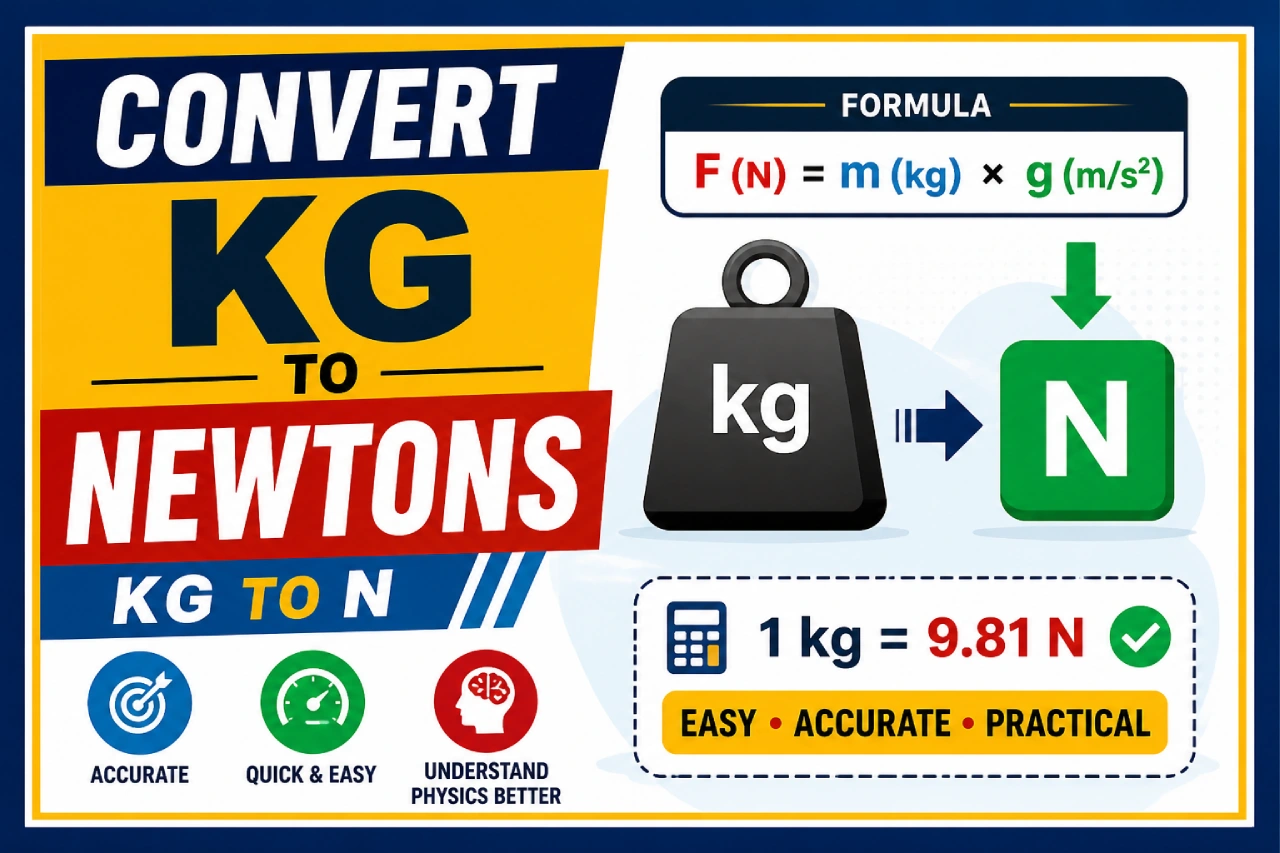
If you want a quick, direct answer: to convert kilograms (kg) to newtons (N), multiply the mass by 9.81 (Earth’s gravity).
So, 1 kg = 9.81 N.
That’s the simple version. But if you’ve ever wondered why that works, when to use it, or how to apply it correctly in real-life situations, this guide will walk you through everything—step by step, clearly and practically.
What Does “kg to Newtons” Actually Mean?
Before jumping into calculations, it’s important to understand what you’re converting.
- Kilogram (kg) measures mass — how much matter an object contains.
- Newton (N) measures force — specifically, how much push or pull is acting on something.
So when you convert kg to newtons, you’re not just changing units—you’re turning mass into weight (force).
In simple terms:
👉 Kilograms tell you how heavy something is in terms of matter
👉 Newtons tell you how strongly gravity is pulling on it
The Formula to Convert kg to Newtons
kg to Newtons Converter
Convert kilograms (kg) to newtons (N) quickly using standard Earth gravity.
Formula: Newtons = kg × 9.80665
At the core of this conversion is a basic principle from Newton’s Second Law of Motion, which states:
Force = mass × acceleration
On Earth, the acceleration due to gravity is approximately 9.81 m/s².
F=m×g
Where:
- F = force in newtons (N)
- m = mass in kilograms (kg)
- g = acceleration due to gravity (≈ 9.81 m/s²)
Simplified Conversion Formula
For everyday use:
Newtons = kilograms × 9.81
That’s it. No complicated math required.
Quick Conversion Examples
- 1 kg → 9.81 N
- 5 kg → 49.05 N
- 10 kg → 98.1 N
- 50 kg → 490.5 N
Why Multiply by 9.81?
This value represents Earth’s gravitational pull. Every kilogram of mass experiences a force of 9.81 newtons due to gravity.
When Should You Convert kg to Newtons?
You’ll use this conversion when dealing with forces, such as in physics, engineering, automotive calculations, and fitness analysis.
kg vs Newtons: Key Differences You Should Know
This is where many people get confused, so let’s break it down clearly.
| Feature | Kilogram (kg) | Newton (N) |
|---|---|---|
| What it measures | Mass | Force |
| Meaning | Amount of matter in an object | Push or pull acting on an object |
| Depends on gravity? | No | Yes |
| Unit type | SI base unit | SI derived unit |
| Example | A dumbbell is 10 kg | Its weight is ~98.1 N |
Simple Way to Understand It
- kg = what the object is
- N = what gravity does to it
So if you take the same object to the Moon:
- Its mass (kg) stays the same
- Its weight (N) changes
That’s the key difference.
kg vs Newton: Common Confusion Explained
Many people say: “I weigh 70 kg.”
In physics:
- 70 kg is your mass
- Your weight = 686.7 N
Everyday language simplifies this, but scientifically, they’re not the same.
Does This Conversion Always Stay the Same?
No. Gravity varies depending on location.
- Earth → 9.81 m/s²
- Moon → 1.62 m/s²
- Mars → 3.71 m/s²
So the formula stays the same, but the result changes.
Step-by-Step Conversion Method
- Take the mass in kg
- Multiply by 9.81
- Add “N”
Example:
12 kg → 117.72 N
Common kg to Newton Conversion Table
| Mass (kg) | Force (N) |
|---|---|
| 1 kg | 9.81 N |
| 2 kg | 19.62 N |
| 5 kg | 49.05 N |
| 10 kg | 98.1 N |
| 20 kg | 196.2 N |
| 50 kg | 490.5 N |
| 100 kg | 981 N |
Real-Life Applications
- Engineering: calculating structural loads
- Fitness: understanding lifting force
- Automotive: braking and load analysis
- Education: solving physics problems
Common Mistakes to Avoid
- Thinking 1 kg = 1 N
- Mixing mass and force
- Using incorrect gravity
- Forgetting units
Shortcut Tip for Quick Estimates
Use 10 instead of 9.81 for quick mental math—but only for rough estimates.
kg to Newtons vs Other Conversions
This conversion connects mass, force, and acceleration. Mastering it helps with many physics calculations.
Frequently Asked Questions (FAQs) About Converting kg to Newtons
1. How do you convert kg to newtons quickly?
Multiply by 9.81.
Example: 10 kg = 98.1 N
2. What is the formula to convert kg to newtons?
From Newton’s Second Law of Motion:
N = kg × 9.81
3. Is 1 kg equal to 9.81 newtons?
Yes, on Earth.
4. Why multiply by 9.81?
It represents Earth’s gravity.
5. Can I use 10 instead of 9.81?
Yes, for estimates.
6. What is the difference between kg and newtons?
kg = mass, N = force.
7. How many newtons is 50 kg?
490.5 N
8. Does it change on other planets?
Yes, due to gravity differences.
9. Is weight measured in kg or newtons?
In physics, newtons.
10. How do you convert newtons back to kg?
Divide by 9.81.
11. Why do engineers use newtons?
Because they measure force.
12. Is kg a unit of force?
No, it’s mass.
Final Thoughts
Converting kg to newtons is simple—but powerful. It helps you understand how mass turns into force and how gravity affects everything around you.
Just remember: multiply by 9.81.
Now here’s a simple question for you:
When you think about your weight, are you thinking in kilograms—or in the invisible force acting on you every second?
Leave a Reply