Category: Convert Tools

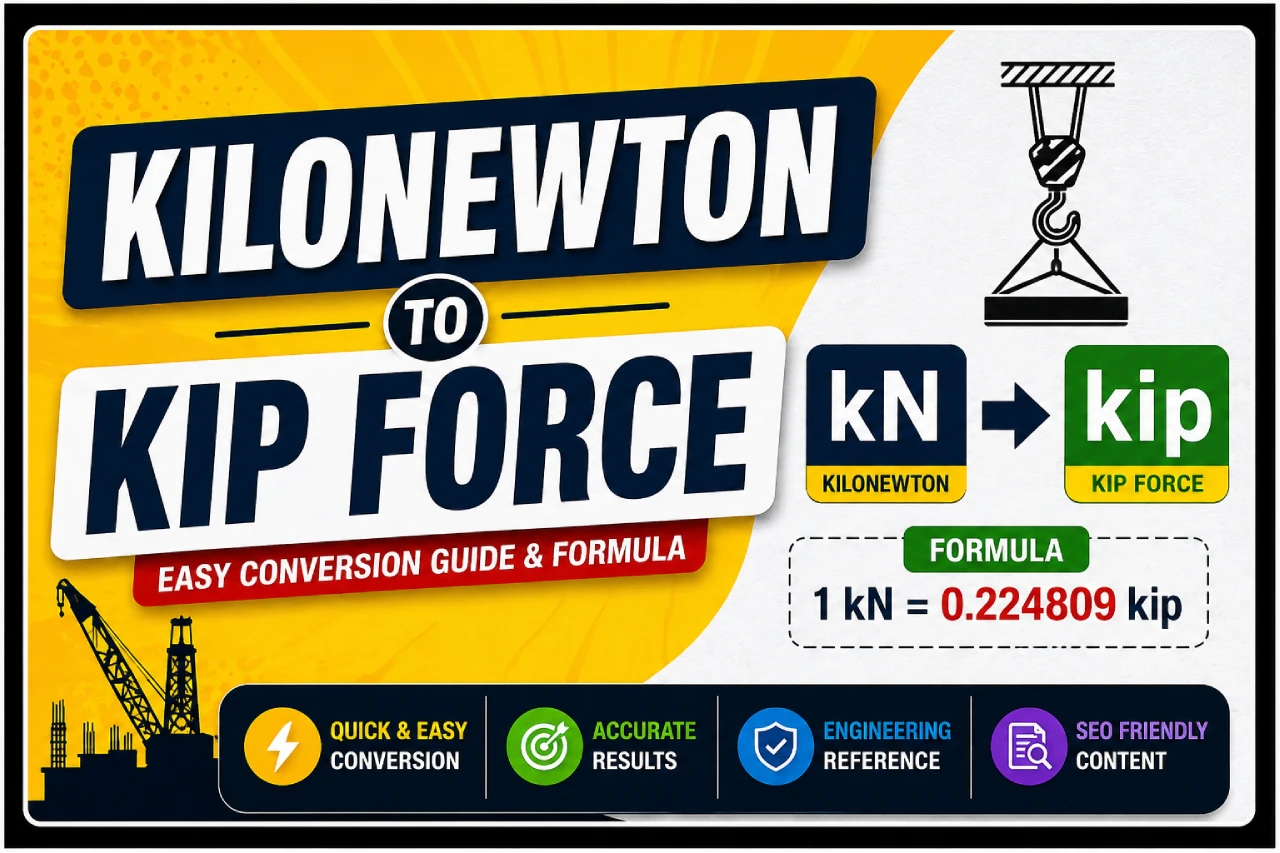
  • Kilonewton to Kip Force (kN to kip Conversion Guide)

    Kilonewton to Kip Force (kN to kip Conversion Guide)

    If you’re looking for the quick answer:

    👉 1 kilonewton (kN) = 0.224809 kip (force)
    👉 1 kip = 4.44822 kN

    So, to convert kilonewtons to kip force:

    👉 Kip = kN × 0.224809

    For example:

    • 10 kN ≈ 2.248 kips
    • 50 kN ≈ 11.24 kips
    • 100 kN ≈ 22.48 kips

    This conversion is extremely important in structural engineering, construction, and load analysis, where U.S. customary units (kips) and metric units (kilonewtons) often need to be used together.

    In this guide, we’ll break everything down step by step so you not only know the answer—but truly understand it.

    What Is a Kilonewton (kN)?

    A kilonewton (kN) is a metric unit of force.

    Definition

    👉 1 kilonewton = 1,000 newtons (N)

    The newton is the SI unit of force, defined as:

    👉 The force required to accelerate 1 kilogram of mass by 1 meter per second squared.

    Real-World Meaning

    • 1 kN ≈ force of 225 pounds under gravity
    • Used in engineering to measure loads, tension, and compression

    Common Uses

    • Structural design
    • Material strength
    • Mechanical systems

    What Is a Kip (Force)?

    A kip is a unit of force used in the U.S. customary system.

    Definition

    👉 1 kip = 1,000 pounds-force (lbf)

    The term “kip” comes from:

    • kilo (1,000)
    • pound

    So:

    👉 Kip = kilopound-force

    Common Uses

    • Structural engineering
    • Bridge design
    • Load calculations

    Example:

    • A beam might تحمل 20 kips
    • A column might support 50 kips

    Kilonewton to Kip Conversion Formula

    Kilonewton to Kip Force Converter

    Enter a value in kilonewtons to convert it into kip force.

    Formula: 1 kN = 0.224809 kip force

    Here’s the key formula:

    👉 Kip = kN × 0.224809

    Reverse Formula

    👉 kN = Kip × 4.44822

    These values come from precise physical definitions of force.

    Step-by-Step Conversion Example

    Let’s convert 25 kN to kips.

    Step 1: Start with kilonewtons

    25 kN

    Step 2: Multiply by conversion factor

    25 × 0.224809

    Step 3: Calculate

    = 5.620225 kips

    Final Answer

    👉 25 kN ≈ 5.62 kips

    Quick Conversion Table

    Here’s a helpful reference.

    Kilonewton (kN)Kip (force)
    1 kN0.2248 kip
    5 kN1.124 kip
    10 kN2.248 kip
    20 kN4.496 kip
    50 kN11.24 kip
    100 kN22.48 kip

    This makes quick estimation easy.

    Understanding the Relationship

    Let’s simplify the relationship.

    👉 1 kip ≈ 4.45 kN

    So:

    • 10 kips ≈ 44.5 kN
    • 20 kips ≈ 89 kN

    This is useful for quick mental calculations.

    Why This Conversion Matters

    You’ll need this conversion when working across systems.

    1. Structural Engineering

    Design codes may use different units.

    2. Construction Projects

    Equipment specs may be in kN or kips.

    3. International Collaboration

    Metric vs U.S. units must be aligned.

    4. Load Calculations

    Accurate conversion ensures safety.

    Kilonewton vs Kip: Key Differences

    UnitSystemSize
    Kilonewton (kN)Metric (SI)Smaller unit
    Kip (force)U.S. customaryLarger unit

    Both measure force—but in different systems.

    Real-World Examples

    Let’s make it practical.

    Example 1: Structural Beam Load

    A beam تحمل 40 kN:

    40 × 0.224809 = 8.99 kips

    👉 About 9 kips

    Example 2: Column Strength

    A column rated at 15 kips:

    15 × 4.44822 = 66.72 kN

    Example 3: Machine Force

    A machine applies 100 kN:

    100 × 0.224809 = 22.48 kips

    Converting Kip Back to Kilonewtons

    Sometimes you need the reverse.

    Formula

    👉 kN = Kip × 4.44822

    Example

    10 kips × 4.44822 = 44.48 kN

    Common Mistakes to Avoid

    1. Confusing Mass and Force

    • Kilogram (kg) = mass
    • Kilonewton (kN) = force

    2. Using Approximate Values Incorrectly

    Use:

    👉 0.224809 for precision
    👉 0.225 for quick estimates

    3. Mixing Units

    Keep track of whether values are in kN or kips.

    Tips for Quick Mental Conversion

    Here are some helpful tricks.

    Trick 1: Multiply by 0.225

    Close enough for quick estimates.

    Trick 2: Divide by 4.45

    To convert kips → kN quickly.

    Trick 3: Use Benchmarks

    • 10 kN ≈ 2.25 kips
    • 50 kN ≈ 11.25 kips

    Practical Applications

    1. Bridge Design

    Loads are often calculated in kips.

    2. Building Construction

    Materials are tested in kN.

    3. Mechanical Systems

    Forces in machines use both units.

    4. Safety Calculations

    Accurate conversion prevents failures.

    Frequently Asked Questions (FAQs)

    What is 1 kN in kips?

    👉 0.2248 kip

    How do you convert kN to kip?

    Multiply by 0.224809.

    What is 10 kN in kips?

    👉 2.248 kips

    What is 1 kip in kN?

    👉 4.448 kN

    Why are kips used?

    To simplify large force values in engineering.

    Is kN an SI unit?

    Yes, it’s part of the metric system.

    Can calculators convert kN to kips?

    Yes, easily.

    What is 100 kN in kips?

    👉 22.48 kips

    Which unit is bigger?

    👉 1 kip is larger than 1 kN.

    Where is this conversion used?

    In structural and civil engineering.

    Final Thoughts

    Converting kilonewtons to kip force is essential when working between metric and U.S. systems.

    The key formula is:

    👉 Kip = kN × 0.224809

    And the reverse:

    👉 kN = Kip × 4.44822

    Once you understand that:

    • kN is metric
    • kip is U.S. customary

    You can switch between them easily.

    This conversion isn’t just math—it’s critical for engineering accuracy, safety, and communication.

    Now here’s a quick question for you:
    Next time you see a force value in kilonewtons, will you instantly know its equivalent in kips?
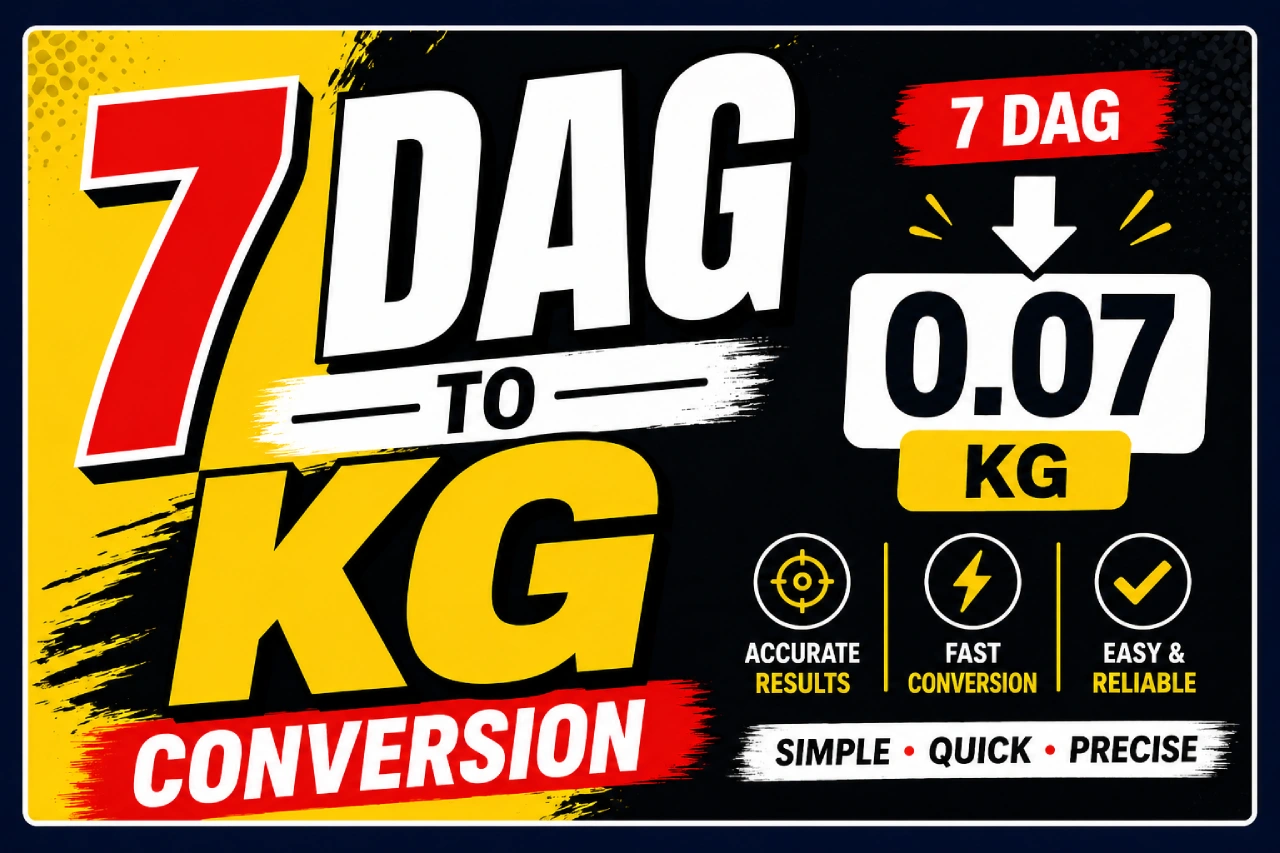
  • 7 dag to kg Conversion (Step-by-Step Guide)

    7 dag to kg Conversion (Step-by-Step Guide)

    If you’re looking for the quick answer:

    👉 7 dag = 0.07 kg

    That’s the exact conversion.

    But if you want to understand how this works (and how to convert any value like a pro), this guide will walk you through everything step by step—from basic definitions to real-world examples and quick tricks you can actually use.

    What Does “dag” Mean?

    The unit dag stands for decagram.

    Breaking It Down

    • deca- means 10
    • gram (g) is the base unit of mass in the metric system

    So:

    👉 1 dag = 10 grams

    This unit is commonly used in some countries (especially in Europe) for:

    • Food measurements
    • Grocery items
    • Cooking quantities

    What Is a Kilogram (kg)?

    A kilogram (kg) is the standard unit of mass in the metric system.

    Key Fact

    👉 1 kg = 1,000 grams

    Kilograms are used worldwide for:

    • Body weight
    • Food packaging
    • Scientific measurements

    Conversion Relationship: dag to kg

    dag to kg Converter

    Enter a value in decagrams (dag) to convert it into kilograms (kg).

    Result: 0 kg

    Formula: kg = dag ÷ 100

    To convert decagrams to kilograms, you need one key relationship.

    Step-by-Step Relationship

    • 1 dag = 10 grams
    • 1 kg = 1,000 grams

    So:

    👉 1 dag = 10 ÷ 1,000 = 0.01 kg

    Final Rule

    👉 1 dag = 0.01 kg

    Conversion Formula

    Now that you know the relationship, here’s the formula.

    👉 Kilograms = Decagrams × 0.01

    Step-by-Step Conversion: 7 dag to kg

    Let’s calculate it.

    Step 1: Start with the value

    7 dag

    Step 2: Multiply by 0.01

    7 × 0.01

    Step 3: Calculate

    = 0.07 kg

    Final Answer

    👉 7 dag = 0.07 kg

    Quick Conversion Table

    Here’s a helpful chart for similar values.

    Decagrams (dag)Kilograms (kg)
    1 dag0.01 kg
    5 dag0.05 kg
    7 dag0.07 kg
    10 dag0.1 kg
    50 dag0.5 kg
    100 dag1 kg

    This makes quick conversions easy.

    Why This Conversion Is So Simple

    The metric system is designed to be easy.

    Key Idea

    👉 Every step is based on powers of 10

    So converting:

    • dag → g → kg
      is just moving the decimal point.

    Shortcut

    👉 Move the decimal 2 places left

    Example:

    7 dag → 0.07 kg

    Visualizing the Conversion

    Let’s break it down in a simple way.

    • 7 dag = 70 grams
    • 70 grams = 0.07 kg

    So you’re simply scaling from grams to kilograms.

    Real-Life Examples

    Let’s make this practical.

    Example 1: Cooking

    A recipe calls for 7 dag of sugar:

    👉 That’s 0.07 kg

    Example 2: Grocery Shopping

    You buy 7 dag of cheese:

    👉 That’s 70 grams or 0.07 kg

    Example 3: Food Labels

    Some European labels use dag instead of grams.

    Understanding this helps you convert instantly.

    Comparing dag, g, and kg

    Here’s how these units relate.

    UnitValue in grams
    1 dag10 g
    1 kg1,000 g

    So:

    👉 1 kg = 100 dag

    Converting Back: kg to dag

    Sometimes you need the reverse conversion.

    Formula

    👉 dag = kg × 100

    Example

    0.07 kg × 100 = 7 dag

    Common Mistakes to Avoid

    1. Confusing dag with dg

    • dag (decagram) = 10 grams
    • dg (decigram) = 0.1 grams

    Huge difference.

    2. Forgetting the Decimal Shift

    Always move the decimal correctly when converting.

    3. Mixing Units

    Keep track of whether you’re working in grams or kilograms.

    Tips for Quick Mental Conversion

    Here are some easy tricks.

    Trick 1: Multiply by 10, Then Divide by 1,000

    7 dag → 70 g → 0.07 kg

    Trick 2: Move Decimal Two Places Left

    7 → 0.07

    Trick 3: Remember Key Benchmarks

    • 10 dag = 0.1 kg
    • 100 dag = 1 kg

    Why This Conversion Matters

    You might think this is a small conversion—but it’s surprisingly useful.

    1. International Cooking

    Many recipes use metric units.

    2. Travel and Shopping

    Different countries use different units.

    3. Science and Education

    Metric conversions are essential in learning.

    4. Everyday Awareness

    Understanding units helps you avoid mistakes.

    Practice Problems

    Try these yourself.

    1. 5 dag = ? kg
    2. 20 dag = ? kg
    3. 50 dag = ? kg
    4. 100 dag = ? kg

    Answers

    1. 0.05 kg
    2. 0.2 kg
    3. 0.5 kg
    4. 1 kg

    Frequently Asked Questions (FAQs)

    What is 7 dag in kg?

    👉 0.07 kg

    How do you convert dag to kg?

    Multiply by 0.01.

    What is 1 dag in kg?

    👉 0.01 kg

    Is dag commonly used?

    Yes, especially in Europe.

    What is 7 dag in grams?

    👉 70 grams

    What is the easiest way to convert?

    Move the decimal two places left.

    Is dag bigger than grams?

    Yes, 1 dag = 10 grams.

    What is 100 dag in kg?

    👉 1 kg

    Can calculators convert dag to kg?

    Yes, but it’s easy to do mentally.

    Why is the metric system easier?

    Because it’s based on powers of 10.

    Final Thoughts

    Converting 7 dag to kg is simple once you understand the relationship:

    👉 1 dag = 0.01 kg

    So:

    👉 7 dag = 0.07 kg

    The beauty of the metric system is how straightforward it is—just move the decimal and you’re done.

    Once you master this, you can convert between grams, kilograms, and decagrams effortlessly.

    Now here’s a quick question for you:
    Next time you see a value in dag, will you instantly know its equivalent in kilograms?

  • Pound to Kip Converter (lb to kip Guide)

    Pound to Kip Converter (lb to kip Guide)

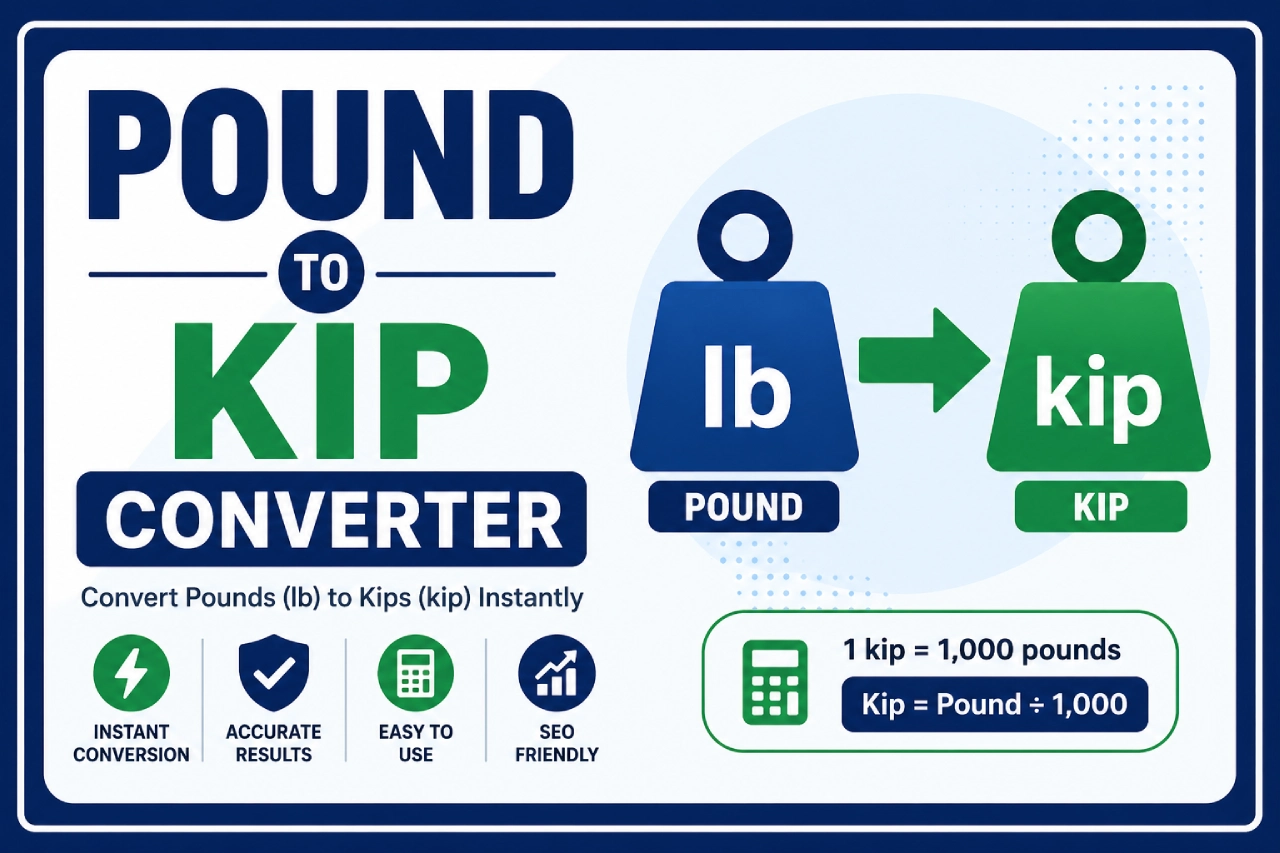
    If you’re looking for the quick answer:

    👉 1 kip = 1,000 pounds (lb)
    👉 1 pound = 0.001 kip

    So, to convert pounds to kips, simply divide by 1,000.

    For example:

    • 1,000 lb = 1 kip
    • 5,000 lb = 5 kips
    • 250 lb = 0.25 kip

    This conversion is widely used in structural engineering, construction, and load calculations, where large force values are easier to express in kips rather than pounds.

    In this guide, we’ll explain everything you need to know about converting pounds to kips, including formulas, examples, real-world applications, and tips for quick calculations.

    What Is a Pound (lb)?

    A pound (lb) is a unit of force or weight in the U.S. customary system.

    Definition

    👉 1 pound represents the force exerted by gravity on a mass of one pound at Earth’s surface.

    Common Uses

    • Body weight
    • Shipping weights
    • Everyday measurements

    Example:

    • A person might weigh 150–200 lb
    • A package might weigh 20 lb

    What Is a Kip?

    A kip is a larger unit of force used mainly in engineering.

    Definition

    👉 1 kip = 1,000 pounds

    The word “kip” comes from combining:

    • k (kilo = 1,000)
    • pound

    So:

    👉 kip = kilopound

    Common Uses

    • Structural engineering
    • Load calculations
    • Bridge design
    • Construction projects

    Example:

    • A beam might تحمل 10 kips of load
    • A column might support 50 kips

    Pound to Kip Conversion Formula

    Pound to Kip Converter

    Enter a value in pounds to convert it into kips.

    The conversion is simple.

    Formula

    👉 Kips = Pounds ÷ 1,000

    Reverse Formula

    👉 Pounds = Kips × 1,000

    Step-by-Step Conversion Example

    Let’s convert 7,500 pounds to kips.

    Step 1: Start with pounds

    7,500 lb

    Step 2: Divide by 1,000

    7,500 ÷ 1,000

    Step 3: Calculate

    = 7.5 kips

    Final Answer

    👉 7,500 lb = 7.5 kips

    Quick Conversion Table

    Here’s a handy reference chart.

    Pounds (lb)Kips
    100 lb0.1 kip
    500 lb0.5 kip
    1,000 lb1 kip
    2,500 lb2.5 kips
    5,000 lb5 kips
    10,000 lb10 kips

    This makes conversions quick and easy.

    Why Use Kips Instead of Pounds?

    You might wonder why engineers prefer kips.

    1. Simplicity

    Large numbers are easier to handle.

    Instead of:

    👉 50,000 lb

    You write:

    👉 50 kips

    2. Cleaner Calculations

    Engineering formulas become simpler.

    3. Standard Practice

    Kips are widely used in:

    • Structural engineering
    • Civil engineering
    • Load analysis

    Real-World Applications

    Understanding pound-to-kip conversion is essential in many fields.

    1. Structural Engineering

    Engineers use kips to measure:

    • Load-bearing capacity
    • Stress on beams
    • Structural safety

    2. Construction

    Builders use kips to calculate:

    • Material strength
    • Load distribution
    • Safety margins

    3. Bridge Design

    Loads on bridges are measured in kips.

    4. Mechanical Engineering

    Used in force and stress calculations.

    Pounds vs Kips: Key Differences

    UnitSizeUsage
    Pound (lb)SmallEveryday measurements
    KipLargeEngineering calculations

    Both represent force—but kips simplify large values.

    Converting Kips Back to Pounds

    Sometimes you need to reverse the conversion.

    Formula

    👉 Pounds = Kips × 1,000

    Example

    8 kips × 1,000 = 8,000 lb

    Understanding the Concept Visually

    Think of it like this:

    • 1 kip = a bundle of 1,000 pounds
    • 5 kips = 5 bundles of 1,000 pounds

    This makes it easier to visualize large forces.

    Common Mistakes to Avoid

    1. Forgetting the Conversion Factor

    Always remember:

    👉 1 kip = 1,000 lb

    2. Mixing Units

    Don’t confuse pounds (force) with pounds (mass).

    3. Misplacing Decimal Points

    Example:

    • 250 lb = 0.25 kip, not 2.5 kips

    Tips for Quick Mental Conversion

    Here are some simple tricks.

    Trick 1: Move the Decimal

    Divide pounds by 1,000.

    Example:

    2,500 lb → 2.5 kips

    Trick 2: Add Three Zeros

    To convert back:

    5 kips → 5,000 lb

    Trick 3: Think in Thousands

    Kips represent thousands of pounds.

    Practical Examples

    Example 1: Beam Load

    A beam تحمل 12,000 lb:

    👉 12,000 ÷ 1,000 = 12 kips

    Example 2: Column Strength

    A column supports 30 kips:

    👉 30 × 1,000 = 30,000 lb

    Example 3: Small Load

    A load of 150 lb:

    👉 150 ÷ 1,000 = 0.15 kip

    Why This Conversion Matters

    Understanding pound-to-kip conversion helps you:

    • Read engineering drawings
    • Interpret load calculations
    • Avoid costly mistakes
    • Communicate clearly in technical fields

    Frequently Asked Questions (FAQs)

    What is 1 pound in kips?

    👉 0.001 kip

    What is 1 kip in pounds?

    👉 1,000 pounds

    How do you convert pounds to kips?

    Divide by 1,000.

    What is 5,000 lb in kips?

    👉 5 kips

    Why are kips used?

    To simplify large force values in engineering.

    Is kip an SI unit?

    No, it’s part of the U.S. customary system.

    Can calculators convert lb to kip?

    Yes, it’s a simple division.

    What is 250 lb in kips?

    👉 0.25 kip

    Where are kips commonly used?

    In structural and civil engineering.

    Is kip the same as kilonewton?

    No, they are different units.

    Final Thoughts

    Converting pounds to kips is one of the simplest conversions you’ll encounter.

    The key rule is:

    👉 Kips = Pounds ÷ 1,000

    Once you understand that a kip represents 1,000 pounds, everything becomes straightforward.

    Whether you’re working on construction projects, reading engineering specs, or studying structural design, this conversion is essential.

    Now here’s a quick question for you:
    Next time you see a load measured in kips, will you instantly know its value in pounds?

  • Convert PSI to Megapascal (MPa) Easily

    Convert PSI to Megapascal (MPa) Easily

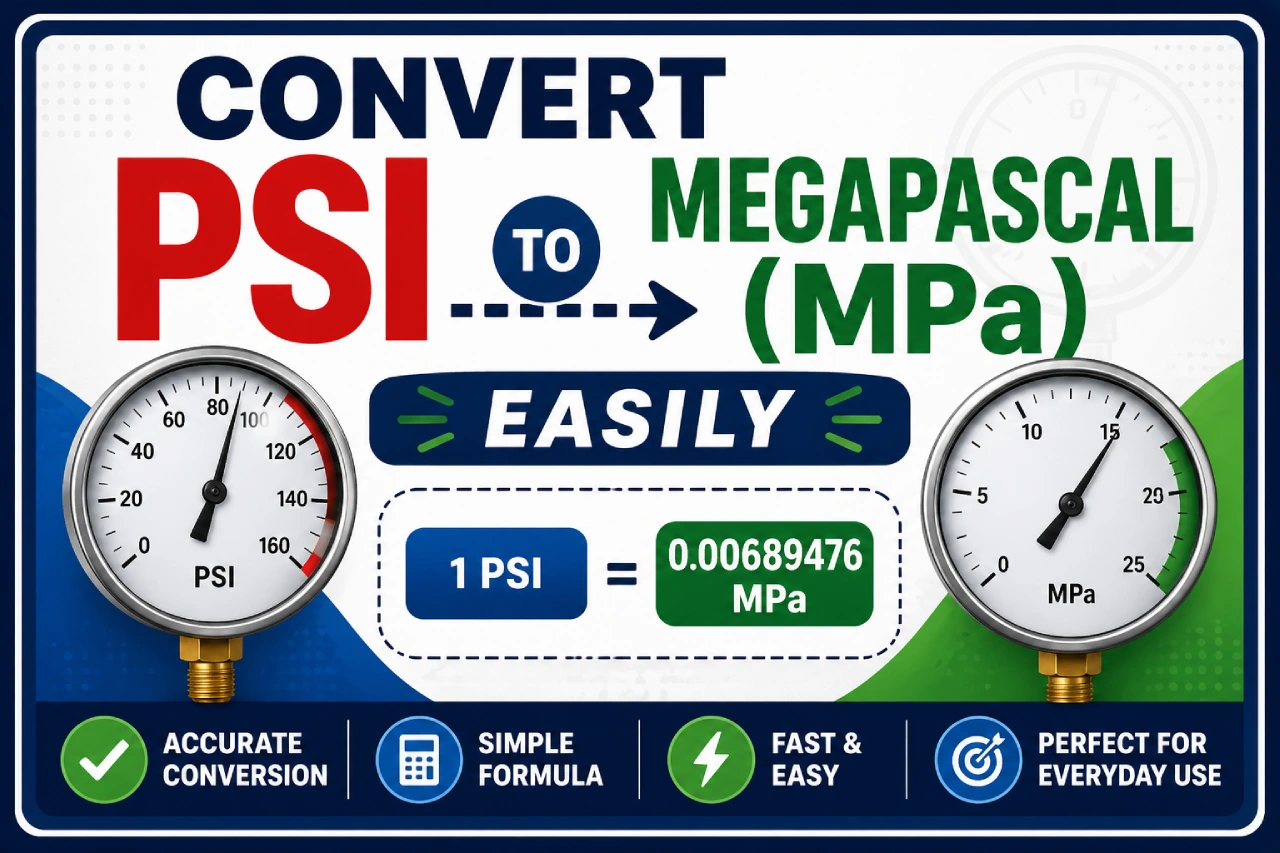
    If you’re looking for the quick answer:

    👉 1 PSI = 0.00689476 MPa

    So, to convert PSI to megapascal (MPa):

    👉 MPa = PSI × 0.00689476

    For example:

    • 100 PSI ≈ 0.689 MPa
    • 500 PSI ≈ 3.447 MPa
    • 1,000 PSI ≈ 6.895 MPa

    This conversion is widely used in engineering, automotive systems, hydraulics, and industrial pressure measurements, especially when switching between U.S. and metric systems.

    In this guide, we’ll break everything down clearly—what PSI and MPa mean, how to convert them, and how to use this conversion in real-world situations.

    Understanding PSI and Megapascal

    Before jumping into calculations, let’s understand the units.

    What Is PSI?

    PSI (pounds per square inch) is a unit of pressure used mainly in the United States.

    Definition

    👉 It measures how much force (in pounds) is applied to one square inch of area.

    Common Uses

    • Tire pressure
    • Air compressors
    • Gas systems
    • Hydraulic equipment

    Example:

    • Car tires: 30–35 PSI
    • Air compressors: 90–120 PSI

    What Is Megapascal (MPa)?

    A megapascal (MPa) is a metric unit of pressure.

    Definition

    👉 1 MPa = 1,000,000 pascals (Pa)

    It’s part of the SI (International System of Units).

    Common Uses

    • Engineering materials
    • Industrial systems
    • Structural design
    • Scientific calculations

    Example:

    • Concrete strength: 20–40 MPa
    • Steel strength: 250+ MPa

    Why Convert PSI to MPa?

    You may need this conversion when:

    • Working with international equipment
    • Reading engineering specifications
    • Comparing pressure values across systems
    • Using scientific or SI-based measurements

    Conversion Formula

    PSI to Megapascal (MPa) Converter

    Result: 0 MPa

    Here’s the key formula:

    👉 MPa = PSI × 0.00689476

    Reverse Conversion

    👉 PSI = MPa ÷ 0.00689476

    These formulas are exact and widely accepted.

    Step-by-Step Conversion Example

    Let’s convert 250 PSI to MPa.

    Step 1: Start with PSI

    250 PSI

    Step 2: Multiply by the conversion factor

    250 × 0.00689476

    Step 3: Calculate

    = 1.72369 MPa

    Final Answer

    👉 250 PSI ≈ 1.72 MPa

    Quick Conversion Table

    Here’s a handy reference chart.

    PSIMPa
    1 PSI0.006895 MPa
    10 PSI0.06895 MPa
    50 PSI0.3447 MPa
    100 PSI0.6895 MPa
    500 PSI3.447 MPa
    1,000 PSI6.895 MPa

    This helps you estimate values quickly.

    Real-World Examples

    Let’s make this practical.

    Example 1: Tire Pressure

    A car tire at 32 PSI:

    32 × 0.00689476 ≈ 0.22 MPa

    Example 2: Hydraulic System

    A hydraulic system at 1,500 PSI:

    1,500 × 0.00689476 ≈ 10.34 MPa

    Example 3: Air Compressor

    An air compressor at 100 PSI:

    100 × 0.00689476 = 0.689 MPa

    PSI vs MPa: Key Differences

    UnitSystemTypical Use
    PSIU.S. customaryEveryday pressure (tires, air)
    MPaMetric (SI)Engineering and industrial use

    PSI is more common in daily U.S. use, while MPa is standard in technical fields worldwide.

    Understanding the Relationship

    Let’s simplify the relationship:

    👉 1 MPa ≈ 145 PSI

    This is useful for quick mental conversion.

    Example

    145 PSI ≈ 1 MPa
    290 PSI ≈ 2 MPa

    Converting MPa Back to PSI

    Sometimes you need the reverse.

    Formula

    👉 PSI = MPa × 145.038

    Example

    2 MPa × 145.038 ≈ 290 PSI

    Why MPa Is Used in Engineering

    MPa is preferred because:

    • It fits neatly into the metric system
    • It handles large pressure values easily
    • It’s standardized globally

    Common Mistakes to Avoid

    1. Using the Wrong Conversion Factor

    Always use:

    👉 0.00689476 for PSI → MPa

    2. Confusing kPa and MPa

    • 1 MPa = 1,000 kPa

    3. Rounding Too Early

    Keep precision until the final result.

    Tips for Quick Mental Conversion

    Here are some simple tricks.

    Trick 1: Divide by 145

    To convert PSI → MPa quickly:

    100 PSI ÷ 145 ≈ 0.69 MPa

    Trick 2: Multiply by 0.007

    Close enough for quick estimates.

    Trick 3: Use Benchmarks

    • 100 PSI ≈ 0.69 MPa
    • 1,000 PSI ≈ 6.9 MPa

    Practical Applications

    1. Automotive Industry

    Used for:

    • Tire pressure
    • Engine systems

    2. Construction

    Material strength is measured in MPa.

    3. Manufacturing

    Machines operate under specific pressure limits.

    4. Oil and Gas

    Pressure measurements are critical for safety.

    Frequently Asked Questions (FAQs)

    What is 1 PSI in MPa?

    👉 0.00689476 MPa

    How do you convert PSI to MPa?

    Multiply by 0.00689476.

    What is 100 PSI in MPa?

    👉 0.689 MPa

    What is 1 MPa in PSI?

    👉 145 PSI

    Why is MPa used instead of PSI?

    Because it’s part of the SI system.

    Is PSI higher than MPa?

    No, they measure the same thing in different units.

    Can calculators convert PSI to MPa?

    Yes, easily.

    What is 500 PSI in MPa?

    👉 3.447 MPa

    Is MPa used worldwide?

    Yes, especially in engineering and science.

    What is the easiest way to estimate?

    Divide PSI by 145.

    Final Thoughts

    Converting PSI to megapascal (MPa) is straightforward once you know the formula:

    👉 MPa = PSI × 0.00689476

    This conversion is essential when working between U.S. and metric systems, especially in engineering, automotive, and industrial applications.

    The key takeaway is simple:

    👉 1 PSI ≈ 0.0069 MPa
    👉 1 MPa ≈ 145 PSI

    Once you remember these, you can convert values quickly and confidently.

    Now here’s a quick question for you:
    Next time you see a pressure value in PSI, will you instantly know what it means in MPa?

  • How Big Is 490 × 420 mm to Inches?

    How Big Is 490 × 420 mm to Inches?

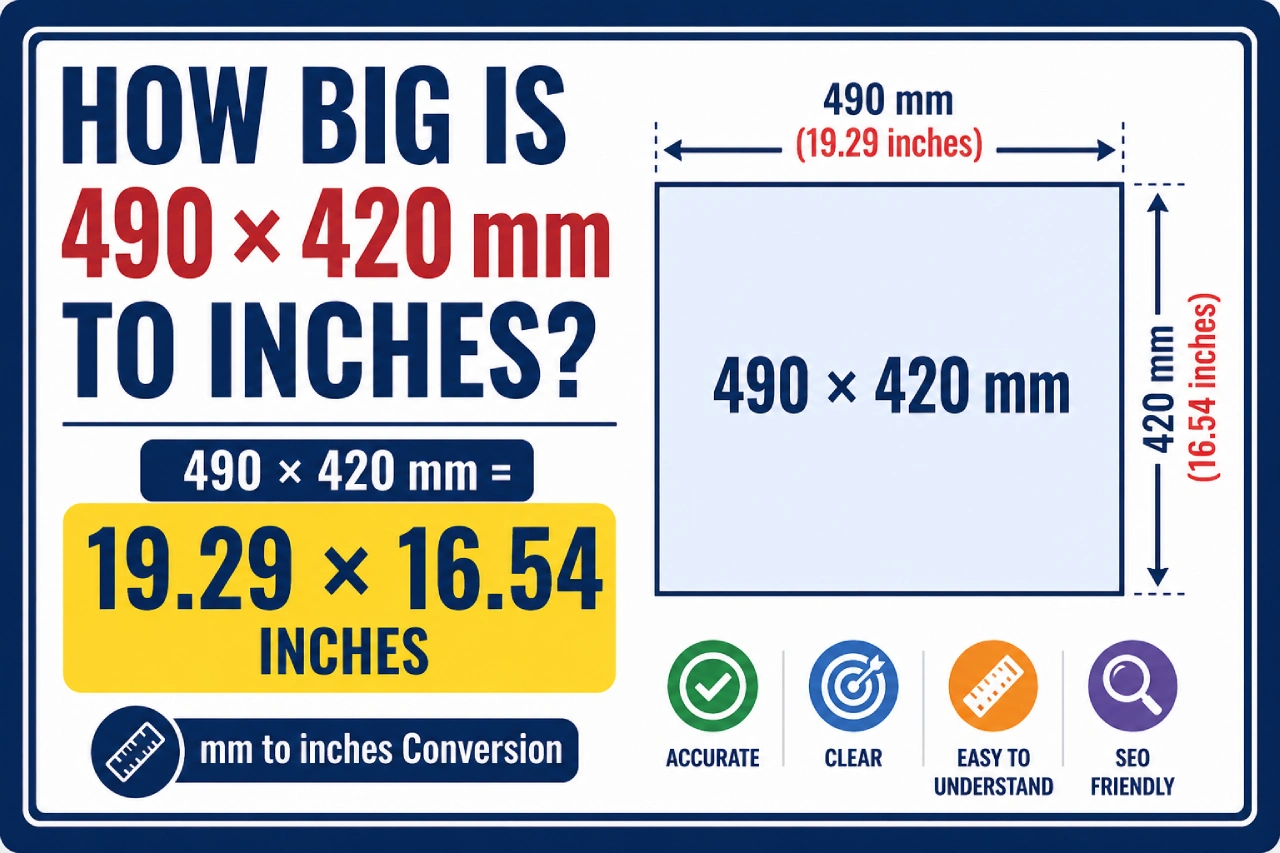
    If you’re looking for the quick answer:

    👉 490 × 420 mm = 19.29 × 16.54 inches (approximately)

    So in simple terms:

    👉 490 mm ≈ 19.29 inches
    👉 420 mm ≈ 16.54 inches

    This size is roughly comparable to a medium-to-large poster, art print, or document sheet, slightly larger than standard A3 paper.

    In this guide, we’ll break down the conversion step by step, explain what this size looks like in real life, and help you understand exactly how big 490 × 420 mm is.

    Understanding Millimeters and Inches

    Before we convert, let’s clarify the units.

    What Is a Millimeter (mm)?

    A millimeter is a unit in the metric system.

    • 1 mm = 0.1 cm
    • 1,000 mm = 1 meter

    Millimeters are commonly used for:

    • Paper sizes
    • Engineering drawings
    • Product dimensions

    What Is an Inch?

    An inch is part of the U.S. customary system.

    • 1 inch = 2.54 cm
    • 1 inch = 25.4 mm

    Inches are widely used in the U.S. for:

    • Screen sizes
    • Furniture
    • Paper and frames

    Conversion Formula: mm to Inches

    mm to Inches Converter

    Enter a value in millimeters to convert it into inches.

    Result will appear here

    The standard formula is:

    👉 Inches = Millimeters ÷ 25.4

    This works for any measurement.

    Step-by-Step Conversion

    Let’s convert both dimensions.

    Convert 490 mm to inches

    490 ÷ 25.4 = 19.29 inches

    Convert 420 mm to inches

    420 ÷ 25.4 = 16.54 inches

    Final Dimensions

    👉 490 × 420 mm ≈ 19.29 × 16.54 inches

    Rounded Measurements (Practical Use)

    In everyday use, you might round the numbers.

    👉 ≈ 19.3 × 16.5 inches

    This makes it easier for:

    • Framing
    • Printing
    • Measurements

    Visualizing the Size

    Numbers are helpful—but let’s make this practical.

    Compared to Common Paper Sizes

    • Slightly larger than A3 (420 × 297 mm)
    • Smaller than A2 (594 × 420 mm)

    So:

    👉 It sits between A3 and A2 sizes

    Compared to Everyday Objects

    490 × 420 mm is roughly:

    • A medium poster or wall art piece
    • A large laptop screen footprint
    • About the size of a small tabletop tray

    Landscape vs Portrait Orientation

    The dimensions can be used in two orientations.

    Landscape (Wide)

    👉 490 mm width × 420 mm height
    👉 19.29" × 16.54"

    Portrait (Tall)

    👉 420 mm width × 490 mm height
    👉 16.54" × 19.29"

    The orientation changes how it looks visually.

    Real-Life Uses of 490 × 420 mm

    This size is commonly used in several applications.

    1. Posters and Art Prints

    Perfect for:

    • Wall decor
    • Graphic designs
    • Photography prints

    2. Presentation Boards

    Used in:

    • School projects
    • Office presentations

    3. Packaging and Layout Design

    Designers often work with custom sizes like this.

    4. Printing Projects

    Used for:

    • Flyers
    • Brochures
    • Custom documents

    Why Convert mm to Inches?

    This conversion is essential because:

    • The U.S. uses inches
    • Most of the world uses millimeters

    You often need both when:

    • Ordering prints online
    • Buying frames
    • Working with international suppliers

    Conversion Table for Similar Sizes

    Here’s a quick reference.

    MillimetersInches
    400 mm15.75 in
    420 mm16.54 in
    450 mm17.72 in
    490 mm19.29 in
    500 mm19.69 in

    This helps with quick comparisons.

    Area Calculation

    Let’s calculate the total area.

    In Square Millimeters

    490 × 420 = 205,800 mm²

    Convert to Square Inches

    205,800 ÷ (25.4²) ≈ 318.99 in²

    👉 So the total area is about 319 square inches

    Aspect Ratio

    Aspect ratio tells you the shape.

    Formula

    490 : 420 = 1.17 : 1

    This means:

    👉 It’s slightly wider than tall (landscape)

    Common Mistakes to Avoid

    1. Using the Wrong Conversion Factor

    Always use:

    👉 1 inch = 25.4 mm

    2. Rounding Too Early

    Keep precision until the final step.

    3. Confusing Dimensions

    Always convert both width and height separately.

    Tips for Quick Conversion

    Trick 1: Divide by 25

    Close enough for quick estimates.

    Trick 2: Use Benchmarks

    • 500 mm ≈ 19.7 inches
    • 400 mm ≈ 15.7 inches

    Trick 3: Use Online Tools

    Helpful for precise conversions.

    Real-World Examples

    Example 1: Buying a Frame

    If a frame is listed as 19 × 16 inches, it will closely fit 490 × 420 mm.

    Example 2: Printing a Poster

    You can request:

    👉 19.3 × 16.5 inches

    Example 3: Designing Artwork

    Set your canvas to:

    👉 490 × 420 mm or 19.29 × 16.54 inches

    Frequently Asked Questions (FAQs)

    How big is 490 × 420 mm in inches?

    👉 19.29 × 16.54 inches

    Is 490 × 420 mm bigger than A3?

    Yes, slightly larger.

    What size frame fits 490 × 420 mm?

    A frame around 19 × 16 inches works well.

    How do you convert mm to inches?

    Divide by 25.4.

    What is 500 mm in inches?

    👉 19.69 inches

    Can I round the size?

    Yes, to 19.3 × 16.5 inches for practical use.

    Is this size good for posters?

    Yes, it’s ideal for medium posters.

    What is the aspect ratio?

    👉 About 1.17:1

    Is mm more accurate than inches?

    Yes, metric units allow finer precision.

    Can printers handle this size?

    Yes, most professional printers can.

    Final Thoughts

    So, how big is 490 × 420 mm?

    👉 About 19.29 × 16.54 inches

    It’s a versatile size—perfect for posters, prints, and presentations.

    Once you understand the conversion:

    👉 Inches = mm ÷ 25.4

    You can easily switch between metric and U.S. measurements.

    Whether you’re printing artwork, buying a frame, or designing something custom, this conversion helps you get it right the first time.

    Now here’s a quick question for you:
    Next time you see dimensions in millimeters, will you instantly picture them in inches?

  • Convert MBH to Btu (IT)/Hour Easily

    Convert MBH to Btu (IT)/Hour Easily

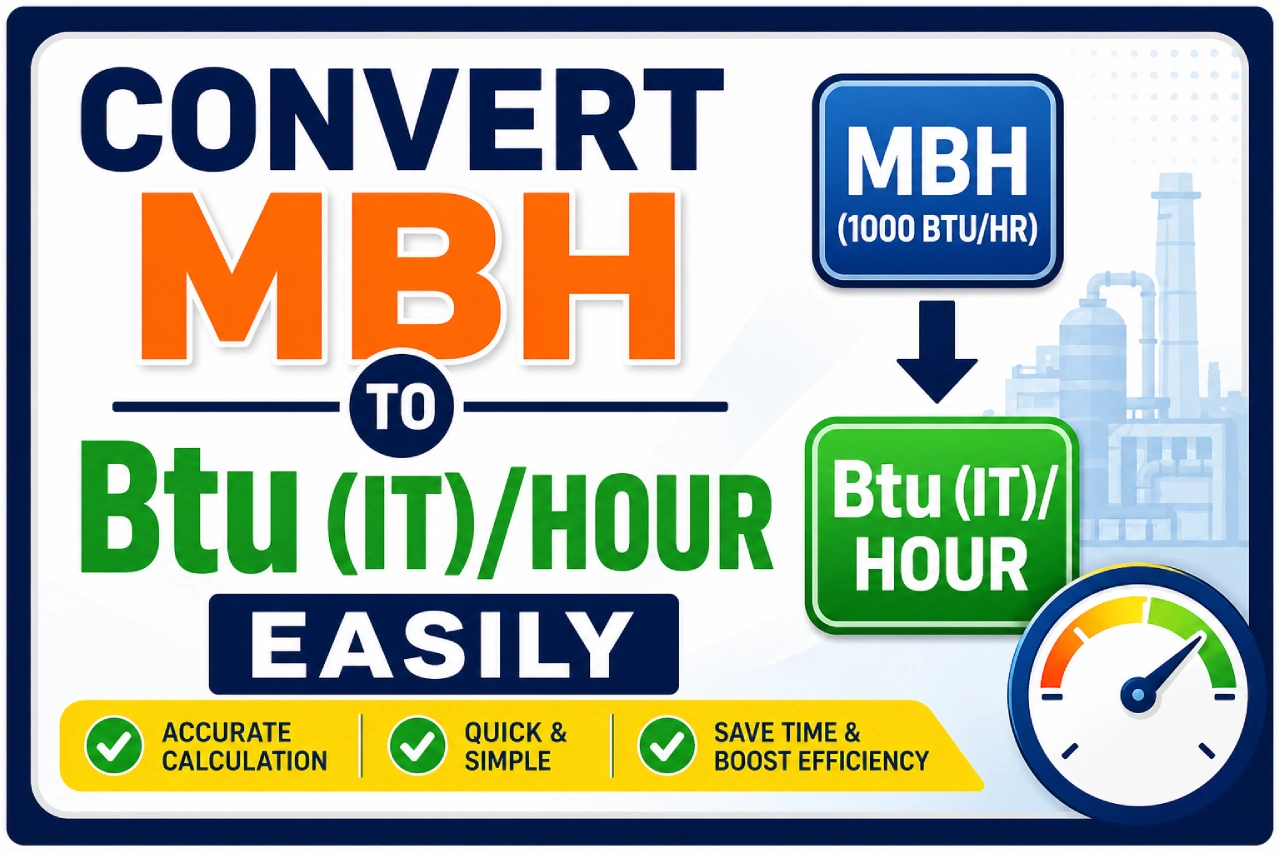
    If you’re looking for the quick answer:

    👉 1 MBH = 1,000 Btu (IT)/hour

    So, to convert MBH to Btu (IT)/hour, simply multiply by 1,000.

    For example:

    • 1 MBH = 1,000 Btu/hr
    • 10 MBH = 10,000 Btu/hr
    • 75 MBH = 75,000 Btu/hr

    This is one of the simplest and most common conversions in HVAC systems, heating equipment, boilers, and energy calculations.

    In this guide, we’ll break down what MBH means, explain Btu (IT)/hour, show step-by-step calculations, and help you confidently apply this conversion in real-world situations.

    What Does MBH Mean?

    The term MBH might look confusing at first, but it’s actually straightforward.

    Breaking It Down

    • M = 1,000 (Roman numeral)
    • BH = British Thermal Units per hour

    So:

    👉 MBH = 1,000 Btu per hour

    It’s simply a shorthand used in engineering to avoid writing large numbers repeatedly.

    Example

    Instead of writing:

    👉 50,000 Btu/hr

    Engineers write:

    👉 50 MBH

    Much cleaner and easier to read.

    What Is Btu (IT)/Hour?

    A Btu (British Thermal Unit) is a unit of energy.

    Definition

    👉 1 Btu (IT) is the amount of heat required to raise the temperature of one pound of water by 1°F under standard conditions.

    The “IT” stands for International Table, which standardizes the measurement.

    Btu per Hour

    When you see Btu/hr, it refers to a rate of energy transfer (power).

    For example:

    • A heater rated at 20,000 Btu/hr produces that much heat every hour
    • An air conditioner removes heat at a certain Btu/hr rate

    MBH to Btu (IT)/Hour Conversion Formula

    MBH to Btu (IT)/Hour Converter

    Result: 0 Btu (IT)/hour

    Formula: 1 MBH = 1,000 Btu (IT)/hour

    The conversion is extremely simple.

    Formula

    Btu/hr = MBH × 1,000

    Why It Works

    Because:

    👉 1 MBH is defined as exactly 1,000 Btu/hr

    This is a fixed relationship, not an approximation.

    Step-by-Step Conversion Example

    Let’s convert 35 MBH to Btu/hr.

    Step 1: Start with MBH

    35 MBH

    Step 2: Multiply by 1,000

    35 × 1,000

    Step 3: Calculate

    = 35,000 Btu/hr

    Final Answer

    👉 35 MBH = 35,000 Btu/hr

    Quick Conversion Table

    Here’s a helpful reference chart.

    MBHBtu (IT)/hr
    1 MBH1,000 Btu/hr
    5 MBH5,000 Btu/hr
    10 MBH10,000 Btu/hr
    25 MBH25,000 Btu/hr
    50 MBH50,000 Btu/hr
    100 MBH100,000 Btu/hr

    This makes quick conversions easy without calculation.

    Why Use MBH Instead of Btu/hr?

    You might wonder why MBH exists at all.

    1. Simplicity

    Large numbers become easier to manage.

    Instead of:

    👉 120,000 Btu/hr

    You write:

    👉 120 MBH

    2. Industry Standard

    MBH is widely used in:

    • HVAC systems
    • Furnace ratings
    • Boiler specifications

    3. Cleaner Documentation

    Engineering drawings and specs look more readable.

    Real-World Applications

    Understanding MBH to Btu/hr is essential in many fields.

    1. HVAC Systems

    Heating and cooling equipment is often rated in MBH.

    Example:

    • A furnace rated at 80 MBH = 80,000 Btu/hr

    2. Boilers

    Boiler output is commonly expressed in MBH.

    3. Air Conditioning

    Cooling capacity is measured in Btu/hr.

    4. Energy Calculations

    Engineers use these units for heat transfer calculations.

    MBH vs Btu/hr: Key Differences

    UnitMeaningUsage
    MBHThousands of Btu/hrSimplified notation
    Btu/hrHeat transfer rateDetailed measurement

    Both represent the same thing—just in different formats.

    Converting Btu/hr Back to MBH

    Sometimes you need the reverse conversion.

    Formula

    MBH = Btu/hr ÷ 1,000

    Example

    50,000 ÷ 1,000 = 50 MBH

    MBH Compared to Other Energy Units

    MBH to Kilowatts (kW)

    • 1 MBH ≈ 0.293 kW

    Btu/hr to Watts

    • 1 Btu/hr ≈ 0.293 watts

    These conversions are useful when working with international systems.

    Common Mistakes to Avoid

    1. Misinterpreting “M”

    Some people think “M” means million.

    👉 In MBH, it means 1,000, not 1,000,000.

    2. Confusing Btu and Btu/hr

    • Btu = energy
    • Btu/hr = energy per hour (power)

    3. Overcomplicating the Formula

    This conversion is direct—no need for complex math.

    Tips for Quick Mental Conversion

    Trick 1: Add Three Zeros

    Multiply MBH by 1,000.

    Example:

    25 MBH → 25,000 Btu/hr

    Trick 2: Remove Three Zeros

    Convert back:

    75,000 Btu/hr → 75 MBH

    Trick 3: Think “Thousands”

    MBH always represents thousands of Btu/hr.

    Practical Examples

    Example 1: Furnace Rating

    A furnace rated at 60 MBH:

    👉 60 × 1,000 = 60,000 Btu/hr

    Example 2: Boiler Output

    A boiler rated at 120 MBH:

    👉 120 × 1,000 = 120,000 Btu/hr

    Example 3: Small Heater

    A heater rated at 8 MBH:

    👉 8 × 1,000 = 8,000 Btu/hr

    Why This Conversion Matters

    Understanding MBH to Btu/hr helps you:

    • Choose the right HVAC system
    • Compare heating capacities
    • Interpret equipment specifications
    • Avoid sizing mistakes

    Frequently Asked Questions (FAQs)

    What does MBH stand for?

    👉 1,000 Btu per hour

    How do you convert MBH to Btu/hr?

    Multiply by 1,000.

    Is MBH the same as Btu/hr?

    Yes, but MBH is a shorthand.

    What is 10 MBH in Btu/hr?

    👉 10,000 Btu/hr

    What is 100 MBH in Btu/hr?

    👉 100,000 Btu/hr

    Why is MBH used?

    To simplify large numbers in HVAC systems.

    What is the difference between Btu and Btu/hr?

    Btu measures energy, while Btu/hr measures power.

    Can calculators convert MBH to Btu/hr?

    Yes, but it’s a simple multiplication.

    Is the conversion exact?

    👉 Yes.
    1 MBH = 1,000 Btu/hr

    Where is MBH commonly used?

    In HVAC, boilers, and heating systems.

    Final Thoughts

    Converting MBH to Btu (IT)/hour is one of the simplest conversions in energy measurement.

    The key rule is:

    👉 1 MBH = 1,000 Btu/hr

    Once you understand that MBH is just a shorthand for thousands of Btu/hr, everything becomes easy.

    Whether you’re working with HVAC systems, comparing heating equipment, or reading technical specifications, this conversion helps you interpret data accurately and confidently.

    Now here’s a quick question for you:
    Next time you see a furnace rated in MBH, will you instantly know its Btu/hr value?

  • Mole Conversion Chart (Complete Chemistry Guide)

    Mole Conversion Chart (Complete Chemistry Guide)

    If you’re looking for a quick answer:

    👉 A mole (mol) is a unit used to count particles in chemistry, and 1 mole equals 6.022 × 10²³ particles.

    This number is known as Avogadro’s number, and it’s the foundation for all mole conversions.

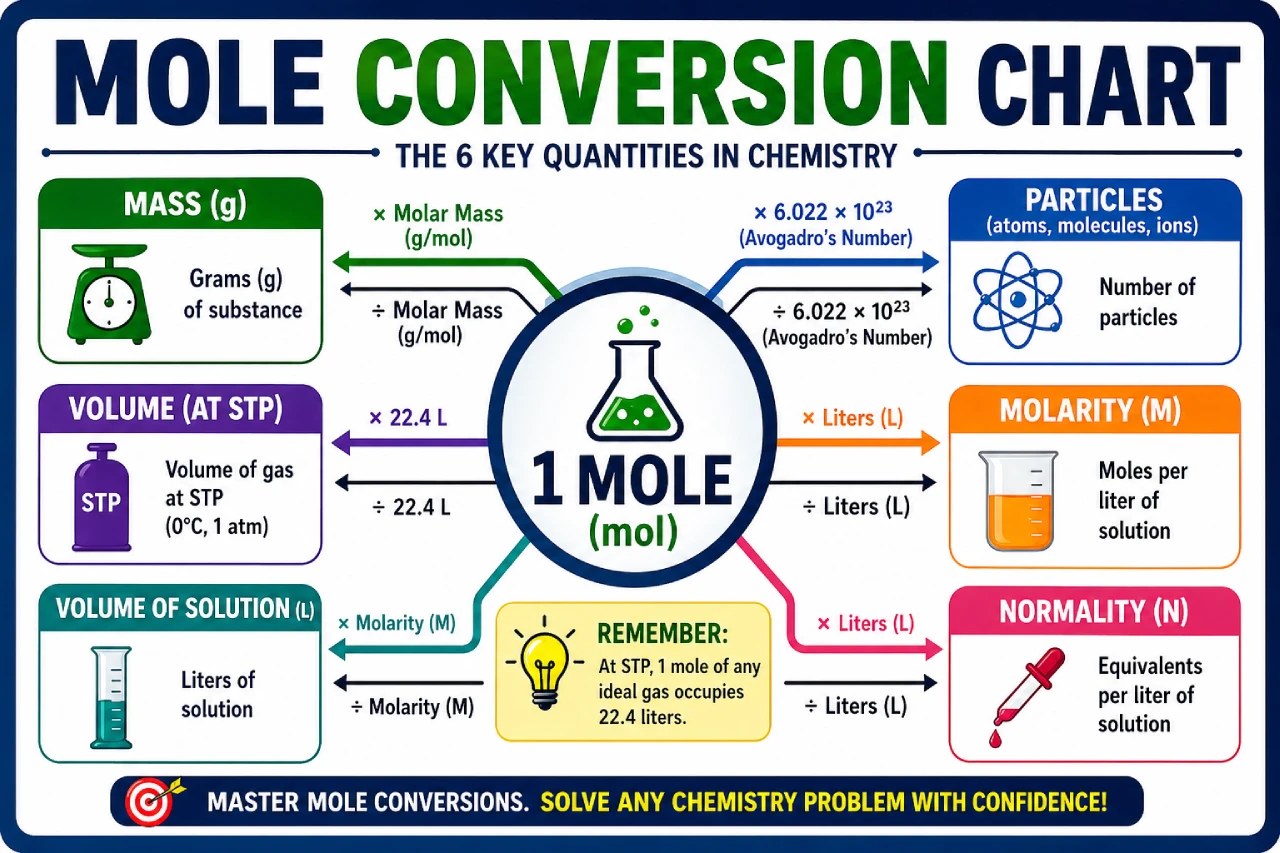
    A mole conversion chart helps you quickly convert between:

    • Moles and grams
    • Moles and particles (atoms, molecules)
    • Moles and volume (for gases)

    In this guide, we’ll walk through a complete mole conversion chart, explain how to use it, and show step-by-step examples so you can confidently solve chemistry problems.

    What Is a Mole in Chemistry?

    A mole is a counting unit—just like a dozen means 12.

    But instead of 12, a mole represents:

    👉 6.022 × 10²³ particles

    These particles could be:

    • Atoms
    • Molecules
    • Ions

    Why Use Moles?

    Because atoms and molecules are incredibly small.

    Instead of counting each one individually, chemists use moles to simplify calculations.

    The Core Mole Relationships

    Before looking at the chart, you need to understand the three main relationships.

    1. Moles to Particles

    👉 1 mole = 6.022 × 10²³ particles

    2. Moles to Grams

    👉 Moles = Mass (grams) ÷ Molar Mass

    3. Moles to Volume (Gases)

    👉 1 mole of gas = 22.4 liters (at STP)

    These three relationships form the foundation of all mole conversions.

    Mole Conversion Chart

    Mole Conversion Chart & Converter

    Convert between moles, particles, grams, liters of gas, and molarity using simple chemistry formulas.

    Mole Conversion Chart

    Conversion Formula
    Moles to Particles Moles × 6.022 × 10²³
    Particles to Moles Particles ÷ 6.022 × 10²³
    Moles to Grams Moles × Molar Mass
    Grams to Moles Grams ÷ Molar Mass
    Moles to Liters at STP Moles × 22.4
    Liters to Moles at STP Liters ÷ 22.4
    Molarity Moles ÷ Liters of Solution

    Here’s a simplified mole conversion chart you can use.

    Basic Mole Conversion Chart

    FromToFormula
    MolesParticlesMoles × 6.022 × 10²³
    ParticlesMolesParticles ÷ 6.022 × 10²³
    MolesGramsMoles × Molar Mass
    GramsMolesGrams ÷ Molar Mass
    MolesLiters (gas)Moles × 22.4
    LitersMolesLiters ÷ 22.4

    This chart is your quick reference for solving most chemistry problems.

    Understanding Molar Mass

    To convert between moles and grams, you need molar mass.

    What Is Molar Mass?

    Molar mass is the mass of 1 mole of a substance, measured in grams per mole (g/mol).

    Example

    • Oxygen (O₂) = 32 g/mol
    • Water (H₂O) = 18 g/mol

    You can find molar mass using the periodic table.

    Step-by-Step Examples

    Let’s apply the chart in real problems.

    Example 1: Moles to Particles

    Convert 2 moles of carbon atoms into particles.

    Step 1: Use the formula

    Particles = Moles × Avogadro’s number

    Step 2: Calculate

    2 × (6.022 × 10²³) = 1.204 × 10²⁴ atoms

    👉 Final Answer: 1.204 × 10²⁴ atoms

    Example 2: Grams to Moles

    Convert 36 grams of water (H₂O) into moles.

    Step 1: Find molar mass

    H₂O = 18 g/mol

    Step 2: Use formula

    Moles = Grams ÷ Molar Mass

    Step 3: Calculate

    36 ÷ 18 = 2 moles

    👉 Final Answer: 2 moles

    Example 3: Moles to Grams

    Convert 3 moles of CO₂ into grams.

    Step 1: Find molar mass

    CO₂ = 44 g/mol

    Step 2: Multiply

    3 × 44 = 132 grams

    👉 Final Answer: 132 grams

    Example 4: Moles to Volume

    Convert 1 mole of gas to volume at STP.

    👉 1 mole = 22.4 liters

    👉 Final Answer: 22.4 L

    Why the Mole Conversion Chart Matters

    This chart is essential for:

    1. Chemical Reactions

    Balancing equations requires mole relationships.

    2. Lab Work

    You need precise conversions for experiments.

    3. Stoichiometry

    Moles are the backbone of reaction calculations.

    4. Real-World Applications

    Used in:

    • Pharmaceuticals
    • Food science
    • Environmental studies

    Common Mistakes to Avoid

    1. Forgetting Units

    Always include units like g/mol or liters.

    2. Using Wrong Molar Mass

    Double-check calculations from the periodic table.

    3. Mixing Up Formulas

    Remember:

    • Multiply when converting from moles
    • Divide when converting to moles

    Tips for Using the Mole Conversion Chart

    Here are some practical tips.

    Tip 1: Identify What You’re Given

    Start with:

    • Grams?
    • Moles?
    • Particles?

    Tip 2: Identify What You Need

    Find the target unit.

    Tip 3: Use the Chart as a Map

    Follow the correct formula step by step.

    Tip 4: Cancel Units

    Dimensional analysis helps avoid mistakes.

    Visualizing the Mole Concept

    Think of a mole like a “super-sized dozen.”

    • 1 dozen = 12 items
    • 1 mole = 6.022 × 10²³ items

    This makes it easier to understand.

    Advanced Mole Conversions

    Sometimes conversions require multiple steps.

    Example

    Convert grams → moles → particles.

    Steps

    1. Convert grams to moles
    2. Convert moles to particles

    This is called multi-step conversion.

    Frequently Asked Questions (FAQs)

    What is a mole in chemistry?

    A mole is a unit representing 6.022 × 10²³ particles.

    What is Avogadro’s number?

    👉 6.022 × 10²³

    How do you convert moles to grams?

    Multiply by molar mass.

    How do you convert grams to moles?

    Divide by molar mass.

    What is molar mass?

    The mass of 1 mole of a substance.

    What is STP?

    Standard Temperature and Pressure.

    How many liters are in 1 mole of gas?

    👉 22.4 liters (at STP)

    Why is the mole important?

    It simplifies counting atoms and molecules.

    Can calculators solve mole problems?

    Yes, but you must use the correct formulas.

    Is mole used outside chemistry?

    Mostly in scientific and industrial fields.

    Final Thoughts

    A mole conversion chart is one of the most powerful tools in chemistry.

    Once you understand the three key relationships:

    • Moles ↔ Particles
    • Moles ↔ Grams
    • Moles ↔ Volume

    Everything else becomes easier.

    The key takeaway is simple:

    👉 Use the right formula based on what you’re converting

    With practice, you’ll move through mole conversions quickly and confidently.

    Now here’s a quick question for you:
    Next time you see a chemistry problem, will you reach for a calculator—or let the mole conversion chart guide you step by step?

  • Quarter to Grams (lb, oz, kg Conversion Guide)

    Quarter to Grams (lb, oz, kg Conversion Guide)

    If you’re looking for a quick answer, here’s the important thing to know:

    👉 “Quarter” is not a single fixed unit—it depends on what you’re measuring.

    Because of that, the conversion to grams changes based on context.

    Here are the most common meanings:

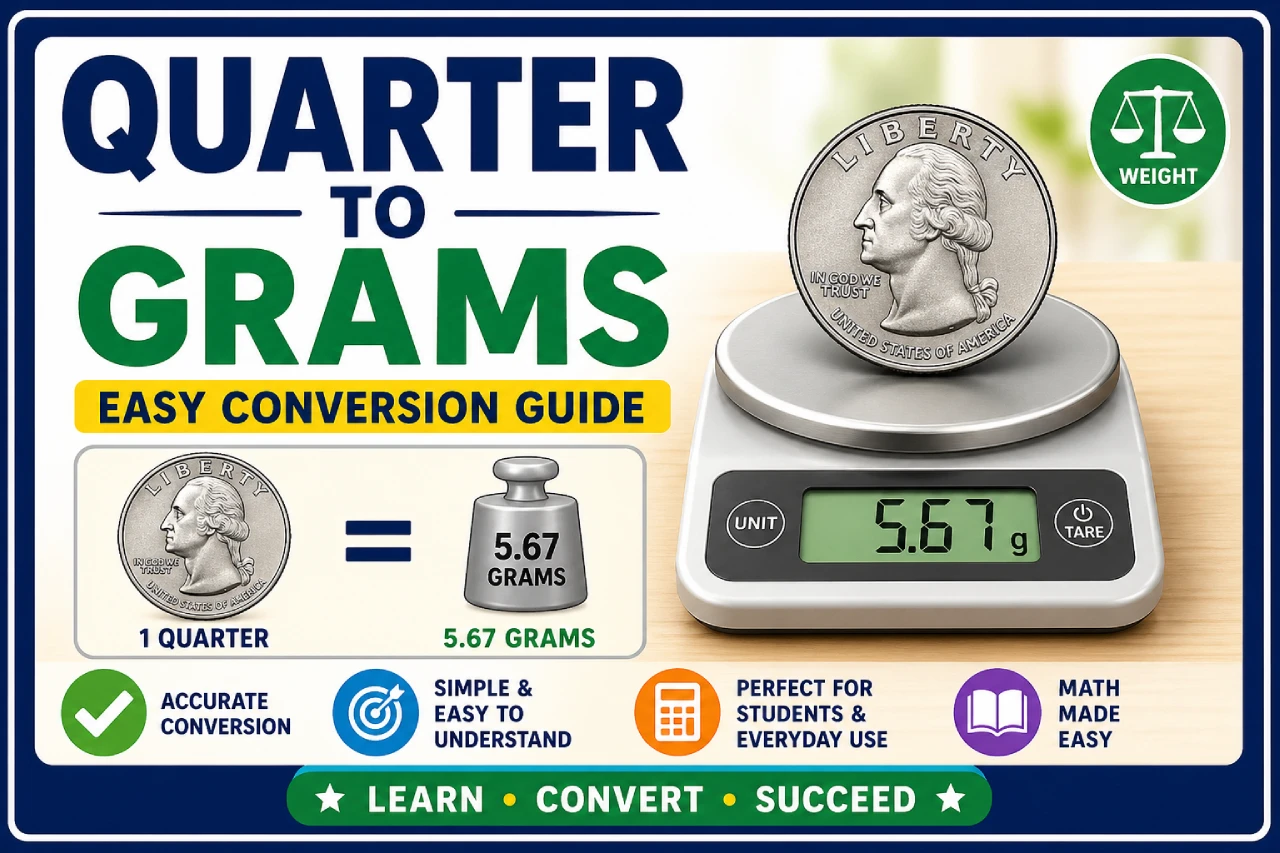
    • Quarter pound → 113.4 grams
    • Quarter ounce → 7.09 grams
    • Quarter kilogram → 250 grams

    So before converting “quarter to grams,” you need to understand which type of quarter you’re dealing with.

    In this guide, we’ll break down each meaning, show formulas, provide examples, and help you avoid common mistakes.

    What Does “Quarter” Mean?

    The word “quarter” simply means one-fourth (1/4) of something.

    That “something” could be:

    • A pound
    • An ounce
    • A kilogram
    • Even a ton

    So:

    👉 Quarter = 1 ÷ 4 of a unit

    That’s why context matters.

    Most Common Conversions of Quarter to Grams

    Let’s look at the three most widely used conversions.

    1. Quarter Pound to Grams

    This is very common in the U.S., especially for food and body weight.

    • 1 pound = 453.592 grams

    So:

    👉 ¼ pound = 453.592 ÷ 4 = 113.398 grams

    Final Answer

    👉 1 quarter pound ≈ 113.4 grams

    2. Quarter Ounce to Grams

    This is often used for small quantities like spices or herbs.

    • 1 ounce = 28.3495 grams

    So:

    👉 ¼ ounce = 28.3495 ÷ 4 = 7.087 grams

    Final Answer

    👉 1 quarter ounce ≈ 7.09 grams

    3. Quarter Kilogram to Grams

    This is the simplest conversion because it stays within the metric system.

    • 1 kilogram = 1,000 grams

    So:

    👉 ¼ kilogram = 1,000 ÷ 4 = 250 grams

    Final Answer

    👉 1 quarter kilogram = 250 grams

    Conversion Formula

    Quarter to Grams Converter

    Result: 0 grams

    You can use a simple formula for any unit.

    Formula

    Grams = (Total unit in grams) ÷ 4

    Example

    If you know:

    1 unit = X grams

    Then:

    ¼ unit = X ÷ 4

    Step-by-Step Example

    Let’s convert ¼ pound to grams.

    Step 1: Know the base value

    1 pound = 453.592 grams

    Step 2: Divide by 4

    453.592 ÷ 4 = 113.398

    Step 3: Round the answer

    👉 113.4 grams

    Quick Conversion Table

    Here’s a helpful reference for common “quarter” conversions.

    UnitQuarter ValueGrams
    Pound¼ lb113.4 g
    Ounce¼ oz7.09 g
    Kilogram¼ kg250 g
    Ton (metric)¼ ton250,000 g

    This table makes conversions quick and easy.

    Why “Quarter” Can Be Confusing

    The biggest issue is ambiguity.

    When someone says:

    👉 “Give me a quarter”

    It could mean:

    • ¼ pound
    • ¼ ounce
    • ¼ kilogram

    That’s a huge difference in grams.

    Example

    • ¼ oz = 7.09 g
    • ¼ lb = 113.4 g

    That’s more than a 100-gram difference

    Real-Life Uses of Quarter Conversions

    1. Cooking and Baking

    Recipes may use:

    • Quarter pound of butter
    • Quarter cup (different measurement system)

    2. Grocery Shopping

    You might buy:

    • ¼ kg of vegetables
    • ¼ lb of cheese

    3. Fitness and Nutrition

    Food labels sometimes require conversions.

    4. Scientific Measurements

    Precise conversions are critical in labs.

    Quarter vs Other Fractions

    Understanding fractions helps you convert faster.

    FractionMeaningExample (lb to g)
    ½Half226.8 g
    ¼Quarter113.4 g
    One-eighth56.7 g

    Once you know these, conversions become easy.

    Converting Grams Back to Quarter Units

    Sometimes you need the reverse conversion.

    Example

    113.4 grams → pounds

    113.4 ÷ 453.592 ≈ 0.25 lb

    👉 That’s ¼ pound

    Common Mistakes to Avoid

    1. Not Identifying the Unit

    Always ask:

    👉 Quarter of what?

    2. Mixing Systems

    • Pounds and ounces = U.S. system
    • Kilograms = metric system

    3. Rounding Too Early

    Keep precision until the final step.

    Tips for Quick Mental Conversion

    Here are some practical tricks.

    Trick 1: Memorize Key Values

    • ¼ lb ≈ 113 g
    • ¼ oz ≈ 7 g
    • ¼ kg = 250 g

    Trick 2: Divide by 4

    If you know the full value, just divide by 4.

    Trick 3: Use Benchmarks

    • 100 g ≈ quarter pound
    • 250 g = quarter kilogram

    Real-World Examples

    Example 1: Cooking

    A recipe calls for ¼ lb of butter:

    👉 Use 113 g

    Example 2: Grocery Store

    You buy ¼ kg of fruit:

    👉 That’s 250 g

    Example 3: Small Measurements

    You measure ¼ oz of spice:

    👉 That’s 7 g

    Why This Conversion Matters

    Understanding how to convert quarter to grams helps you:

    • Follow recipes accurately
    • Shop internationally
    • Understand nutrition labels
    • Avoid measurement errors

    Frequently Asked Questions (FAQs)

    What is a quarter in grams?

    It depends on the unit:

    • ¼ lb = 113.4 g
    • ¼ oz = 7.09 g
    • ¼ kg = 250 g

    How do you convert quarter to grams?

    Divide the base unit (in grams) by 4.

    What is a quarter pound in grams?

    👉 113.4 grams

    What is a quarter ounce in grams?

    👉 7.09 grams

    What is a quarter kilogram in grams?

    👉 250 grams

    Why is the value different?

    Because “quarter” depends on the original unit.

    Is quarter always 25%?

    Yes, mathematically it’s 25% of a unit.

    What is ¼ lb in kg?

    👉 About 0.113 kg

    Can calculators convert quarter to grams?

    Yes, if you know the base unit.

    Is metric easier for this?

    Yes, because it uses base-10 conversions.

    Final Thoughts

    Converting quarter to grams is simple—but only if you know what the “quarter” refers to.

    The key takeaway:

    👉 Quarter = 1/4 of a unit

    So:

    • ¼ lb ≈ 113.4 g
    • ¼ oz ≈ 7.09 g
    • ¼ kg = 250 g

    Once you understand this, you’ll never be confused again.

    Now here’s a quick question for you:
    Next time someone says “a quarter,” will you know exactly what unit they mean before converting it?

  • How to Calculate 1.5 × 3 in Mathematics (Step-by-Step)

    How to Calculate 1.5 × 3 in Mathematics (Step-by-Step)

    If you’re looking for the quick answer:

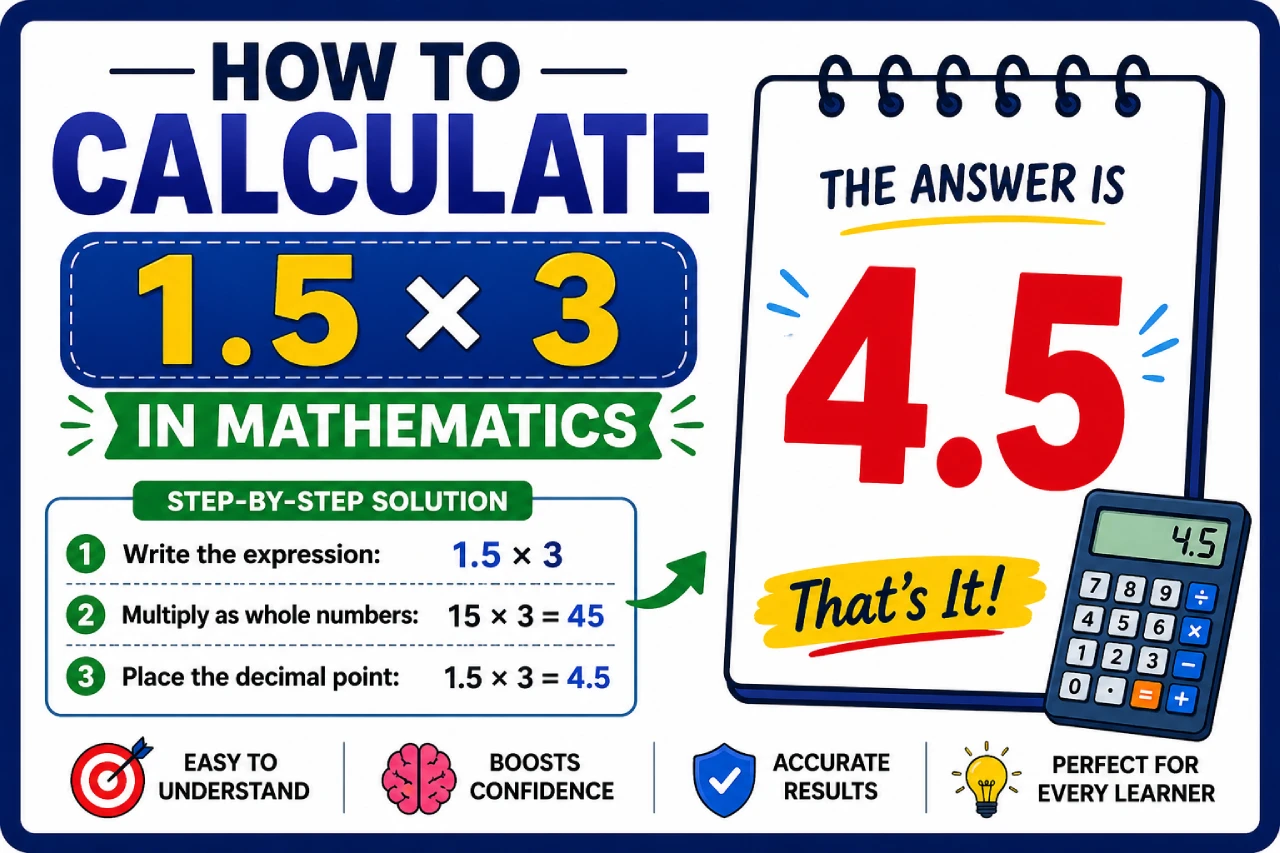
    👉 1.5 × 3 = 4.5

    That’s the exact result.

    But if you’ve ever wondered how to calculate it—or why it works the way it does—you’re in the right place. In this guide, we’ll break it down step by step, explore multiple methods, and make sure you fully understand how to multiply decimals like 1.5 × 3 with confidence.

    Understanding the Numbers

    Before jumping into the calculation, let’s quickly understand what these numbers represent.

    What Is 1.5?

    The number 1.5 is a decimal.

    It can also be written as:

    👉 1.5 = 1 + 0.5

    Or as a fraction:

    👉 1.5 = 3/2

    So, 1.5 represents one and a half.

    What Is 3?

    The number 3 is a whole number.

    When you multiply something by 3, you are essentially adding it three times.

    Method 1: Direct Multiplication

    The simplest way is straightforward multiplication.

    1.5×3=4.51.5 \times 3 = 4.51.5×3=4.5

    👉 Final Answer: 4.5

    Method 2: Break It Into Parts

    This is one of the easiest ways to understand what’s happening.

    Step 1: Split 1.5

    1.5 = 1 + 0.5

    Step 2: Multiply Each Part

    • 1 × 3 = 3
    • 0.5 × 3 = 1.5

    Step 3: Add the Results

    3 + 1.5 = 4.5

    👉 Same answer, but now you understand the logic behind it.

    Method 3: Convert to Fractions

    Sometimes fractions make things clearer.

    Step 1: Convert 1.5 to a fraction

    1.5 = 3/2

    Step 2: Multiply

    (3/2) × 3 = 9/2

    Step 3: Convert back to decimal

    9 ÷ 2 = 4.5

    👉 Again, the result is 4.5

    Method 4: Remove the Decimal First

    This method is helpful when working with decimals.

    Step 1: Multiply both numbers by 10

    1.5 × 3 becomes:

    15 × 3 = 45

    Step 2: Adjust the decimal

    Since we moved the decimal one place, divide by 10:

    45 ÷ 10 = 4.5

    Why the Answer Is 4.5

    Let’s think about it in a simple way.

    👉 If you have 1.5 apples, and you take that amount 3 times, you get:

    • 1.5 + 1.5 + 1.5 = 4.5

    So multiplication is just repeated addition.

    Visualizing 1.5 × 3

    Imagine:

    • Each group = 1.5 units
    • Number of groups = 3

    Total = 4.5 units

    Or picture:

    • One whole (1) × 3 = 3
    • Half (0.5) × 3 = 1.5

    Total = 3 + 1.5 = 4.5

    Real-Life Examples

    Example 1: Money

    If something costs $1.50 and you buy 3 of them:

    1.5 × 3 = $4.50

    Example 2: Time

    If one task takes 1.5 hours, doing it 3 times takes:

    1.5 × 3 = 4.5 hours

    Example 3: Distance

    If you walk 1.5 miles each day for 3 days:

    Total distance = 4.5 miles

    Common Mistakes to Avoid

    1. Ignoring the Decimal

    Some people mistakenly calculate:

    1.5 × 3 = 15 × 3 = 45 (without adjusting)

    Always remember to place the decimal correctly.

    2. Confusing Multiplication With Addition

    Multiplication is repeated addition, but you must multiply properly.

    3. Forgetting Fraction Conversion

    Knowing that 1.5 = 3/2 can simplify calculations.

    Tips for Multiplying Decimals Easily

    Tip 1: Break the Number

    Split decimals into whole and fractional parts.

    Tip 2: Use Fractions

    Decimals like 0.5 or 1.5 are easy to convert.

    Tip 3: Move the Decimal

    Temporarily remove the decimal, then adjust later.

    Tip 4: Estimate First

    1.5 × 3 is close to 2 × 3 = 6
    So the answer should be slightly less than 6 → 4.5 makes sense.

    Why Learning This Matters

    Understanding simple multiplication like this builds the foundation for:

    • Algebra
    • Geometry
    • Real-world problem solving
    • Financial calculations

    Once you master this, more complex math becomes easier.

    Practice Problems

    Try these to test your understanding:

    1. 1.5 × 2 = ?
    2. 1.5 × 4 = ?
    3. 2.5 × 3 = ?
    4. 0.5 × 6 = ?

    Answers

    1. 3
    2. 6
    3. 7.5
    4. 3

    Frequently Asked Questions (FAQs)

    What is 1.5 × 3?

    👉 4.5

    How do you multiply decimals?

    Multiply normally, then place the decimal correctly.

    Can I use fractions instead?

    Yes. 1.5 = 3/2 makes multiplication easier.

    Why is the answer not 45?

    Because the decimal must be accounted for.

    Is 1.5 × 3 the same as 3 × 1.5?

    Yes. Multiplication is commutative.

    What is 1.5 as a fraction?

    👉 3/2

    Is 1.5 a whole number?

    No, it’s a decimal.

    Can calculators solve this?

    Yes, instantly.

    What is 1.5 × 10?

    👉 15

    What is 1.5 × 5?

    👉 7.5

    Final Thoughts

    So, how do you calculate 1.5 × 3?

    👉 The answer is 4.5

    But more importantly, you now understand why.

    You’ve seen multiple methods:

    • Direct multiplication
    • Breaking into parts
    • Using fractions
    • Removing decimals

    Once you grasp these techniques, even more complex calculations will feel easy.

    Now here’s a quick question for you:
    Next time you see a decimal multiplication problem, will you solve it instantly—or break it down step by step like a pro?

  • 9 Tablespoons to Cups (tbsp to cup Guide)

    9 Tablespoons to Cups (tbsp to cup Guide)

    If you’re looking for the quick answer:

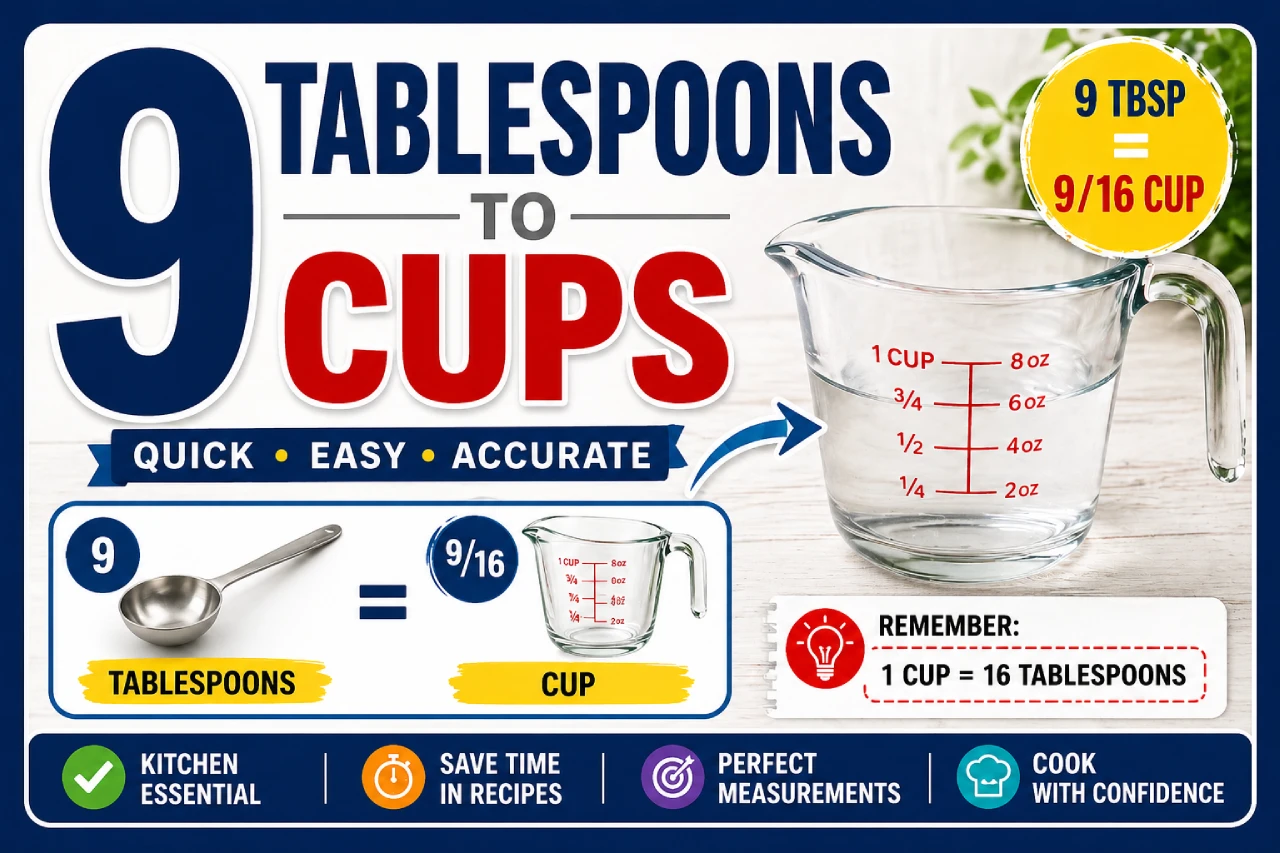
    👉 9 tablespoons = 0.5625 cups

    In everyday cooking terms:

    👉 9 tablespoons = ½ cup + 1 tablespoon

    This is one of those conversions that comes up more often than you’d expect—especially when you’re scaling recipes, using measuring spoons instead of cups, or working with smaller ingredient amounts.

    In this guide, we’ll break down the math, show easy kitchen shortcuts, and help you understand exactly how to convert 9 tablespoons to cups without confusion.

    The Conversion Formula

    Tablespoons to Cups Converter

    Enter tablespoons below to convert them into cups.

    The key relationship is:

    👉 1 cup = 16 tablespoons

    Conversion Formula

    Cups = Tablespoons ÷ 16

    This formula works for any value.

    Step-by-Step Conversion: 9 Tablespoons to Cups

    Let’s calculate it clearly.

    Step 1: Start with tablespoons

    9 tablespoons

    Step 2: Divide by 16

    9 ÷ 16

    Step 3: Calculate

    = 0.5625 cups

    Final Result

    👉 9 tablespoons = 0.5625 cups

    Converting 9 Tablespoons into Fractions

    Decimals aren’t always helpful in the kitchen.

    Let’s convert 0.5625 into a fraction.

    0.5625 = 9/16 cup

    So:

    👉 9 tablespoons = 9/16 cup

    Easier Kitchen Version

    👉 9 tablespoons = ½ cup + 1 tablespoon

    This is the most practical way to measure it.

    Quick Conversion Table

    Here’s a helpful reference for nearby values.

    TablespoonsCups
    1 tbsp0.0625 cup
    4 tbsp0.25 cup
    8 tbsp0.5 cup
    9 tbsp0.5625 cup
    12 tbsp0.75 cup
    16 tbsp1 cup

    This makes it easy to estimate quickly.

    Why This Conversion Matters in Cooking

    If you’ve ever been in the kitchen without the right measuring tools, you know how important conversions can be.

    1. Recipe Adjustments

    Sometimes recipes use cups, but you only have tablespoons.

    2. Small Batch Cooking

    When cooking smaller portions, tablespoons are more practical.

    3. Baking Accuracy

    Precise measurements can make or break a recipe.

    4. Ingredient Substitution

    You may need to convert units when swapping ingredients.

    Real-Life Kitchen Example

    Let’s say a recipe calls for:

    👉 9 tablespoons of milk

    But you only have a measuring cup.

    Instead of guessing, you can measure:

    👉 ½ cup + 1 tablespoon

    Simple, accurate, and stress-free.

    Tablespoons vs Cups: Key Differences

    UnitSizeBest For
    TablespoonSmallSpices, oils
    CupLargeFlour, liquids

    Both are essential—but used differently depending on quantity.

    Converting Cups Back to Tablespoons

    Sometimes you need to reverse the conversion.

    Formula

    Tablespoons = Cups × 16

    Example

    0.5625 × 16 = 9 tablespoons

    This confirms the original value.

    Common Mistakes to Avoid

    1. Forgetting the 16 Rule

    Always remember:

    👉 1 cup = 16 tablespoons

    2. Mixing Metric and U.S. Units

    U.S. tablespoons differ slightly from other countries.

    3. Rounding Too Much

    In baking, precision matters—don’t over-round.

    Tips for Quick Kitchen Conversions

    Here are some practical tricks.

    Trick 1: Think “Half Cup = 8 tbsp”

    So:

    9 tbsp = half cup + 1 tbsp

    Trick 2: Use Measuring Tools Smartly

    • Use a ½ cup measure + 1 tablespoon
    • No need for complex math while cooking

    Trick 3: Memorize Key Benchmarks

    • 4 tbsp = ¼ cup
    • 8 tbsp = ½ cup
    • 16 tbsp = 1 cup

    Practical Uses in Everyday Cooking

    Baking

    Precise measurements are critical for:

    • Cakes
    • Cookies
    • Bread

    Cooking

    Flexible recipes allow easy conversions for:

    • Sauces
    • Soups
    • Dressings

    Meal Prep

    Smaller measurements help when portioning meals.

    Metric Conversion (Optional)

    If you prefer metric units:

    • 1 tablespoon ≈ 14.79 mL

    So:

    9 tbsp ≈ 133 mL

    This is useful for international recipes.

    Frequently Asked Questions (FAQs)

    How many cups is 9 tablespoons?

    👉 0.5625 cups

    What is 9 tablespoons in fraction form?

    👉 9/16 cup

    How do you convert tablespoons to cups?

    Divide by 16.

    Is 9 tablespoons more than half a cup?

    Yes, slightly more.

    What is the easiest way to measure 9 tablespoons?

    👉 ½ cup + 1 tablespoon

    How many tablespoons are in a cup?

    👉 16 tablespoons

    Can I use teaspoons instead?

    Yes:

    • 1 tbsp = 3 tsp
    • 9 tbsp = 27 teaspoons

    Why is this conversion important?

    It ensures accurate cooking and baking.

    Is 0.5625 cup exact?

    Yes, mathematically exact.

    What is 8 tablespoons in cups?

    👉 ½ cup

    Final Thoughts

    Converting 9 tablespoons to cups is simple once you know the rule:

    👉 Cups = Tablespoons ÷ 16

    Using this:

    👉 9 tablespoons = 0.5625 cups = 9/16 cup

    But in the kitchen, the easiest way to remember is:

    👉 ½ cup + 1 tablespoon

    That’s practical, quick, and accurate—exactly what you need when cooking.

    Now here’s a quick question for you:
    Next time a recipe calls for tablespoons, will you confidently convert it to cups without reaching for a calculator?