Category: Convert Tools

  • Teaspoons to Ounces Conversion (tsp to oz Guide)

    Teaspoons to Ounces Conversion (tsp to oz Guide)

    If you’re looking for the quick answer:

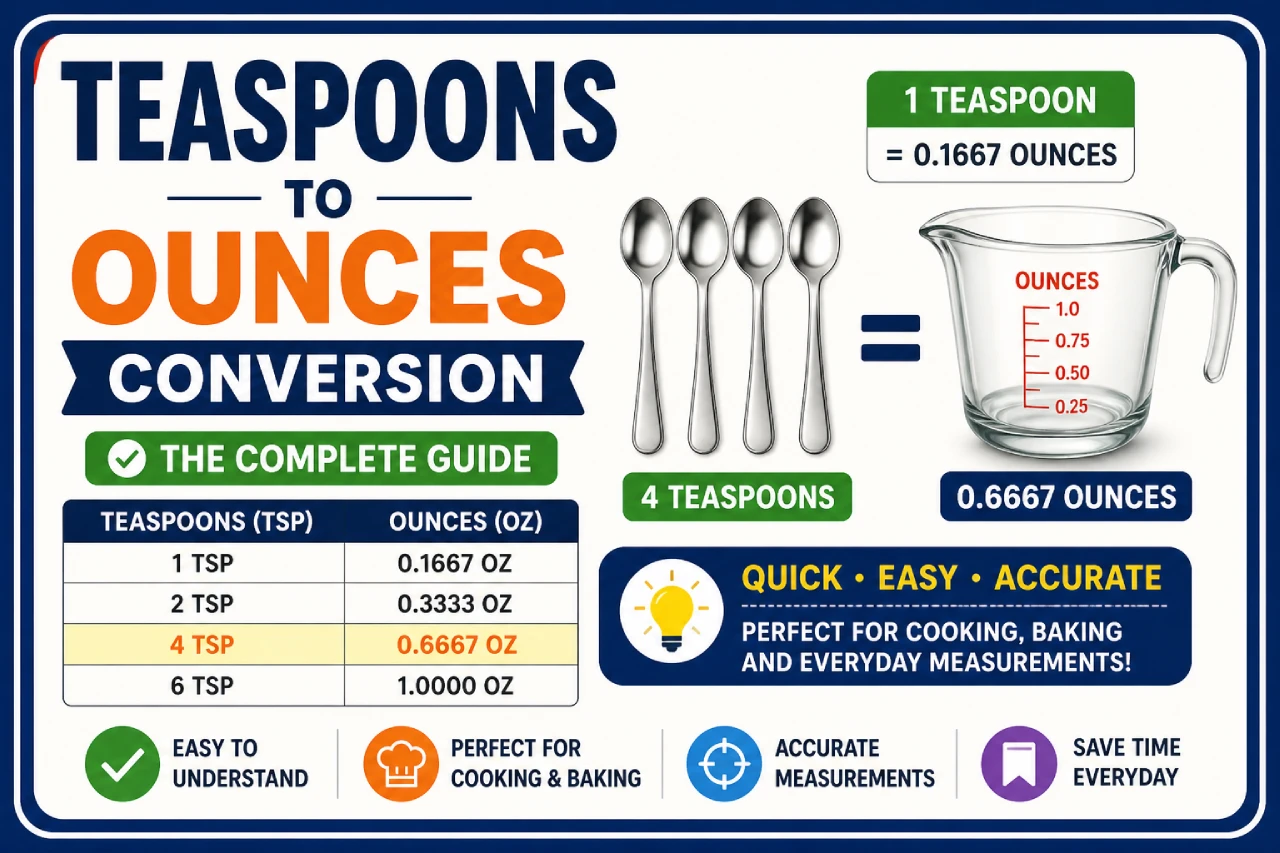
    👉 1 teaspoon (tsp) = 0.1667 fluid ounces (fl oz)
    👉 6 teaspoons = 1 fluid ounce

    So, to convert teaspoons to ounces:

    👉 Ounces = Teaspoons ÷ 6

    For example:

    • 6 tsp = 1 oz
    • 12 tsp = 2 oz
    • 3 tsp = 0.5 oz

    This conversion is extremely useful in cooking, baking, and measuring liquids, especially in the United States where both teaspoons and ounces are commonly used.

    In this guide, you’ll learn how the conversion works, how to apply it in real-life situations, and how to avoid common mistakes.

    Understanding the Units

    Before converting, let’s understand what these units mean.

    What Is a Teaspoon (tsp)?

    A teaspoon (tsp) is a small unit of volume used mainly in cooking.

    Definition

    👉 1 teaspoon = 1/3 tablespoon

    In Metric Terms

    👉 1 teaspoon ≈ 4.93 milliliters (mL)

    Common Uses

    • Measuring spices
    • Baking ingredients
    • Liquid flavorings

    What Is an Ounce (fl oz)?

    An ounce (fluid ounce) is a larger unit of volume.

    Definition

    👉 1 fluid ounce = 6 teaspoons

    In Metric Terms

    👉 1 fluid ounce ≈ 29.57 milliliters (mL)

    Common Uses

    • Liquid measurements
    • Beverage quantities
    • Cooking and recipes

    Teaspoons to Ounces Conversion Formula

    Teaspoons to Ounces Converter

    Use this simple teaspoons to ounces converter to quickly convert tsp to fl oz for cooking, baking, recipes, and liquid measurements.

    6 teaspoons = 1 fluid ounce

    Formula: Ounces = Teaspoons ÷ 6

    Here’s the key formula:

    👉 Ounces (fl oz) = Teaspoons ÷ 6

    Reverse Formula

    👉 Teaspoons = Ounces × 6

    Step-by-Step Conversion Example

    Let’s convert 9 teaspoons to ounces.

    Step 1: Start with teaspoons

    9 tsp

    Step 2: Divide by 6

    9 ÷ 6

    Step 3: Calculate

    = 1.5 oz

    👉 Final Answer: 9 tsp = 1.5 oz

    Another Example

    Convert 15 teaspoons to ounces.

    15 ÷ 6 = 2.5 oz

    👉 Final Answer: 15 tsp = 2.5 oz

    Quick Conversion Table

    Here’s a helpful reference chart.

    Teaspoons (tsp)Ounces (fl oz)
    1 tsp0.17 oz
    3 tsp0.5 oz
    6 tsp1 oz
    9 tsp1.5 oz
    12 tsp2 oz
    18 tsp3 oz

    Why This Conversion Matters

    This is one of the most practical conversions you’ll use.

    1. Cooking and Baking

    Recipes often switch between teaspoons and ounces.

    2. Measuring Liquids

    Especially for:

    • Oils
    • Extracts
    • Syrups

    3. Nutrition Tracking

    Liquid intake is sometimes measured in ounces.

    4. Kitchen Efficiency

    Knowing conversions saves time.

    Real-Life Examples

    Let’s make it practical.

    Example 1: Recipe Conversion

    A recipe calls for 12 teaspoons of vanilla extract:

    12 ÷ 6 = 2 oz

    Example 2: Small Quantity

    You need 3 teaspoons of oil:

    3 ÷ 6 = 0.5 oz

    Example 3: Larger Quantity

    You measure 24 teaspoons of liquid:

    24 ÷ 6 = 4 oz

    Teaspoons vs Tablespoons vs Ounces

    Here’s how they relate.

    • 1 tablespoon = 3 teaspoons
    • 1 ounce = 6 teaspoons
    • 1 ounce = 2 tablespoons

    Quick Comparison Table

    UnitEquivalent
    1 tsp0.17 oz
    1 tbsp0.5 oz
    1 oz6 tsp

    Understanding Fluid vs Weight Ounces

    This is where people get confused.

    Fluid Ounce (fl oz)

    👉 Measures volume

    Ounce (oz)

    👉 Can measure weight

    Important Tip

    When converting teaspoons:

    👉 Always use fluid ounces (fl oz)

    Converting Ounces Back to Teaspoons

    Sometimes you need the reverse.

    Formula

    👉 Teaspoons = Ounces × 6

    Example

    2 oz × 6 = 12 tsp

    Common Mistakes to Avoid

    1. Confusing Weight and Volume

    Teaspoons measure volume, not weight.

    2. Using the Wrong Conversion

    Always remember:

    👉 6 tsp = 1 oz

    3. Mixing Metric and U.S. Units

    Stick to one system when possible.

    Tips for Quick Mental Conversion

    Here are some easy tricks.

    Trick 1: Divide by 6

    This is the exact method.

    Trick 2: Use Benchmarks

    • 6 tsp = 1 oz
    • 3 tsp = 0.5 oz

    Trick 3: Double or Halve

    • 12 tsp = 2 oz
    • 18 tsp = 3 oz

    Practical Applications

    1. Home Cooking

    Perfect for scaling recipes.

    2. Baking

    Precise measurements matter.

    3. Beverage Preparation

    Cocktails and drinks often use ounces.

    4. Meal Prep

    Helps with portion control.

    Why Precision Matters

    In cooking, small errors can affect:

    • Taste
    • Texture
    • Consistency

    That’s why accurate conversion is important.

    Practice Problems

    Try these yourself.

    1. 6 tsp = ? oz
    2. 18 tsp = ? oz
    3. 2 oz = ? tsp
    4. 9 tsp = ? oz

    Answers

    1. 1 oz
    2. 3 oz
    3. 12 tsp
    4. 1.5 oz

    Frequently Asked Questions (FAQs)

    How many teaspoons are in 1 ounce?

    👉 6 teaspoons

    How do you convert teaspoons to ounces?

    Divide by 6.

    What is 3 teaspoons in ounces?

    👉 0.5 oz

    What is 12 teaspoons in ounces?

    👉 2 oz

    Is a teaspoon a unit of volume?

    Yes, it measures liquid volume.

    What is the easiest way to convert?

    Divide teaspoons by 6.

    Are teaspoons used worldwide?

    Yes, but sizes may vary slightly.

    What is 1 tablespoon in ounces?

    👉 0.5 oz

    Can calculators convert tsp to oz?

    Yes, easily.

    Why is this conversion useful?

    It simplifies cooking and measurement.

    Final Thoughts

    Converting teaspoons to ounces is simple once you know the key rule:

    👉 Ounces = Teaspoons ÷ 6

    This conversion is essential in everyday cooking, baking, and liquid measurement.

    Once you memorize that:

    👉 6 teaspoons = 1 ounce

    You can quickly convert values without even thinking.

    Now here’s a quick question for you:
    Next time a recipe gives measurements in teaspoons, will you instantly know how many ounces you need?
  • Convert lbs to Ton (Pounds to Tons Guide)

    Convert lbs to Ton (Pounds to Tons Guide)

    If you’re looking for the quick answer:

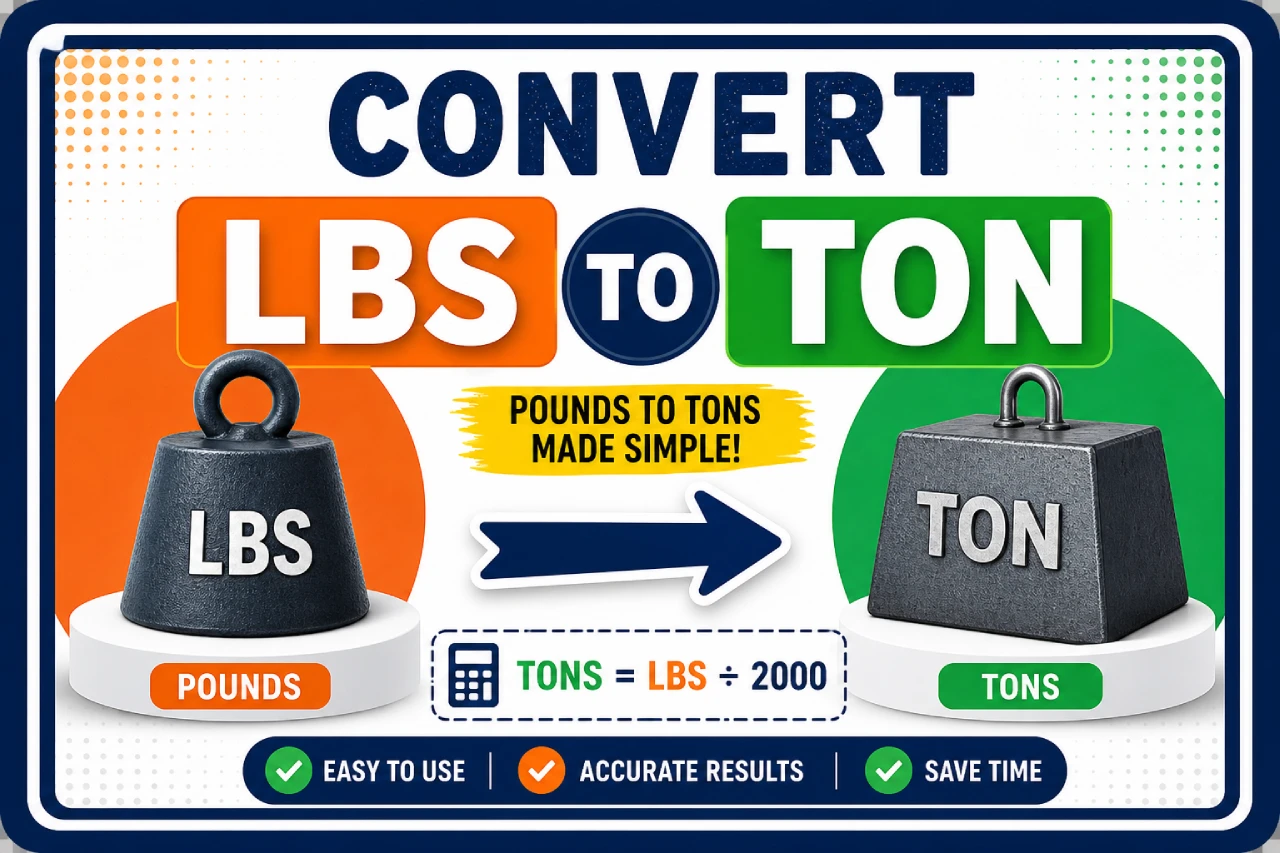
    👉 1 ton = 2,000 pounds (lbs)
    👉 Tons = Pounds ÷ 2,000

    So, for example:

    • 2,000 lbs = 1 ton
    • 1,000 lbs = 0.5 ton
    • 500 lbs = 0.25 ton

    This is the standard U.S. short ton, which is the most commonly used ton in the United States.

    In this guide, we’ll go beyond the basic formula. You’ll learn how the conversion works, when to use it, different types of tons, and how to apply it in real-life situations like construction, shipping, and everyday calculations.

    What Is a Pound (lb)?

    A pound (lb) is a unit of weight in the U.S. customary system.

    Definition

    👉 1 pound = 16 ounces

    Common Uses

    • Body weight
    • Food packaging
    • Shipping items
    • Everyday measurements

    Example:

    • A laptop might weigh 3–5 lbs
    • A person might weigh 150–200 lbs

    What Is a Ton?

    A ton is a larger unit of weight.

    In the United States

    👉 1 ton (short ton) = 2,000 pounds

    Important Note

    There are different types of tons worldwide:

    Type of TonPounds
    U.S. short ton2,000 lbs
    Long ton (UK)2,240 lbs
    Metric ton (tonne)2,204.62 lbs

    In this article, we focus on the U.S. short ton, since it’s the standard in the United States.

    Conversion Formula

    lbs to Ton Converter

    Use this simple lbs to ton converter to quickly convert pounds into U.S. tons. Enter any pound value below and get the result instantly.

    Result: 0 tons

    Formula: tons = pounds ÷ 2,000

    Here’s the main formula:

    👉 Tons = Pounds ÷ 2,000

    Reverse Formula

    👉 Pounds = Tons × 2,000

    Step-by-Step Conversion Example

    Let’s convert 3,500 lbs to tons.

    Step 1: Start with pounds

    3,500 lbs

    Step 2: Divide by 2,000

    3,500 ÷ 2,000

    Step 3: Calculate

    = 1.75 tons

    👉 Final Answer: 3,500 lbs = 1.75 tons

    Another Example

    Convert 750 lbs to tons.

    Step 1

    750 ÷ 2,000

    Step 2

    = 0.375 tons

    👉 Final Answer: 750 lbs = 0.375 tons

    Quick Conversion Table

    Here’s a helpful chart.

    Pounds (lbs)Tons
    100 lbs0.05 ton
    500 lbs0.25 ton
    1,000 lbs0.5 ton
    2,000 lbs1 ton
    5,000 lbs2.5 tons
    10,000 lbs5 tons

    Why This Conversion Matters

    You’ll need this conversion more often than you think.

    1. Construction and Materials

    Materials like gravel, sand, and concrete are often sold by the ton.

    2. Shipping and Freight

    Shipping companies calculate costs based on weight.

    3. Truck Load Limits

    Trucks have maximum weight limits in tons.

    4. Industrial Applications

    Factories and warehouses use tons for large quantities.

    Real-Life Examples

    Let’s make this practical.

    Example 1: Moving Equipment

    You’re moving a machine weighing 4,000 lbs:

    4,000 ÷ 2,000 = 2 tons

    Example 2: Construction Materials

    You order 6,000 lbs of gravel:

    6,000 ÷ 2,000 = 3 tons

    Example 3: Shipping Load

    A shipment weighs 1,200 lbs:

    1,200 ÷ 2,000 = 0.6 tons

    Understanding the Difference Between Tons

    This is where many people get confused.

    U.S. Short Ton (Most Common)

    👉 1 ton = 2,000 lbs

    Metric Ton (Tonne)

    👉 1 tonne = 2,204.62 lbs

    Long Ton (UK)

    👉 1 long ton = 2,240 lbs

    Why It Matters

    Using the wrong ton can lead to errors in:

    • Shipping
    • Engineering
    • International trade

    Converting Tons Back to Pounds

    Sometimes you need the reverse.

    Formula

    👉 Pounds = Tons × 2,000

    Example

    2.5 tons × 2,000 = 5,000 lbs

    Common Mistakes to Avoid

    1. Using the Wrong Type of Ton

    Always confirm whether it’s:

    • Short ton
    • Metric ton
    • Long ton

    2. Forgetting to Divide by 2,000

    This is the most common mistake.

    3. Misplacing the Decimal

    Example:

    • 500 lbs = 0.25 ton, not 2.5 tons

    Tips for Quick Mental Conversion

    Here are some easy tricks.

    Trick 1: Divide by 2,000

    This is the exact method.

    Trick 2: Think in Halves

    • 1,000 lbs = 0.5 ton
    • 500 lbs = 0.25 ton

    Trick 3: Use Benchmarks

    • 2,000 lbs = 1 ton
    • 4,000 lbs = 2 tons

    Practical Applications

    1. Landscaping

    Bulk materials are often measured in tons.

    2. Heavy Equipment

    Machines are weighed in tons.

    3. Transportation

    Weight limits are crucial for safety.

    4. Agriculture

    Harvest yields may be measured in tons.

    Why Precision Matters

    Small errors can lead to:

    • Overloaded trucks
    • Incorrect pricing
    • Safety issues

    That’s why accurate conversion is essential.

    Practice Problems

    Try these yourself.

    1. 2,500 lbs = ? tons
    2. 1,800 lbs = ? tons
    3. 5 tons = ? lbs
    4. 750 lbs = ? tons

    Answers

    1. 1.25 tons
    2. 0.9 tons
    3. 10,000 lbs
    4. 0.375 tons

    Frequently Asked Questions (FAQs)

    How many pounds are in a ton?

    👉 2,000 lbs (U.S. short ton)

    How do you convert lbs to tons?

    Divide by 2,000.

    What is 1,000 lbs in tons?

    👉 0.5 ton

    What is 500 lbs in tons?

    👉 0.25 ton

    Is a ton always 2,000 lbs?

    No, it depends on the type of ton.

    What is a metric ton?

    👉 2,204.62 lbs

    Can calculators convert lbs to tons?

    Yes, easily.

    What is 3,000 lbs in tons?

    👉 1.5 tons

    Why are tons used?

    To simplify large weight measurements.

    Where is this conversion used?

    Construction, shipping, and industry.

    Final Thoughts

    Converting lbs to tons is simple once you remember the key rule:

    👉 Tons = Pounds ÷ 2,000

    This conversion is essential in real-world situations—from construction projects to shipping calculations.

    The most important takeaway:

    👉 Always confirm which type of ton you’re using.

    Once you understand that, you can convert values quickly and accurately without confusion.

    Now here’s a quick question for you:
    Next time you see a weight in pounds, will you instantly know its value in tons?

  • Convert 50 Nm to ft-lb Easily

    Convert 50 Nm to ft-lb Easily

    If you’re looking for the quick answer:

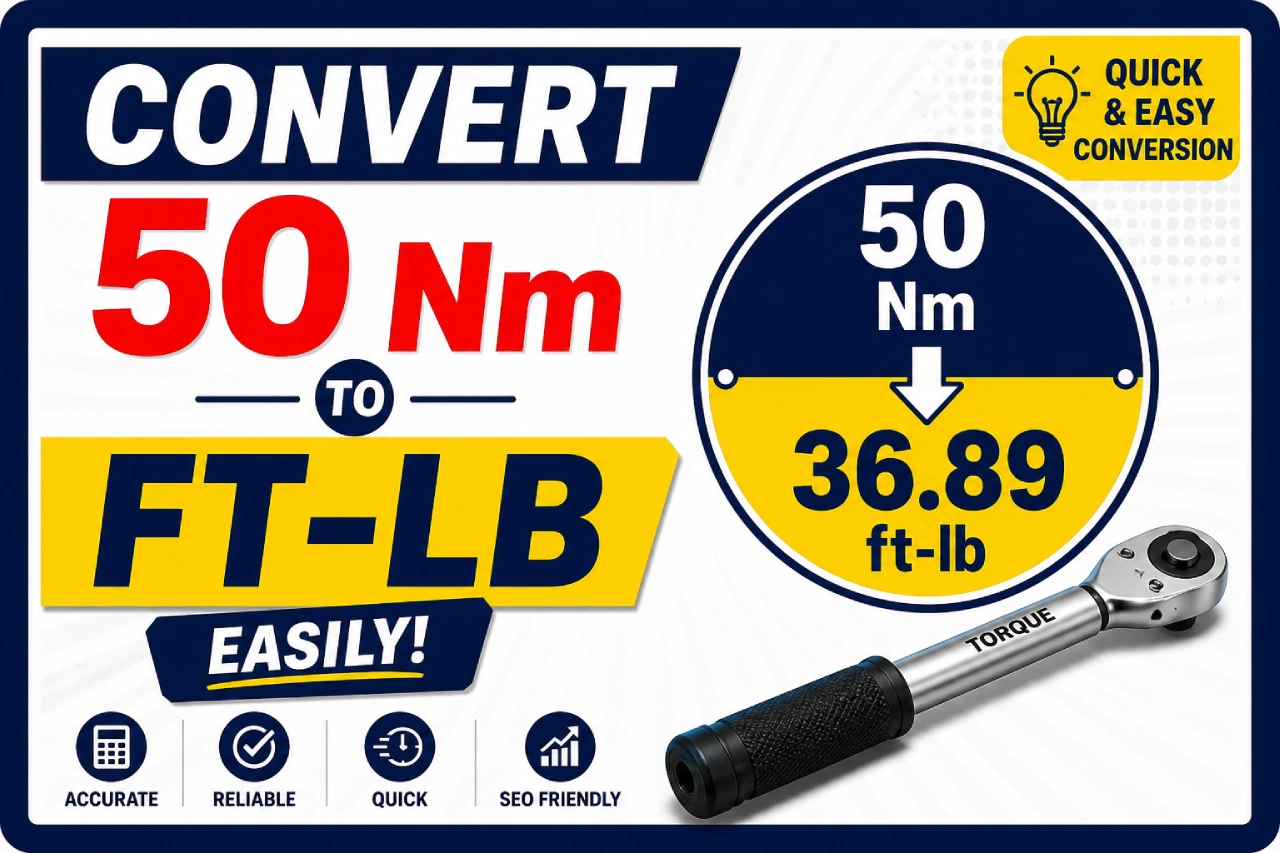
    👉 50 Nm = 36.88 ft-lb (approximately)
    👉 50 Nm = 36.8781 ft-lb (exact)

    This is the standard conversion used in automotive, mechanical, and engineering applications.

    To convert newton-meters (Nm) to foot-pounds (ft-lb):

    👉 ft-lb = Nm × 0.737562

    So:

    👉 50 × 0.737562 = 36.8781 ft-lb

    In this guide, we’ll go beyond just the number. You’ll learn how this conversion works, why it matters, and how to apply it confidently in real-world situations.

    What Does 50 Nm Actually Mean?

    Before converting, let’s understand the unit.

    What Is Nm (Newton-Meter)?

    A newton-meter (Nm) is a unit of torque in the metric system.

    👉 Torque = rotational force

    Simple Explanation

    If you apply 1 newton of force at a distance of 1 meter, you create 1 Nm of torque.

    So:

    👉 50 Nm = a moderate amount of rotational force

    Real-World Context

    • Small bolts: 10–30 Nm
    • Car lug nuts: 80–120 Nm
    • Engine components: 40–200 Nm

    So 50 Nm is commonly used in automotive and mechanical work.

    Conversion Formula

    Nm to ft-lb Converter

    Enter a value in Newton-meters to instantly convert it to foot-pounds.

    Formula: ft-lb = Nm × 0.737562149

    Here’s the key formula:

    👉 ft-lb = Nm × 0.737562

    Reverse Formula

    👉 Nm = ft-lb × 1.35582

    Step-by-Step Conversion: 50 Nm to ft-lb

    Let’s calculate it clearly.

    Step 1: Start with Nm

    50 Nm

    Step 2: Multiply by conversion factor

    50 × 0.737562

    Step 3: Calculate

    = 36.8781 ft-lb

    Final Answer

    👉 50 Nm ≈ 36.88 ft-lb

    Quick Conversion Table

    Here’s a reference for nearby values.

    Nmft-lb
    10 Nm7.38 ft-lb
    20 Nm14.75 ft-lb
    30 Nm22.13 ft-lb
    40 Nm29.50 ft-lb
    50 Nm36.88 ft-lb
    60 Nm44.25 ft-lb

    Why This Conversion Matters

    This isn’t just math—it’s practical.

    1. Automotive Work

    Torque specs vary by region.

    • European manuals → Nm
    • U.S. manuals → ft-lb

    Knowing both prevents mistakes.

    2. Torque Wrench Settings

    If your wrench uses ft-lb but your manual uses Nm:

    👉 You must convert accurately.

    3. Mechanical Repairs

    Proper torque ensures:

    • Parts stay secure
    • Components don’t break

    Real-Life Example

    Let’s say you’re tightening a bolt with a required torque of 50 Nm.

    If your torque wrench is in ft-lb:

    👉 Set it to 36.88 ft-lb

    This ensures the correct force is applied.

    Understanding Torque in Simple Terms

    Torque is easier to understand with an example.

    Using a Wrench

    • Longer wrench → more torque
    • More force → more torque

    So:

    👉 Torque = Force × Distance

    Nm vs ft-lb: Key Differences

    UnitSystemUsage
    NmMetric (SI)Global engineering
    ft-lbU.S. customaryAutomotive and tools

    Both measure the same thing—but in different systems.

    Converting Back: ft-lb to Nm

    Sometimes you need the reverse.

    Formula

    👉 Nm = ft-lb × 1.35582

    Example

    36.88 ft-lb × 1.35582 ≈ 50 Nm

    Common Mistakes to Avoid

    1. Confusing Torque with Energy

    • ft-lb (torque) ≠ foot-pound (energy unit)

    2. Using Rough Estimates for Precision Work

    Use exact values when accuracy matters.

    3. Mixing Units

    Always confirm whether values are in Nm or ft-lb.

    Tips for Quick Mental Conversion

    Here are some helpful tricks.

    Trick 1: Multiply by 0.74

    👉 50 × 0.74 ≈ 37 ft-lb (quick estimate)

    Trick 2: Use Benchmarks

    • 10 Nm ≈ 7.4 ft-lb
    • 100 Nm ≈ 74 ft-lb

    Trick 3: Reverse Trick

    Divide by 0.74 to go back.

    Practical Applications of 50 Nm

    Let’s look at where 50 Nm is commonly used.

    1. Automotive Bolts

    Many engine and suspension bolts fall in this range.

    2. Bicycle Components

    Some high-end bike parts use torque specs around 50 Nm.

    3. Machinery

    Medium-strength fasteners often require this torque.

    4. DIY Projects

    Home repairs may involve similar torque values.

    Why Precision Matters

    Applying the correct torque is critical.

    Too Little Torque

    • Parts loosen
    • Safety risks

    Too Much Torque

    • Threads strip
    • Bolts break

    That’s why accurate conversion is essential.

    Advanced Insight: Why 0.737562?

    This number comes from the relationship between:

    • Newtons and pounds-force
    • Meters and feet

    It’s based on precise physical constants used worldwide.

    Practice Problems

    Try these yourself.

    1. 25 Nm = ? ft-lb
    2. 75 Nm = ? ft-lb
    3. 100 Nm = ? ft-lb
    4. 36.88 ft-lb = ? Nm

    Answers

    1. 18.44 ft-lb
    2. 55.32 ft-lb
    3. 73.76 ft-lb
    4. 50 Nm

    Frequently Asked Questions (FAQs)

    What is 50 Nm in ft-lb?

    👉 36.88 ft-lb

    What is the exact value?

    👉 36.8781 ft-lb

    How do you convert Nm to ft-lb?

    Multiply by 0.737562.

    What is 1 Nm in ft-lb?

    👉 0.7376 ft-lb

    Why is torque important?

    It ensures proper fastening and safety.

    Is Nm bigger than ft-lb?

    Yes, 1 Nm is slightly larger.

    Can calculators convert Nm to ft-lb?

    Yes, easily.

    What is 100 Nm in ft-lb?

    👉 73.76 ft-lb

    Where is this conversion used?

    Automotive, engineering, and machinery.

    Is this conversion exact?

    Yes, based on standard physics definitions.

    Final Thoughts

    Converting 50 Nm to ft-lb is simple once you know the formula:

    👉 ft-lb = Nm × 0.737562

    So:

    👉 50 Nm = 36.88 ft-lb

    This conversion is essential in real-world tasks—especially automotive work, mechanical repairs, and engineering projects.

    Once you understand torque and how these units relate, you’ll never second-guess your conversions again.

    Now here’s a quick question for you:
    Next time you see a torque value in Nm, will you instantly know its equivalent in ft-lb?

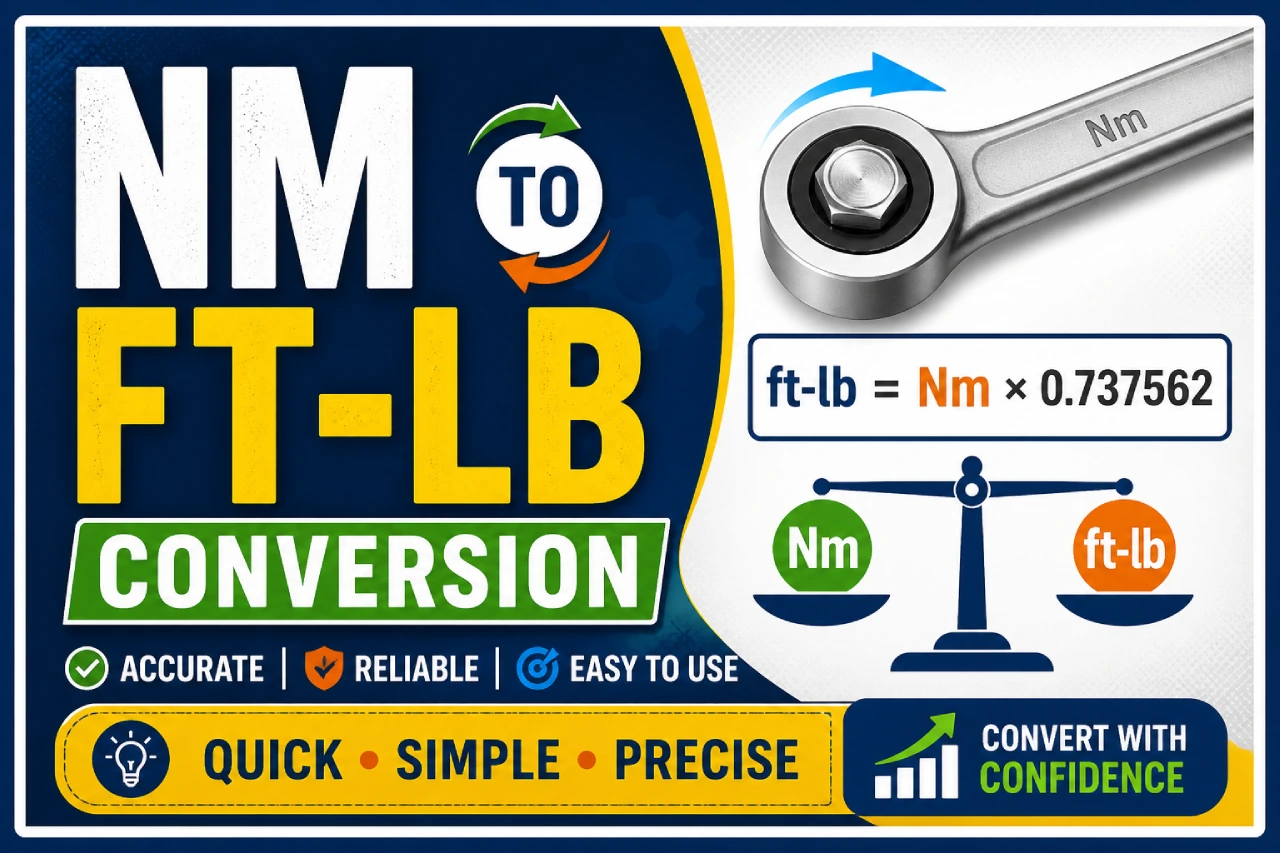
  • Nm to ft-lb Conversion (Newton-Meter to Foot-Pound Guide)

    Nm to ft-lb Conversion (Newton-Meter to Foot-Pound Guide)

    If you’re looking for the quick answer:

    👉 1 Nm = 0.737562 ft-lb
    👉 ft-lb = Nm × 0.737562

    For example:

    • 10 Nm ≈ 7.38 ft-lb
    • 50 Nm ≈ 36.88 ft-lb
    • 100 Nm ≈ 73.76 ft-lb

    This conversion is widely used in automotive work, mechanical engineering, and torque measurements, especially when switching between metric (Nm) and U.S. customary units (ft-lb).

    In this guide, we’ll break everything down clearly—so you not only know the formula but actually understand what it means and how to use it in real-world situations.

    What Is Nm (Newton-Meter)?

    A newton-meter (Nm) is a unit of torque in the metric system.

    Definition

    👉 Torque is the force applied at a distance from a pivot point.

    👉 1 Nm = 1 newton of force applied at a distance of 1 meter

    Common Uses

    • Engine torque ratings
    • Mechanical systems
    • Engineering calculations

    Example

    • A car engine might produce 200–400 Nm of torque

    What Is ft-lb (Foot-Pound)?

    A foot-pound (ft-lb) is a unit of torque in the U.S. customary system.

    Definition

    👉 1 ft-lb = 1 pound of force applied at a distance of 1 foot

    Common Uses

    • Automotive torque specs
    • Construction tools
    • Machinery

    Example

    • Lug nuts on a car may require 80–100 ft-lb

    Nm to ft-lb Conversion Formula

    Nm to ft-lb Converter

    Enter a value in Newton-meters to convert it into foot-pounds.

    Result: 0 ft-lb

    Here’s the key formula:

    👉 ft-lb = Nm × 0.737562

    Reverse Formula

    👉 Nm = ft-lb × 1.35582

    These are precise, widely accepted values.

    Step-by-Step Conversion Example

    Let’s convert 75 Nm to ft-lb.

    Step 1: Start with Nm

    75 Nm

    Step 2: Multiply by conversion factor

    75 × 0.737562

    Step 3: Calculate

    = 55.317 ft-lb

    👉 Final Answer: 75 Nm ≈ 55.32 ft-lb

    Quick Conversion Table

    Here’s a handy reference chart.

    Nmft-lb
    1 Nm0.7376 ft-lb
    10 Nm7.38 ft-lb
    20 Nm14.75 ft-lb
    50 Nm36.88 ft-lb
    100 Nm73.76 ft-lb
    200 Nm147.51 ft-lb

    This helps you estimate quickly.

    Understanding Torque: The Key Concept

    To really understand this conversion, you need to understand torque.

    What Is Torque?

    👉 Torque is a twisting force.

    It depends on:

    • Force applied
    • Distance from the pivot point

    Simple Example

    Using a wrench:

    • A longer wrench = more torque
    • More force = more torque

    Why Convert Nm to ft-lb?

    You’ll need this conversion in many real-world situations.

    1. Automotive Work

    Torque specs may be listed in Nm or ft-lb.

    Example:

    • European cars → Nm
    • U.S. cars → ft-lb

    2. Tool Usage

    Torque wrenches may use different units.

    3. Engineering Projects

    Global projects require unit conversion.

    4. DIY Repairs

    Understanding torque prevents over-tightening.

    Nm vs ft-lb: Key Differences

    UnitSystemUsage
    NmMetric (SI)Engineering, global
    ft-lbU.S. customaryAutomotive, tools

    Both measure torque—but in different systems.

    Real-Life Examples

    Let’s make this practical.

    Example 1: Lug Nut Torque

    If a car requires 100 Nm:

    100 × 0.737562 = 73.76 ft-lb

    Example 2: Engine Bolt

    A bolt requires 40 Nm:

    40 × 0.737562 = 29.50 ft-lb

    Example 3: Heavy Machinery

    A machine produces 300 Nm:

    300 × 0.737562 = 221.27 ft-lb

    Converting ft-lb Back to Nm

    Sometimes you need the reverse.

    Formula

    👉 Nm = ft-lb × 1.35582

    Example

    50 ft-lb × 1.35582 = 67.79 Nm

    Why Precision Matters

    Torque is critical in many applications.

    Too Little Torque

    • Parts may loosen
    • Safety risks

    Too Much Torque

    • Bolts can break
    • Components can be damaged

    That’s why accurate conversion is essential.

    Common Mistakes to Avoid

    1. Confusing Torque with Energy

    • ft-lb (torque) ≠ foot-pound (energy)

    2. Using Rounded Values Incorrectly

    Use:

    👉 0.737562 for precision
    👉 0.74 for quick estimates

    3. Mixing Units

    Always confirm whether values are in Nm or ft-lb.

    Tips for Quick Mental Conversion

    Here are some easy tricks.

    Trick 1: Multiply by 0.74

    Good for quick estimates.

    Trick 2: Use Benchmarks

    • 10 Nm ≈ 7.4 ft-lb
    • 100 Nm ≈ 74 ft-lb

    Trick 3: Reverse Trick

    Divide by 0.74 to go back.

    Practical Applications

    1. Car Maintenance

    Proper torque ensures safety.

    2. Construction

    Bolts and fasteners require specific torque.

    3. Manufacturing

    Machines must be calibrated accurately.

    4. Engineering Design

    Torque calculations are essential for performance.

    Frequently Asked Questions (FAQs)

    What is 1 Nm in ft-lb?

    👉 0.7376 ft-lb

    How do you convert Nm to ft-lb?

    Multiply by 0.737562.

    What is 100 Nm in ft-lb?

    👉 73.76 ft-lb

    What is 1 ft-lb in Nm?

    👉 1.35582 Nm

    Why is torque important?

    It ensures proper fastening and performance.

    Is Nm bigger than ft-lb?

    1 Nm is slightly larger than 1 ft-lb.

    Can calculators convert Nm to ft-lb?

    Yes, easily.

    What is 50 Nm in ft-lb?

    👉 36.88 ft-lb

    Where is this conversion used?

    In automotive, engineering, and machinery.

    Is this conversion exact?

    Yes, based on standard definitions.

    Final Thoughts

    Converting Nm to ft-lb is simple once you know the formula:

    👉 ft-lb = Nm × 0.737562

    And the reverse:

    👉 Nm = ft-lb × 1.35582

    This conversion is essential in fields where precision matters—especially automotive and engineering work.

    Once you understand torque and how these units relate, you’ll be able to convert values quickly and confidently.

    Now here’s a quick question for you:
    Next time you see a torque value in Nm, will you instantly know its equivalent in ft-lb?

  • Convert 137 mm to Inches Easily

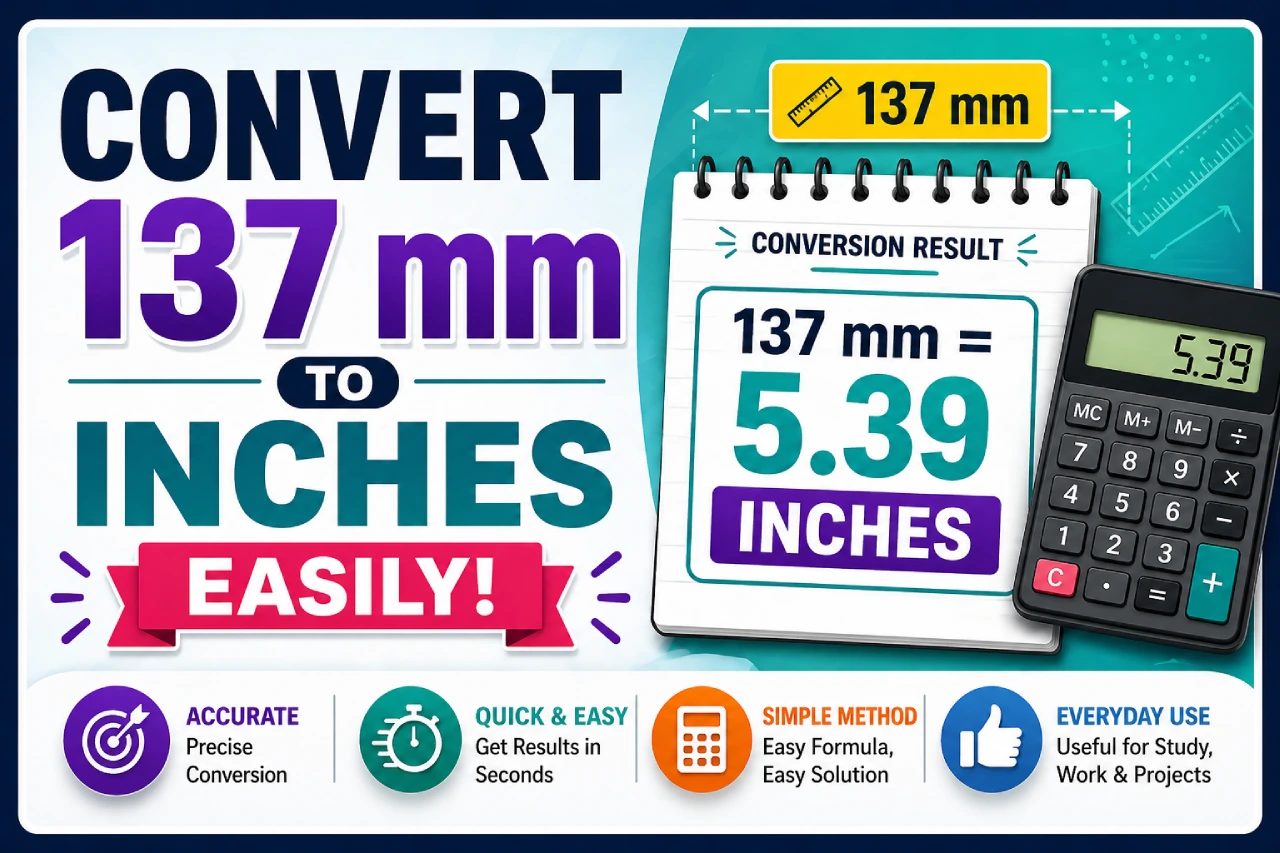
    Convert 137 mm to Inches Easily

    If you’re looking for the quick answer:

    👉 137 mm = 5.39 inches (approximately)

    To be more precise:

    👉 137 mm = 5.3937 inches

    That’s the exact conversion using the standard formula. But if you want to understand how this works—and how to convert any millimeter value to inches effortlessly—this guide will walk you through everything step by step.

    Understanding the Units

    Before we jump into calculations, let’s quickly understand the two units involved.

    What Is a Millimeter (mm)?

    A millimeter (mm) is a unit of length in the metric system.

    Definition

    👉 1 millimeter = 1/1,000 of a meter

    Common Uses

    • Engineering measurements
    • Manufacturing
    • Construction
    • Everyday objects like screws, pipes, and small dimensions

    Example:

    • A coin thickness ≈ 1–2 mm
    • A smartphone thickness ≈ 7–10 mm

    What Is an Inch?

    An inch is a unit of length in the U.S. customary system.

    Definition

    👉 1 inch = 25.4 millimeters

    This is an exact, internationally agreed conversion.

    Common Uses

    • Screen sizes
    • Furniture dimensions
    • Construction in the U.S.
    • Personal measurements

    Conversion Formula

    mm to Inches Converter

    Enter a value in millimeters to convert it into inches.

    Result: 0 inches

    Here’s the formula you need:

    👉 Inches = Millimeters ÷ 25.4

    Step-by-Step Conversion: 137 mm to Inches

    Let’s calculate it together.

    Step 1: Start with the value

    137 mm

    Step 2: Divide by 25.4

    137 ÷ 25.4

    Step 3: Calculate

    = 5.3937 inches

    Final Answer

    👉 137 mm ≈ 5.39 inches

    Quick Conversion Table

    Here’s a helpful reference for nearby values.

    Millimeters (mm)Inches
    130 mm5.12 in
    135 mm5.31 in
    137 mm5.39 in
    140 mm5.51 in
    150 mm5.91 in

    This makes it easy to estimate quickly.

    Why 25.4 Is Important

    The number 25.4 is the key to all mm-to-inch conversions.

    👉 1 inch = 25.4 mm

    This value is exact and used worldwide in engineering and science.

    Shortcut Methods

    Here are some quick ways to convert without a calculator.

    Method 1: Divide by 25

    137 ÷ 25 ≈ 5.48 (slightly higher estimate)

    Method 2: Multiply by 0.03937

    👉 Inches = mm × 0.03937

    137 × 0.03937 ≈ 5.39 inches

    Method 3: Use Benchmarks

    • 100 mm ≈ 3.94 inches
    • 150 mm ≈ 5.91 inches

    So 137 mm falls right in between.

    Real-Life Examples

    Let’s make this practical.

    Example 1: Screen Size

    A device measuring 137 mm wide:

    👉 ≈ 5.39 inches

    Example 2: Pipe Diameter

    A pipe with 137 mm diameter:

    👉 ≈ 5.39 inches

    Example 3: Furniture Measurement

    A shelf depth of 137 mm:

    👉 ≈ 5.4 inches

    Converting Inches Back to mm

    Sometimes you need the reverse.

    Formula

    👉 Millimeters = Inches × 25.4

    Example

    5.39 inches × 25.4 ≈ 137 mm

    Why This Conversion Matters

    You’ll need this conversion in many situations.

    1. International Measurements

    Metric vs U.S. systems often overlap.

    2. Construction Projects

    Plans may use different units.

    3. Online Shopping

    Product dimensions vary by region.

    4. Engineering and Manufacturing

    Precision is critical.

    mm vs Inches: Key Differences

    UnitSystemSize
    Millimeter (mm)MetricSmaller
    InchU.S. customaryLarger

    Both measure length—but in different systems.

    Common Mistakes to Avoid

    1. Using the Wrong Conversion Factor

    Always use:

    👉 25.4 mm per inch

    2. Rounding Too Early

    Keep precision until the final step.

    3. Mixing Units

    Don’t confuse mm with cm or inches with feet.

    Tips for Accurate Conversion

    Tip 1: Use a Calculator

    Especially for precise work.

    Tip 2: Memorize Key Values

    • 25.4 mm = 1 inch
    • 50 mm ≈ 2 inches
    • 100 mm ≈ 4 inches

    Tip 3: Double-Check Units

    Always confirm what unit you’re converting from.

    Practical Applications

    1. DIY Projects

    When following instructions from different regions.

    2. Automotive Work

    Parts may be listed in mm or inches.

    3. Electronics

    Screen sizes and components use inches.

    4. Home Improvement

    Measurements often require conversion.

    Advanced Insight: Precision vs Approximation

    In casual use:

    👉 137 mm ≈ 5.39 inches

    In technical fields:

    👉 137 mm = 5.3937 inches

    The difference may seem small—but it matters in precision work.

    Practice Problems

    Try these yourself.

    1. 100 mm = ? inches
    2. 200 mm = ? inches
    3. 50 mm = ? inches
    4. 75 mm = ? inches

    Answers

    1. 3.94 inches
    2. 7.87 inches
    3. 1.97 inches
    4. 2.95 inches

    Frequently Asked Questions (FAQs)

    What is 137 mm in inches?

    👉 5.39 inches (approximately)

    What is the exact value?

    👉 5.3937 inches

    How do you convert mm to inches?

    Divide by 25.4.

    What is 1 mm in inches?

    👉 0.03937 inches

    Why is 25.4 used?

    It’s the exact conversion standard.

    Is mm smaller than inches?

    Yes, much smaller.

    Can calculators convert mm to inches?

    Yes, easily.

    What is 150 mm in inches?

    👉 5.91 inches

    Is this conversion exact?

    Yes, based on international standards.

    Where is this conversion used?

    In construction, engineering, and everyday measurements.

    Final Thoughts

    Converting 137 mm to inches is simple once you know the formula:

    👉 Inches = mm ÷ 25.4

    So:

    👉 137 mm = 5.39 inches (approx.)

    This conversion is incredibly useful in everyday life—from DIY projects to professional engineering work.

    Once you understand the relationship between millimeters and inches, you can convert values quickly and confidently.

    Now here’s a quick question for you:
    Next time you see a measurement in millimeters, will you instantly know its size in inches?

  • Grams to Centigrams Conversion (g to cg Guide)

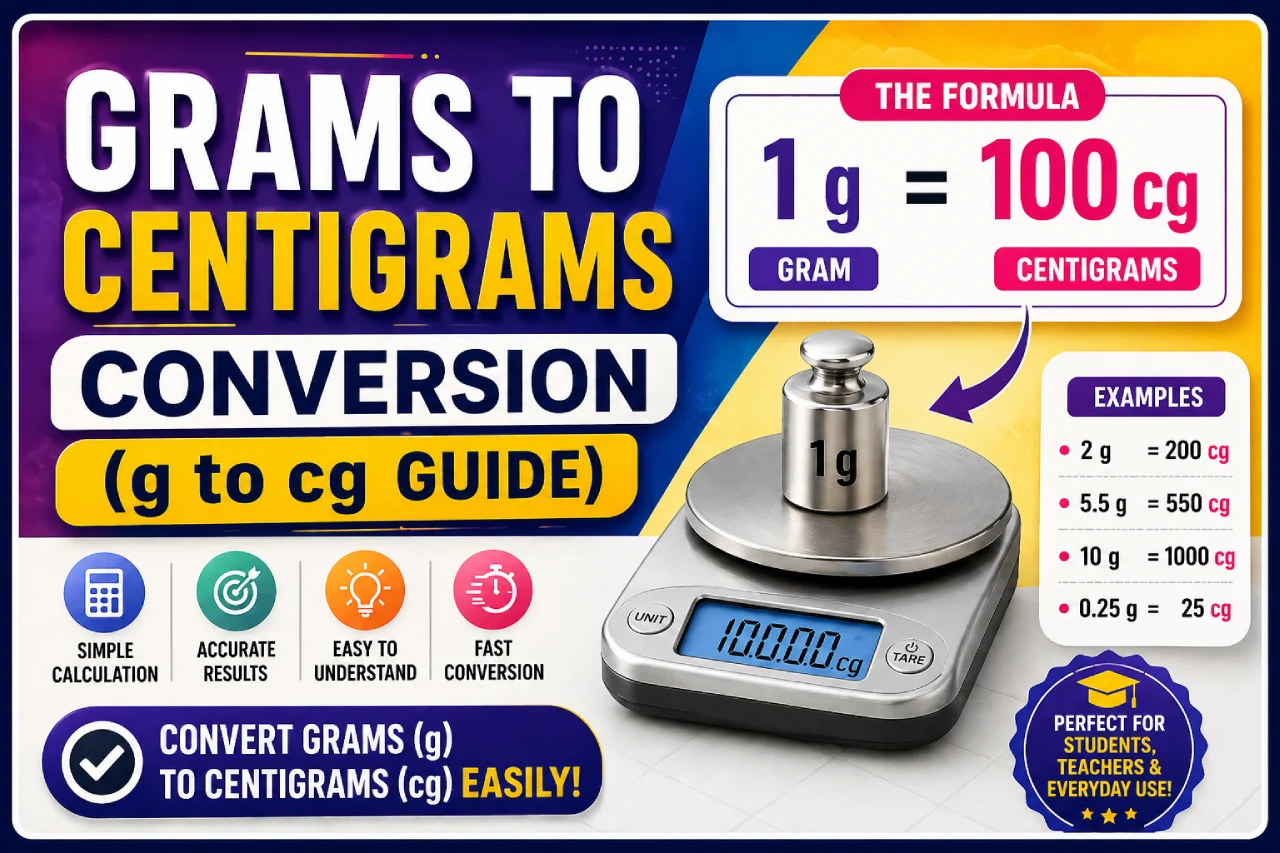
    Grams to Centigrams Conversion (g to cg Guide)

    If you’re looking for the quick answer:

    👉 1 gram (g) = 100 centigrams (cg)
    👉 Centigrams = Grams × 100

    So, for example:

    • 1 g = 100 cg
    • 5 g = 500 cg
    • 0.5 g = 50 cg

    This is one of the simplest conversions in the metric system because it’s based on powers of 10. But to really understand it—and use it confidently in real-life situations—let’s break everything down step by step.

    What Is a Gram (g)?

    A gram is a basic unit of mass in the metric system.

    Definition

    👉 1 gram = 1/1000 of a kilogram

    Common Uses

    • Food measurements
    • Cooking ingredients
    • Small objects
    • Science experiments

    Example:

    • A paperclip weighs about 1 gram
    • A chocolate bar might weigh 100 grams

    What Is a Centigram (cg)?

    A centigram is a smaller unit of mass.

    Definition

    👉 1 centigram = 1/100 of a gram

    In Numbers

    👉 1 cg = 0.01 g

    Where It’s Used

    • Scientific measurements
    • Laboratory work
    • Precise calculations

    Centigrams are useful when grams are too large for accurate measurement.

    Relationship Between Grams and Centigrams

    Let’s connect the two units clearly.

    • 1 gram = 100 centigrams
    • 1 centigram = 0.01 grams

    👉 The difference is two decimal places

    Conversion Formula

    Grams to Centigrams Converter

    Enter a value in grams to convert it into centigrams.

    Here’s the simple formula:

    👉 Centigrams (cg) = Grams (g) × 100

    Reverse Formula

    👉 Grams (g) = Centigrams (cg) ÷ 100

    Step-by-Step Conversion Example

    Let’s convert 3.5 grams to centigrams.

    Step 1: Start with grams

    3.5 g

    Step 2: Multiply by 100

    3.5 × 100

    Step 3: Calculate

    = 350 cg

    👉 Final Answer: 3.5 g = 350 cg

    Another Example

    Convert 0.25 grams to centigrams.

    Step 1

    0.25 × 100

    Step 2

    = 25 cg

    👉 Final Answer: 0.25 g = 25 cg

    Quick Conversion Table

    Here’s a handy reference chart.

    Grams (g)Centigrams (cg)
    0.01 g1 cg
    0.1 g10 cg
    1 g100 cg
    2 g200 cg
    5 g500 cg
    10 g1,000 cg

    This makes quick conversions easy.

    Why This Conversion Is So Easy

    The metric system is designed for simplicity.

    Key Idea

    👉 All units are based on powers of 10

    That means:

    • No complex fractions
    • No confusing numbers
    • Just move the decimal point

    Shortcut Method

    To convert grams to centigrams:

    👉 Move the decimal point two places to the right

    Example

    • 1.2 g → 120 cg
    • 0.75 g → 75 cg

    Real-Life Examples

    Let’s see where this conversion shows up in everyday life.

    1. Cooking and Recipes

    While most recipes use grams, smaller quantities may be expressed in centigrams.

    2. Science Experiments

    Lab measurements often require precise units like centigrams.

    3. Pharmaceuticals

    Some medications are measured in smaller units for accuracy.

    4. Jewelry and Precious Materials

    Tiny weights may be expressed in centigrams.

    Converting Back: Centigrams to Grams

    Sometimes you need the reverse.

    Formula

    👉 Grams = Centigrams ÷ 100

    Example

    Convert 250 cg to grams:

    250 ÷ 100 = 2.5 g

    👉 Final Answer: 250 cg = 2.5 g

    Understanding the Metric Scale

    Here’s how grams and centigrams fit into the metric system.

    UnitRelation to Gram
    Kilogram (kg)1,000 g
    Gram (g)Base unit
    Centigram (cg)0.01 g
    Milligram (mg)0.001 g

    This structure makes conversions predictable and easy.

    Common Mistakes to Avoid

    1. Moving the Decimal the Wrong Way

    • g → cg → move right
    • cg → g → move left

    2. Confusing cg with mg

    • 1 cg = 10 mg
    • They are not the same

    3. Forgetting the Conversion Factor

    Always remember:

    👉 1 g = 100 cg

    Tips for Quick Mental Conversion

    Here are some simple tricks.

    Trick 1: Multiply by 100

    This is the easiest method.

    Trick 2: Add Two Zeros

    For whole numbers:

    5 g → 500 cg

    Trick 3: Shift Decimal Right

    0.8 g → 80 cg

    Practical Examples

    Example 1: Food Measurement

    A spice weighs 2.5 g:

    👉 2.5 × 100 = 250 cg

    Example 2: Lab Sample

    A sample weighs 0.08 g:

    👉 0.08 × 100 = 8 cg

    Example 3: Jewelry Weight

    A small item weighs 1.75 g:

    👉 1.75 × 100 = 175 cg

    Why This Conversion Matters

    Even though it’s simple, it’s useful in many fields.

    1. Accuracy

    Small units allow precise measurement.

    2. Flexibility

    You can easily switch between units.

    3. Global Standard

    The metric system is used worldwide.

    Practice Problems

    Try these yourself.

    1. 4 g = ? cg
    2. 0.6 g = ? cg
    3. 250 cg = ? g
    4. 1.2 g = ? cg

    Answers

    1. 400 cg
    2. 60 cg
    3. 2.5 g
    4. 120 cg

    Frequently Asked Questions (FAQs)

    What is 1 gram in centigrams?

    👉 100 cg

    How do you convert grams to centigrams?

    Multiply by 100.

    What is 5 grams in centigrams?

    👉 500 cg

    What is 1 centigram in grams?

    👉 0.01 g

    Is cg smaller than g?

    Yes, much smaller.

    What is 0.5 g in cg?

    👉 50 cg

    Why is the metric system easy?

    Because it uses powers of 10.

    Can calculators convert g to cg?

    Yes, easily.

    What is 100 cg in grams?

    👉 1 g

    Where is this conversion used?

    In science, medicine, and everyday measurements.

    Final Thoughts

    Converting grams to centigrams is one of the simplest tasks in the metric system.

    The key rule is:

    👉 Centigrams = Grams × 100

    Or simply:

    👉 Move the decimal two places to the right

    Once you understand this, you can convert values instantly without even thinking.

    Whether you’re measuring ingredients, working in a lab, or handling precise quantities, this conversion is both practical and essential.

    Now here’s a quick question for you:
    Next time you see a value in grams, will you instantly know its equivalent in centigrams?

  • Cubic Yards to Tons Calculator (Beginner Guide)

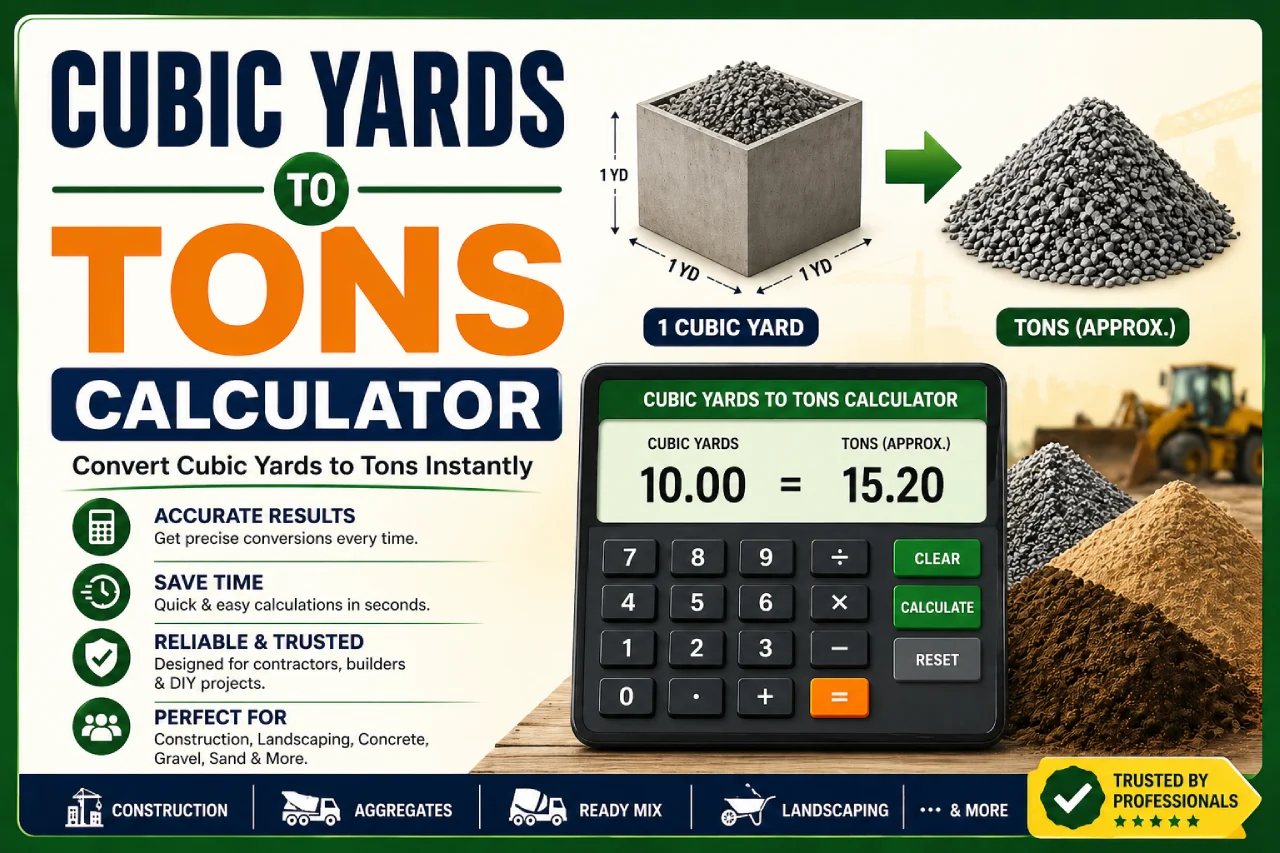
    Cubic Yards to Tons Calculator (Beginner Guide)

    If you’re looking for the quick answer:

    👉 Tons = Cubic Yards × Material Density

    There is no single fixed conversion between cubic yards and tons because it depends on the material you’re measuring.

    For example:

    • 1 cubic yard of gravel ≈ 1.4–1.7 tons
    • 1 cubic yard of sand ≈ 1.3–1.5 tons
    • 1 cubic yard of topsoil ≈ 1.1–1.3 tons

    So, a cubic yards to tons calculator works by multiplying the volume by the material’s density.

    In this guide, you’ll learn exactly how to calculate it, understand material differences, and confidently estimate loads for construction, landscaping, and more.

    What Is a Cubic Yard?

    A cubic yard (yd³) is a unit of volume.

    Definition

    👉 1 cubic yard = 3 ft × 3 ft × 3 ft = 27 cubic feet

    Common Uses

    • Soil
    • Gravel
    • Sand
    • Concrete
    • Mulch

    It tells you how much space a material occupies.

    What Is a Ton?

    A ton is a unit of weight.

    In the U.S.

    👉 1 ton = 2,000 pounds

    Important Note

    A cubic yard measures volume, while a ton measures weight.

    That’s why conversion depends on density.

    Why You Need a Cubic Yards to Tons Calculator

    You can’t convert directly unless you know:

    👉 What material you’re working with

    Different materials have different densities.

    For example:

    • Gravel is heavier than mulch
    • Sand is denser than topsoil

    Conversion Formula

    Cubic Yards to Tons Converter

    Enter cubic yards and choose a material to estimate tons.

    Result will appear here

    Here’s the key formula:

    👉 Tons = Cubic Yards × Density (tons per cubic yard)

    Common Material Densities

    Here’s a practical reference chart.

    MaterialTons per Cubic Yard
    Gravel1.4 – 1.7
    Sand1.3 – 1.5
    Topsoil1.1 – 1.3
    Mulch0.2 – 0.4
    Concrete2.0 – 2.4
    Asphalt2.0 – 2.2

    These values are averages and may vary slightly.

    Step-by-Step Example

    Let’s calculate 5 cubic yards of gravel.

    Step 1: Choose density

    Gravel ≈ 1.5 tons per cubic yard

    Step 2: Multiply

    5 × 1.5 = 7.5 tons

    👉 Final Answer: 5 yd³ gravel ≈ 7.5 tons

    Another Example

    Convert 10 cubic yards of sand.

    Step 1: Density

    Sand ≈ 1.4 tons/yd³

    Step 2: Multiply

    10 × 1.4 = 14 tons

    👉 Final Answer: 10 yd³ sand ≈ 14 tons

    Cubic Yards to Tons Calculator (Manual Method)

    You can calculate it yourself in seconds.

    Step 1

    Identify the material

    Step 2

    Find its density

    Step 3

    Multiply:

    👉 Volume × Density = Tons

    That’s it.

    Why Density Matters

    Density is the key factor.

    Definition

    Density = weight per unit volume

    Example

    • 1 yd³ of feathers → very light
    • 1 yd³ of concrete → very heavy

    Same volume, completely different weight.

    Real-Life Applications

    This conversion is widely used in everyday projects.

    1. Landscaping

    When ordering:

    • Soil
    • Mulch
    • Gravel

    You need to know weight for delivery.

    2. Construction

    Used for:

    • Concrete calculations
    • Road building
    • Foundation work

    3. Truck Loading

    Trucks have weight limits, not volume limits.

    4. Budgeting

    Materials are often priced per ton.

    Quick Conversion Table

    Here’s a general reference.

    Cubic YardsGravel (tons)Sand (tons)
    1 yd³1.51.4
    2 yd³3.02.8
    5 yd³7.57.0
    10 yd³15.014.0

    Estimating Without Exact Density

    Sometimes you don’t have exact values.

    Use These Averages

    • Gravel → 1.5 tons/yd³
    • Sand → 1.4 tons/yd³
    • Soil → 1.2 tons/yd³

    These give reliable estimates.

    Converting Tons Back to Cubic Yards

    Sometimes you need the reverse.

    Formula

    👉 Cubic Yards = Tons ÷ Density

    Example

    10 tons of gravel:

    10 ÷ 1.5 ≈ 6.67 yd³

    Common Mistakes to Avoid

    1. Assuming a Fixed Conversion

    There is no universal conversion.

    2. Ignoring Material Type

    Always check the density.

    3. Overloading Trucks

    Weight matters more than volume for transport.

    4. Using Rough Estimates for Precise Work

    For critical projects, use exact density values.

    Tips for Accurate Calculations

    Tip 1: Ask Your Supplier

    Suppliers often provide density values.

    Tip 2: Add a Safety Margin

    Order slightly more material to avoid shortages.

    Tip 3: Use Consistent Units

    Stick to cubic yards and tons.

    Tip 4: Consider Moisture Content

    Wet materials weigh more than dry ones.

    Real-World Example: Driveway Project

    Let’s say you’re building a gravel driveway.

    Step 1: Volume

    You need 8 cubic yards

    Step 2: Density

    Gravel ≈ 1.5 tons/yd³

    Step 3: Calculate

    8 × 1.5 = 12 tons

    👉 You should order about 12 tons of gravel

    Why Moisture Changes Weight

    Water adds weight.

    • Dry sand = lighter
    • Wet sand = heavier

    This can affect your final tonnage.

    Frequently Asked Questions (FAQs)

    How many tons are in 1 cubic yard?

    It depends on the material.

    What is the formula for cubic yards to tons?

    👉 Tons = Cubic Yards × Density

    How many tons is 3 cubic yards of gravel?

    👉 About 4.5 tons

    How many cubic yards is 1 ton?

    Depends on the material.

    Is sand heavier than gravel?

    Not always—densities are similar.

    How accurate are these conversions?

    They are estimates unless exact density is known.

    Can calculators do this automatically?

    Yes, if density is provided.

    Why is mulch so light?

    Because it’s less dense.

    How many tons is 10 cubic yards of soil?

    👉 About 12 tons

    Should I round up or down?

    Always round up for safety.

    Final Thoughts

    A cubic yards to tons calculator is simple once you understand the concept:

    👉 You’re converting volume into weight using density

    The key takeaway:

    👉 Tons = Cubic Yards × Material Density

    There’s no one-size-fits-all answer—but with the right density, you can calculate anything accurately.

    Whether you’re planning a landscaping project, ordering materials, or working in construction, this knowledge saves time, money, and effort.

    Now here’s a quick question for you:
    Next time you order materials, will you think in cubic yards—or calculate the exact tonnage first?

  • How Many mL in a Drop?

    How Many mL in a Drop?

    If you’re looking for the quick answer:

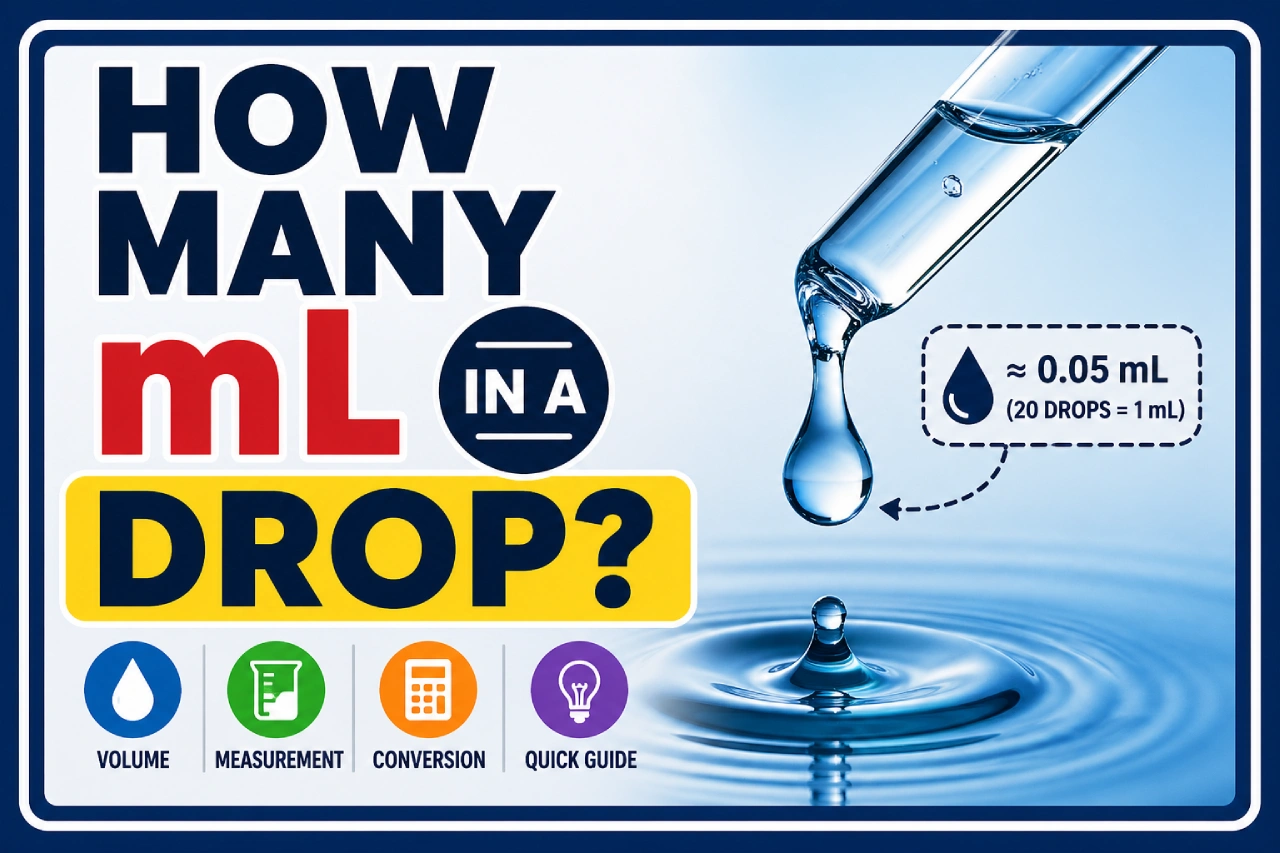
    👉 1 drop ≈ 0.05 mL
    👉 20 drops ≈ 1 mL

    That’s the standard estimate used in many medical and pharmaceutical settings.

    But here’s the important part:
    👉 The exact volume of a drop can vary depending on the liquid, dropper, and conditions.

    In this guide, we’ll break down everything you need to know—from standard conversions to real-world variations—so you can confidently work with drops and milliliters.

    What Is a Drop?

    A drop is a very small unit of volume, often used when dealing with liquids.

    Why It’s Not a Fixed Unit

    Unlike milliliters, a “drop” isn’t officially standardized across all uses.

    Its size depends on:

    • The liquid’s viscosity (thickness)
    • Surface tension
    • The dropper design
    • Temperature

    That’s why we use an approximate standard value.

    Standard Drop-to-mL Conversion

    Drop to mL Converter

    Enter the number of drops below to convert drops into milliliters.

    Result: 0 mL

    Note: A common estimate is 20 drops = 1 mL, meaning 1 drop is about 0.05 mL. Actual drop size can vary by liquid and dropper.

    In medicine and pharmacy, a standard reference is used:

    👉 1 drop = 0.05 mL

    This leads to:

    👉 20 drops = 1 mL

    This value comes from standardized droppers used in healthcare.

    Conversion Formula

    Here’s the simple formula:

    👉 mL = Number of Drops × 0.05

    Reverse Formula

    👉 Drops = mL × 20

    Quick Conversion Table

    Here’s a helpful reference.

    DropsMilliliters (mL)
    1 drop0.05 mL
    5 drops0.25 mL
    10 drops0.5 mL
    20 drops1 mL
    50 drops2.5 mL
    100 drops5 mL

    This makes quick calculations easy.

    Step-by-Step Example

    Let’s convert 15 drops to mL.

    Step 1: Use the formula

    mL = Drops × 0.05

    Step 2: Multiply

    15 × 0.05 = 0.75 mL

    👉 Final Answer: 15 drops = 0.75 mL

    Why Does Drop Size Vary?

    Here’s where things get interesting.

    1. Type of Liquid

    Different liquids behave differently.

    • Water: standard reference
    • Oil: thicker, larger drops
    • Alcohol: thinner, smaller drops

    2. Dropper Design

    Not all droppers are equal.

    • Medical droppers are calibrated
    • Household droppers are not

    3. Surface Tension

    Liquids with higher surface tension form larger drops.

    4. Temperature

    Warmer liquids may produce smaller drops.

    Medical and Pharmaceutical Standards

    In healthcare, precision is critical.

    Standard Medical Drop

    👉 1 drop = 0.05 mL (20 drops per mL)

    This standard is widely used in:

    • Eye drops
    • Oral medications
    • IV drip calculations

    Drops in Different Contexts

    The meaning of a “drop” changes depending on where it’s used.

    1. Eye Drops

    Eye droppers are designed for accuracy.

    👉 Typically close to 0.05 mL per drop

    2. Essential Oils

    Drops can vary widely.

    👉 Often 0.03–0.05 mL per drop

    3. IV Drip (Medical)

    In IV systems:

    • 10, 15, 20, or 60 drops per mL may be used depending on the set

    So:

    👉 Always check the drop factor

    4. Household Droppers

    These are less accurate.

    👉 Drop size may vary significantly

    Real-Life Examples

    Let’s make this practical.

    Example 1: Medication Dose

    A prescription says:

    👉 Take 10 drops

    Using the standard:

    10 × 0.05 = 0.5 mL

    Example 2: Essential Oil Recipe

    You add 30 drops:

    30 × 0.05 = 1.5 mL

    Example 3: IV Drip Calculation

    If the drop factor is 20 drops/mL:

    👉 40 drops = 2 mL

    Drops vs Teaspoons and Tablespoons

    Let’s compare drops to common kitchen units.

    • 1 teaspoon = 5 mL
    • 1 tablespoon = 15 mL

    Using the standard:

    👉 1 teaspoon ≈ 100 drops
    👉 1 tablespoon ≈ 300 drops

    Why This Conversion Matters

    Understanding drops to mL is essential in many areas.

    1. Medicine

    Accurate dosing can be critical for safety.

    2. Cooking and Flavoring

    Drops are used for strong ingredients like extracts.

    3. Aromatherapy

    Essential oils are often measured in drops.

    4. Science and Labs

    Precise liquid measurements are required.

    Common Mistakes to Avoid

    1. Assuming All Drops Are Equal

    Not all droppers produce the same size drops.

    2. Ignoring Liquid Type

    Oil and water behave differently.

    3. Mixing Measurement Systems

    Stick to consistent units when converting.

    4. Over-Rounding

    Small errors can matter when working with drops.

    Tips for Accurate Measurement

    Here are some practical tips.

    Tip 1: Use a Calibrated Dropper

    Medical droppers provide consistent results.

    Tip 2: Count Carefully

    Small quantities require precision.

    Tip 3: Use mL for Accuracy

    Whenever possible, measure in milliliters instead of drops.

    Tip 4: Know Your Drop Factor

    Especially important for IV systems.

    Quick Mental Conversion Tricks

    Here are some easy shortcuts.

    Trick 1: Remember 20 Drops = 1 mL

    This is the most useful rule.

    Trick 2: Divide by 20

    To convert drops → mL:

    50 drops ÷ 20 = 2.5 mL

    Trick 3: Multiply by 20

    To convert mL → drops:

    2 mL × 20 = 40 drops

    Practice Problems

    Try these yourself.

    1. 25 drops = ? mL
    2. 40 drops = ? mL
    3. 2 mL = ? drops
    4. 5 mL = ? drops

    Answers

    1. 1.25 mL
    2. 2 mL
    3. 40 drops
    4. 100 drops

    Frequently Asked Questions (FAQs)

    How many mL is 1 drop?

    👉 Approximately 0.05 mL

    How many drops are in 1 mL?

    👉 About 20 drops

    Is drop size always the same?

    No, it varies by liquid and dropper.

    How many drops in 5 mL?

    👉 About 100 drops

    Can I rely on drops for medicine?

    Yes, if using a calibrated dropper.

    Why do oils have different drop sizes?

    Because of viscosity and surface tension.

    What is the safest way to measure?

    Use a measuring syringe or mL scale.

    Is 1 drop equal to 0.1 mL?

    No, that’s too large. Standard is 0.05 mL.

    What is a dropper?

    A tool used to dispense small amounts of liquid.

    Are drops used in cooking?

    Yes, especially for strong flavors.

    Final Thoughts

    So, how many mL are in a drop?

    👉 About 0.05 mL per drop (standard)
    👉 20 drops = 1 mL

    But remember:

    👉 Drops are not perfectly consistent

    Their size depends on the liquid and the dropper.

    For everyday use, the 20 drops per mL rule works well. But for precise applications—like medicine—always rely on calibrated tools.

    Now here’s a quick question for you:
    Next time you measure liquid in drops, will you trust the dropper—or double-check with milliliters for accuracy?

  • Convert Nanogram to Milligram (ng to mg Guide)

    Convert Nanogram to Milligram (ng to mg Guide)

    If you’re looking for the quick answer:

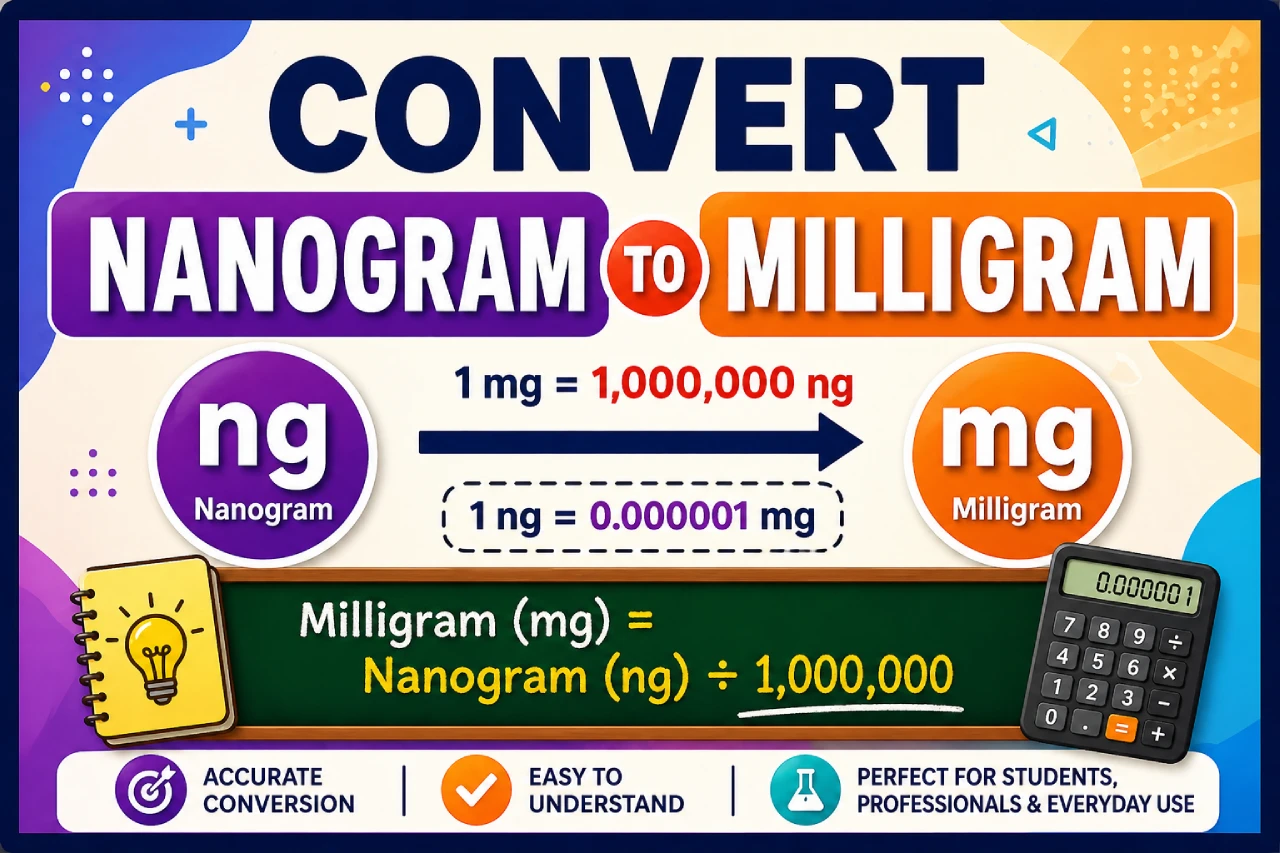
    👉 1 nanogram (ng) = 0.000001 milligram (mg)
    👉 Milligrams = Nanograms ÷ 1,000,000

    So, for example:

    • 1,000 ng = 0.001 mg
    • 1,000,000 ng = 1 mg
    • 500 ng = 0.0005 mg

    This conversion is extremely important in medicine, laboratory work, pharmacology, and scientific research, where measurements are incredibly small and precision matters.

    In this guide, we’ll break down everything step by step—so you don’t just memorize the formula, but actually understand it.

    Understanding the Units

    Before we convert anything, let’s understand what nanograms and milligrams really are.

    What Is a Nanogram (ng)?

    A nanogram is a very tiny unit of mass.

    Definition

    👉 1 nanogram = 1 billionth of a gram
    👉 1 ng = 0.000000001 grams (10⁻⁹ g)

    Where It’s Used

    • Drug dosages
    • DNA measurements
    • Environmental testing
    • Medical diagnostics

    To give you perspective:

    👉 A nanogram is so small that it’s often used to measure microscopic substances.

    What Is a Milligram (mg)?

    A milligram is a larger unit compared to a nanogram—but still very small.

    Definition

    👉 1 milligram = 1 thousandth of a gram
    👉 1 mg = 0.001 grams (10⁻³ g)

    Common Uses

    • Medication doses
    • Nutritional values
    • Food labeling

    Key Relationship Between ng and mg

    Let’s connect the two units.

    • 1 mg = 1,000,000 ng
    • 1 ng = 0.000001 mg

    👉 That’s a difference of six decimal places

    Conversion Formula

    Nanogram to Milligram Converter

    Nanogram to Milligram Converter

    Enter a value in nanograms to convert it into milligrams.

    Milligrams: 0 mg
    Formula: milligrams = nanograms ÷ 1,000,000

    Here’s the formula you need.

    👉 Milligrams (mg) = Nanograms (ng) ÷ 1,000,000

    Reverse Formula

    👉 Nanograms (ng) = Milligrams (mg) × 1,000,000

    Step-by-Step Conversion Example

    Let’s convert 750,000 ng to mg.

    Step 1: Start with nanograms

    750,000 ng

    Step 2: Divide by 1,000,000

    750,000 ÷ 1,000,000

    Step 3: Calculate

    = 0.75 mg

    Final Answer

    👉 750,000 ng = 0.75 mg

    Another Example

    Convert 2,500 ng to mg.

    Step 1

    2,500 ÷ 1,000,000

    Step 2

    = 0.0025 mg

    👉 Final Answer: 0.0025 mg

    Quick Conversion Table

    Here’s a helpful chart for quick reference.

    Nanograms (ng)Milligrams (mg)
    1 ng0.000001 mg
    100 ng0.0001 mg
    1,000 ng0.001 mg
    10,000 ng0.01 mg
    100,000 ng0.1 mg
    1,000,000 ng1 mg

    This makes it easy to estimate values quickly.

    Why This Conversion Matters

    You might wonder why such small units are important.

    1. Medicine and Dosage

    Certain drugs are measured in micrograms or nanograms.

    Even tiny errors can have serious consequences.

    2. Laboratory Testing

    Scientific experiments often involve extremely small quantities.

    3. Environmental Science

    Pollutants in air and water are measured in ng.

    4. Nutrition and Supplements

    Trace elements may be measured in very small amounts.

    Visualizing the Difference

    Let’s make this easier to understand.

    • 1 gram = a paperclip
    • 1 milligram = 1/1,000 of that
    • 1 nanogram = 1/1,000,000,000 of that

    👉 So a nanogram is one million times smaller than a milligram

    Converting mg Back to ng

    Sometimes you need to reverse the conversion.

    Formula

    👉 ng = mg × 1,000,000

    Example

    0.5 mg × 1,000,000 = 500,000 ng

    Common Mistakes to Avoid

    1. Misplacing the Decimal

    Since the numbers are small, decimal placement is critical.

    2. Confusing Units

    • ng (nanogram)
    • mg (milligram)

    They are very different.

    3. Forgetting the Conversion Factor

    Always remember:

    👉 1 mg = 1,000,000 ng

    Tips for Quick Mental Conversion

    Here are some simple tricks.

    Trick 1: Move the Decimal 6 Places

    To convert ng → mg:

    👉 Move the decimal 6 places left

    Example:

    500,000 ng → 0.5 mg

    Trick 2: Use Scientific Notation

    • ng = 10⁻⁹ g
    • mg = 10⁻³ g

    Difference = 10⁶

    Trick 3: Use Benchmarks

    • 1,000,000 ng = 1 mg
    • 500,000 ng = 0.5 mg

    Practical Examples

    Example 1: Medical Dose

    A medication contains 250,000 ng:

    👉 250,000 ÷ 1,000,000 = 0.25 mg

    Example 2: Lab Measurement

    A sample has 75,000 ng:

    👉 75,000 ÷ 1,000,000 = 0.075 mg

    Example 3: Environmental Data

    Pollution level = 10,000 ng:

    👉 10,000 ÷ 1,000,000 = 0.01 mg

    Why the Metric System Makes This Easy

    The metric system is based on powers of 10.

    This means:

    • Conversions are just decimal shifts
    • No complicated fractions
    • Easy to learn and apply

    Practice Problems

    Try these yourself.

    1. 1,500 ng = ? mg
    2. 250,000 ng = ? mg
    3. 5,000,000 ng = ? mg
    4. 80,000 ng = ? mg

    Answers

    1. 0.0015 mg
    2. 0.25 mg
    3. 5 mg
    4. 0.08 mg

    Frequently Asked Questions (FAQs)

    What is 1 ng in mg?

    👉 0.000001 mg

    How do you convert nanograms to milligrams?

    Divide by 1,000,000.

    What is 1 mg in ng?

    👉 1,000,000 ng

    Why are nanograms used?

    To measure extremely small quantities.

    What is 500,000 ng in mg?

    👉 0.5 mg

    Is ng smaller than mg?

    Yes, much smaller.

    Can calculators convert ng to mg?

    Yes, easily.

    What is 10,000 ng in mg?

    👉 0.01 mg

    Why is precision important?

    Small errors can lead to large inaccuracies.

    Is this conversion exact?

    Yes, it’s based on the metric system.

    Final Thoughts

    Converting nanograms to milligrams is simple once you understand the relationship:

    👉 1 ng = 0.000001 mg
    👉 mg = ng ÷ 1,000,000

    The key idea is:

    👉 Move the decimal six places to the left

    This conversion is critical in fields where precision matters—like medicine, science, and environmental studies.

    Once you master it, you’ll handle even the smallest measurements with confidence.

    Now here’s a quick question for you:
    Next time you see a value in nanograms, will you instantly know its equivalent in milligrams?

  • hPa to PSI Conversion (Exact Formula Explained)

    hPa to PSI Conversion (Exact Formula Explained)

    If you’re looking for the quick answer:

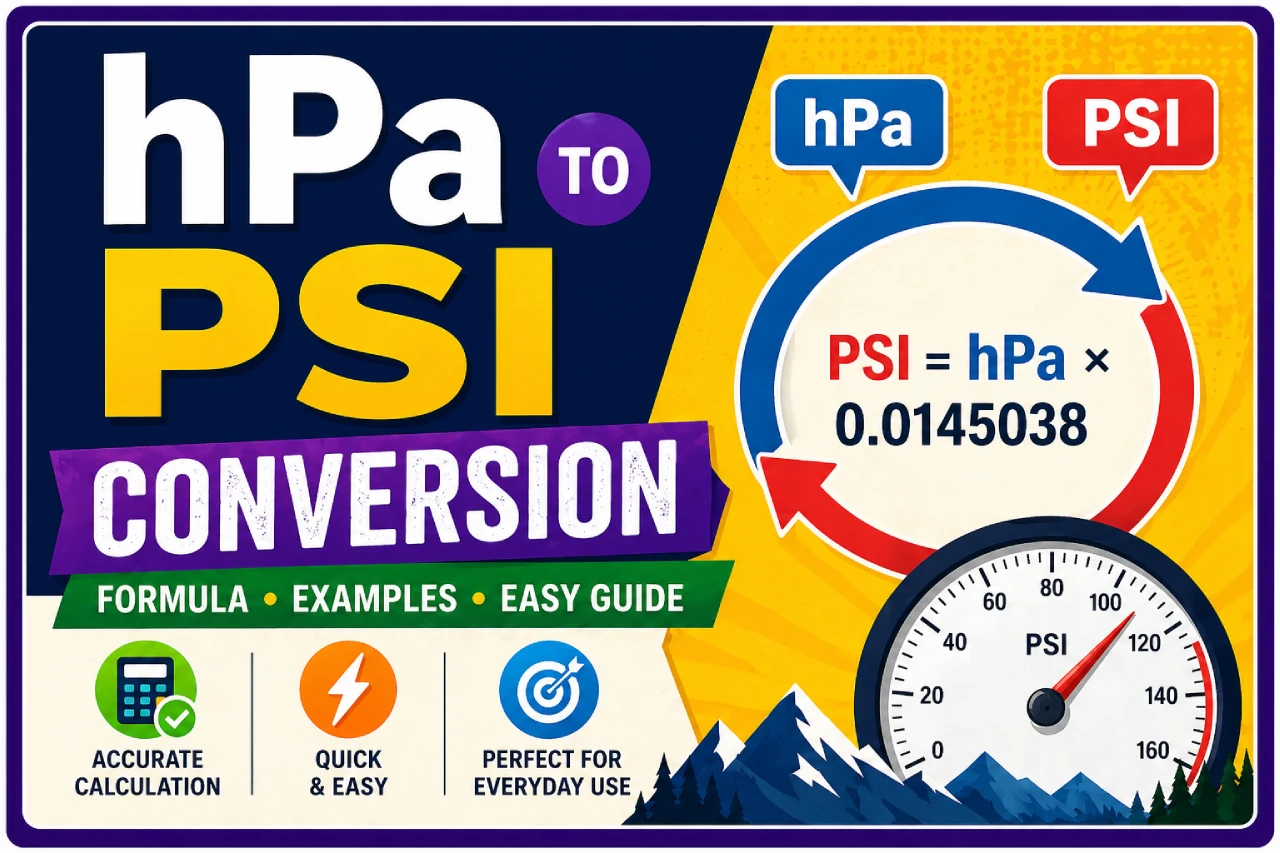
    👉 1 hPa = 0.0145038 psi
    👉 PSI = hPa × 0.0145038

    For example:

    • 100 hPa ≈ 1.450 psi
    • 500 hPa ≈ 7.252 psi
    • 1013.25 hPa ≈ 14.696 psi (standard atmospheric pressure)

    This conversion is especially useful in weather data, aviation, HVAC systems, and engineering, where pressure readings are often given in hectopascals (hPa) but need to be understood in PSI.

    In this guide, you’ll learn exactly how to convert hPa to PSI, understand what these units mean, and confidently apply the conversion in real-life situations.

    What Is hPa (Hectopascal)?

    A hectopascal (hPa) is a metric unit of pressure.

    Definition

    👉 1 hPa = 100 pascals (Pa)

    The pascal is the SI unit of pressure, defined as:

    👉 1 Pa = 1 newton per square meter (N/m²)

    Why hPa Is Used

    Hectopascals are commonly used because they produce manageable numbers.

    Common Uses

    • Weather reports
    • Atmospheric pressure measurements
    • Aviation systems

    Example

    • Normal atmospheric pressure = 1013.25 hPa

    What Is PSI?

    PSI (pounds per square inch) is a unit of pressure used mainly in the United States.

    Definition

    👉 It measures how much force (in pounds) is applied over one square inch.

    Common Uses

    • Tire pressure
    • Air compressors
    • Hydraulic systems
    • Gas pressure

    Example

    • Car tires: 30–35 PSI
    • Air compressors: 90–120 PSI

    hPa to PSI Conversion Formula

    hPa to PSI Converter

    Enter pressure in hectopascals (hPa) to convert it into pounds per square inch (PSI).

    Result: 0 PSI

    Here’s the key formula:

    👉 PSI = hPa × 0.0145038

    Reverse Formula

    👉 hPa = PSI ÷ 0.0145038

    This conversion factor is precise and widely accepted.

    Step-by-Step Conversion Example

    Let’s convert 750 hPa to PSI.

    Step 1: Start with hPa

    750 hPa

    Step 2: Multiply by conversion factor

    750 × 0.0145038

    Step 3: Calculate

    = 10.87785 psi

    Final Answer

    👉 750 hPa ≈ 10.88 PSI

    Quick Conversion Table

    Here’s a handy reference chart.

    hPaPSI
    1 hPa0.0145 psi
    10 hPa0.145 psi
    100 hPa1.450 psi
    500 hPa7.252 psi
    1000 hPa14.504 psi
    1013.25 hPa14.696 psi

    This table helps you estimate values quickly.

    Understanding the Relationship

    Let’s simplify it.

    👉 1 PSI ≈ 68.95 hPa

    This is useful for quick reverse conversions.

    Example

    • 2 PSI ≈ 138 hPa
    • 10 PSI ≈ 689 hPa

    Real-World Applications

    Understanding hPa to PSI conversion is more useful than you might think.

    1. Weather and Atmospheric Pressure

    Weather forecasts often use hPa.

    Example:

    • A pressure system at 980 hPa:
      👉 980 × 0.0145038 ≈ 14.21 PSI

    2. Aviation

    Pilots rely on hPa for altitude and pressure readings.

    3. HVAC Systems

    Engineers may need PSI for system pressure calculations.

    4. Industrial Equipment

    Some machines use metric pressure units, others use PSI.

    hPa vs PSI: Key Differences

    UnitSystemTypical Use
    hPaMetric (SI)Weather, aviation
    PSIU.S. customaryMechanical systems

    Both measure pressure—but in different systems.

    Converting PSI Back to hPa

    Sometimes you need the reverse.

    Formula

    👉 hPa = PSI × 68.95

    Example

    5 PSI × 68.95 = 344.75 hPa

    Why hPa Is Common in Weather

    Meteorologists prefer hPa because:

    • It aligns with the metric system
    • It produces manageable numbers
    • It’s internationally standardized

    Common Mistakes to Avoid

    1. Using the Wrong Conversion Factor

    Always use:

    👉 0.0145038 for hPa → PSI

    2. Confusing Pa, hPa, and kPa

    • 1 hPa = 100 Pa
    • 1 kPa = 1,000 Pa

    3. Rounding Too Early

    Keep precision until the final step.

    Tips for Quick Mental Conversion

    Here are some simple tricks.

    Trick 1: Multiply by 0.015

    Close enough for quick estimates.

    Trick 2: Divide by 70

    To convert PSI → hPa quickly.

    Trick 3: Use Benchmarks

    • 1000 hPa ≈ 14.5 PSI
    • 500 hPa ≈ 7.25 PSI

    Practical Examples

    Example 1: Weather Pressure

    A storm system at 990 hPa:

    990 × 0.0145038 ≈ 14.36 PSI

    Example 2: Low Pressure System

    850 hPa:

    850 × 0.0145038 ≈ 12.33 PSI

    Example 3: Standard Atmosphere

    1013.25 hPa:

    👉 14.696 PSI

    This is the standard atmospheric pressure at sea level.

    Why This Conversion Matters

    Understanding hPa to PSI helps you:

    • Interpret weather data
    • Work across measurement systems
    • Avoid confusion in technical fields
    • Improve accuracy in calculations

    Frequently Asked Questions (FAQs)

    What is 1 hPa in PSI?

    👉 0.0145038 PSI

    How do you convert hPa to PSI?

    Multiply by 0.0145038.

    What is 1000 hPa in PSI?

    👉 14.504 PSI

    What is 1 PSI in hPa?

    👉 68.95 hPa

    Why is hPa used in weather?

    Because it’s part of the metric system and easy to interpret.

    Is PSI higher than hPa?

    They measure the same pressure in different units.

    Can calculators convert hPa to PSI?

    Yes, easily.

    What is 500 hPa in PSI?

    👉 7.252 PSI

    What is standard atmospheric pressure?

    👉 1013.25 hPa or 14.696 PSI

    Is hPa the same as millibar?

    👉 Yes, 1 hPa = 1 millibar

    Final Thoughts

    Converting hPa to PSI is straightforward once you know the formula:

    👉 PSI = hPa × 0.0145038

    And the reverse:

    👉 hPa = PSI × 68.95

    Whether you’re reading weather reports, working with engineering systems, or comparing pressure values across regions, this conversion helps you stay accurate and confident.

    Now here’s a quick question for you:
    Next time you see atmospheric pressure in hPa, will you instantly know what it means in PSI?