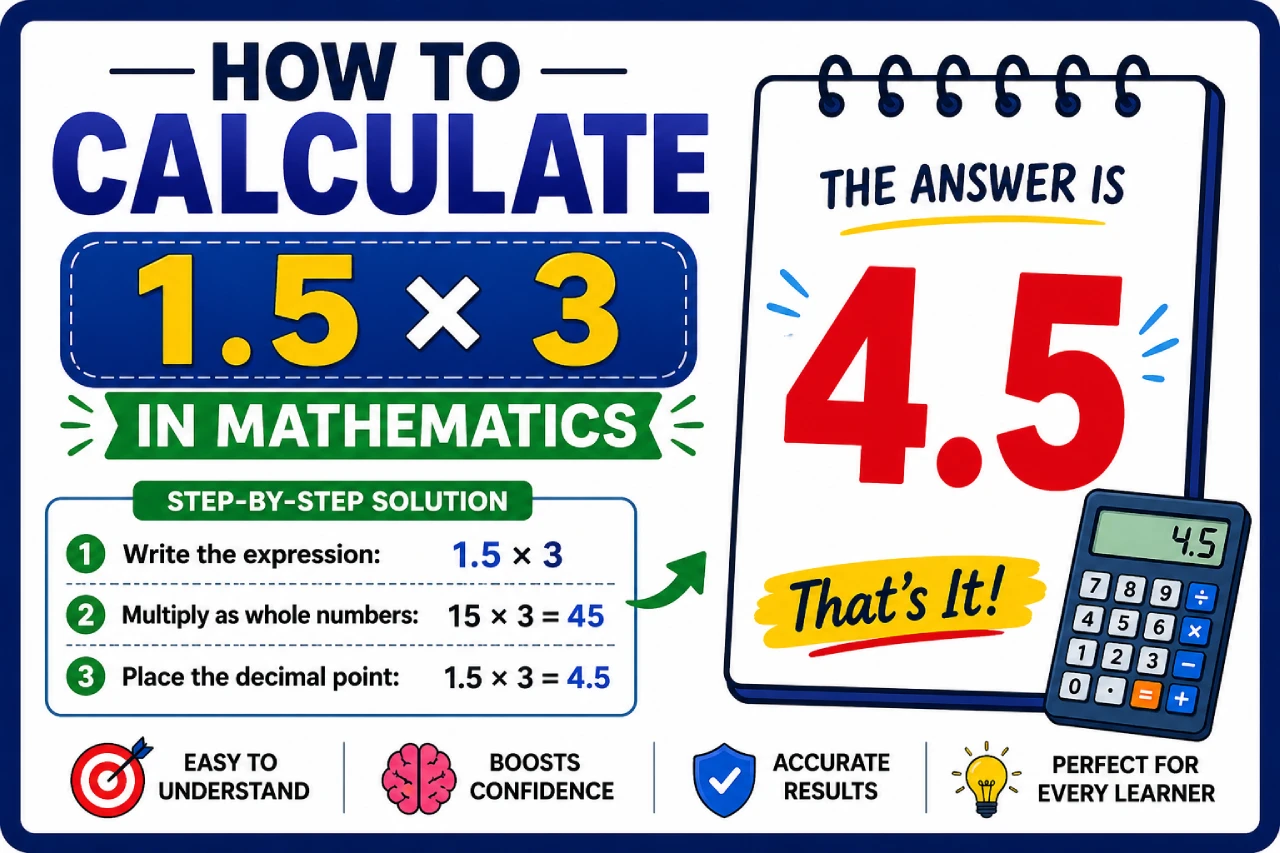
If you’re looking for the quick answer:
👉 1.5 × 3 = 4.5
That’s the exact result.
But if you’ve ever wondered how to calculate it—or why it works the way it does—you’re in the right place. In this guide, we’ll break it down step by step, explore multiple methods, and make sure you fully understand how to multiply decimals like 1.5 × 3 with confidence.
Understanding the Numbers
Before jumping into the calculation, let’s quickly understand what these numbers represent.
What Is 1.5?
The number 1.5 is a decimal.
It can also be written as:
👉 1.5 = 1 + 0.5
Or as a fraction:
👉 1.5 = 3/2
So, 1.5 represents one and a half.
What Is 3?
The number 3 is a whole number.
When you multiply something by 3, you are essentially adding it three times.
Method 1: Direct Multiplication
The simplest way is straightforward multiplication.
1.5×3=4.5
👉 Final Answer: 4.5
Method 2: Break It Into Parts
This is one of the easiest ways to understand what’s happening.
Step 1: Split 1.5
1.5 = 1 + 0.5
Step 2: Multiply Each Part
- 1 × 3 = 3
- 0.5 × 3 = 1.5
Step 3: Add the Results
3 + 1.5 = 4.5
👉 Same answer, but now you understand the logic behind it.
Method 3: Convert to Fractions
Sometimes fractions make things clearer.
Step 1: Convert 1.5 to a fraction
1.5 = 3/2
Step 2: Multiply
(3/2) × 3 = 9/2
Step 3: Convert back to decimal
9 ÷ 2 = 4.5
👉 Again, the result is 4.5
Method 4: Remove the Decimal First
This method is helpful when working with decimals.
Step 1: Multiply both numbers by 10
1.5 × 3 becomes:
15 × 3 = 45
Step 2: Adjust the decimal
Since we moved the decimal one place, divide by 10:
45 ÷ 10 = 4.5
Why the Answer Is 4.5
Let’s think about it in a simple way.
👉 If you have 1.5 apples, and you take that amount 3 times, you get:
- 1.5 + 1.5 + 1.5 = 4.5
So multiplication is just repeated addition.
Visualizing 1.5 × 3
Imagine:
- Each group = 1.5 units
- Number of groups = 3
Total = 4.5 units
Or picture:
- One whole (1) × 3 = 3
- Half (0.5) × 3 = 1.5
Total = 3 + 1.5 = 4.5
Real-Life Examples
Example 1: Money
If something costs $1.50 and you buy 3 of them:
1.5 × 3 = $4.50
Example 2: Time
If one task takes 1.5 hours, doing it 3 times takes:
1.5 × 3 = 4.5 hours
Example 3: Distance
If you walk 1.5 miles each day for 3 days:
Total distance = 4.5 miles
Common Mistakes to Avoid
1. Ignoring the Decimal
Some people mistakenly calculate:
1.5 × 3 = 15 × 3 = 45 (without adjusting)
Always remember to place the decimal correctly.
2. Confusing Multiplication With Addition
Multiplication is repeated addition, but you must multiply properly.
3. Forgetting Fraction Conversion
Knowing that 1.5 = 3/2 can simplify calculations.
Tips for Multiplying Decimals Easily
Tip 1: Break the Number
Split decimals into whole and fractional parts.
Tip 2: Use Fractions
Decimals like 0.5 or 1.5 are easy to convert.
Tip 3: Move the Decimal
Temporarily remove the decimal, then adjust later.
Tip 4: Estimate First
1.5 × 3 is close to 2 × 3 = 6
So the answer should be slightly less than 6 → 4.5 makes sense.
Why Learning This Matters
Understanding simple multiplication like this builds the foundation for:
- Algebra
- Geometry
- Real-world problem solving
- Financial calculations
Once you master this, more complex math becomes easier.
Practice Problems
Try these to test your understanding:
- 1.5 × 2 = ?
- 1.5 × 4 = ?
- 2.5 × 3 = ?
- 0.5 × 6 = ?
Answers
- 3
- 6
- 7.5
- 3
Frequently Asked Questions (FAQs)
What is 1.5 × 3?
👉 4.5
How do you multiply decimals?
Multiply normally, then place the decimal correctly.
Can I use fractions instead?
Yes. 1.5 = 3/2 makes multiplication easier.
Why is the answer not 45?
Because the decimal must be accounted for.
Is 1.5 × 3 the same as 3 × 1.5?
Yes. Multiplication is commutative.
What is 1.5 as a fraction?
👉 3/2
Is 1.5 a whole number?
No, it’s a decimal.
Can calculators solve this?
Yes, instantly.
What is 1.5 × 10?
👉 15
What is 1.5 × 5?
👉 7.5
Final Thoughts
So, how do you calculate 1.5 × 3?
👉 The answer is 4.5
But more importantly, you now understand why.
You’ve seen multiple methods:
- Direct multiplication
- Breaking into parts
- Using fractions
- Removing decimals
Once you grasp these techniques, even more complex calculations will feel easy.
Now here’s a quick question for you:
Next time you see a decimal multiplication problem, will you solve it instantly—or break it down step by step like a pro?
Leave a Reply