Blog

  • How to Calculate 1.5 × 3 in Mathematics (Step-by-Step)

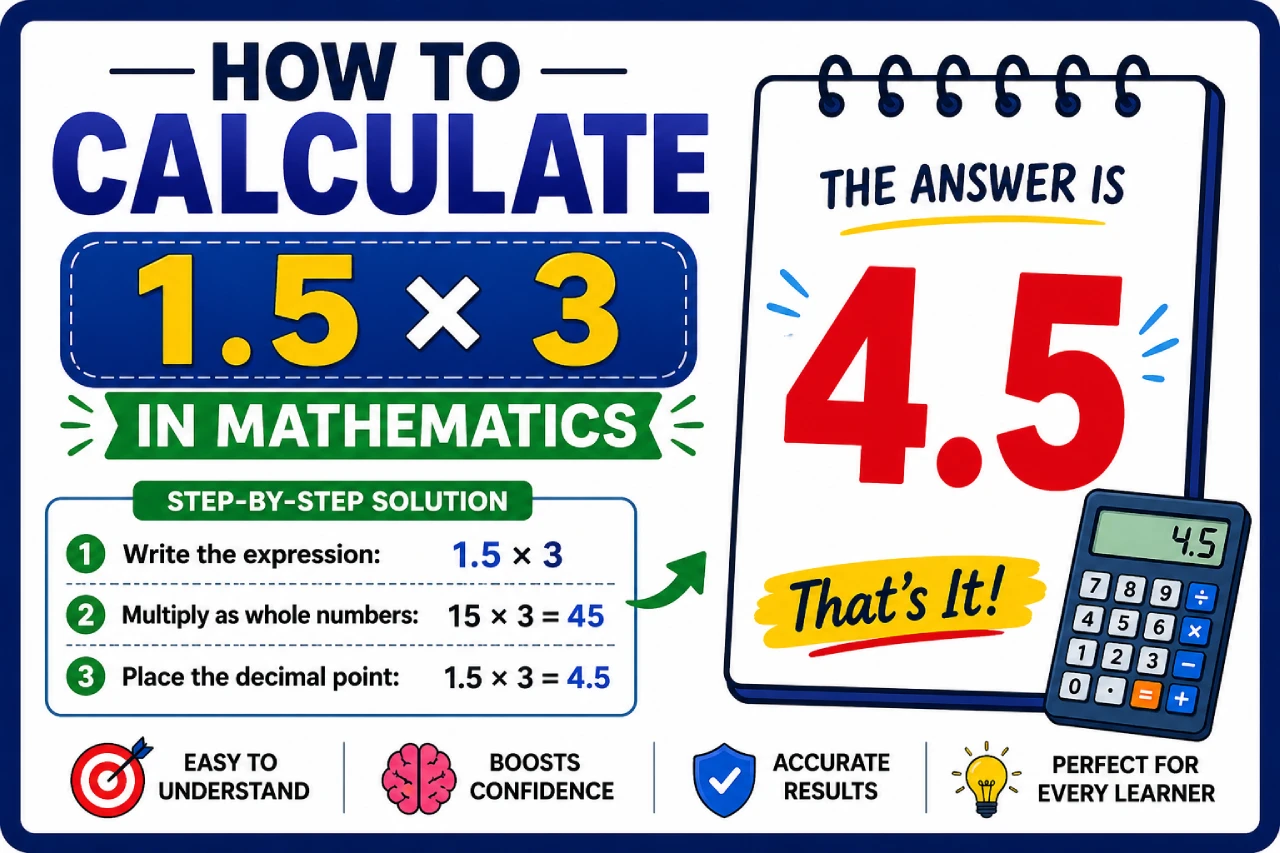
    How to Calculate 1.5 × 3 in Mathematics (Step-by-Step)

    If you’re looking for the quick answer:

    👉 1.5 × 3 = 4.5

    That’s the exact result.

    But if you’ve ever wondered how to calculate it—or why it works the way it does—you’re in the right place. In this guide, we’ll break it down step by step, explore multiple methods, and make sure you fully understand how to multiply decimals like 1.5 × 3 with confidence.

    Understanding the Numbers

    Before jumping into the calculation, let’s quickly understand what these numbers represent.

    What Is 1.5?

    The number 1.5 is a decimal.

    It can also be written as:

    👉 1.5 = 1 + 0.5

    Or as a fraction:

    👉 1.5 = 3/2

    So, 1.5 represents one and a half.

    What Is 3?

    The number 3 is a whole number.

    When you multiply something by 3, you are essentially adding it three times.

    Method 1: Direct Multiplication

    The simplest way is straightforward multiplication.

    1.5×3=4.51.5 \times 3 = 4.51.5×3=4.5

    👉 Final Answer: 4.5

    Method 2: Break It Into Parts

    This is one of the easiest ways to understand what’s happening.

    Step 1: Split 1.5

    1.5 = 1 + 0.5

    Step 2: Multiply Each Part

    • 1 × 3 = 3
    • 0.5 × 3 = 1.5

    Step 3: Add the Results

    3 + 1.5 = 4.5

    👉 Same answer, but now you understand the logic behind it.

    Method 3: Convert to Fractions

    Sometimes fractions make things clearer.

    Step 1: Convert 1.5 to a fraction

    1.5 = 3/2

    Step 2: Multiply

    (3/2) × 3 = 9/2

    Step 3: Convert back to decimal

    9 ÷ 2 = 4.5

    👉 Again, the result is 4.5

    Method 4: Remove the Decimal First

    This method is helpful when working with decimals.

    Step 1: Multiply both numbers by 10

    1.5 × 3 becomes:

    15 × 3 = 45

    Step 2: Adjust the decimal

    Since we moved the decimal one place, divide by 10:

    45 ÷ 10 = 4.5

    Why the Answer Is 4.5

    Let’s think about it in a simple way.

    👉 If you have 1.5 apples, and you take that amount 3 times, you get:

    • 1.5 + 1.5 + 1.5 = 4.5

    So multiplication is just repeated addition.

    Visualizing 1.5 × 3

    Imagine:

    • Each group = 1.5 units
    • Number of groups = 3

    Total = 4.5 units

    Or picture:

    • One whole (1) × 3 = 3
    • Half (0.5) × 3 = 1.5

    Total = 3 + 1.5 = 4.5

    Real-Life Examples

    Example 1: Money

    If something costs $1.50 and you buy 3 of them:

    1.5 × 3 = $4.50

    Example 2: Time

    If one task takes 1.5 hours, doing it 3 times takes:

    1.5 × 3 = 4.5 hours

    Example 3: Distance

    If you walk 1.5 miles each day for 3 days:

    Total distance = 4.5 miles

    Common Mistakes to Avoid

    1. Ignoring the Decimal

    Some people mistakenly calculate:

    1.5 × 3 = 15 × 3 = 45 (without adjusting)

    Always remember to place the decimal correctly.

    2. Confusing Multiplication With Addition

    Multiplication is repeated addition, but you must multiply properly.

    3. Forgetting Fraction Conversion

    Knowing that 1.5 = 3/2 can simplify calculations.

    Tips for Multiplying Decimals Easily

    Tip 1: Break the Number

    Split decimals into whole and fractional parts.

    Tip 2: Use Fractions

    Decimals like 0.5 or 1.5 are easy to convert.

    Tip 3: Move the Decimal

    Temporarily remove the decimal, then adjust later.

    Tip 4: Estimate First

    1.5 × 3 is close to 2 × 3 = 6
    So the answer should be slightly less than 6 → 4.5 makes sense.

    Why Learning This Matters

    Understanding simple multiplication like this builds the foundation for:

    • Algebra
    • Geometry
    • Real-world problem solving
    • Financial calculations

    Once you master this, more complex math becomes easier.

    Practice Problems

    Try these to test your understanding:

    1. 1.5 × 2 = ?
    2. 1.5 × 4 = ?
    3. 2.5 × 3 = ?
    4. 0.5 × 6 = ?

    Answers

    1. 3
    2. 6
    3. 7.5
    4. 3

    Frequently Asked Questions (FAQs)

    What is 1.5 × 3?

    👉 4.5

    How do you multiply decimals?

    Multiply normally, then place the decimal correctly.

    Can I use fractions instead?

    Yes. 1.5 = 3/2 makes multiplication easier.

    Why is the answer not 45?

    Because the decimal must be accounted for.

    Is 1.5 × 3 the same as 3 × 1.5?

    Yes. Multiplication is commutative.

    What is 1.5 as a fraction?

    👉 3/2

    Is 1.5 a whole number?

    No, it’s a decimal.

    Can calculators solve this?

    Yes, instantly.

    What is 1.5 × 10?

    👉 15

    What is 1.5 × 5?

    👉 7.5

    Final Thoughts

    So, how do you calculate 1.5 × 3?

    👉 The answer is 4.5

    But more importantly, you now understand why.

    You’ve seen multiple methods:

    • Direct multiplication
    • Breaking into parts
    • Using fractions
    • Removing decimals

    Once you grasp these techniques, even more complex calculations will feel easy.

    Now here’s a quick question for you:
    Next time you see a decimal multiplication problem, will you solve it instantly—or break it down step by step like a pro?
  • 9 Tablespoons to Cups (tbsp to cup Guide)

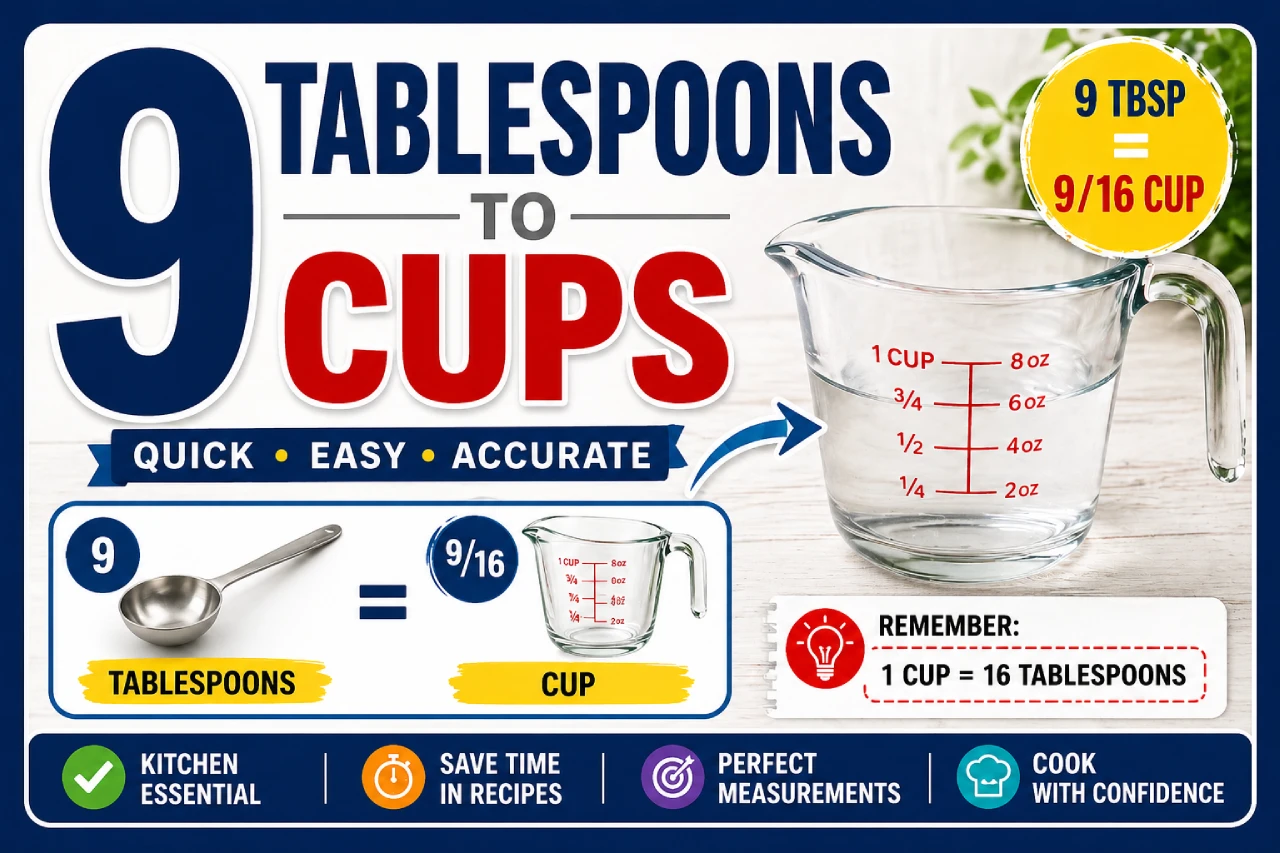
    9 Tablespoons to Cups (tbsp to cup Guide)

    If you’re looking for the quick answer:

    👉 9 tablespoons = 0.5625 cups

    In everyday cooking terms:

    👉 9 tablespoons = ½ cup + 1 tablespoon

    This is one of those conversions that comes up more often than you’d expect—especially when you’re scaling recipes, using measuring spoons instead of cups, or working with smaller ingredient amounts.

    In this guide, we’ll break down the math, show easy kitchen shortcuts, and help you understand exactly how to convert 9 tablespoons to cups without confusion.

    The Conversion Formula

    Tablespoons to Cups Converter

    Enter tablespoons below to convert them into cups.

    The key relationship is:

    👉 1 cup = 16 tablespoons

    Conversion Formula

    Cups = Tablespoons ÷ 16

    This formula works for any value.

    Step-by-Step Conversion: 9 Tablespoons to Cups

    Let’s calculate it clearly.

    Step 1: Start with tablespoons

    9 tablespoons

    Step 2: Divide by 16

    9 ÷ 16

    Step 3: Calculate

    = 0.5625 cups

    Final Result

    👉 9 tablespoons = 0.5625 cups

    Converting 9 Tablespoons into Fractions

    Decimals aren’t always helpful in the kitchen.

    Let’s convert 0.5625 into a fraction.

    0.5625 = 9/16 cup

    So:

    👉 9 tablespoons = 9/16 cup

    Easier Kitchen Version

    👉 9 tablespoons = ½ cup + 1 tablespoon

    This is the most practical way to measure it.

    Quick Conversion Table

    Here’s a helpful reference for nearby values.

    TablespoonsCups
    1 tbsp0.0625 cup
    4 tbsp0.25 cup
    8 tbsp0.5 cup
    9 tbsp0.5625 cup
    12 tbsp0.75 cup
    16 tbsp1 cup

    This makes it easy to estimate quickly.

    Why This Conversion Matters in Cooking

    If you’ve ever been in the kitchen without the right measuring tools, you know how important conversions can be.

    1. Recipe Adjustments

    Sometimes recipes use cups, but you only have tablespoons.

    2. Small Batch Cooking

    When cooking smaller portions, tablespoons are more practical.

    3. Baking Accuracy

    Precise measurements can make or break a recipe.

    4. Ingredient Substitution

    You may need to convert units when swapping ingredients.

    Real-Life Kitchen Example

    Let’s say a recipe calls for:

    👉 9 tablespoons of milk

    But you only have a measuring cup.

    Instead of guessing, you can measure:

    👉 ½ cup + 1 tablespoon

    Simple, accurate, and stress-free.

    Tablespoons vs Cups: Key Differences

    UnitSizeBest For
    TablespoonSmallSpices, oils
    CupLargeFlour, liquids

    Both are essential—but used differently depending on quantity.

    Converting Cups Back to Tablespoons

    Sometimes you need to reverse the conversion.

    Formula

    Tablespoons = Cups × 16

    Example

    0.5625 × 16 = 9 tablespoons

    This confirms the original value.

    Common Mistakes to Avoid

    1. Forgetting the 16 Rule

    Always remember:

    👉 1 cup = 16 tablespoons

    2. Mixing Metric and U.S. Units

    U.S. tablespoons differ slightly from other countries.

    3. Rounding Too Much

    In baking, precision matters—don’t over-round.

    Tips for Quick Kitchen Conversions

    Here are some practical tricks.

    Trick 1: Think “Half Cup = 8 tbsp”

    So:

    9 tbsp = half cup + 1 tbsp

    Trick 2: Use Measuring Tools Smartly

    • Use a ½ cup measure + 1 tablespoon
    • No need for complex math while cooking

    Trick 3: Memorize Key Benchmarks

    • 4 tbsp = ¼ cup
    • 8 tbsp = ½ cup
    • 16 tbsp = 1 cup

    Practical Uses in Everyday Cooking

    Baking

    Precise measurements are critical for:

    • Cakes
    • Cookies
    • Bread

    Cooking

    Flexible recipes allow easy conversions for:

    • Sauces
    • Soups
    • Dressings

    Meal Prep

    Smaller measurements help when portioning meals.

    Metric Conversion (Optional)

    If you prefer metric units:

    • 1 tablespoon ≈ 14.79 mL

    So:

    9 tbsp ≈ 133 mL

    This is useful for international recipes.

    Frequently Asked Questions (FAQs)

    How many cups is 9 tablespoons?

    👉 0.5625 cups

    What is 9 tablespoons in fraction form?

    👉 9/16 cup

    How do you convert tablespoons to cups?

    Divide by 16.

    Is 9 tablespoons more than half a cup?

    Yes, slightly more.

    What is the easiest way to measure 9 tablespoons?

    👉 ½ cup + 1 tablespoon

    How many tablespoons are in a cup?

    👉 16 tablespoons

    Can I use teaspoons instead?

    Yes:

    • 1 tbsp = 3 tsp
    • 9 tbsp = 27 teaspoons

    Why is this conversion important?

    It ensures accurate cooking and baking.

    Is 0.5625 cup exact?

    Yes, mathematically exact.

    What is 8 tablespoons in cups?

    👉 ½ cup

    Final Thoughts

    Converting 9 tablespoons to cups is simple once you know the rule:

    👉 Cups = Tablespoons ÷ 16

    Using this:

    👉 9 tablespoons = 0.5625 cups = 9/16 cup

    But in the kitchen, the easiest way to remember is:

    👉 ½ cup + 1 tablespoon

    That’s practical, quick, and accurate—exactly what you need when cooking.

    Now here’s a quick question for you:
    Next time a recipe calls for tablespoons, will you confidently convert it to cups without reaching for a calculator?

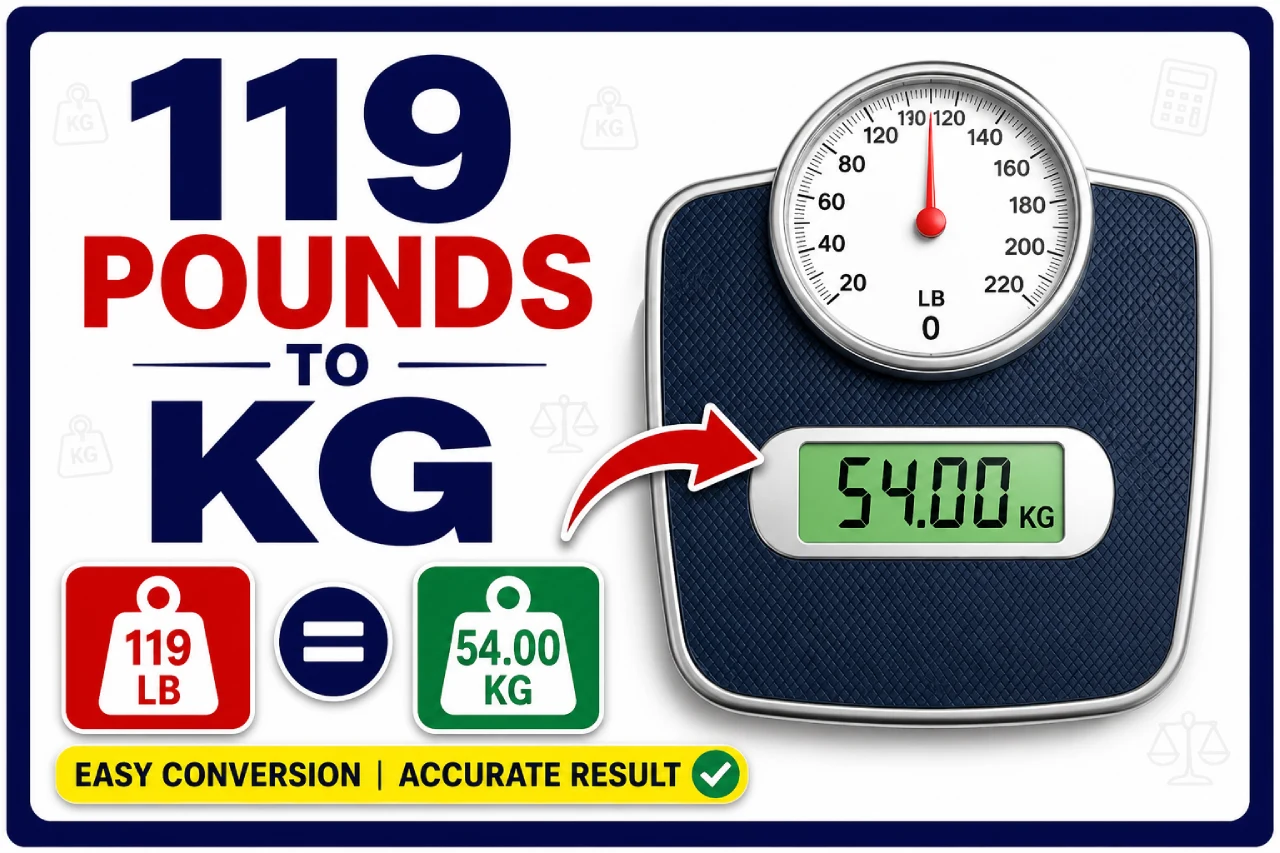
  • 119 Pounds to kg (lbs in kg Explained)

    119 Pounds to kg (lbs in kg Explained)

    If you’re looking for the quick answer:

    👉 119 pounds = 53.98 kilograms (approximately 54 kg)

    So, when you convert 119 pounds to kg, the result is:

    119 lbs ≈ 54 kg

    This is a very common conversion, especially for fitness tracking, health records, travel, and international comparisons, since the U.S. uses pounds while most of the world uses kilograms.

    In this guide, we’ll break down the formula, show step-by-step calculations, and help you understand what 119 lbs in kg actually means in real life.

    The Conversion Formula: Pounds to Kilograms

    Pounds to Kilograms Converter

    Enter a value in pounds to convert it into kilograms.

    The relationship between pounds and kilograms is fixed:

    1 pound = 0.453592 kilograms

    Conversion Formula

    Kilograms = Pounds × 0.453592

    This formula works for any value.

    Step-by-Step Conversion: 119 lbs to kg

    Let’s calculate it clearly.

    Step 1: Start with pounds

    119 lbs

    Step 2: Multiply by the conversion factor

    119 × 0.453592

    Step 3: Calculate

    = 53.977448 kg

    Final Result

    👉 119 lbs ≈ 53.98 kg

    Rounded:

    👉 119 lbs ≈ 54 kg

    Quick Conversion Table

    Here’s a helpful reference for nearby values.

    Pounds (lbs)Kilograms (kg)
    110 lbs49.90 kg
    115 lbs52.16 kg
    119 lbs53.98 kg
    120 lbs54.43 kg
    125 lbs56.70 kg
    130 lbs58.97 kg

    This makes quick estimation easier.

    What Does 119 lbs (54 kg) Feel Like?

    Numbers are helpful—but real-life context makes them meaningful.

    Body Weight Context

    • 54 kg is considered a light to moderate adult weight, depending on height
    • It’s common for smaller-framed adults or teenagers

    Everyday Comparisons

    119 pounds is roughly equal to:

    • A large suitcase fully packed
    • A small adult person
    • A heavy piece of furniture

    Why Convert Pounds to Kilograms?

    This conversion is useful in many situations.

    1. Fitness and Health

    Many fitness programs and health charts use kilograms.

    2. Travel

    Airlines list baggage limits in kilograms.

    3. International Communication

    Most countries use the metric system.

    4. Medical Records

    Doctors often record weight in kilograms.

    Pounds vs Kilograms: Key Differences

    UnitSystemEquivalent
    Pound (lb)U.S. customary0.453592 kg
    Kilogram (kg)Metric2.20462 lbs

    Because kilograms are larger units, the number becomes smaller when converting from pounds.

    Converting Kilograms Back to Pounds

    Sometimes you need the reverse conversion.

    Formula

    Pounds = Kilograms × 2.20462

    Example

    54 × 2.20462 ≈ 119 lbs

    This confirms the original value.

    Common Mistakes to Avoid

    1. Using the Wrong Conversion Factor

    Always use:

    1 lb = 0.453592 kg

    2. Rounding Too Early

    Keep precision until the final result.

    3. Confusing Units

    Remember:

    • Pounds → larger number
    • Kilograms → smaller number

    Tips for Quick Mental Conversion

    Here are simple tricks.

    Trick 1: Divide by 2.2

    119 ÷ 2.2 ≈ 54 kg

    Trick 2: Multiply by 0.45

    119 × 0.45 ≈ 53.55 kg

    Close to the exact answer.

    Trick 3: Use Benchmarks

    • 100 lbs ≈ 45 kg
    • 120 lbs ≈ 54 kg

    Real-World Examples

    Example 1: Fitness Tracking

    If your weight is 119 lbs, your metric equivalent is 54 kg.

    Example 2: Luggage Limits

    Airlines often allow 23 kg (50 lbs) per bag.
    119 lbs equals about 2.4 such bags combined.

    Example 3: Sports

    Athletes often track weight in kilograms internationally.

    Why This Conversion Matters

    Understanding 119 pounds to kg helps you:

    • Track health and fitness
    • Compare international data
    • Follow global standards
    • Avoid confusion when traveling

    Frequently Asked Questions (FAQs)

    How much is 119 lbs in kg?

    119 lbs ≈ 54 kg

    How do you convert pounds to kilograms?

    Multiply pounds by 0.453592.

    Is 119 lbs equal to 55 kg?

    It’s slightly less—about 54 kg.

    What is the easiest way to convert?

    Divide by 2.2 for a quick estimate.

    Why do countries use kg instead of lbs?

    Because the metric system is globally standardized.

    What is 1 kg in pounds?

    1 kg ≈ 2.20462 lbs

    Can calculators convert lbs to kg?

    Yes. Most tools support this.

    Is kg more accurate than lbs?

    Both are accurate, but kg is the global standard.

    What is 120 lbs in kg?

    120 × 0.453592 ≈ 54.43 kg

    Why does the number decrease when converting?

    Because kilograms are larger units than pounds.

    Final Thoughts

    Converting 119 pounds to kilograms is simple once you know the formula:

    👉 Kilograms = Pounds × 0.453592

    Using this:

    119 lbs ≈ 54 kg

    This is a practical, everyday weight that’s easy to understand, whether you’re tracking fitness, traveling, or comparing international measurements.

    Once you remember the shortcut—divide by 2.2 for quick estimates—you’ll be able to convert pounds to kilograms instantly.

    Now here’s a quick question for you:
    Next time you see your weight in pounds, will you automatically picture it in kilograms?

  • 181 lbs to kg (lbs to kg Formula Guide)

    181 lbs to kg (lbs to kg Formula Guide)

    If you’re looking for the quick answer:

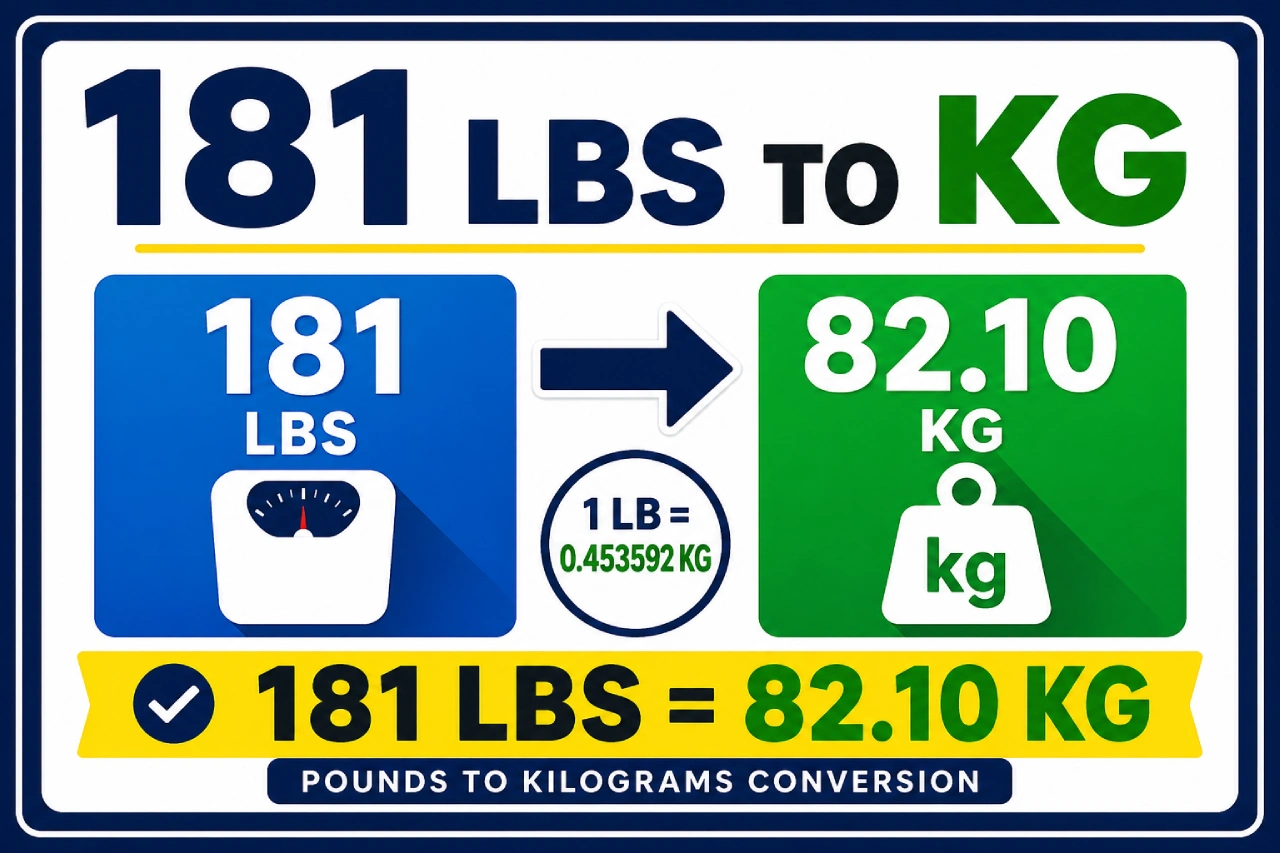
    👉 181 pounds = 82.10 kilograms (approximately 82.1 kg)

    So, when you convert 181 lbs to kg, the result is:

    181 lbs ≈ 82.1 kg

    This conversion is especially useful for fitness tracking, medical records, international travel, and global communication, since the United States uses pounds while most of the world uses kilograms.

    In this guide, we’ll break down the exact formula, show step-by-step calculations, and help you understand what 181 pounds in kilograms really means in everyday life.

    Understanding Pounds and Kilograms

    Before diving into the math, let’s quickly understand the units.

    What Is a Pound (lb)?

    A pound (lb) is a unit of weight used primarily in the United States.

    • 1 pound = 16 ounces
    • Commonly used for body weight, food, and shipping

    For example:

    • A person might weigh 150–200 lbs
    • A grocery item might weigh 3 lbs

    What Is a Kilogram (kg)?

    A kilogram (kg) is the standard unit of mass in the metric system, used worldwide.

    • 1 kilogram = 1,000 grams

    It’s used for:

    • Body weight
    • Medical measurements
    • Scientific calculations

    For example:

    • A person might weigh 60–90 kg
    • A suitcase might weigh 20 kg

    The Conversion Formula: Pounds to Kilograms

    Pounds to Kilograms Converter

    Enter a value in pounds to convert it into kilograms.

    Result: 0 kg

    The relationship between pounds and kilograms is fixed:

    1 pound = 0.453592 kilograms

    Conversion Formula

    Kilograms = Pounds × 0.453592

    This formula works for any value.

    Step-by-Step Conversion: 181 lbs to kg

    Let’s calculate it step by step.

    Step 1: Start with pounds

    181 lbs

    Step 2: Multiply by the conversion factor

    181 × 0.453592

    Step 3: Calculate

    = 82.100152 kg

    Final Result

    👉 181 lbs ≈ 82.10 kg

    Rounded:

    👉 181 lbs ≈ 82.1 kg

    Quick Conversion Table

    Here’s a helpful reference for nearby values.

    Pounds (lbs)Kilograms (kg)
    170 lbs77.11 kg
    175 lbs79.38 kg
    180 lbs81.65 kg
    181 lbs82.10 kg
    185 lbs83.91 kg
    190 lbs86.18 kg

    This helps you estimate similar conversions quickly.

    What Does 181 lbs (82.1 kg) Feel Like?

    Numbers are useful—but real-life context makes them meaningful.

    Body Weight Context

    • 82 kg is considered a moderate to above-average adult weight, depending on height
    • Common among athletes, gym-goers, and active individuals

    Everyday Comparisons

    181 pounds is roughly equal to:

    • A large adult person
    • Two heavy suitcases combined
    • A medium-sized home appliance

    Why Convert Pounds to Kilograms?

    This conversion is useful in many real-world situations.

    1. Fitness and Health

    Many fitness apps and medical charts use kilograms.

    2. Travel

    Airlines list baggage limits in kilograms.

    3. International Communication

    Most countries use the metric system.

    4. Medical Records

    Doctors often record weight in kilograms.

    Pounds vs Kilograms: Key Differences

    UnitSystemEquivalent
    Pound (lb)U.S. customary0.453592 kg
    Kilogram (kg)Metric2.20462 lbs

    Because kilograms are larger units, the number becomes smaller when converting from pounds.

    Converting Kilograms Back to Pounds

    Sometimes you need the reverse conversion.

    Formula

    Pounds = Kilograms × 2.20462

    Example

    82.1 × 2.20462 ≈ 181 lbs

    This confirms the original value.

    Common Mistakes to Avoid

    1. Using the Wrong Conversion Factor

    Always use:

    1 lb = 0.453592 kg

    2. Rounding Too Early

    Keep precision until the final result.

    3. Confusing Units

    Remember:

    • Pounds → larger number
    • Kilograms → smaller number

    Tips for Quick Mental Conversion

    Here are some simple tricks.

    Trick 1: Divide by 2.2

    181 ÷ 2.2 ≈ 82.3 kg

    Very close to the exact value.

    Trick 2: Multiply by 0.45

    181 × 0.45 ≈ 81.45 kg

    A quick estimate.

    Trick 3: Use Benchmarks

    • 180 lbs ≈ 82 kg
    • 200 lbs ≈ 91 kg

    Real-World Examples

    Example 1: Fitness Tracking

    If your weight is 181 lbs, your metric equivalent is 82.1 kg.

    Example 2: Luggage Limits

    Airlines often allow 23 kg (50 lbs) per bag.
    181 lbs equals about 3.6 such bags combined.

    Example 3: Sports and Training

    Athletes often track weight in kilograms internationally.

    Why This Conversion Matters

    Understanding 181 lbs to kg helps you:

    • Track fitness progress
    • Compare international data
    • Follow global standards
    • Communicate weight clearly

    Frequently Asked Questions (FAQs)

    How much is 181 lbs in kg?

    181 lbs ≈ 82.1 kg

    How do you convert pounds to kilograms?

    Multiply pounds by 0.453592.

    Is 181 lbs equal to 80 kg?

    No, it’s slightly higher at 82.1 kg.

    What is the easiest way to convert?

    Divide by 2.2 for a quick estimate.

    Why do countries use kg instead of lbs?

    Because the metric system is globally standardized.

    What is 1 kg in pounds?

    1 kg ≈ 2.20462 lbs

    Can calculators convert lbs to kg?

    Yes. Most tools support this.

    Is kg more accurate than lbs?

    Both are accurate, but kg is the scientific standard.

    What is 180 lbs in kg?

    180 × 0.453592 ≈ 81.65 kg

    Why does the number decrease when converting?

    Because kilograms are larger units than pounds.

    Final Thoughts

    Converting 181 pounds to kilograms is simple once you know the formula:

    👉 Kilograms = Pounds × 0.453592

    Using this:

    181 lbs ≈ 82.1 kg

    This is a practical, everyday weight that’s easy to understand, whether you’re tracking fitness, traveling, or comparing international measurements.

    Once you remember the shortcut—divide by 2.2 for quick estimates—you’ll be able to convert pounds to kilograms instantly.

    Now here’s a quick question for you:
    Next time you see your weight in pounds, will you automatically picture it in kilograms?

  • 194 Pounds to kg (lbs to kg Formula Guide)

    194 Pounds to kg (lbs to kg Formula Guide)

    If you’re looking for the quick answer:

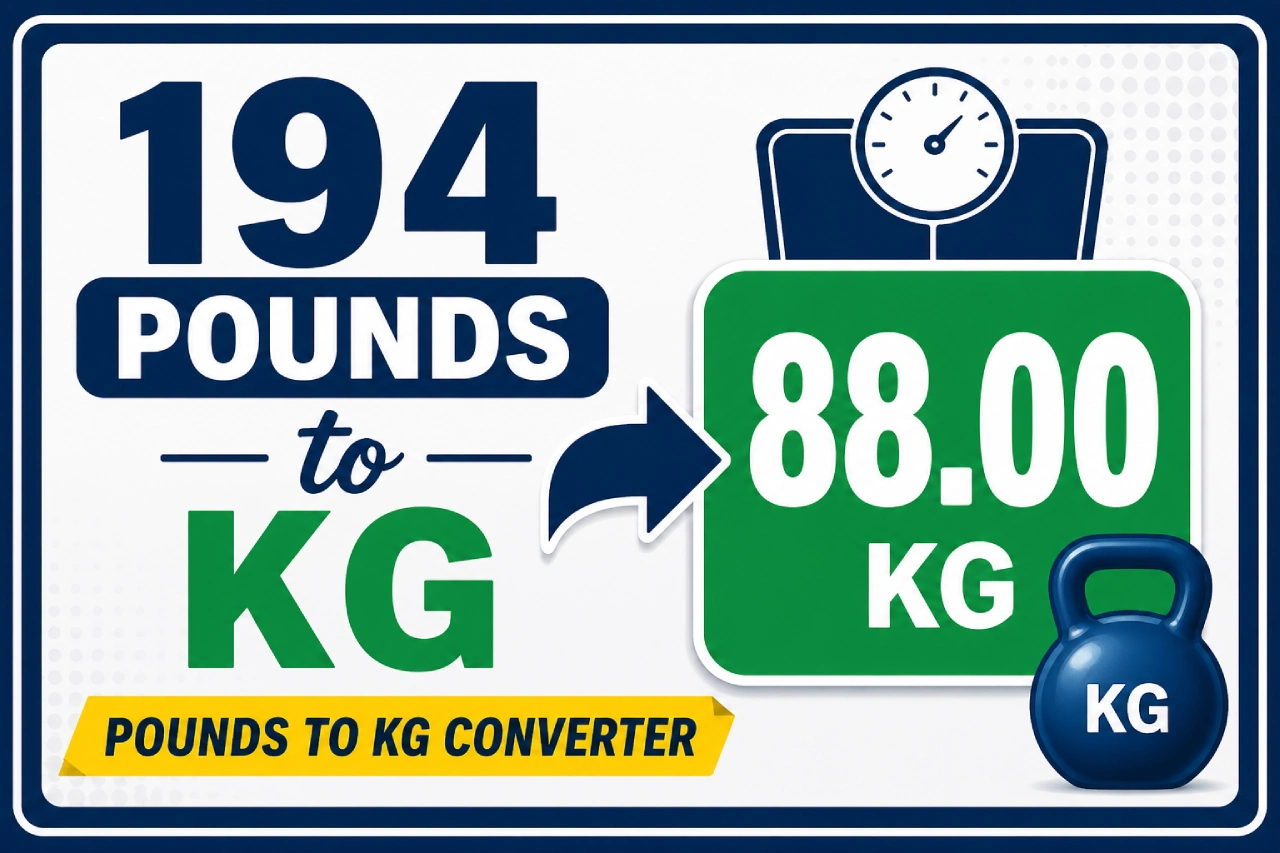
    👉 194 pounds = 87.99 kilograms (approximately 88 kg)

    So, when you convert 194 pounds to kg, the result is:

    194 lbs ≈ 88 kg

    This is a common conversion, especially for fitness tracking, medical records, travel, and international communication, where the United States uses pounds and most other countries use kilograms.

    In this guide, we’ll walk through the exact formula, step-by-step calculation, and practical examples so you can fully understand what 194 lbs in kg really means.

    The Conversion Formula: Pounds to Kilograms

    Pounds to kg Converter

    Result will appear here

    The relationship between pounds and kilograms is fixed:

    1 pound = 0.453592 kilograms

    Conversion Formula

    Kilograms = Pounds × 0.453592

    This formula works for any value.

    Step-by-Step Conversion: 194 lbs to kg

    Let’s calculate it clearly.

    Step 1: Start with pounds

    194 lbs

    Step 2: Multiply by the conversion factor

    194 × 0.453592

    Step 3: Calculate

    = 87.996848 kg

    Final Result

    👉 194 lbs ≈ 87.99 kg

    Rounded:

    👉 194 lbs ≈ 88 kg

    Quick Conversion Table

    Here’s a helpful reference for nearby values.

    Pounds (lbs)Kilograms (kg)
    180 lbs81.65 kg
    185 lbs83.91 kg
    190 lbs86.18 kg
    194 lbs87.99 kg
    200 lbs90.72 kg
    210 lbs95.25 kg

    This makes it easy to estimate similar conversions.

    What Does 194 lbs (88 kg) Feel Like?

    Numbers are useful, but real-life comparisons make them meaningful.

    Body Weight Context

    • 88 kg is considered a moderate to above-average adult weight, depending on height
    • It’s common among athletes, gym-goers, and physically active individuals

    Everyday Comparisons

    194 pounds is roughly equal to:

    • A large adult human
    • Two medium suitcases fully packed
    • A heavy home appliance

    Why Convert Pounds to Kilograms?

    This conversion is useful in many real-world situations.

    1. Fitness and Health

    Many fitness programs and medical charts use kilograms.

    2. Travel

    Airlines often list baggage limits in kilograms.

    3. International Communication

    Most countries use the metric system.

    4. Science and Medicine

    Kilograms are the standard unit globally.

    Pounds vs Kilograms: Key Differences

    UnitSystemEquivalent
    Pound (lb)U.S. customary0.453592 kg
    Kilogram (kg)Metric2.20462 lbs

    Because kilograms are larger units, the number becomes smaller when converting from pounds.

    Converting Kilograms Back to Pounds

    Sometimes you need the reverse conversion.

    Formula

    Pounds = Kilograms × 2.20462

    Example

    88 × 2.20462 ≈ 194 lbs

    This confirms the original value.

    Common Mistakes to Avoid

    1. Using the Wrong Conversion Factor

    Always use:

    1 lb = 0.453592 kg

    2. Rounding Too Early

    Keep precision until the final step.

    3. Confusing Mass and Weight

    In everyday use, pounds and kilograms are treated as weight, but technically they measure mass.

    Tips for Quick Mental Conversion

    Here are some simple tricks.

    Trick 1: Divide by 2.2

    194 ÷ 2.2 ≈ 88 kg

    This is a quick estimate.

    Trick 2: Multiply by 0.45

    194 × 0.45 ≈ 87.3 kg

    Close enough for rough calculations.

    Trick 3: Use Benchmarks

    • 100 lbs ≈ 45 kg
    • 200 lbs ≈ 90 kg

    Real-World Examples

    Example 1: Fitness Tracking

    If your weight is 194 lbs, your metric equivalent is 88 kg.

    Example 2: Luggage Limits

    Airlines may allow 23 kg (50 lbs) per bag.
    194 lbs equals about 4 such bags combined.

    Example 3: Sports and Training

    Athletes often track weight in kilograms internationally.

    Why This Conversion Matters

    Understanding 194 pounds to kg helps you:

    • Track fitness progress
    • Compare international data
    • Follow global standards
    • Communicate weight accurately

    Frequently Asked Questions (FAQs)

    How much is 194 lbs in kg?

    194 lbs ≈ 88 kg

    How do you convert pounds to kilograms?

    Multiply pounds by 0.453592.

    Is 194 lbs equal to 90 kg?

    Not exactly—it’s slightly less at 88 kg.

    What is the easiest way to convert?

    Divide by 2.2 for a quick estimate.

    Why do countries use kg instead of lbs?

    Because the metric system is globally standardized.

    What is 1 kg in pounds?

    1 kg ≈ 2.20462 lbs

    Can calculators convert lbs to kg?

    Yes. Most tools support this.

    Is kg more accurate than lbs?

    Both are accurate, but kg is the scientific standard.

    What is 200 lbs in kg?

    200 × 0.453592 ≈ 90.72 kg

    Why does the number decrease when converting?

    Because kilograms are larger units than pounds.

    Final Thoughts

    Converting 194 pounds to kilograms is simple once you know the formula:

    👉 Kilograms = Pounds × 0.453592

    Using this:

    194 lbs ≈ 88 kg

    This is a practical, everyday weight that’s easy to relate to, whether you’re tracking fitness, traveling, or comparing international measurements.

    Once you remember the shortcut—divide by 2.2 for quick estimates—you’ll be able to convert pounds to kilograms instantly.

    Now here’s a quick question for you:
    Next time you see your weight in pounds, will you automatically picture it in kilograms?

  • Convert 35 British Pound Sterling to US Dollars

    Convert 35 British Pound Sterling to US Dollars

    If you’re looking for the quick answer:

    👉 35 British pounds (GBP) is approximately $43 to $45 US dollars (USD), depending on the current exchange rate.

    A commonly used estimate:

    35 GBP ≈ $44 USD

    Exchange rates change daily, so the exact value may vary slightly. But for most practical purposes, $44 USD is a reliable ballpark figure.

    In this guide, we’ll break down how the conversion works, explain the formula, show real-world examples, and help you understand what 35 British pounds is actually worth in U.S. dollars.

    Understanding GBP and USD

    Before jumping into calculations, let’s quickly understand the currencies involved.

    What Is British Pound Sterling (GBP)?

    The British pound sterling (GBP) is the official currency of the United Kingdom.

    • It’s one of the oldest currencies still in use
    • Often symbolized as £
    • Known for being a relatively strong global currency

    It’s widely used in:

    • The UK (England, Scotland, Wales, Northern Ireland)
    • International trade
    • Foreign exchange markets

    What Is the US Dollar (USD)?

    The U.S. dollar (USD) is the official currency of the United States and one of the most widely used currencies globally.

    • Symbol: $
    • Used in global trade and finance
    • Often considered the world’s primary reserve currency

    Current Exchange Rate Overview

    Exchange rates fluctuate constantly based on market conditions.

    As a general reference:

    👉 1 GBP ≈ 1.25–1.30 USD

    This means the British pound is typically stronger than the U.S. dollar.

    Conversion Formula: GBP to USD

    British Pound Sterling to US Dollars Converter

    Enter an amount in British Pounds to convert it into US Dollars.

    $0.00

    Note: Exchange rates change frequently. You can update the rate manually.

    To convert pounds to dollars, use this formula:

    USD = GBP × Exchange Rate

    Example Using an Average Rate

    Let’s assume:

    1 GBP = 1.26 USD

    Now calculate:

    35 × 1.26 = 44.1 USD

    Final Answer

    👉 35 GBP ≈ $44.10 USD

    Step-by-Step Conversion

    Let’s break it down clearly.

    Step 1: Start with pounds

    35 GBP

    Step 2: Multiply by exchange rate

    35 × 1.26

    Step 3: Calculate

    = 44.1 USD

    Final Result

    👉 35 pounds ≈ $44 USD (rounded)

    Quick Conversion Table

    Here’s a handy chart for similar values.

    GBPUSD (Approx.)
    10 GBP$12.60
    20 GBP$25.20
    30 GBP$37.80
    35 GBP$44.10
    50 GBP$63.00
    100 GBP$126.00

    This helps with quick estimates.

    Why Exchange Rates Change

    The value of GBP to USD is not fixed.

    Factors That Affect Exchange Rates

    • Interest rates
    • Inflation
    • Economic growth
    • Political stability
    • Global demand

    For example:

    • A strong UK economy can increase GBP value
    • A strong U.S. economy can increase USD value

    Real-Life Value of 35 GBP in USD

    Understanding the dollar value is useful—but what can $44 USD actually buy?

    In the United States

    $44 can cover:

    • A casual restaurant meal for one or two people
    • A tank of gas (depending on location)
    • A monthly streaming subscription bundle
    • Basic groceries for a few days

    In the United Kingdom

    35 GBP might buy:

    • A mid-range dinner
    • Public transportation passes
    • Clothing items

    Even though the currencies differ, purchasing power can feel similar.

    Practical Uses of This Conversion

    1. Travel Planning

    If you’re visiting the UK, you’ll need to convert GBP to USD for budgeting.

    2. Online Shopping

    Many UK-based websites list prices in pounds.

    3. Freelance Payments

    International freelancers often receive payments in GBP or USD.

    4. Currency Exchange

    Understanding rates helps you avoid poor exchange deals.

    Converting USD Back to GBP

    Sometimes you need the reverse conversion.

    Formula

    GBP = USD ÷ Exchange Rate

    Example

    44 ÷ 1.26 ≈ 35 GBP

    This confirms the earlier result.

    Common Mistakes to Avoid

    1. Using Outdated Exchange Rates

    Rates change daily—always check current values.

    2. Ignoring Fees

    Banks and exchange services may charge:

    • Conversion fees
    • Transaction fees

    3. Rounding Too Early

    Keep precision until the final step.

    Tips for Accurate Currency Conversion

    Here are some practical tips.

    Use Reliable Tools

    • Currency converter apps
    • Bank websites
    • Financial platforms

    Check Live Rates

    Always use up-to-date exchange rates.

    Consider Fees

    Real conversion may be slightly lower due to charges.

    Quick Mental Conversion Tips

    Trick 1: Multiply by 1.25

    A quick estimate:

    35 × 1.25 = $43.75

    Very close to the actual value.

    Trick 2: Think “Pound Is Stronger”

    GBP is usually worth more than USD.

    Trick 3: Use Benchmarks

    • 10 GBP ≈ $12–13
    • 50 GBP ≈ $62–65

    Real-World Examples

    Example 1: Online Purchase

    If a product costs 35 GBP, expect to pay around $44 USD.

    Example 2: Travel Budget

    If you budget 100 GBP, that’s about $126 USD.

    Example 3: Freelance Payment

    Receiving 35 GBP equals roughly $44 in USD.

    Frequently Asked Questions (FAQs)

    How much is 35 GBP in USD?

    Approximately $44 USD, depending on the exchange rate.

    What is the current GBP to USD rate?

    Usually between 1.25 and 1.30 USD per GBP.

    Why does the value change?

    Exchange rates fluctuate due to economic factors.

    Is GBP stronger than USD?

    Yes, typically.

    How do you convert GBP to USD?

    Multiply by the exchange rate.

    Can I use USD in the UK?

    No, GBP is the official currency.

    Where can I check live rates?

    Banks, financial apps, and official economic websites.

    Do banks charge conversion fees?

    Yes, most do.

    Is 35 GBP a lot of money?

    It’s a moderate amount—about $44 USD.

    What is 1 GBP in USD?

    Approximately $1.25–$1.30 USD

    Final Thoughts

    So, how much is 35 British pounds in US dollars?

    👉 About $44 USD, depending on the current exchange rate.

    The key takeaway is simple:

    USD = GBP × Exchange Rate

    Once you understand this, converting currencies becomes quick and easy.

    Whether you’re traveling, shopping online, or sending money internationally, knowing how to convert GBP to USD helps you make smarter financial decisions.

    Now here’s a quick question for you:
    Next time you see a price in pounds, will you instantly know what it means in dollars?

  • Convert Water Column to PSI (inWC to PSI Guide)

    Convert Water Column to PSI (inWC to PSI Guide)

    If you’re looking for the quick answer:

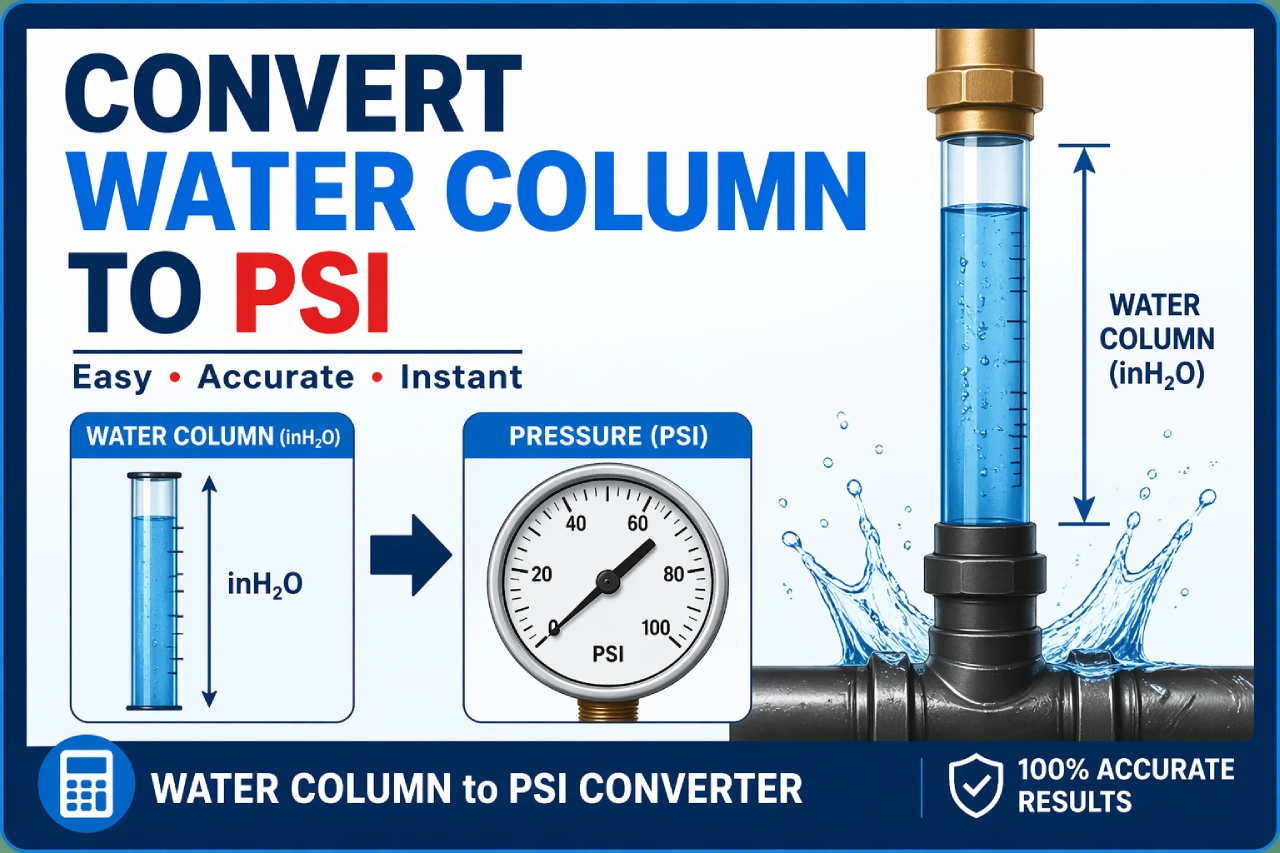
    👉 1 inch of water column (inWC) ≈ 0.0361 PSI

    So, to convert water column to PSI, you can use:

    PSI = Inches of Water Column × 0.0361

    For example:

    • 10 inWC ≈ 0.361 PSI
    • 27.7 inWC ≈ 1 PSI
    • 100 inWC ≈ 3.61 PSI

    This conversion is commonly used in gas systems, HVAC, plumbing, and pressure measurement—especially when dealing with low-pressure systems like natural gas or air ducts.

    In this guide, we’ll break down what water column means, how the conversion works, and how to apply it in real-world situations.

    Why Convert Water Column to PSI?

    Water column is great for low pressures, but PSI is more widely used.

    You might need to convert when:

    • Reading HVAC specifications
    • Working with gas appliances
    • Comparing pressure ratings
    • Using pressure gauges

    The Conversion Formula

    Water Column to PSI Converter

    Enter a value in inches of water column to convert it into PSI.

    Formula: PSI = inH₂O × 0.0360912

    For Inches of Water Column

    PSI = inWC × 0.0361

    Reverse Conversion

    inWC = PSI × 27.7

    These are standard engineering approximations.

    Step-by-Step Conversion Example

    Let’s convert 50 inches of water column to PSI.

    Step 1: Start with inWC

    50 inWC

    Step 2: Multiply by 0.0361

    50 × 0.0361

    Step 3: Calculate

    = 1.805 PSI

    Final Answer

    👉 50 inWC ≈ 1.81 PSI

    Quick Conversion Table

    Here’s a handy reference chart.

    Inches WCPSI
    1 inWC0.0361 PSI
    5 inWC0.18 PSI
    10 inWC0.361 PSI
    27.7 inWC1 PSI
    50 inWC1.81 PSI
    100 inWC3.61 PSI

    This helps with quick estimations.

    Real-World Applications

    1. Gas Pressure Systems

    Natural gas appliances often use water column measurements.

    For example:

    • Residential gas pressure ≈ 7 inWC
    • Propane systems ≈ 11 inWC

    Converted:

    • 7 inWC ≈ 0.25 PSI
    • 11 inWC ≈ 0.40 PSI

    2. HVAC Systems

    Air pressure in ducts is often measured in inches of water column.

    3. Plumbing Systems

    Water column helps measure low-pressure differences.

    4. Industrial Equipment

    Used in pressure testing and calibration.

    Why Water Column Is Used for Low Pressure

    Water column is ideal for small pressures because:

    • It provides more precise readings
    • It’s easier to visualize
    • It avoids tiny decimal values in PSI

    For example:

    • 0.25 PSI is easier to understand as 7 inWC

    Water Column vs PSI: Key Differences

    UnitMeasuresBest For
    Water ColumnPressure via heightLow-pressure systems
    PSIForce per areaMedium to high pressure

    Both measure pressure—but in different ways.

    Converting Feet of Water Column to PSI

    Sometimes water column is expressed in feet.

    Conversion

    • 1 foot WC ≈ 0.433 PSI

    Example

    10 ft WC × 0.433 = 4.33 PSI

    Understanding the Science Behind It

    The conversion comes from:

    • Water density
    • Gravity
    • Pressure formulas

    Pressure from a fluid column depends on:

    • Height
    • Density of the fluid

    For water, this relationship produces the standard conversion factors.

    Common Mistakes to Avoid

    1. Mixing Inches and Feet

    • Inches WC and feet WC are different units

    2. Using the Wrong Conversion Factor

    Always use:

    • 0.0361 for inches WC
    • 0.433 for feet WC

    3. Rounding Too Early

    Keep precision until the final result.

    Tips for Quick Mental Conversion

    Trick 1: Divide by 27.7

    To convert inWC → PSI quickly:

    10 inWC ≈ 0.36 PSI

    Trick 2: Multiply by 0.036

    Close enough for quick estimates.

    Trick 3: Remember Benchmarks

    • 27.7 inWC ≈ 1 PSI
    • 7 inWC ≈ 0.25 PSI

    Practical Examples

    Example 1: Gas Stove Pressure

    7 inWC:

    7 × 0.0361 = 0.25 PSI

    Example 2: HVAC System

    20 inWC:

    20 × 0.0361 = 0.72 PSI

    Example 3: Industrial System

    100 inWC:

    100 × 0.0361 = 3.61 PSI

    Frequently Asked Questions (FAQs)

    What is 1 inch of water column in PSI?

    1 inWC ≈ 0.0361 PSI

    How do you convert water column to PSI?

    Multiply by 0.0361.

    What is 7 inWC in PSI?

    7 × 0.0361 ≈ 0.25 PSI

    Why is water column used?

    It’s ideal for measuring low pressure.

    What is 27.7 inWC?

    It equals 1 PSI.

    Is water column accurate?

    Yes, especially for low-pressure systems.

    What is feet of water column?

    It measures pressure based on height in feet.

    How do you convert ftWC to PSI?

    Multiply by 0.433.

    Can calculators convert water column to PSI?

    Yes. Many engineering tools support this.

    Is PSI better than water column?

    It depends on the application.

    Final Thoughts

    Converting water column to PSI is simple once you know the formula:

    👉 PSI = inWC × 0.0361

    This conversion is essential in:

    • HVAC systems
    • Gas appliances
    • Plumbing
    • Industrial pressure measurements

    The key takeaway is:

    Water column is perfect for low pressure, while PSI is more universal.

    Once you understand how they relate, you’ll be able to interpret pressure readings with confidence.

    Now here’s a quick question for you:
    Next time you see a gas pressure rating in inches of water column, will you know exactly what it means in PSI?

  • Watts to Kilowatt-Hours (kWh) (Easy Calculation Guide)

    Watts to Kilowatt-Hours (kWh) (Easy Calculation Guide)

    If you’re looking for the quick answer:

    👉 You cannot convert watts (W) directly to kilowatt-hours (kWh) without time.

    To convert watts to kWh, you must include how long the power is used.

    The formula is:

    kWh = (Watts × Hours) ÷ 1,000

    For example:

    • A 1,000-watt appliance used for 1 hour = 1 kWh
    • A 500-watt device used for 2 hours = 1 kWh

    This conversion is essential for understanding electricity usage, energy bills, and appliance efficiency.

    In this guide, we’ll break everything down clearly—what watts and kWh mean, how the conversion works, and how to calculate your energy usage in real life.

    Why You Can’t Convert Watts to kWh Directly

    This is the most important concept:

    👉 Watts measure power, while kWh measures energy over time.

    Without time, the conversion doesn’t make sense.

    Example

    • A 1,000-watt heater running for 1 hour uses 1 kWh
    • The same heater running for 5 hours uses 5 kWh

    Same watts, different energy usage.

    The Conversion Formula

    Watts to Kilowatt-Hours Converter

    Enter power in watts and usage time to calculate energy in kilowatt-hours.

    Result: 0 kWh
    Formula: kWh = Watts × Hours ÷ 1000

    Here’s the key formula:

    kWh = (Watts × Hours) ÷ 1,000

    Breakdown

    • Watts = power
    • Hours = time used
    • Divide by 1,000 to convert to kilowatts

    Step-by-Step Conversion Example

    Let’s calculate energy usage for a 750-watt appliance used for 3 hours.

    Step 1: Multiply watts by time

    750 × 3 = 2,250 watt-hours

    Step 2: Convert to kWh

    2,250 ÷ 1,000 = 2.25 kWh

    Final Answer

    👉 750 W used for 3 hours = 2.25 kWh

    Quick Conversion Table

    Here’s a simple reference.

    WattsTime (Hours)kWh
    100 W10 hrs1 kWh
    500 W2 hrs1 kWh
    1,000 W1 hr1 kWh
    2,000 W1 hr2 kWh
    1,500 W2 hrs3 kWh

    This helps you estimate energy usage quickly.

    Real-World Examples

    Let’s make this practical.

    Example 1: Light Bulb

    A 60-watt bulb used for 5 hours:

    (60 × 5) ÷ 1,000 = 0.3 kWh

    Example 2: Air Conditioner

    A 1,500-watt AC running for 4 hours:

    (1,500 × 4) ÷ 1,000 = 6 kWh

    Example 3: Laptop

    A 65-watt laptop used for 8 hours:

    (65 × 8) ÷ 1,000 = 0.52 kWh

    These examples show how usage time affects energy consumption.

    Why This Conversion Matters

    Understanding watts to kWh helps you:

    1. Read Your Electricity Bill

    Utility companies charge based on kWh, not watts.

    2. Estimate Energy Costs

    You can calculate how much appliances cost to run.

    3. Save Energy

    Knowing usage helps you reduce consumption.

    4. Compare Appliances

    Energy-efficient devices use fewer kWh.

    Calculating Electricity Cost

    Once you know kWh, you can estimate cost.

    Formula

    Cost = kWh × Price per kWh

    Example

    If electricity costs $0.15 per kWh:

    2.25 kWh × 0.15 = $0.34

    So:

    👉 Running that appliance costs about 34 cents

    Watts vs kWh: Key Differences

    UnitMeasuresMeaning
    Watt (W)PowerEnergy usage rate
    kWhEnergyTotal energy used over time

    Understanding this difference is crucial.

    Converting kWh Back to Watts

    Sometimes you want to reverse the calculation.

    Formula

    Watts = (kWh × 1,000) ÷ Hours

    Example

    2 kWh used over 4 hours:

    (2 × 1,000) ÷ 4 = 500 watts

    Common Mistakes to Avoid

    1. Ignoring Time

    You must include hours to calculate kWh.

    2. Confusing kW and kWh

    • kW = power
    • kWh = energy

    3. Forgetting to Divide by 1,000

    This step converts watts to kilowatts.

    Tips for Quick Mental Conversion

    Here are some simple tricks.

    Trick 1: Think “1,000 Watts = 1 kW”

    This simplifies calculations.

    Trick 2: Multiply First, Divide Later

    (Watts × Hours) → then divide by 1,000

    Trick 3: Use Benchmarks

    • 1,000 W for 1 hour = 1 kWh
    • 500 W for 2 hours = 1 kWh

    Practical Everyday Uses

    Household Appliances

    Understanding energy usage helps you manage:

    • Air conditioners
    • Heaters
    • Refrigerators

    Solar Energy Systems

    Solar panels are rated in watts but produce energy in kWh.

    Electric Vehicles

    Charging is measured in kWh, not watts.

    Frequently Asked Questions (FAQs)

    Can you convert watts to kWh directly?

    No. You need time (hours).

    What is the formula for watts to kWh?

    kWh = (Watts × Hours) ÷ 1,000

    How many kWh is 1,000 watts?

    1,000 watts used for 1 hour = 1 kWh

    What is 500 watts for 2 hours?

    (500 × 2) ÷ 1,000 = 1 kWh

    Is kWh the same as kilowatts?

    No.
    kW = power
    kWh = energy over time

    How do I calculate electricity cost?

    Multiply kWh by your electricity rate.

    What is the easiest way to estimate?

    Divide watts by 1,000 and multiply by hours.

    Why is kWh used on bills?

    Because it measures total energy usage.

    Can calculators convert watts to kWh?

    Yes, if you include time.

    What is 100 watts for 10 hours?

    (100 × 10) ÷ 1,000 = 1 kWh

    Final Thoughts

    Converting watts to kilowatt-hours (kWh) isn’t just about numbers—it’s about understanding how energy is used in your daily life.

    The key takeaway is simple:

    👉 kWh = (Watts × Hours) ÷ 1,000

    Once you understand this, you can:

    • Estimate your electricity usage
    • Reduce your energy bills
    • Make smarter decisions about appliances

    And honestly, once you start thinking in kWh, your electricity bill suddenly makes a lot more sense.

    Now here’s a quick question for you:
    Next time you turn on an appliance, will you know how much energy it’s really using?

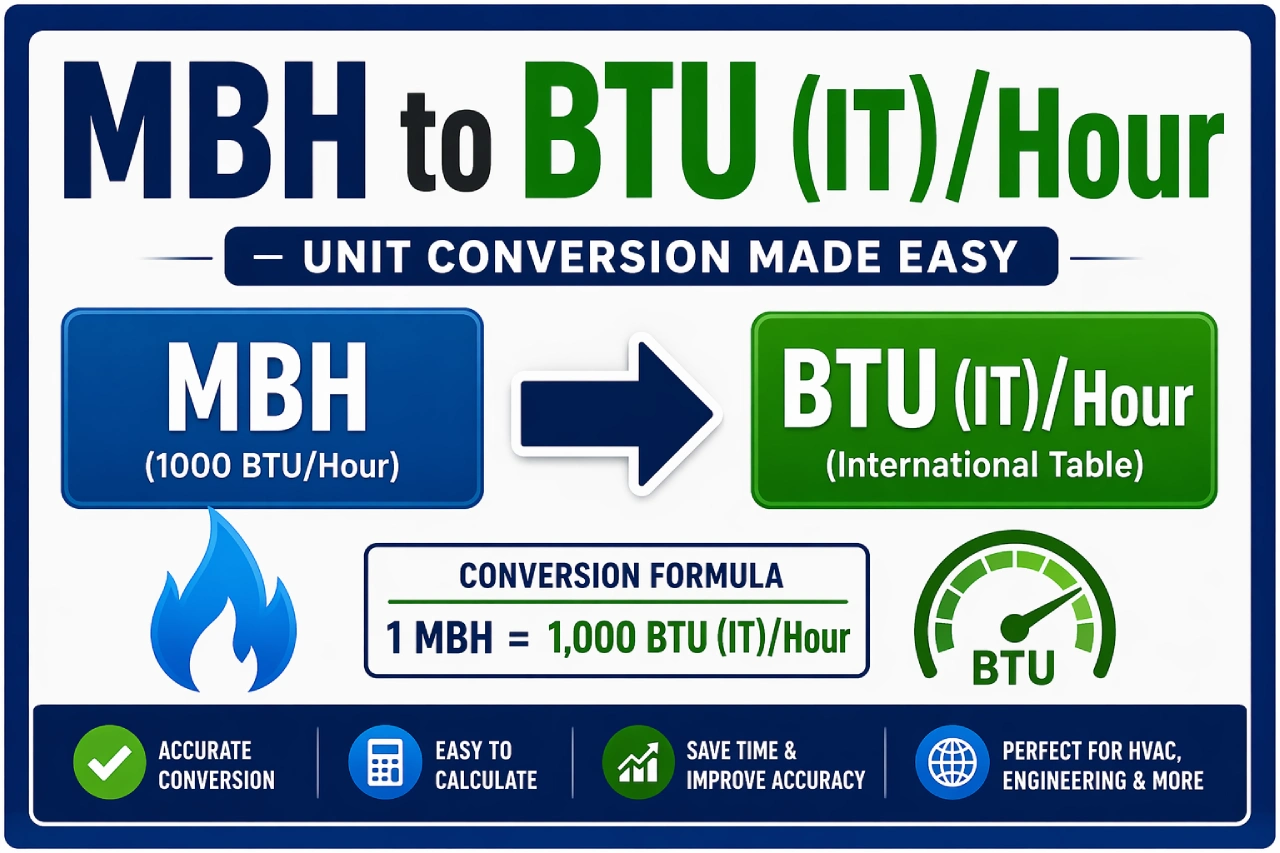
  • MBH to BTU (IT)/Hour Formula and Examples

    MBH to BTU (IT)/Hour Formula and Examples

    If you’re looking for the quick answer:

    1 MBH = 1,000 BTU (IT)/hour

    So, to convert MBH to BTU (IT)/hour, you simply multiply by 1,000.

    For example:

    • 1 MBH = 1,000 BTU/hr
    • 10 MBH = 10,000 BTU/hr
    • 50 MBH = 50,000 BTU/hr

    This conversion is commonly used in HVAC systems, heating equipment, boilers, and air conditioning design. If you’ve ever seen furnace ratings or HVAC specs, you’ve likely encountered both MBH and BTU/hr.

    In this guide, we’ll break down what MBH and BTU (IT)/hour mean, how the conversion works, and how to apply it in real-world scenarios.

    What Does MBH Mean?

    The term MBH can be confusing at first glance.

    Breaking It Down

    • M = 1,000 (Roman numeral)
    • BH = British Thermal Units per hour

    So:

    👉 MBH = 1,000 BTU per hour

    It’s simply a shorthand used in engineering and HVAC to represent large numbers more conveniently.

    What Is BTU (IT)/Hour?

    A BTU (British Thermal Unit) is a measure of energy.

    Definition

    1 BTU (IT) is the amount of heat required to raise the temperature of one pound of water by one degree Fahrenheit under standard conditions.

    The “IT” stands for International Table, which is the standardized definition used in engineering.

    BTU per Hour

    When you see BTU/hr, it refers to power or heat transfer rate.

    For example:

    • A heater rated at 10,000 BTU/hr produces that much heat every hour
    • An air conditioner rated at 12,000 BTU/hr removes that amount of heat

    MBH to BTU (IT)/Hour Conversion Formula

    MBH to BTU (IT)/Hour Converter

    Formula: 1 MBH = 1,000 BTU (IT)/hour

    The conversion is straightforward:

    BTU/hr = MBH × 1,000

    Why This Works

    Because:

    1 MBH = 1,000 BTU/hr

    This is an exact and fixed conversion.

    Step-by-Step Conversion Example

    Let’s convert 25 MBH to BTU/hr.

    Step 1: Start with MBH

    25 MBH

    Step 2: Multiply by 1,000

    25 × 1,000

    Step 3: Calculate

    = 25,000 BTU/hr

    Final Answer

    25 MBH = 25,000 BTU/hr

    Quick Conversion Table

    Here’s a handy reference chart.

    MBHBTU/hr
    1 MBH1,000 BTU/hr
    5 MBH5,000 BTU/hr
    10 MBH10,000 BTU/hr
    25 MBH25,000 BTU/hr
    50 MBH50,000 BTU/hr
    100 MBH100,000 BTU/hr

    This makes quick conversions easy.

    Why Use MBH Instead of BTU/hr?

    You might wonder why engineers use MBH at all.

    Simplicity

    Instead of writing:

    👉 100,000 BTU/hr

    You can write:

    👉 100 MBH

    This makes large values easier to read and manage.

    Common in HVAC Industry

    MBH is widely used in:

    • Furnace specifications
    • Boiler ratings
    • Heating system design

    Real-World Applications

    Understanding MBH to BTU/hr is essential in many industries.

    1. HVAC Systems

    Heating and cooling equipment is often rated in BTU/hr or MBH.

    Example:

    • A furnace rated at 80 MBH = 80,000 BTU/hr

    2. Boilers

    Boilers use MBH to describe heating capacity.

    3. Air Conditioning

    Cooling capacity is often listed in BTU/hr.

    4. Energy Calculations

    Engineers use these units to calculate heat transfer.

    MBH vs BTU/hr: Key Differences

    UnitMeaningUsage
    MBHThousands of BTU/hrHVAC shorthand
    BTU/hrHeat transfer rateDetailed measurement

    They represent the same thing—just in different formats.

    Converting BTU/hr Back to MBH

    Sometimes you need the reverse conversion.

    Formula

    MBH = BTU/hr ÷ 1,000

    Example

    50,000 ÷ 1,000 = 50 MBH

    MBH vs Other Energy Units

    Let’s compare MBH with other common units.

    MBH to kW (Kilowatts)

    • 1 MBH ≈ 0.293 kW

    BTU/hr to Watts

    • 1 BTU/hr ≈ 0.293 watts

    These conversions are useful when working with international systems.

    Common Mistakes to Avoid

    1. Misunderstanding “M”

    Some people think “M” means million.

    In this case:

    👉 M = 1,000 (not 1,000,000)

    2. Confusing BTU and BTU/hr

    • BTU = energy
    • BTU/hr = power (rate of energy)

    3. Forgetting the Conversion Factor

    Always remember:

    1 MBH = 1,000 BTU/hr

    Practical Examples

    Example 1: Furnace Rating

    A furnace rated at 60 MBH:

    60 × 1,000 = 60,000 BTU/hr

    Example 2: Boiler Output

    A boiler rated at 120 MBH:

    120 × 1,000 = 120,000 BTU/hr

    Example 3: Small Heater

    A heater rated at 5 MBH:

    5 × 1,000 = 5,000 BTU/hr

    Why This Conversion Matters

    Understanding MBH to BTU/hr helps you:

    • Choose the right HVAC system
    • Compare heating capacities
    • Understand energy efficiency
    • Avoid costly mistakes in system sizing

    Tips for Quick Mental Conversion

    Trick 1: Add Three Zeros

    Multiply MBH by 1,000.

    Example:

    25 MBH → 25,000 BTU/hr

    Trick 2: Remove Three Zeros

    To reverse:

    50,000 BTU/hr → 50 MBH

    Trick 3: Think “Thousands”

    MBH always represents thousands of BTU/hr.

    Frequently Asked Questions (FAQs)

    What does MBH stand for?

    MBH means 1,000 BTU per hour.

    How do you convert MBH to BTU/hr?

    Multiply by 1,000.

    Is MBH the same as BTU/hr?

    Yes, but MBH is a shorthand.

    What is 10 MBH in BTU/hr?

    10,000 BTU/hr

    What is 100 MBH in BTU/hr?

    100,000 BTU/hr

    Why is MBH used?

    To simplify large numbers in HVAC systems.

    What is the difference between BTU and BTU/hr?

    BTU measures energy, while BTU/hr measures power.

    Is MBH used outside HVAC?

    Mostly in heating and energy-related industries.

    Can calculators convert MBH to BTU/hr?

    Yes. It’s a simple multiplication.

    Is the conversion exact?

    Yes.
    1 MBH = 1,000 BTU/hr

    Final Thoughts

    Converting MBH to BTU (IT)/hour is one of the simplest conversions in energy measurement.

    The key rule is:

    👉 1 MBH = 1,000 BTU/hr

    Once you understand that MBH is just a shorthand for thousands of BTU/hr, everything becomes easy.

    Whether you’re choosing a furnace, comparing HVAC systems, or working on engineering calculations, this conversion helps you interpret specifications accurately.

    Now here’s a quick question for you:
    Next time you see a furnace rated in MBH, will you instantly know its BTU/hr value?

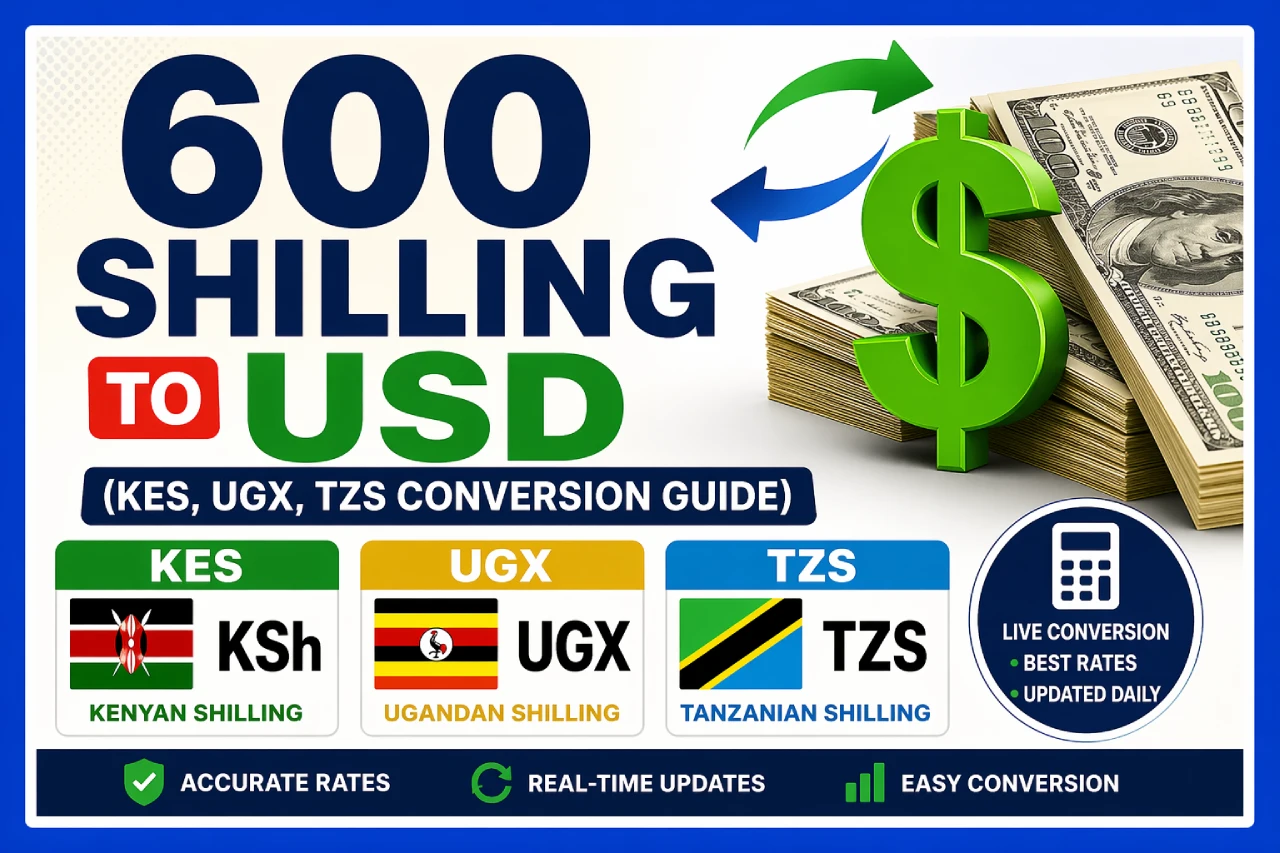
  • 600 Shilling to USD (KES, UGX, TZS Conversion Guide)

    600 Shilling to USD (KES, UGX, TZS Conversion Guide)

    If you’re looking for the quick answer:

    600 shillings is roughly between $4.00 and $5.00 USD (depending on the country and current exchange rate).

    Here’s the key detail most people miss:
    👉 “Shilling” is not a single currency. Several countries use it, including:

    • Kenyan Shilling (KES)
    • Ugandan Shilling (UGX)
    • Tanzanian Shilling (TZS)
    • Somali Shilling (SOS)

    So the exact value of 600 shillings to USD depends on which country’s shilling you mean.

    In this guide, we’ll break down conversions for the most common shillings, explain how exchange rates work, and help you understand what 600 shillings is actually worth in real life.

    What Is a Shilling?

    A shilling is a unit of currency used in several African countries. While the name comes from historical British currency, modern shillings are independent currencies with their own values.

    Common Shilling Currencies

    • Kenyan Shilling (KES) – widely used in East Africa
    • Ugandan Shilling (UGX) – used in Uganda
    • Tanzanian Shilling (TZS) – used in Tanzania
    • Somali Shilling (SOS) – used in Somalia

    Each has a different exchange rate against the U.S. dollar.

    What Is USD?

    The U.S. Dollar (USD) is the official currency of the United States and one of the most widely used currencies globally.

    It’s commonly used for:

    • International trade
    • Travel
    • Online payments
    • Global pricing

    Because of its stability, many currencies—including shillings—are often compared to USD.

    600 Shilling to USD (By Country)

    Let’s look at approximate conversions. Exchange rates change daily, so these are general estimates.

    1. Kenyan Shilling (KES)

    • 1 USD ≈ 130 KES (approx.)

    Conversion

    600 ÷ 130 ≈ $4.62 USD

    👉 600 KES ≈ $4.60 USD

    2. Ugandan Shilling (UGX)

    • 1 USD ≈ 3,700 UGX

    Conversion

    600 ÷ 3,700 ≈ $0.16 USD

    👉 600 UGX ≈ $0.15 USD

    3. Tanzanian Shilling (TZS)

    • 1 USD ≈ 2,500 TZS

    Conversion

    600 ÷ 2,500 ≈ $0.24 USD

    👉 600 TZS ≈ $0.24 USD

    4. Somali Shilling (SOS)

    • 1 USD ≈ 570 SOS

    Conversion

    600 ÷ 570 ≈ $1.05 USD

    👉 600 SOS ≈ $1.05 USD

    Quick Comparison Table

    Currency600 Shillings in USD
    Kenyan Shilling (KES)~$4.60
    Ugandan Shilling (UGX)~$0.15
    Tanzanian Shilling (TZS)~$0.24
    Somali Shilling (SOS)~$1.05

    This shows how much the value varies depending on the country.

    Why the Value of Shillings Differs

    You might wonder why 600 shillings can be worth $4 in one country and just $0.15 in another.

    The answer lies in exchange rates.

    Factors That Affect Exchange Rates

    • Economic stability
    • Inflation
    • Government policies
    • Supply and demand
    • Trade balance

    Countries with stronger economies tend to have stronger currencies.

    How to Convert Shillings to USD

    Shilling to USD Converter

    Enter an amount in shillings to convert it into U.S. dollars.

    Note: Exchange rates change regularly. This tool uses approximate rates for quick estimation.

    The general formula is:

    USD = Shillings ÷ Exchange Rate

    Example (Kenyan Shilling)

    600 ÷ 130 = $4.62

    Example (Ugandan Shilling)

    600 ÷ 3,700 = $0.16

    This method works for any currency.

    Real-Life Value of 600 Shillings

    Understanding the dollar value is helpful, but what does 600 shillings actually buy?

    In Kenya (KES)

    600 KES (~$4.60) could buy:

    • A basic meal
    • Public transportation for a day
    • Small grocery items

    In Uganda (UGX)

    600 UGX (~$0.15) might buy:

    • A small snack
    • A local item from a street vendor

    In Tanzania (TZS)

    600 TZS (~$0.24) could cover:

    • A drink or light snack

    In Somalia (SOS)

    600 SOS (~$1.05) might buy:

    • Basic daily essentials

    These examples show how purchasing power varies by country.

    Why This Conversion Matters

    Understanding 600 shilling to USD is useful for:

    1. Travel

    If you’re visiting a country that uses shillings, you’ll need to understand local pricing.

    2. Online Transactions

    Freelancers and businesses often deal with international payments.

    3. Remittances

    People sending money abroad need accurate conversions.

    4. Budget Planning

    Knowing exchange rates helps avoid overspending.

    Common Mistakes to Avoid

    1. Assuming All Shillings Are the Same

    Always check which country’s currency you’re using.

    2. Ignoring Exchange Rate Changes

    Rates fluctuate daily.

    3. Forgetting Fees

    Currency conversion often includes bank or service fees.

    Tips for Accurate Currency Conversion

    Here are some practical tips.

    Use Reliable Tools

    • Currency converter apps
    • Bank exchange rates
    • Financial websites

    Check Live Rates

    Exchange rates change frequently.

    Consider Fees

    Always account for:

    • Bank charges
    • Transfer fees
    • Currency spreads

    Frequently Asked Questions (FAQs)

    How much is 600 shillings in USD?

    It depends on the country.
    For example, 600 KES ≈ $4.60 USD.

    Why does the value change?

    Because different countries have different exchange rates.

    Which shilling is most valuable?

    Among these, the Kenyan shilling has a higher value per unit.

    How do you convert shillings to USD?

    Divide the amount by the current exchange rate.

    Is 600 shillings a lot of money?

    It depends on the country and cost of living.

    What is the strongest shilling?

    Currency strength depends on economic factors and exchange rates.

    Can I use USD in these countries?

    In some places yes, but local currency is usually preferred.

    Do exchange rates change daily?

    Yes, they fluctuate constantly.

    Where can I check live rates?

    Banks, financial apps, and official economic websites.

    Is there a fixed conversion rate?

    No. Exchange rates are always changing.

    Final Thoughts

    So, how much is 600 shillings in USD?

    👉 It depends entirely on the country:

    • Kenyan Shilling: about $4.60
    • Ugandan Shilling: about $0.15
    • Tanzanian Shilling: about $0.24
    • Somali Shilling: about $1.05

    The key takeaway is simple:

    Always check which shilling you’re dealing with before converting.

    Currency values vary widely, and understanding exchange rates helps you make smarter financial decisions—whether you’re traveling, sending money, or shopping internationally.

    Now here’s a quick question for you:
    When you see a price in shillings next time, will you pause and ask—which country’s currency is it?