Blog

  • How Long Is 900 Seconds? (Exact Answer Explained)

    How Long Is 900 Seconds? (Exact Answer Explained)

    If you’re looking for the quick answer:

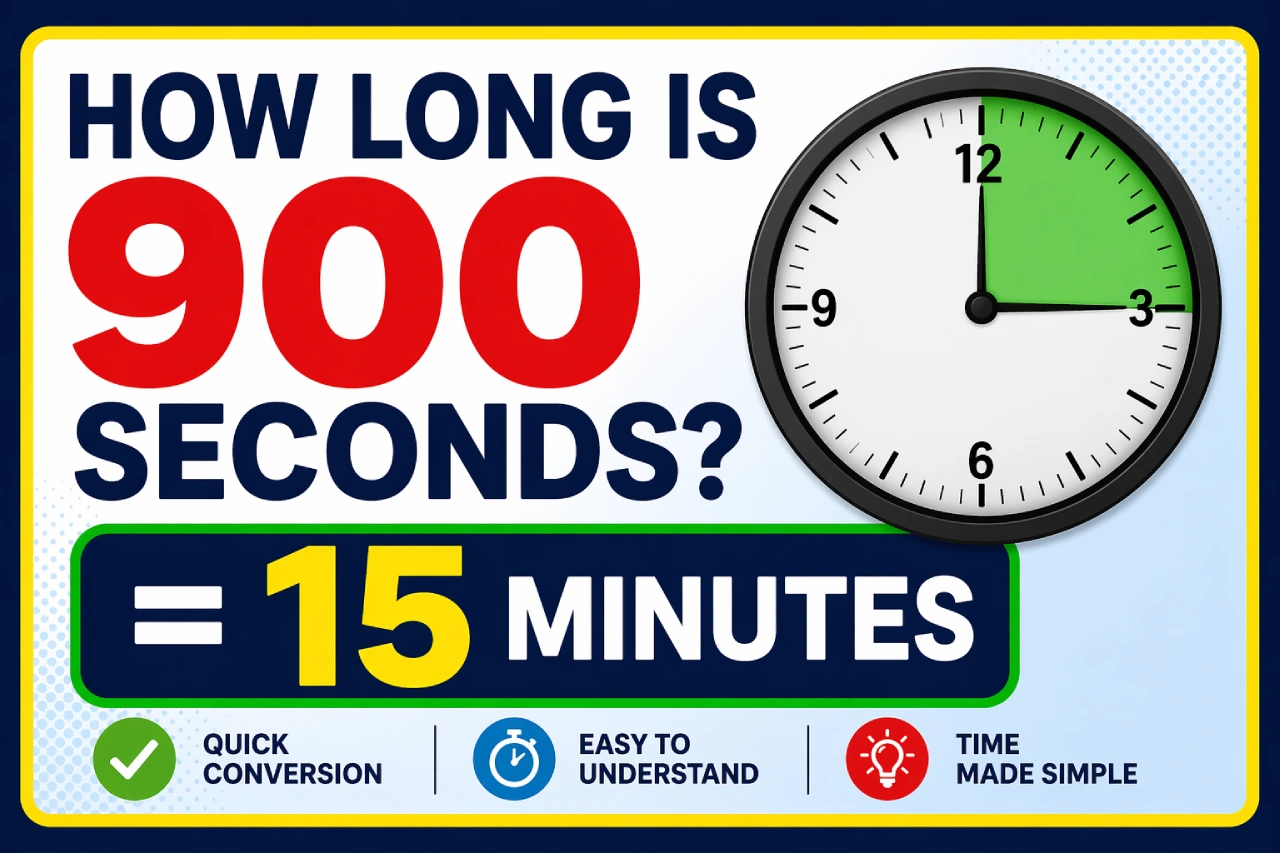
    900 seconds = 15 minutes

    That’s it—900 seconds is exactly 15 minutes, or 0.25 hours.

    This might seem like a simple conversion, but understanding how time units relate to each other can be incredibly useful in everyday life—from cooking and workouts to productivity and time management.

    In this guide, we’ll break down how the conversion works, explore what 900 seconds actually feels like in real life, and show practical examples so you can easily relate to this amount of time.

    How to Convert 900 Seconds to Minutes

    Seconds to Minutes Converter

    Seconds to Minutes Converter

    Enter seconds below to convert them into minutes.

    Result will appear here

    Let’s break it down step by step.

    Step 1: Know the conversion factor

    1 minute = 60 seconds

    Step 2: Divide seconds by 60

    900 ÷ 60 = 15 minutes

    Final Answer

    900 seconds = 15 minutes

    Converting 900 Seconds to Hours

    Seconds to Hours Converter

    Seconds to Hours Converter

    Enter seconds to convert them into hours.

    Result will appear here

    Sometimes it’s useful to express time in hours.

    Step 1: Know the conversion factor

    1 hour = 3,600 seconds

    Step 2: Divide

    900 ÷ 3,600 = 0.25 hours

    Final Answer

    900 seconds = 0.25 hours (¼ of an hour)

    Visualizing 900 Seconds

    Numbers are easier to understand when you connect them to real life.

    Everyday Activities That Take About 15 Minutes

    Here’s what you can do in 900 seconds:

    • Take a quick shower
    • Prepare a simple meal
    • Walk about ¾ mile (1.2 km)
    • Complete a short workout session
    • Watch part of a TV show
    • Brew and enjoy a cup of coffee

    Suddenly, 900 seconds doesn’t feel abstract—it’s a manageable chunk of time.

    Why Understanding 900 Seconds Matters

    You might wonder why this conversion is important.

    1. Time Management

    Breaking time into seconds can help improve focus and productivity.

    For example:

    • The Pomodoro Technique often uses 15–25 minute intervals
    • 900 seconds fits perfectly into a short productivity block

    2. Fitness and Workouts

    Many workouts are structured in timed intervals.

    A 15-minute session can include:

    • Warm-up
    • High-intensity exercises
    • Cool-down

    3. Cooking and Baking

    Recipes often use minutes, but timers may display seconds.

    Knowing that 900 seconds = 15 minutes avoids confusion.

    4. Digital Applications

    Apps, games, and software often track time in seconds.

    Understanding conversions helps you interpret durations quickly.

    Breaking Down 900 Seconds Further

    Let’s divide 900 seconds into smaller segments.

    Into Minutes

    • 900 seconds = 15 minutes

    Into 5-Minute Blocks

    • 15 minutes = 3 blocks of 5 minutes

    Into 1-Minute Segments

    • 15 minutes = 15 one-minute intervals

    This breakdown helps visualize time more clearly.

    Comparing 900 Seconds to Other Time Values

    Here’s how 900 seconds compares to other common durations.

    TimeEquivalent
    60 seconds1 minute
    300 seconds5 minutes
    600 seconds10 minutes
    900 seconds15 minutes
    1,800 seconds30 minutes
    3,600 seconds1 hour

    This makes it easier to estimate time quickly.

    Real-Life Examples of 900 Seconds

    Example 1: Exercise Routine

    A beginner workout might include:

    • 5 minutes warm-up
    • 5 minutes exercise
    • 5 minutes cool-down

    Total = 15 minutes (900 seconds)

    Example 2: Cooking Pasta

    Boiling pasta often takes about 10–15 minutes, which is close to 900 seconds.

    Example 3: Reading Time

    You can read several pages of a book in 15 minutes.

    Example 4: Daily Tasks

    • Checking emails
    • Tidying a room
    • Planning your day

    All can be done in about 900 seconds.

    Common Mistakes to Avoid

    1. Confusing Seconds and Minutes

    Remember:

    • 60 seconds = 1 minute

    2. Using the Wrong Conversion

    Always divide by 60 when converting seconds to minutes.

    3. Overestimating Time

    People often underestimate how much can be done in 15 minutes.

    Tips to Remember the Conversion

    Here are some simple tricks.

    Trick 1: Think “60”

    Divide seconds by 60 to get minutes.

    Trick 2: Use Benchmarks

    • 600 seconds = 10 minutes
    • 900 seconds = 15 minutes

    Trick 3: Visualize a Quarter Hour

    15 minutes = ¼ of an hour

    This makes it easy to remember.

    Why 15 Minutes Is a Powerful Time Block

    From personal experience, 15 minutes is one of the most effective time blocks.

    It’s:

    • Short enough to stay focused
    • Long enough to complete meaningful tasks

    Many productivity experts recommend using 15-minute intervals to:

    • Start difficult tasks
    • Build habits
    • Avoid procrastination

    Frequently Asked Questions (FAQs)

    How long is 900 seconds?

    900 seconds equals 15 minutes.

    How do you convert seconds to minutes?

    Divide seconds by 60.

    Is 900 seconds equal to 1 hour?

    No.
    It equals 0.25 hours (15 minutes).

    How many minutes are in 900 seconds?

    15 minutes

    What is 900 seconds in hours?

    0.25 hours

    Is 900 seconds a long time?

    It’s a short but useful amount of time—perfect for quick tasks.

    What can you do in 900 seconds?

    You can exercise, cook, clean, or complete small tasks.

    How many seconds are in 15 minutes?

    15 × 60 = 900 seconds

    Why do some systems use seconds instead of minutes?

    Seconds provide more precise measurements.

    Can calculators convert seconds to minutes?

    Yes. Most calculators support time conversions.

    Final Thoughts

    So, how long is 900 seconds?

    It’s exactly 15 minutes—a quarter of an hour.

    While that might sound simple, understanding this conversion can help you manage time more effectively, whether you’re working, exercising, or organizing your day.

    Once you start thinking in terms of seconds and minutes, you’ll realize how powerful even a short block of time can be.

    Now here’s a simple question for you:
    If you had just 900 seconds right now, how would you use those 15 minutes?
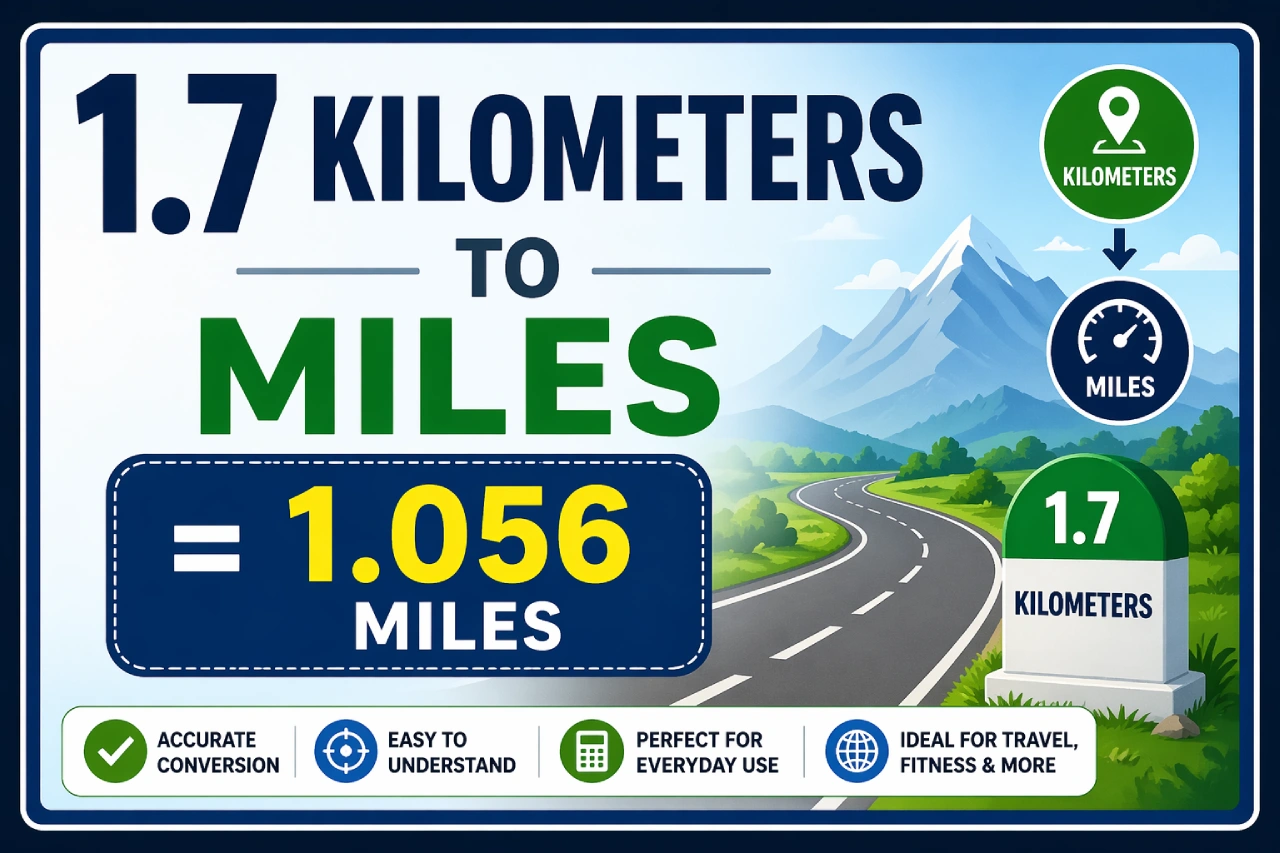
  • 1.7 Kilometers to Miles

    1.7 Kilometers to Miles

    If you’re looking for the quick answer:

    1.7 kilometers = 1.056 miles (approximately).

    Rounded for everyday use:

    👉 1.7 km ≈ 1.06 miles

    This is a very practical distance—just a little over one mile—commonly used in walking routes, running workouts, and short travel distances.

    In this guide, we’ll break down the exact formula, show step-by-step calculations, and help you understand what 1.7 kilometers to miles really looks and feels like in real life.

    The Conversion Formula: Kilometers to Miles

    Kilometers to Miles Converter

    Kilometers to Miles Converter

    Quickly convert kilometers to miles or miles to kilometers.

    Converted Result
    0
    1 kilometer = 0.621371 miles
    1 mile = 1.60934 kilometers

    The relationship between kilometers and miles is fixed:

    1 kilometer = 0.621371 miles

    Conversion Formula

    Miles = Kilometers × 0.621371

    This formula works for any value.

    Step-by-Step Conversion: 1.7 km to Miles

    Let’s calculate it clearly.

    Step 1: Start with kilometers

    1.7 km

    Step 2: Multiply by the conversion factor

    1.7 × 0.621371

    Step 3: Calculate

    = 1.05633 miles

    Final Result

    1.7 km ≈ 1.056 miles

    Rounded:

    👉 1.7 km ≈ 1.06 miles

    Quick Conversion Table

    Here’s a helpful chart for nearby values.

    Kilometers (km)Miles (mi)
    1 km0.62 mi
    1.5 km0.93 mi
    1.7 km1.06 mi
    2 km1.24 mi
    3 km1.86 mi

    This makes quick estimation easier.

    What Does 1.7 km Feel Like?

    Numbers are useful—but real-life comparisons make them meaningful.

    Walking Distance

    At a normal walking pace:

    • 1.7 km takes about 20–25 minutes

    Running Distance

    At a moderate running pace:

    • 1.7 km takes about 8–12 minutes

    Everyday Perspective

    1.7 km is roughly:

    • A short neighborhood walk
    • A quick jog around a park
    • A casual trip between nearby places

    Comparing 1.7 km to Familiar Distances

    Let’s put it into context.

    • Slightly more than 1 mile
    • About 17 football fields (each ~100 meters)
    • Around 10–12 city blocks (depending on layout)

    This helps you visualize the distance easily.

    Why Convert Kilometers to Miles?

    This conversion is useful in many situations.

    1. Travel and Navigation

    Maps may show distances in kilometers, but U.S. users think in miles.

    2. Fitness and Running

    Workout apps often allow switching between km and miles.

    3. International Communication

    Different countries use different measurement systems.

    4. Sports and Events

    Race distances may be listed in kilometers or miles.

    Kilometers vs Miles: Key Differences

    UnitSystemEquivalent
    Kilometer (km)Metric0.621 miles
    Mile (mi)U.S. customary1.609 km

    Because miles are longer units, the number becomes smaller when converting from km.

    Converting Miles Back to Kilometers

    Sometimes you need the reverse conversion.

    Formula

    Kilometers = Miles × 1.60934

    Example

    1.056 × 1.60934 ≈ 1.7 km

    This confirms the original value.

    Common Mistakes to Avoid

    1. Using the Wrong Conversion Factor

    Always use:

    1 km = 0.621371 miles

    2. Rounding Too Early

    Keep full precision until the final step.

    3. Confusing Units

    Remember:

    • Kilometers → smaller unit
    • Miles → larger unit

    Tips for Quick Mental Conversion

    Here are simple tricks.

    Trick 1: Multiply by 0.62

    1.7 × 0.62 ≈ 1.05 miles

    Very close to the exact answer.

    Trick 2: Think “Half Plus a Bit”

    1 km ≈ 0.6 miles

    So:

    1.7 km ≈ slightly over 1 mile

    Trick 3: Use Benchmarks

    • 1 km ≈ 0.62 miles
    • 2 km ≈ 1.24 miles

    Real-World Examples

    Example 1: Running

    If your workout is 1.7 km, you’re running just over 1 mile.

    Example 2: Walking Route

    A destination 1.7 km away is about a 1-mile walk.

    Example 3: Travel Distance

    Driving 1.7 km equals roughly 1.06 miles, useful for navigation.

    Frequently Asked Questions (FAQs)

    How many miles is 1.7 kilometers?

    1.7 km ≈ 1.06 miles

    How do you convert km to miles?

    Multiply kilometers by 0.621371.

    Is 1.7 km equal to 1 mile?

    It’s slightly more than 1 mile.

    How long does it take to walk 1.7 km?

    About 20–25 minutes.

    What is 2 km in miles?

    2 × 0.621371 ≈ 1.24 miles

    Why do different countries use km and miles?

    The metric system is global, while the U.S. uses miles.

    Is km smaller than miles?

    Yes.
    1 km is shorter than 1 mile.

    What is 1 mile in km?

    1 mile ≈ 1.609 km

    Can calculators convert km to miles?

    Yes. Most tools support this.

    What is the easiest way to estimate?

    Multiply by 0.62.

    Final Thoughts

    Converting 1.7 kilometers to miles is simple once you know the formula:

    Miles = Kilometers × 0.621371

    Using this, we get:

    1.7 km ≈ 1.06 miles

    This is a short, practical distance—perfect for walking, jogging, or quick trips.

    Once you remember the shortcut—multiply by 0.62 for quick estimates—you’ll be able to convert distances instantly.

    Now here’s a quick question for you:
    Next time you see a distance in kilometers, will you automatically picture it in miles?

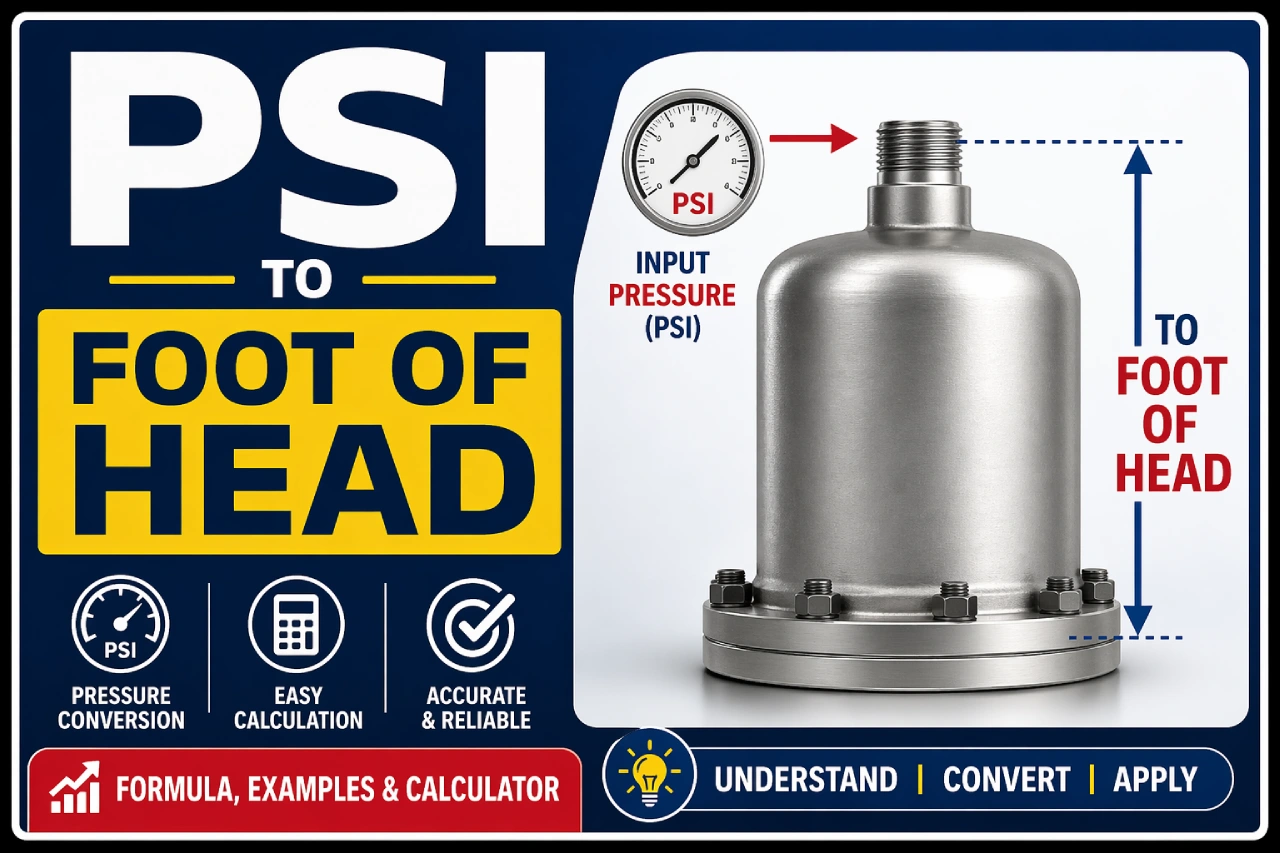
  • PSI to Foot of Head (Easy Conversion Guide)

    PSI to Foot of Head (Easy Conversion Guide)

    If you’re looking for the quick answer:

    1 PSI ≈ 2.31 feet of head (for water)

    So, to convert PSI to feet of head, you simply multiply by 2.31.

    For example:

    • 10 PSI ≈ 23.1 ft of head
    • 50 PSI ≈ 115.5 ft of head
    • 100 PSI ≈ 231 ft of head

    This conversion is widely used in plumbing, pump systems, hydraulics, irrigation, and fluid engineering. It helps translate pressure (PSI) into a physical height (feet of head), making it easier to visualize how fluids behave in real systems.

    In this guide, we’ll break down exactly what PSI and feet of head mean, how the formula works, and how to apply it in real-world scenarios.

    The PSI to Foot of Head Formula

    PSI to Foot of Head Converter

    PSI to Foot of Head Converter

    Convert pressure in PSI to feet of head instantly. Useful for water pressure, pump sizing, and plumbing calculations.

    Result
    0 ft of head
    Formula used:
    1 PSI = 2.31 feet of head

    Calculation:
    Foot of Head = PSI × 2.31
    Note: This conversion is based on water at standard conditions.

    The relationship between PSI and feet of head depends on the fluid’s density. For water (which is the standard reference), the formula is:

    Feet of Head = PSI × 2.31

    This conversion factor comes from the physical properties of water.

    Why 2.31?

    The number 2.31 comes from the relationship between pressure and the weight of water.

    At standard conditions:

    • 1 PSI = 144 pounds per square foot
    • Water weighs about 62.4 lbs per cubic foot

    Using these values, engineers derive:

    1 PSI ≈ 2.31 feet of water head

    Step-by-Step Conversion Example

    Let’s convert 25 PSI to feet of head.

    Step 1: Start with PSI

    25 PSI

    Step 2: Multiply by 2.31

    25 × 2.31

    Step 3: Calculate

    = 57.75 ft of head

    Final Answer

    25 PSI ≈ 57.75 feet of head

    Quick PSI to Foot of Head Conversion Table

    Here’s a handy reference chart.

    PSIFeet of Head
    1 PSI2.31 ft
    5 PSI11.55 ft
    10 PSI23.1 ft
    20 PSI46.2 ft
    50 PSI115.5 ft
    100 PSI231 ft

    This makes it easy to estimate values quickly.

    Why Convert PSI to Feet of Head?

    This conversion is essential in many real-world applications.

    1. Pump Systems

    Pump performance is often measured in feet of head, not PSI.

    Engineers use this to determine how high a pump can lift water.

    2. Plumbing Systems

    Understanding pressure in terms of height helps diagnose issues like:

    • Low water pressure
    • Flow problems
    • Pipe elevation changes

    3. Irrigation Systems

    Farmers and landscapers use feet of head to design efficient water distribution systems.

    4. Hydraulic Engineering

    Fluid systems rely on head calculations to ensure proper flow and pressure.

    PSI vs Feet of Head: Key Differences

    UnitMeasuresDescription
    PSIPressureForce per unit area
    Feet of headEnergy/heightHeight fluid can be lifted

    Both measure the same physical concept (fluid energy), but in different ways.

    Converting Feet of Head Back to PSI

    Sometimes you need the reverse conversion.

    Formula

    PSI = Feet of Head ÷ 2.31

    Example

    115.5 ÷ 2.31 = 50 PSI

    This confirms the earlier calculation.

    Does the Conversion Change for Other Liquids?

    Yes—and this is important.

    The factor 2.31 only applies to water.

    For other fluids, the conversion depends on density.

    Example

    • Oil (lighter than water) → higher feet of head per PSI
    • Mercury (heavier than water) → lower feet of head per PSI

    General Formula

    Feet of Head = (PSI × 2.31) ÷ Specific Gravity

    Where:

    • Specific gravity compares the fluid to water

    Real-World Examples

    Example 1: Household Water Pressure

    If your home has 50 PSI water pressure:

    50 × 2.31 = 115.5 ft of head

    This means the system can theoretically lift water over 100 feet.

    Example 2: Pump System

    A pump rated at 200 ft of head equals:

    200 ÷ 2.31 ≈ 86.6 PSI

    Example 3: Irrigation System

    If a sprinkler system needs 30 ft of head:

    30 ÷ 2.31 ≈ 13 PSI

    Common Mistakes to Avoid

    1. Using the Conversion for All Liquids

    The 2.31 factor is only accurate for water.

    2. Mixing Units

    Always confirm whether you’re working with:

    • PSI (pressure)
    • Feet of head (height/energy)

    3. Rounding Too Early

    Keep precision until the final step.

    Easy Mental Conversion Tips

    Trick 1: Multiply by 2.3

    For quick estimates:

    10 PSI ≈ 23 ft of head

    Trick 2: Divide by 2.3

    To reverse:

    100 ft ÷ 2.3 ≈ 43 PSI

    Trick 3: Remember Benchmarks

    • 10 PSI ≈ 23 ft
    • 50 PSI ≈ 115 ft
    • 100 PSI ≈ 231 ft

    Practical Applications in Everyday Life

    Plumbing

    Understanding head helps troubleshoot water pressure problems.

    Well Systems

    Pump depth and pressure ratings are often given in feet of head.

    HVAC Systems

    Fluid pressure in heating and cooling systems may be expressed in head.

    Industrial Systems

    Engineers rely on this conversion for system design and safety.

    Frequently Asked Questions (FAQs)

    What is 1 PSI in feet of head?

    1 PSI ≈ 2.31 feet of head (for water)

    How do you convert PSI to feet of head?

    Multiply PSI by 2.31.

    What is 50 PSI in feet of head?

    50 × 2.31 = 115.5 ft

    Why is the factor 2.31 used?

    It comes from the physical properties of water.

    Is this conversion exact?

    It’s accurate for water under standard conditions.

    Does it work for other liquids?

    Only if you adjust for density.

    What is feet of head used for?

    It measures how high fluid can be lifted.

    How do you convert feet of head to PSI?

    Divide by 2.31.

    What is 100 ft of head in PSI?

    100 ÷ 2.31 ≈ 43.3 PSI

    Can calculators convert PSI to feet of head?

    Yes. Most engineering tools support this.

    Final Thoughts

    Converting PSI to foot of head is simple once you understand the relationship between pressure and fluid height.

    The key rule is:

    Feet of Head = PSI × 2.31 (for water)

    This conversion is essential for anyone working with pumps, plumbing, or fluid systems.

    Once you learn a few key benchmarks and understand the concept, you’ll be able to estimate values quickly without needing a calculator.

    Now here’s a quick question for you:
    Next time you see a pressure reading in PSI, will you be able to visualize how high that water could actually rise?

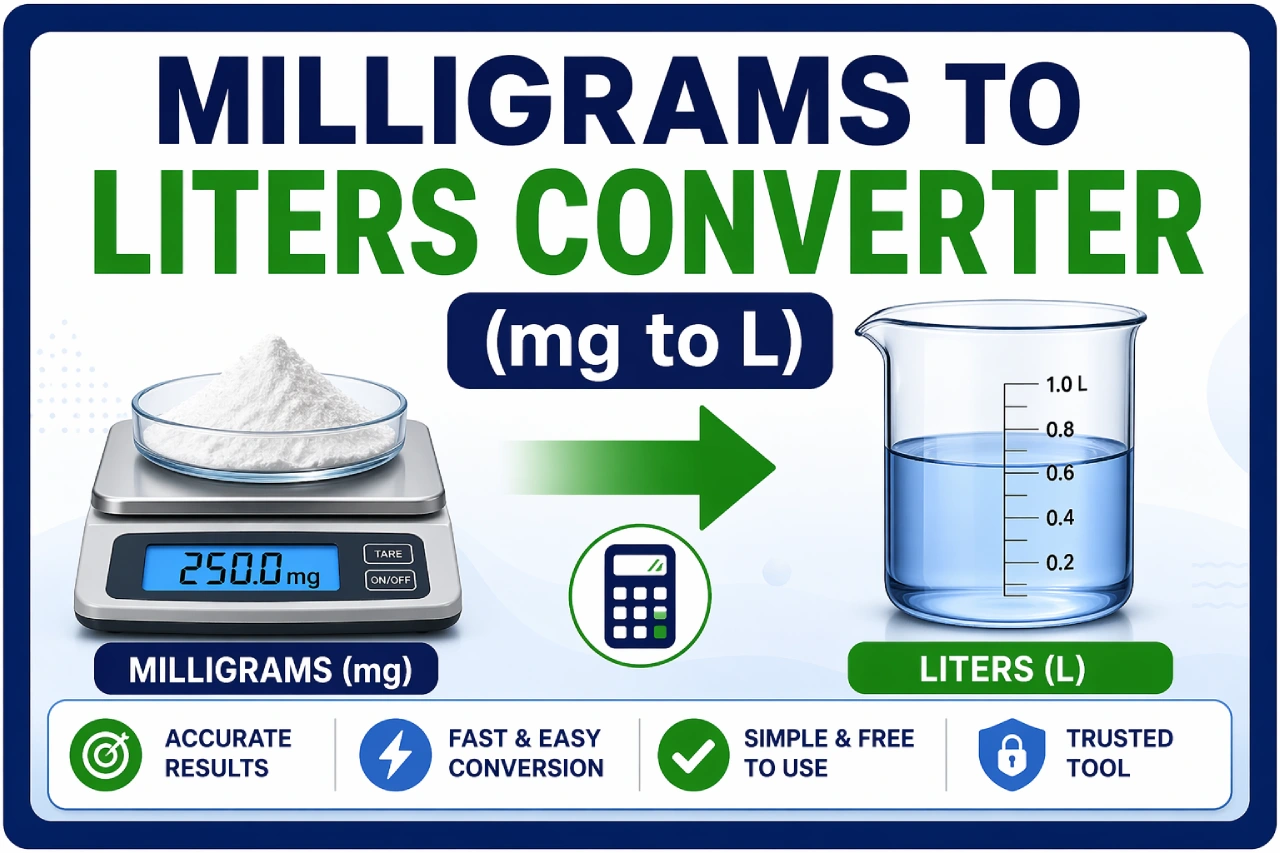
  • Milligrams to Liters Converter (mg to L Guide)

    Milligrams to Liters Converter (mg to L Guide)

    If you’re looking for a quick answer:

    You cannot directly convert milligrams (mg) to liters (L) without knowing the substance’s density.

    That’s because:

    • Milligrams measure mass (weight)
    • Liters measure volume

    To convert mg to liters, you must use this formula:

    Liters = Milligrams ÷ (Density × 1,000,000)

    For example, if you’re working with water (density = 1 g/mL):

    • 1,000,000 mg = 1 liter

    So:

    1 mg of water = 0.000001 liters

    This guide will explain exactly how a milligrams to liters converter works, when you can use it, and how to calculate conversions accurately for different substances.

    Understanding Milligrams and Liters

    Before diving into conversions, let’s understand the units.

    What Is a Milligram (mg)?

    A milligram (mg) is a unit of mass in the metric system.

    • 1 mg = 0.001 grams
    • 1,000 mg = 1 gram

    Milligrams are used for:

    • Medications and supplements
    • Chemical measurements
    • Food nutrients
    • Laboratory work

    For example:

    • A vitamin tablet might contain 500 mg
    • A medication dose could be 250 mg

    What Is a Liter (L)?

    A liter (L) is a unit of volume in the metric system.

    • 1 liter = 1,000 milliliters (mL)

    Liters are used for:

    • Liquids like water, milk, and fuel
    • Laboratory solutions
    • Industrial fluids

    For example:

    • A water bottle may hold 1 liter
    • A soda bottle might be 2 liters

    Why You Can’t Convert mg to Liters Directly

    This is the most important concept:

    👉 Mass and volume are different physical properties.

    To connect them, you need density.

    What Is Density?

    Density tells you how much mass is packed into a certain volume.

    Density = Mass ÷ Volume

    Different substances have different densities.

    Example

    • Water: 1 g/mL
    • Oil: ~0.9 g/mL
    • Mercury: 13.6 g/mL

    Because of this, 1,000 mg of different substances will occupy different volumes.

    The Conversion Formula

    Milligrams to Liters Converter

    Milligrams to Liters Converter

    Convert milligrams (mg) to liters (L) using density. Since mg measures mass and liters measure volume, you must enter the density of the substance.

    Result

    Enter values to calculate
    Formula used:
    Liters = Milligrams ÷ (Density × 1,000,000)
    Note: For water, 1,000,000 mg = 1 liter because water has a density of 1 g/mL.

    To convert milligrams to liters, use:

    Liters = Milligrams ÷ (Density × 1,000,000)

    Where:

    • Density is in g/mL or kg/L

    Step-by-Step Example (Using Water)

    Let’s convert 500,000 mg of water into liters.

    Step 1: Convert mg to grams

    500,000 mg = 500 grams

    Step 2: Use water density

    Water density = 1 g/mL

    Step 3: Convert grams to liters

    500 g ÷ 1000 = 0.5 liters

    Final Answer

    500,000 mg of water = 0.5 liters

    Milligrams to Liters for Common Substances

    Here are approximate conversions for different materials.

    Water

    • 1,000 mg = 0.001 L
    • 1,000,000 mg = 1 L

    Oil

    • 1,000,000 mg ≈ 1.11 liters

    Milk

    • 1,000,000 mg ≈ 0.97 liters

    Mercury

    • 1,000,000 mg ≈ 0.074 liters

    These differences show why density matters.

    Quick Reference Table (Water Only)

    Milligrams (mg)Liters (L)
    1,000 mg0.001 L
    10,000 mg0.01 L
    100,000 mg0.1 L
    1,000,000 mg1 L

    This works only for water or substances with similar density.

    Real-World Applications

    1. Medicine and Healthcare

    Doctors may convert mg to mL or liters when preparing liquid medications.

    2. Laboratory Work

    Scientists frequently convert mass to volume for solutions.

    3. Food and Nutrition

    Nutritional values may require converting between weight and volume.

    4. Chemical Engineering

    Precise conversions are critical for mixing substances.

    Why Density Matters So Much

    Let’s compare two substances:

    Example: 1,000,000 mg

    • Water → 1 liter
    • Oil → ~1.11 liters
    • Mercury → ~0.074 liters

    Same mass, completely different volumes.

    That’s why a milligrams to liters converter must always include density.

    Common Mistakes to Avoid

    1. Ignoring Density

    You cannot convert mg to liters without knowing density.

    2. Assuming All Liquids Are Like Water

    Different liquids have different densities.

    3. Confusing Units

    Remember:

    • mg = mass
    • L = volume

    Easy Mental Conversion Tips

    For Water Only

    • 1,000 mg = 1 mL
    • 1,000,000 mg = 1 L

    Quick Shortcut

    For water:

    Liters = mg ÷ 1,000,000

    For Other Substances

    Always adjust using density.

    Simple Formula Breakdown

    Let’s simplify the process:

    1. Convert mg → grams
    2. Divide by density
    3. Convert mL → liters

    This ensures accuracy every time.

    Frequently Asked Questions (FAQs)

    Can you convert mg to liters directly?

    No. You need density.

    How many liters is 1 mg of water?

    0.000001 liters

    What is the formula for mg to liters?

    Liters = mg ÷ (density × 1,000,000)

    Is mg the same as mL?

    No.
    mg = mass
    mL = volume

    How many mg are in 1 liter of water?

    1,000,000 mg

    Why do different substances give different results?

    Because they have different densities.

    What is the easiest conversion for water?

    Divide mg by 1,000,000

    Can calculators convert mg to liters?

    Yes, but you must input density.

    Is 1000 mg equal to 1 liter?

    No.
    It equals 0.001 liters (for water).

    What is density in simple terms?

    It tells how heavy something is for its size.

    Final Thoughts

    A milligrams to liters converter isn’t just about plugging in numbers—it’s about understanding the relationship between mass, volume, and density.

    The key takeaway is:

    👉 You need density to convert mg to liters

    For water, the conversion is simple. But for other substances, you must adjust based on how dense they are.

    Once you understand this concept, you can confidently handle conversions in science, medicine, cooking, and everyday life.

    Now here’s a quick question for you:
    Next time you see a value in milligrams, will you know how to convert it into liters—or will you first check the density?

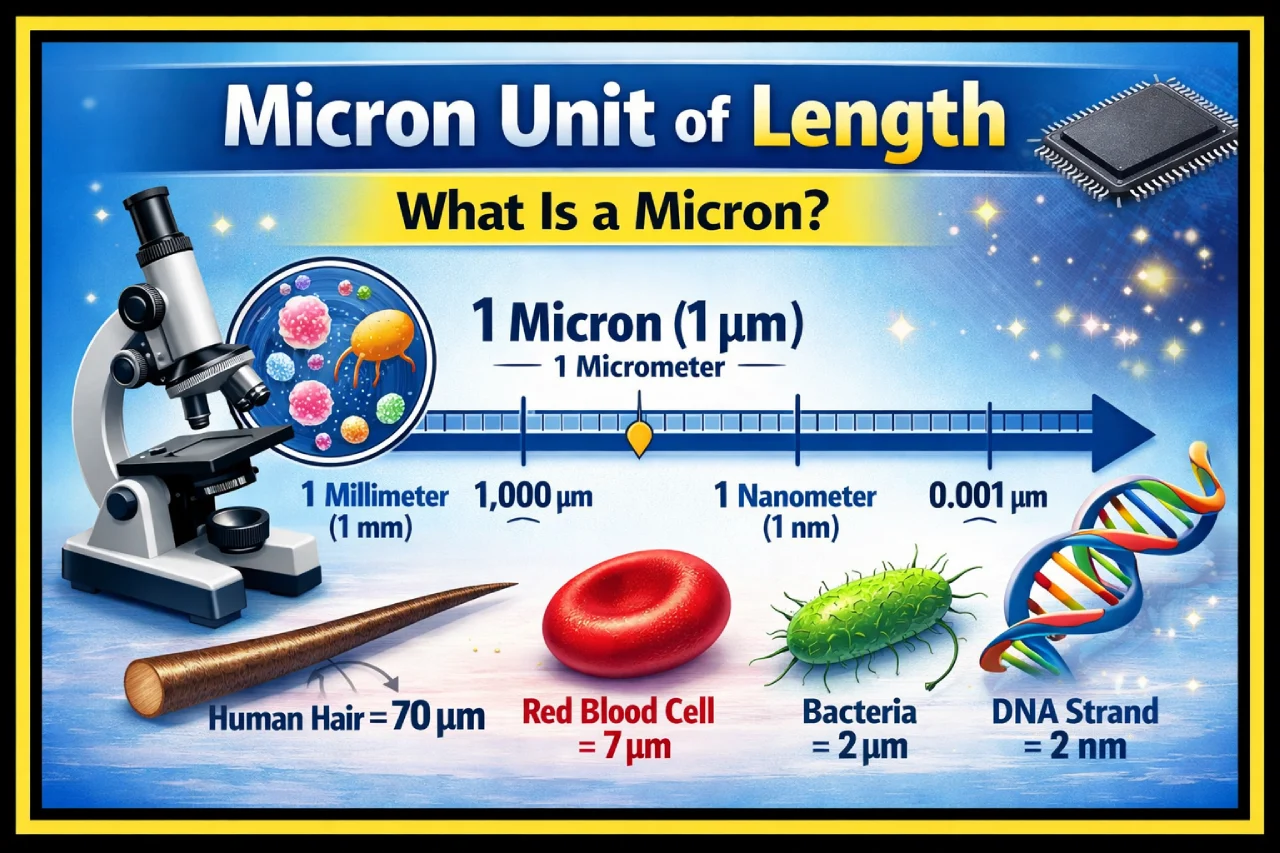
  • Micron Unit of Length (What Is a Micron?)

    Micron Unit of Length (What Is a Micron?)

    If you’re looking for the quick answer:

    A micron is equal to one micrometer, which is 1/1,000,000 of a meter (10⁻⁶ meters).

    In simple terms:

    1 micron (µm) = 0.001 millimeters = 0.00003937 inches

    The term “micron” is commonly used in industries like manufacturing, filtration, medicine, and electronics to describe extremely small measurements—far smaller than what we can see with the naked eye.

    In this guide, we’ll break down exactly what a micron is, how it compares to other units, where it’s used, and how to visualize something so incredibly tiny.

    What Is a Micron?

    A micron is another name for a micrometer (µm), which is a standard unit of length in the metric system.

    Official Definition

    1 micron = 1 micrometer = 10⁻⁶ meters

    That means:

    • 1 meter = 1,000,000 microns
    • 1 millimeter = 1,000 microns

    Although “micron” is not the official SI term anymore, it is still widely used in practical applications because it’s easy to say and remember.

    Why Is It Called a Micron?

    The word “micron” comes from the Greek word “mikros,” meaning small.

    The official SI unit is micrometer, but “micron” continues to be used in:

    • Manufacturing
    • Engineering
    • Filtration systems
    • Industrial applications

    Both terms refer to the same measurement.

    Micron Conversion to Other Units

    Understanding how a micron compares to other units helps put its size into perspective.

    Basic Conversions

    • 1 micron = 0.001 millimeters (mm)
    • 1 micron = 0.0001 centimeters (cm)
    • 1 micron = 0.00003937 inches (in)
    • 1 micron = 1,000 nanometers (nm)

    Conversion Table

    UnitEquivalent to 1 Micron
    Millimeters0.001 mm
    Centimeters0.0001 cm
    Inches0.00003937 in
    Nanometers1,000 nm

    These values show just how small a micron really is.

    Visualizing a Micron

    A micron is so small that it’s difficult to imagine without comparisons.

    Real-World Comparisons

    • A human hair is about 70 microns thick
    • A red blood cell is about 6–8 microns wide
    • A bacterium is typically 1–5 microns long
    • A grain of dust may be around 10–50 microns

    To put it simply:

    👉 You cannot see a single micron with the naked eye.

    Micron vs Millimeter vs Nanometer

    Micron vs Millimeter vs Nanometer Converter

    Micron vs Millimeter vs Nanometer Converter

    Your result will appear here
    Quick Reference:
    1 millimeter = 1,000 microns
    1 micron = 1,000 nanometers
    1 millimeter = 1,000,000 nanometers

    Let’s compare common small units of measurement.

    UnitSize
    Millimeter (mm)0.001 m
    Micron (µm)0.000001 m
    Nanometer (nm)0.000000001 m

    Key Takeaway

    • 1 mm = 1,000 microns
    • 1 micron = 1,000 nanometers

    This shows how the micron sits between millimeters and nanometers.

    Where Is the Micron Used?

    The micron is essential in fields that require precision at a microscopic level.

    1. Filtration Systems

    Microns are widely used to measure filter effectiveness.

    For example:

    • A 10-micron filter removes larger particles
    • A 1-micron filter captures much finer contaminants
    • A 0.5-micron filter can remove bacteria

    This is common in:

    • Water purification
    • Air filtration
    • Industrial systems

    2. Manufacturing and Engineering

    Precision parts are often measured in microns.

    For example:

    • Machine tolerances may be within ±5 microns
    • Surface finishes are measured in microns

    3. Medicine and Biology

    Microns are used to measure:

    • Cells
    • Bacteria
    • Tissue structures

    4. Electronics

    In microchips and semiconductors:

    • Circuit components are often measured in microns or smaller

    5. Paint and Coating Thickness

    Paint layers are often measured in microns.

    For example:

    • A car paint layer may be 100–200 microns thick

    Why the Micron Matters

    You might wonder why such a tiny unit is important.

    The answer is precision.

    When working with:

    • Microelectronics
    • Medical devices
    • Filtration systems
    • Scientific research

    Even a difference of a few microns can significantly impact performance.

    Converting Microns to Inches

    In the United States, inches are often used instead of metric units.

    Formula

    Inches = Microns × 0.00003937

    Example

    100 microns × 0.00003937 = 0.003937 inches

    This shows how small microns are compared to inches.

    Converting Inches to Microns

    Formula

    Microns = Inches × 25,400

    Example

    1 inch × 25,400 = 25,400 microns

    This helps when converting U.S. measurements into metric precision.

    Common Micron Values in Daily Life

    Here are some typical micron measurements you may encounter.

    ItemSize (Microns)
    Human hair50–100 µm
    Dust particle10–50 µm
    Bacteria1–5 µm
    Smoke particle<1 µm

    These examples show how microns are used to describe extremely small objects.

    Common Mistakes to Avoid

    1. Confusing Microns with Millimeters

    Remember:

    • 1 mm = 1,000 microns

    2. Misunderstanding Scale

    Microns are microscopic—you can’t see them without magnification.

    3. Using Incorrect Conversions

    Always use accurate values:

    • 1 micron = 0.00003937 inches

    Tips to Remember Micron Conversions

    Here are some quick tricks.

    Trick 1: Think “One Millionth”

    A micron is one-millionth of a meter.

    Trick 2: Use Benchmarks

    • 1 mm = 1,000 microns
    • 1 inch = 25,400 microns

    Trick 3: Visual Anchors

    Think of a human hair (~70 microns) to understand scale.

    Real-World Example

    Let’s say you’re buying a water filter labeled 5 microns.

    This means:

    • It can trap particles larger than 5 microns
    • It will remove most dust, pollen, and some bacteria

    Understanding this helps you choose the right filter.

    Frequently Asked Questions (FAQs)

    What is a micron in simple terms?

    A micron is a very small unit of length equal to one millionth of a meter.

    Is a micron the same as a micrometer?

    Yes.
    They are the same unit.

    How many microns are in a millimeter?

    1,000 microns = 1 millimeter

    How small is a micron?

    It’s smaller than what the human eye can see.

    How many microns are in an inch?

    1 inch = 25,400 microns

    Why is the micron important?

    It allows precise measurement of extremely small objects.

    What is 100 microns in inches?

    100 × 0.00003937 ≈ 0.00394 inches

    Is micron still used today?

    Yes, especially in industrial and practical applications.

    What is smaller than a micron?

    A nanometer is smaller.

    Can you see a micron?

    No, it requires magnification.

    Final Thoughts

    The micron unit of length may be tiny, but its importance is enormous.

    It plays a crucial role in:

    • Science
    • Engineering
    • Medicine
    • Manufacturing

    The key takeaway is simple:

    1 micron = one-millionth of a meter

    Once you understand how small this unit is and where it’s used, you’ll start noticing it everywhere—from air filters to electronics and even medical research.

    Now here’s a quick question for you:
    Next time you see a “micron rating” on a filter or product, will you know exactly how small that measurement really is?

  • 78 mm to Inches (mm to in Formula Guide)

    78 mm to Inches (mm to in Formula Guide)

    If you’re looking for the quick answer:

    78 millimeters (mm) = 3.07 inches (approximately).

    So, when you convert 78 mm to inches, the result is about 3.07 inches when rounded to two decimal places.

    This is a common conversion used in construction, engineering, DIY projects, and product measurements, especially when working between the metric system (mm) and the U.S. customary system (inches).

    In this guide, we’ll break down the exact formula, show step-by-step calculations, and explain what 78 mm actually looks like in real life so you can confidently use this conversion anywhere.

    The Conversion Formula: mm to Inches

    The relationship between millimeters and inches is fixed:

    1 inch = 25.4 millimeters

    Conversion Formula

    Inches = Millimeters ÷ 25.4

    This formula works for any value.

    Step-by-Step Conversion: 78 mm to Inches

    Let’s calculate it step by step.

    Step 1: Start with the value in mm

    78 mm

    Step 2: Divide by 25.4

    78 ÷ 25.4

    Step 3: Calculate

    = 3.0709 inches

    Final Result

    78 mm ≈ 3.07 inches

    Converting 78 mm to Inches and Fractions

    In many U.S. applications—especially construction—measurements are often expressed in fractions instead of decimals.

    Step 1: Take the decimal value

    3.0709 inches

    Step 2: Convert decimal to fraction

    0.0709 ≈ 1/16 (0.0625)

    Final Answer

    78 mm ≈ 3 1/16 inches

    This makes the measurement easier to use in practical settings.

    Visualizing 78 mm

    Let’s make this number more relatable.

    Everyday Objects

    • A standard smartphone width is around 70–80 mm
    • A small notebook width may be close to this range
    • A baseball diameter is roughly 73 mm, slightly smaller

    Length Comparison

    At just over 3 inches, 78 mm is about:

    • The width of a small coffee mug
    • The length of a credit card (roughly 85 mm, slightly larger)

    These comparisons help you picture the size more clearly.

    Quick mm to Inches Conversion Table

    Here’s a helpful chart for nearby values.

    Millimeters (mm)Inches (in)
    50 mm1.97 in
    60 mm2.36 in
    70 mm2.76 in
    78 mm3.07 in
    80 mm3.15 in
    100 mm3.94 in

    This makes it easier to estimate similar conversions.

    Why Convert mm to Inches?

    This conversion is useful in many real-world situations.

    1. Construction and DIY Projects

    Many tools and materials in the U.S. use inches, while imported parts use millimeters.

    2. Engineering and Manufacturing

    Designs may be created in metric units but manufactured in imperial systems.

    3. Product Dimensions

    Electronics, furniture, and appliances often list measurements in both units.

    4. International Communication

    Converting between systems ensures accuracy across countries.

    Millimeters vs Inches: Key Differences

    UnitSystemEquivalent
    Millimeter (mm)Metric0.03937 inches
    Inch (in)U.S. customary25.4 mm

    Because inches are larger units, converting from mm results in smaller decimal values.

    Converting Inches Back to Millimeters

    Sometimes you need to reverse the conversion.

    Formula

    Millimeters = Inches × 25.4

    Example

    3.07 × 25.4 ≈ 78 mm

    This confirms the original value.

    Common Mistakes to Avoid

    1. Using the Wrong Conversion Factor

    Always use:

    1 inch = 25.4 mm

    2. Rounding Too Early

    Keep the full value until the final step.

    3. Confusing mm with cm

    Remember:

    • 1 cm = 10 mm

    Tips for Quick Mental Conversion

    Here are some easy tricks.

    Trick 1: Divide by 25

    Instead of 25.4, use 25 for quick estimates.

    Example:

    78 ÷ 25 ≈ 3.12 inches

    This is close to the exact value.

    Trick 2: Remember Benchmarks

    • 25 mm ≈ 1 inch
    • 50 mm ≈ 2 inches
    • 75 mm ≈ 3 inches

    So:

    78 mm is just slightly above 3 inches

    Trick 3: Use Fraction Approximations

    3.07 inches is close to 3 1/16 inches, which is easier to visualize.

    Real-World Examples of 78 mm

    Electronics

    A small device or component might measure around 78 mm wide.

    Tools and Hardware

    Certain bolts, brackets, or fittings may use measurements close to this.

    Home Projects

    When working with imported materials, you may need to convert mm to inches for compatibility.

    Understanding both units ensures accurate results.

    Frequently Asked Questions (FAQs)

    How many inches is 78 mm?

    78 mm ≈ 3.07 inches

    How do you convert mm to inches?

    Divide millimeters by 25.4.

    What is 78 mm in fraction form?

    Approximately 3 1/16 inches

    Is 78 mm close to 3 inches?

    Yes, it’s slightly more than 3 inches.

    How many mm are in 1 inch?

    1 inch = 25.4 mm

    What is 80 mm in inches?

    80 ÷ 25.4 ≈ 3.15 inches

    Why do most countries use mm?

    Because the metric system is the global standard.

    Is mm smaller than inches?

    Yes, millimeters are much smaller units.

    Can calculators convert mm to inches?

    Yes. Most calculators and apps support unit conversions.

    What is 100 mm in inches?

    100 ÷ 25.4 ≈ 3.94 inches

    Final Thoughts

    Converting 78 mm to inches is simple once you understand the relationship between these units.

    Using the formula:

    Inches = mm ÷ 25.4

    we get:

    78 mm ≈ 3.07 inches

    This conversion is especially useful in construction, engineering, and everyday measurements where both metric and imperial systems are used.

    Once you remember the key rule—1 inch equals 25.4 mm—you’ll be able to convert between these units quickly and confidently.

    Now here’s a quick thought for you:
    Next time you see a measurement in millimeters, will you instantly know its value in inches?

  • 197 Kilograms to Pounds (kg in lbs Explained)

    197 Kilograms to Pounds (kg in lbs Explained)

    If you’re looking for the quick answer:

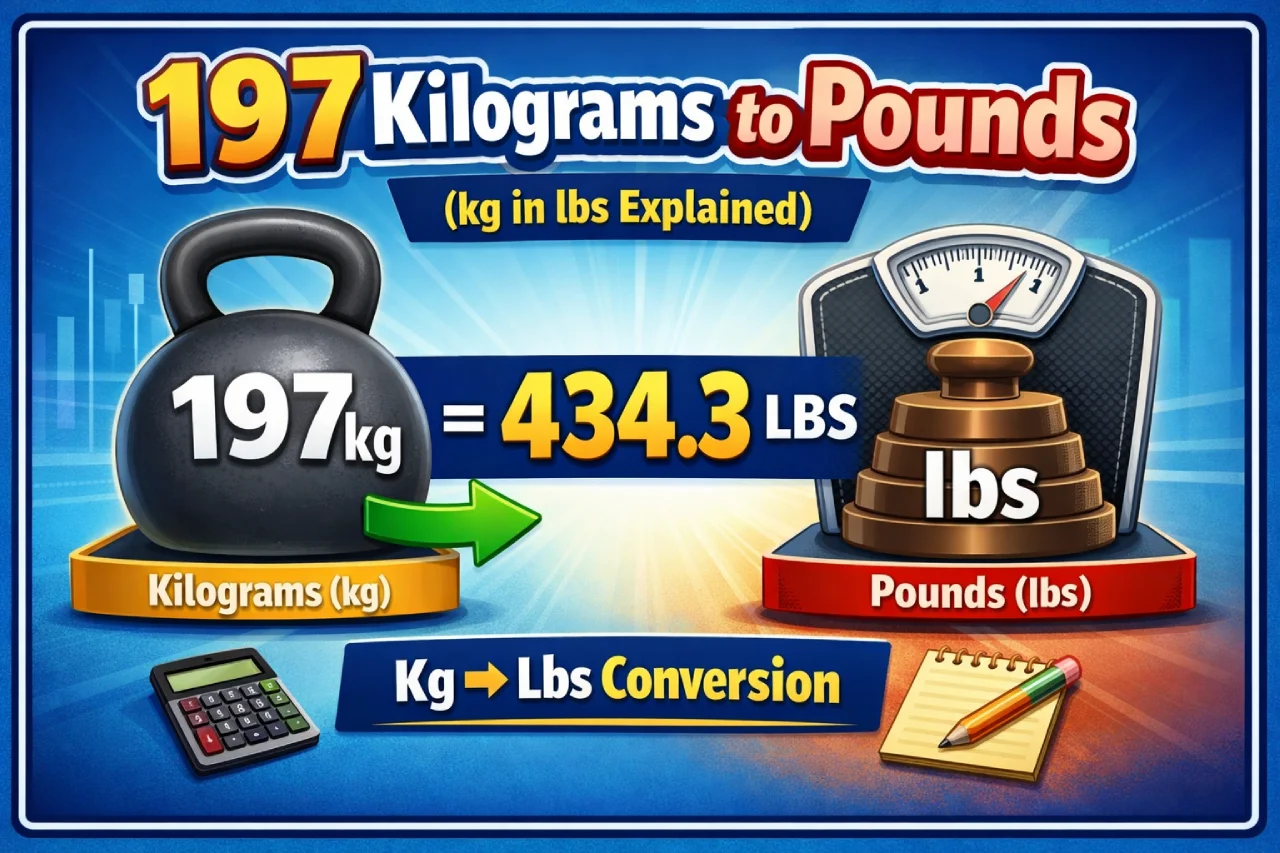
    197 kilograms (kg) = 434.31 pounds (lbs) (approximately).

    So, when you convert 197 kilograms to pounds, the result is about 434.3 lbs when rounded to one decimal place.

    This is a fairly large weight, and conversions like this are common when comparing international measurements, fitness data, shipping weights, or scientific values. Since most countries use kilograms while the United States uses pounds, understanding this conversion helps you interpret numbers accurately.

    In this guide, we’ll break down the exact formula, show step-by-step calculations, and explore real-world examples so you can fully understand what 197 kg in pounds actually means.

    The Conversion Formula: Kilograms to Pounds

    Kg to Pounds Converter

    Kg to Pounds Converter

    Enter weight in kilograms to convert it into pounds.

    Result will appear here

    The relationship between kilograms and pounds is fixed:

    1 kilogram = 2.20462 pounds

    Conversion Formula

    Pounds = Kilograms × 2.20462

    This formula works for any value.

    Step-by-Step Conversion: 197 kg to lbs

    Let’s break it down clearly.

    Step 1: Start with kilograms

    197 kg

    Step 2: Multiply by the conversion factor

    197 × 2.20462

    Step 3: Calculate

    = 434.309 lbs

    Final Result

    197 kg ≈ 434.31 pounds

    Quick Conversion Table

    Here’s a helpful reference for nearby values.

    Kilograms (kg)Pounds (lbs)
    180 kg396.83 lbs
    190 kg418.88 lbs
    197 kg434.31 lbs
    200 kg440.92 lbs
    210 kg462.97 lbs

    This makes it easier to estimate similar conversions quickly.

    What Does 197 kg (434 lbs) Represent?

    Let’s put this number into perspective.

    Body Weight Context

    A weight of 197 kg (434 lbs) is:

    • Significantly above average human weight
    • Common in strongman competitions or heavyweight sports
    • Often associated with extreme strength or specialized training

    Fitness and Strength

    In weightlifting terms, 434 lbs could represent:

    • A heavy deadlift or squat
    • Advanced-level strength training weight
    • Competitive lifting benchmarks

    Real-World Comparisons

    • A large motorcycle may weigh around 400–500 lbs
    • A vending machine can weigh in a similar range
    • Two large refrigerators combined may approach this weight

    These comparisons help visualize how heavy 197 kg really is.

    Why Convert Kilograms to Pounds?

    There are several practical reasons for this conversion.

    1. International Comparisons

    Most countries use kilograms, while the U.S. uses pounds.

    2. Fitness and Health

    Weightlifting programs may use pounds, even if body weight is measured in kg.

    3. Shipping and Logistics

    Global shipping often requires converting between units.

    4. Scientific and Technical Use

    Different industries use different measurement systems.

    Kilograms vs Pounds: Key Differences

    UnitSystemEquivalent
    Kilogram (kg)Metric2.20462 lbs
    Pound (lb)U.S. customary0.453592 kg

    Because pounds are smaller units, the number is always larger when converting from kg to lbs.

    Converting Pounds Back to Kilograms

    Sometimes you need to reverse the conversion.

    Formula

    Kilograms = Pounds × 0.453592

    Example

    434.31 × 0.453592 ≈ 197 kg

    This confirms the original calculation.

    Common Mistakes to Avoid

    1. Using the Wrong Conversion Factor

    Always use:

    1 kg = 2.20462 lbs

    2. Rounding Too Early

    Keep decimals until the final step for accuracy.

    3. Confusing Units

    Remember:

    • Kilograms → smaller number
    • Pounds → larger number

    Tips for Quick Mental Conversion

    Here are some easy shortcuts.

    Trick 1: Multiply by 2.2

    For quick estimates:

    197 × 2.2 ≈ 433.4 lbs

    This is very close to the exact value.

    Trick 2: Use Benchmarks

    • 100 kg ≈ 220 lbs
    • 200 kg ≈ 441 lbs

    So:

    197 kg is just slightly under 441 lbs

    Trick 3: Double and Adjust

    Double the kg value and add a bit more for accuracy.

    Real-World Examples

    Example 1: Gym Weight

    If a barbell weighs 197 kg, that equals:

    434.31 lbs

    Example 2: Shipping Load

    A package weighing 197 kg would be listed as:

    434 lbs in the U.S.

    Example 3: Industrial Equipment

    Machinery parts are often measured in kilograms but referenced in pounds for U.S. markets.

    Frequently Asked Questions (FAQs)

    How many pounds is 197 kg?

    197 kg ≈ 434.31 lbs

    How do you convert kg to lbs?

    Multiply kilograms by 2.20462.

    Is 197 kg equal to 400 lbs?

    No.
    It’s about 434 lbs, which is heavier.

    What is 197 kg rounded?

    Approximately 434 lbs.

    How many kg is 400 lbs?

    400 × 0.453592 ≈ 181.44 kg

    Why do different countries use different units?

    The U.S. uses the customary system, while most countries use the metric system.

    Is kg more accurate than lbs?

    Both are accurate—they just use different systems.

    What is the easiest way to estimate kg to lbs?

    Multiply by 2.2.

    What is 200 kg in pounds?

    200 kg ≈ 440.92 lbs

    Can calculators convert kg to lbs?

    Yes. Most calculators and apps support unit conversions.

    Final Thoughts

    Converting 197 kilograms to pounds is simple once you know the formula:

    Pounds = Kilograms × 2.20462

    Using this, we get:

    197 kg ≈ 434.31 lbs

    This conversion is especially useful when working across international systems, whether in fitness, shipping, or everyday measurements.

    Once you remember the shortcut—multiply by 2.2 for quick estimates—you’ll be able to convert values easily without needing a calculator.

    Now here’s a quick question for you:
    When you see a weight like 197 kg, can you instantly picture how heavy it is in pounds?

  • Cubic Yards to Tons (Easy Calculation Method)

    Cubic Yards to Tons (Easy Calculation Method)

    If you’re looking for the quick answer:

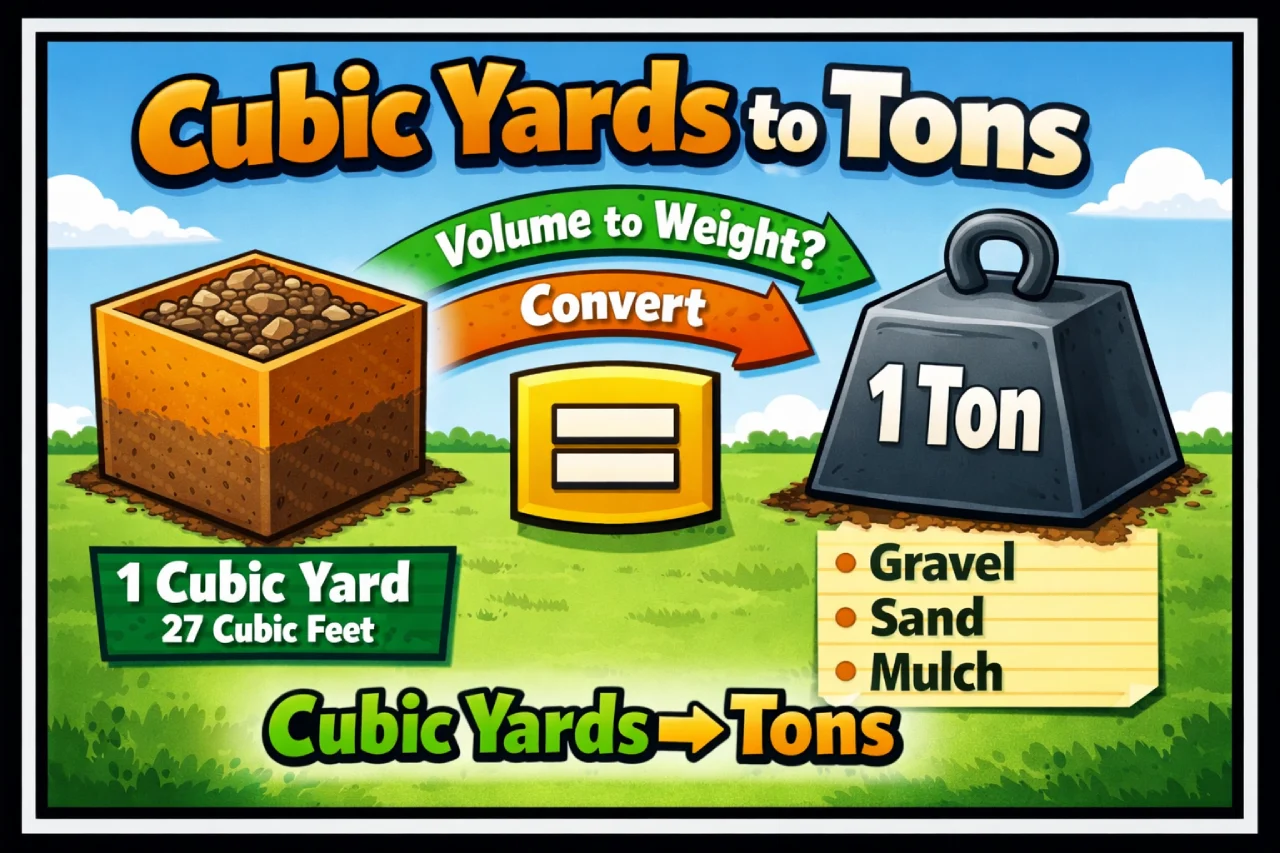
    There is no single fixed conversion from cubic yards to tons.

    Why? Because cubic yards measure volume, while tons measure weight, and the conversion depends entirely on the material’s density.

    However, here’s a useful rule of thumb:

    • 1 cubic yard of gravel ≈ 1.4 to 1.7 tons
    • 1 cubic yard of sand ≈ 1.3 to 1.5 tons
    • 1 cubic yard of soil ≈ 1.1 to 1.4 tons

    So, to convert cubic yards to tons, you must multiply by the material’s density factor.

    If you want a detailed breakdown for different materials, you can also check this complete guide on how many cubic yards are in a ton.

    In this article, we’ll explain exactly how this conversion works, why density matters, and how to calculate it step by step for real-world applications like construction, landscaping, and hauling.

    Why There Is No Fixed Conversion

    This is the most important concept:

    👉 Volume and weight are different things.

    A cubic yard measures how much space something takes up, while a ton measures how heavy it is.

    Different materials have different densities.

    Example

    • A cubic yard of feathers would weigh very little
    • A cubic yard of stone would be extremely heavy

    That’s why the conversion depends on density.

    The Conversion Formula

    Cubic Yards to Tons Converter

    Cubic Yards to Tons Converter

    Convert cubic yards into tons based on the material’s density. Different materials weigh differently, so select the right material for an accurate result.

    Result
    0 tons
    Formula:
    Tons = Cubic Yards × Material Density
    Note: This converter gives an estimate. Actual weight may vary depending on moisture content, compaction, and the exact material blend.

    To convert cubic yards to tons, use this formula:

    Tons = Cubic Yards × Density (tons per cubic yard)

    The density varies by material.

    Common Material Conversion Factors

    Here are typical conversion values used in construction and landscaping.

    MaterialTons per Cubic Yard
    Gravel1.4 – 1.7 tons
    Sand1.3 – 1.5 tons
    Topsoil1.1 – 1.4 tons
    Mulch0.2 – 0.4 tons
    Crushed stone1.5 – 1.7 tons
    Concrete2.0 – 2.4 tons

    These values are estimates, but they’re widely used in real-world projects.

    Step-by-Step Conversion Example

    Let’s convert 3 cubic yards of gravel into tons.

    Step 1: Identify the material

    Gravel

    Step 2: Use the density factor

    Average gravel density = 1.5 tons per cubic yard

    Step 3: Multiply

    3 × 1.5 = 4.5 tons

    Final Answer

    3 cubic yards of gravel ≈ 4.5 tons

    Real-World Applications

    Understanding cubic yards to tons is essential in many industries.

    1. Construction Projects

    Contractors often estimate materials in cubic yards but purchase them in tons.

    Example:

    • Ordering gravel for a driveway
    • Calculating concrete weight

    2. Landscaping

    Landscapers use cubic yards for soil and mulch but need tons for transport.

    3. Trucking and Hauling

    Trucks are rated by weight capacity (tons), not volume.

    4. Home Improvement

    DIY projects often require converting between these units for budgeting and planning.

    Cubic Yards vs Tons: Key Differences

    UnitMeasuresExample
    Cubic yardVolumeAmount of space material occupies
    TonWeightHow heavy the material is

    Understanding this difference prevents costly mistakes.

    Converting Tons Back to Cubic Yards

    Sometimes you need to reverse the calculation.

    Formula

    Cubic Yards = Tons ÷ Density

    Example

    If you have 6 tons of sand:

    6 ÷ 1.4 ≈ 4.3 cubic yards

    Common Mistakes to Avoid

    1. Assuming a Fixed Conversion

    There is no universal number—always consider the material.

    2. Ignoring Moisture Content

    Wet materials weigh more than dry ones.

    3. Using Incorrect Density Values

    Always use realistic averages for your material.

    4. Confusing Units

    Remember:

    • Cubic yards = volume
    • Tons = weight

    Quick Estimation Tips

    Here are some easy ways to estimate.

    Rule of Thumb

    • Soil ≈ 1.2 tons per cubic yard
    • Gravel ≈ 1.5 tons per cubic yard
    • Sand ≈ 1.4 tons per cubic yard

    Simple Shortcut

    Multiply cubic yards by:

    • 1.5 for gravel
    • 1.3–1.4 for sand
    • 1.2 for soil

    This gives a quick estimate.

    Practical Examples

    Example 1: Mulch

    5 cubic yards × 0.3 = 1.5 tons

    Example 2: Crushed Stone

    4 cubic yards × 1.6 = 6.4 tons

    Example 3: Concrete

    2 cubic yards × 2.2 = 4.4 tons

    These examples show how much the weight varies depending on the material.

    Why This Conversion Matters

    Understanding cubic yards to tons helps you:

    • Avoid overordering or underordering materials
    • Calculate transportation costs accurately
    • Ensure trucks are not overloaded
    • Plan projects efficiently

    It’s especially important in construction and landscaping where mistakes can be expensive.

    Frequently Asked Questions (FAQs)

    How many tons are in a cubic yard?

    It depends on the material.
    For example, gravel is about 1.5 tons per cubic yard.

    Is 1 cubic yard equal to 1 ton?

    No. The weight depends on density.

    How do you convert cubic yards to tons?

    Multiply cubic yards by the material’s tons-per-yard factor.

    How many cubic yards are in a ton?

    Divide tons by the material’s density.

    What is the weight of 1 cubic yard of soil?

    Approximately 1.1 to 1.4 tons.

    How much does 1 cubic yard of gravel weigh?

    About 1.4 to 1.7 tons.

    Why is there no fixed conversion?

    Because different materials have different densities.

    Does moisture affect weight?

    Yes. Wet materials weigh more than dry ones.

    Can calculators convert cubic yards to tons?

    Yes, but you must input the correct density.

    What is the easiest way to estimate?

    Use common averages like 1.5 tons per cubic yard for gravel.

    Final Thoughts

    Converting cubic yards to tons isn’t about memorizing a single number—it’s about understanding how volume and weight relate through density.

    The key takeaway is:

    Tons = Cubic Yards × Material Density

    Once you know the type of material you’re working with, the conversion becomes simple.

    Whether you’re planning a landscaping project, ordering construction materials, or estimating hauling loads, this knowledge helps you make smarter decisions and avoid costly mistakes.

    Now here’s a quick question for you:
    Next time you order materials, will you think in cubic yards—or in tons?

  • Mbits in Kbits (Megabit to Kilobit Conversion Guide)

    Mbits in Kbits (Megabit to Kilobit Conversion Guide)

    If you’re looking for the quick answer:

    1 megabit (Mbit) = 1,000 kilobits (kbit)

    So, to convert Mbits to Kbits, you simply multiply by 1,000.

    For example:

    • 1 Mbit = 1,000 Kbits
    • 5 Mbits = 5,000 Kbits
    • 10 Mbits = 10,000 Kbits

    This conversion is widely used in internet speed measurements, data transfer rates, networking, and digital communication. If you’ve ever seen internet speeds like “100 Mbps” or “50 Mbps,” you’re already dealing with megabits.

    In this guide, we’ll break down what megabits and kilobits are, explain the conversion clearly, and show practical examples so you can understand how these units apply in real-world scenarios.

    If you want a deeper explanation of this conversion, check out this detailed guide on megabit to kilobit conversion.

    The Key Conversion: Mbits to Kbits

    Mbits to Kbits Converter

    Mbits to Kbits Converter

    Enter megabits (Mbits) to convert them into kilobits (Kbits).

    Formula: 1 Mbit = 1,000 Kbits

    The relationship between megabits and kilobits is simple:

    1 Mbit = 1,000 Kbits

    Conversion Formula

    Kbits = Mbits × 1,000

    This formula works for any value.

    Step-by-Step Example

    Let’s convert 25 Mbits to Kbits.

    Step 1: Start with megabits

    25 Mbits

    Step 2: Multiply by 1,000

    25 × 1,000

    Step 3: Calculate

    = 25,000 Kbits

    Final Answer

    25 Mbits = 25,000 Kbits

    Quick Conversion Table

    Here’s a handy reference chart.

    Megabits (Mbit)Kilobits (Kbit)
    1 Mbit1,000 Kbits
    2 Mbits2,000 Kbits
    5 Mbits5,000 Kbits
    10 Mbits10,000 Kbits
    50 Mbits50,000 Kbits
    100 Mbits100,000 Kbits

    This makes it easy to estimate conversions quickly.

    Why Multiply by 1,000?

    In networking and data transfer, units are based on the decimal system (base 10).

    That means:

    • 1 kilobit = 1,000 bits
    • 1 megabit = 1,000,000 bits

    So:

    1 Mbit = 1,000 × 1,000 bits = 1,000,000 bits
    1 Kbit = 1,000 bits

    Dividing:

    1,000,000 ÷ 1,000 = 1,000 Kbits

    That’s why the conversion factor is 1,000.

    Mbits vs MB (Megabytes): Common Confusion

    One of the biggest mistakes people make is confusing megabits (Mbit) with megabytes (MB).

    Key Difference

    • 1 byte = 8 bits

    So:

    • 1 MB = 8 Mbits

    Example

    If your internet speed is 100 Mbps, that equals:

    100 ÷ 8 = 12.5 MB per second

    Understanding this difference is crucial when downloading files or comparing internet speeds.

    Real-World Examples of Mbits to Kbits

    Internet Speed

    If your internet speed is 50 Mbps, that equals:

    50 × 1,000 = 50,000 Kbps

    Streaming Video

    Streaming platforms may require:

    • 5 Mbps for HD video
    • 25 Mbps for 4K

    Converted:

    • 5 Mbps = 5,000 Kbps
    • 25 Mbps = 25,000 Kbps

    File Downloads

    If a file downloads at 10 Mbps, that equals:

    10 × 1,000 = 10,000 Kbps

    Why This Conversion Matters

    Understanding Mbits to Kbits is useful in many areas.

    1. Internet Speed Comparison

    Different providers may display speeds in Mbps or Kbps.

    2. Network Troubleshooting

    Technicians often work with different units.

    3. Data Transfer Understanding

    Knowing how units relate helps you estimate download times.

    4. Streaming and Gaming

    Bandwidth requirements are often listed in megabits.

    Mbits vs Kbits: Key Differences

    UnitEquivalentUsage
    Kilobit (kbit)1,000 bitsOlder or smaller speeds
    Megabit (Mbit)1,000,000 bitsModern internet speeds

    Megabits represent larger data rates, so values are smaller compared to kilobits.

    Converting Kbits Back to Mbits

    Sometimes you need to reverse the conversion.

    Formula

    Mbits = Kbits ÷ 1,000

    Example

    10,000 Kbits ÷ 1,000 = 10 Mbits

    Common Mistakes to Avoid

    1. Confusing Bits and Bytes

    Remember:

    • Bits = lowercase “b”
    • Bytes = uppercase “B”

    2. Using 1024 Instead of 1000

    For networking speeds, use 1,000, not 1,024.

    3. Mixing Units

    Always check whether values are in:

    • Kbps (kilobits per second)
    • Mbps (megabits per second)

    Tips for Quick Mental Conversion

    Here are some easy tricks.

    Trick 1: Add Three Zeros

    To convert Mbits to Kbits, just add three zeros.

    Example:

    5 Mbits → 5,000 Kbits

    Trick 2: Remove Three Zeros

    To go the other way:

    10,000 Kbits → 10 Mbits

    Trick 3: Use Benchmarks

    • 1 Mbit = 1,000 Kbits
    • 10 Mbits = 10,000 Kbits
    • 100 Mbits = 100,000 Kbits

    Frequently Asked Questions (FAQs)

    How many Kbits are in 1 Mbit?

    1 Mbit = 1,000 Kbits

    How do you convert Mbits to Kbits?

    Multiply by 1,000.

    Is 1 Mbit equal to 1,024 Kbits?

    No. In networking, 1 Mbit = 1,000 Kbits.

    What is 10 Mbits in Kbits?

    10 × 1,000 = 10,000 Kbits

    Why do internet speeds use megabits?

    Because megabits provide a convenient way to express large data transfer rates.

    What is the difference between Mbps and Kbps?

    • Mbps = megabits per second
    • Kbps = kilobits per second

    Is Mbit the same as MB?

    No.
    1 MB = 8 Mbits

    What is 100 Mbits in Kbits?

    100 × 1,000 = 100,000 Kbits

    Why is the conversion based on 1,000?

    Because networking uses the decimal system (base 10).

    Can calculators convert Mbits to Kbits?

    Yes. Most tools support data unit conversions.

    Final Thoughts

    Converting Mbits to Kbits is one of the simplest conversions in digital data measurement.

    The key rule to remember is:

    1 Mbit = 1,000 Kbits

    Once you know this, you can quickly convert internet speeds, data transfer rates, and bandwidth values without any confusion.

    Whether you’re comparing internet plans, troubleshooting network issues, or just trying to understand download speeds, this conversion gives you a clearer picture of how data moves.

    Now here’s a quick question for you:
    Next time you see your internet speed in Mbps, will you instantly know its value in Kbps?

  • 1.6 mm to Inches: Step-by-Step Guide

    1.6 mm to Inches: Step-by-Step Guide

    If you’re looking for the quick answer:

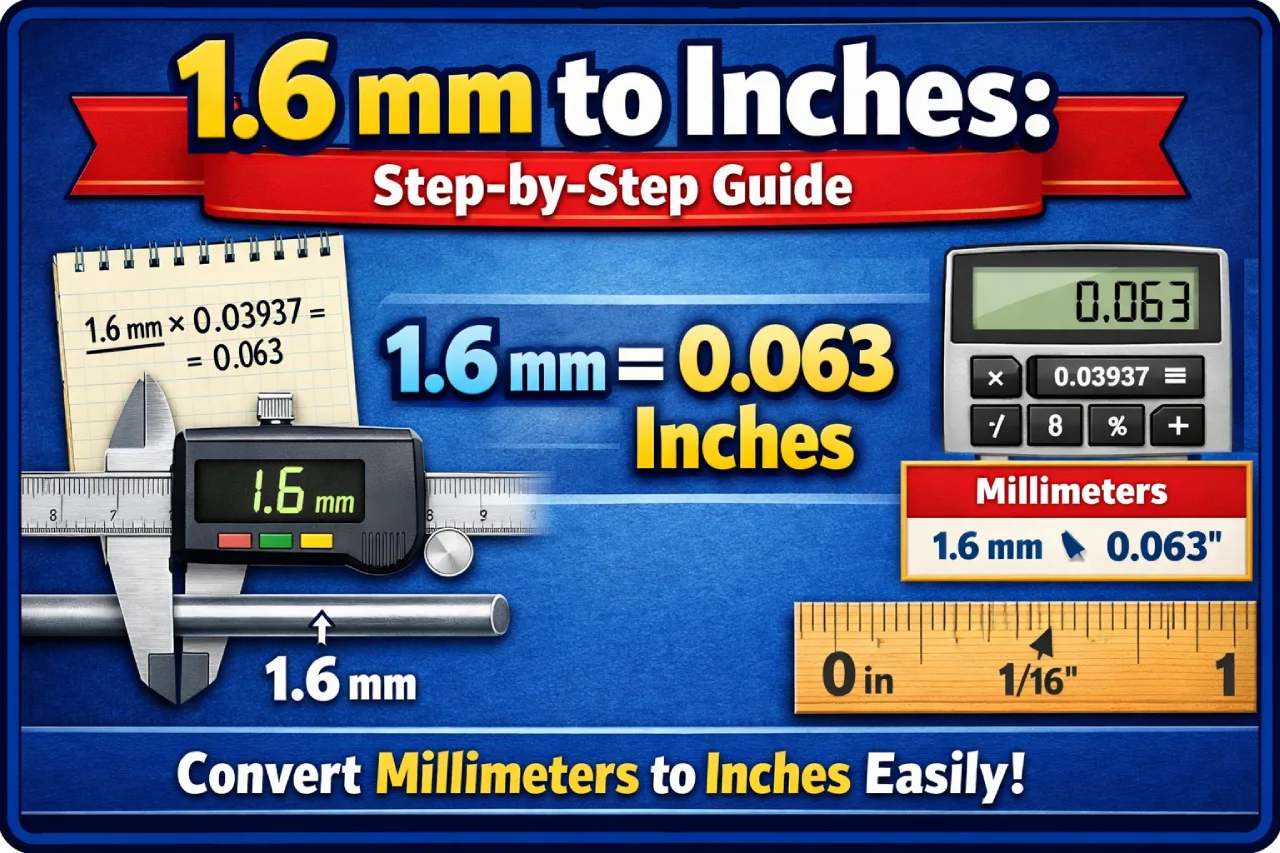
    1.6 millimeters (mm) = 0.063 inches (approximately).

    So when you convert 1.6 mm to inches, the result is about 0.063 in when rounded to three decimal places.

    This is a very small measurement, often used in engineering, manufacturing, electronics, jewelry, and precision tools. Since most countries use the metric system (millimeters) while the United States commonly uses inches, knowing how to convert between these units is incredibly useful.

    In this guide, we’ll walk through the exact formula, step-by-step calculation, practical examples, and tips so you can confidently convert millimeters to inches in any situation.

    If you want to explore larger conversions, you can also check this detailed guide on 730 mm to inches, which explains the process on a bigger scale.

    The Conversion Formula: mm to Inches

    MM to Inches Converter

    MM to Inches Converter

    Enter a value in millimeters to instantly convert it into inches.

    Result will appear here
    Formula: Inches = Millimeters ÷ 25.4

    The relationship between millimeters and inches is:

    1 inch = 25.4 millimeters

    Conversion Formula

    Inches = Millimeters ÷ 25.4

    This formula works for any millimeter value.

    Step-by-Step Conversion: 1.6 mm to Inches

    Let’s break it down clearly.

    Step 1: Start with the millimeter value

    1.6 mm

    Step 2: Divide by 25.4

    1.6 ÷ 25.4

    Step 3: Calculate

    = 0.06299 inches

    Final Result

    1.6 mm ≈ 0.063 inches

    Visualizing 1.6 mm

    Since this is a very small measurement, it helps to compare it with real-world objects.

    Thickness Comparison

    • A typical credit card is about 0.76 mm thick
    • So 1.6 mm is roughly twice that thickness

    Paper Stack

    A stack of about 15–16 sheets of paper can measure close to 1.6 mm.

    Mechanical Parts

    Many small screws, washers, or electronic components have thicknesses around this range.

    Understanding these comparisons helps you visualize the measurement better.

    Quick mm to Inches Conversion Table

    Here’s a handy reference chart.

    Millimeters (mm)Inches (in)
    1 mm0.039 in
    1.5 mm0.059 in
    1.6 mm0.063 in
    2 mm0.079 in
    5 mm0.197 in
    10 mm0.394 in

    This table makes it easier to estimate nearby values.

    Why Convert mm to Inches?

    There are many situations where this conversion becomes useful.

    1. Engineering and Manufacturing

    Designs often use metric units, but tools or specifications may use inches.

    2. Construction and DIY Projects

    Materials from different countries may use different measurement systems.

    3. Electronics and Gadgets

    Small components are often measured in millimeters, but product descriptions may use inches.

    4. Jewelry and Crafts

    Precise measurements are critical in design work.

    Understanding both units ensures accuracy.

    Millimeters vs Inches: Key Differences

    UnitSystemEquivalent
    Millimeter (mm)Metric system0.03937 inches
    Inch (in)U.S. customary25.4 mm

    Because inches are larger, converting from mm results in smaller decimal values.

    Converting Inches Back to Millimeters

    Sometimes you need the reverse conversion.

    Formula

    Millimeters = Inches × 25.4

    Example

    0.063 × 25.4 ≈ 1.6 mm

    This confirms the original conversion.

    Common Mistakes to Avoid

    1. Using the Wrong Conversion Factor

    Always use:

    1 inch = 25.4 mm

    2. Rounding Too Early

    Wait until the final step before rounding.

    3. Confusing mm with cm

    Remember:

    • 1 cm = 10 mm

    Tips for Quick Mental Conversion

    Here are some simple tricks.

    Trick 1: Divide by 25

    Instead of 25.4, use 25 for quick estimates.

    Example:

    1.6 ÷ 25 ≈ 0.064 inches

    This is very close to the exact value.

    Trick 2: Remember Benchmarks

    • 1 mm ≈ 0.04 inches
    • 10 mm ≈ 0.4 inches

    These help estimate quickly.

    Real-World Examples of 1.6 mm

    Jewelry Thickness

    Some rings or chains may have thicknesses around 1.5–2 mm.

    Electronics

    Thin components like connectors or small panels often fall in this range.

    Manufacturing

    Precision parts often require measurements in millimeters, especially under 5 mm.

    Understanding the inch equivalent helps when working with U.S.-based tools.

    Frequently Asked Questions (FAQs)

    How many inches is 1.6 mm?

    1.6 mm ≈ 0.063 inches

    How do you convert mm to inches?

    Divide millimeters by 25.4.

    Is 1.6 mm thick?

    It’s relatively thin—about twice the thickness of a credit card.

    What is the easiest way to estimate mm to inches?

    Divide by 25 for a quick estimate.

    How many mm are in 1 inch?

    1 inch = 25.4 mm

    Is mm smaller than inches?

    Yes.
    Millimeters are much smaller units.

    What is 2 mm in inches?

    2 ÷ 25.4 ≈ 0.079 inches

    Why do most countries use mm?

    Because the metric system is the global standard.

    Can calculators convert mm to inches?

    Yes. Most calculators and apps support unit conversions.

    What is 10 mm in inches?

    10 ÷ 25.4 ≈ 0.394 inches

    Final Thoughts

    Converting 1.6 mm to inches is simple once you understand the relationship between these units.

    Using the formula:

    Inches = mm ÷ 25.4

    we find:

    1.6 mm ≈ 0.063 inches

    This conversion is especially useful in precision work, where small measurements matter.

    Once you remember the key rule—1 inch equals 25.4 mm—you can quickly convert between systems with confidence.

    Now here’s a quick thought for you:
    The next time you see a measurement in millimeters, will you instantly picture it in inches?