If you want the quick answer first:
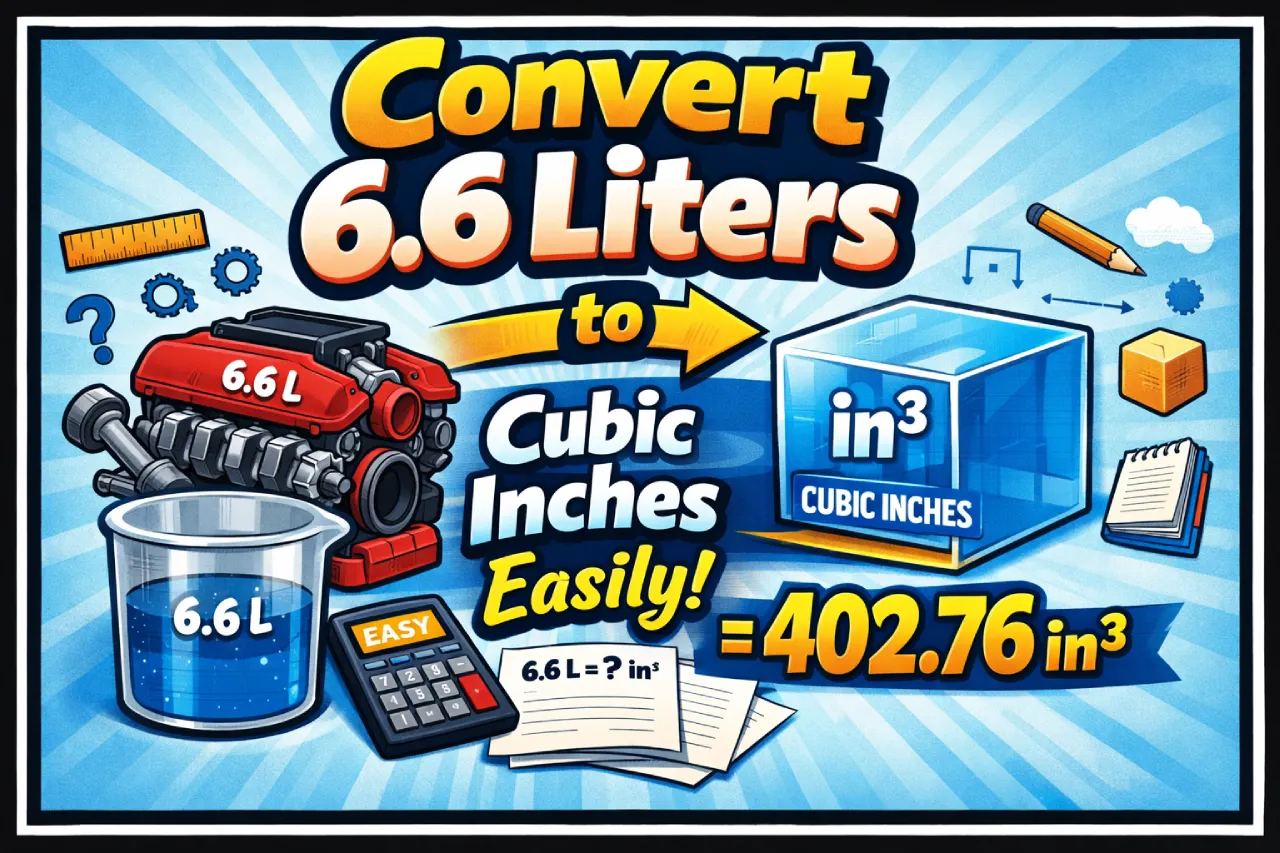
6.6 liters = 402.76 cubic inches (approximately).
This means that when you convert 6.6 liters to cubic inches, the result is about 402.76 in³. This conversion is commonly used when comparing engine displacement, container volume, and mechanical specifications, especially when measurements move between the metric system (liters) and the U.S. customary system (cubic inches).
For example, many vehicles list engine sizes in liters worldwide, while older American automotive specifications often describe engine displacement in cubic inches. Converting between these units helps bridge the gap between these two systems.
In this guide, we’ll explain how to convert 6.6 liters into cubic inches, show the formula behind the calculation, explore real-world examples such as engine sizes, and provide practical tips for performing similar conversions quickly.
Understanding Liters and Cubic Inches
Before performing the conversion, it’s helpful to understand what each unit represents.
What Is a Liter?
A liter (L) is a metric unit of volume commonly used around the world.
One liter equals:
1 liter = 1,000 cubic centimeters
or
1 liter = 0.001 cubic meters
Liters are used for measuring volumes such as:
- Engine displacement
- Liquid containers
- Fuel capacity
- Beverage bottles
- Scientific measurements
For example:
- A typical soda bottle contains 2 liters
- A car engine might be 2.0 L or 3.5 L
- A water bottle might hold 0.5 liters
Liters are widely used because the metric system provides a consistent way to measure volume.
What Is a Cubic Inch?
A cubic inch (in³) is a unit of volume in the U.S. customary measurement system.
It represents the volume of a cube that measures one inch on each side.
Cubic inches are commonly used in:
- Engine displacement (especially older American vehicles)
- Mechanical engineering
- Manufacturing specifications
- Small container volumes
For example:
- Classic muscle car engines might measure 350 cubic inches
- Some V8 engines exceed 400 cubic inches
Because cubic inches are smaller than liters, conversions often produce larger numbers.
The Formula for Converting Liters to Cubic Inches
Liters to Cubic Inches
Enter liters below to instantly convert into cubic inches.
The key relationship between liters and cubic inches is:
1 liter = 61.0237 cubic inches
Using this value, we can create the conversion formula:
Cubic Inches = Liters × 61.0237
Applying the Formula
To convert 6.6 liters to cubic inches:
6.6 × 61.0237 = 402.7564 cubic inches
Rounded to two decimal places:
6.6 L ≈ 402.76 cubic inches
Step-by-Step Conversion
Let’s walk through the calculation clearly.
Step 1: Start with the liter value
6.6 liters
Step 2: Multiply by the conversion factor
6.6 × 61.0237
Step 3: Perform the calculation
= 402.7564 cubic inches
Final Result
6.6 liters equals approximately 402.76 cubic inches.
Visualizing 6.6 Liters
Numbers become easier to understand when compared with familiar examples.
Engine Displacement
Many modern truck engines measure around 6.0–7.0 liters.
A 6.6-liter engine is commonly found in large V8 truck engines, which explains why this conversion often appears in automotive discussions.
For example, a 6.6L engine is roughly equivalent to 403 cubic inches, which is a very large engine by modern standards.
Liquid Volume
6.6 liters of liquid equals:
- About 1.74 gallons
- Slightly more than three large soda bottles
These comparisons help make the volume easier to visualize.
Quick Liters-to-Cubic-Inches Conversion Table
Here’s a reference chart for nearby values.
| Liters | Cubic Inches |
|---|---|
| 4.0 L | 244.09 in³ |
| 5.0 L | 305.12 in³ |
| 6.0 L | 366.14 in³ |
| 6.6 L | 402.76 in³ |
| 7.0 L | 427.17 in³ |
| 8.0 L | 488.19 in³ |
Tables like this make it easy to estimate conversions without repeating calculations.
Why Convert Liters to Cubic Inches?
There are several situations where this conversion becomes useful.
Automotive Engines
Modern vehicles often list engine size in liters, while older American engines are described in cubic inches.
For example:
- A 6.6L engine ≈ 403 cubic inches
This helps enthusiasts compare engines across different generations.
Mechanical Engineering
Some engineering specifications use cubic inches while others use metric units.
Conversions help maintain consistency between systems.
Manufacturing and Product Design
Products manufactured internationally often list volumes in liters but may be interpreted using cubic inches in the United States.
Education and Science
Students studying measurement systems frequently convert between metric and customary units.
Liters vs Cubic Inches: Key Differences
Although both units measure volume, they belong to different systems.
| Unit | Measurement System | Equivalent |
|---|---|---|
| Liter | Metric system | 1,000 cm³ |
| Cubic inch | U.S. customary system | 16.387 cm³ |
Understanding these relationships helps when comparing volumes internationally.
Converting Cubic Inches Back to Liters
Sometimes the reverse conversion is needed.
The formula becomes:
Liters = Cubic Inches ÷ 61.0237
Example
402.76 ÷ 61.0237 ≈ 6.6 liters
This confirms the earlier calculation.
Common Mistakes in Volume Conversion
Even simple conversions can lead to errors if the wrong factors are used.
Using the Wrong Conversion Factor
Always remember:
1 liter = 61.0237 cubic inches
Rounding Too Early
Rounding during intermediate steps can slightly change the final result.
Confusing Cubic Units
Volume units are cubic measurements, not linear measurements.
That means they represent three-dimensional space.
Tips for Quick Mental Conversion
Here are a few helpful tricks.
First, remember the approximate rule:
1 liter ≈ 61 cubic inches
Second, multiply the liter value by 60 for a quick estimate.
Example:
6.6 × 60 ≈ 396 cubic inches
This estimate is close to the exact value of 402.76 cubic inches.
Third, remember a useful benchmark:
5 liters ≈ 305 cubic inches
This helps estimate larger engine sizes quickly.
Real-World Examples of 6.6 Liters
Truck Engines
Many heavy-duty pickup trucks use engines around 6.6 liters, which translates to roughly 403 cubic inches.
Industrial Equipment
Some industrial pumps or compressors list displacement values in liters but may be compared using cubic inches.
Liquid Containers
Large containers or tanks might hold volumes around 6–7 liters, depending on the application.
Understanding the cubic inch equivalent helps compare specifications more easily.
Frequently Asked Questions (FAQs)
How many cubic inches is 6.6 liters?
6.6 liters equals approximately 402.76 cubic inches.
How do you convert liters to cubic inches?
Multiply the liter value by 61.0237.
Why are engine sizes measured in liters?
Most modern automotive manufacturers use the metric system.
What is 6.6 liters in gallons?
6.6 liters ≈ 1.74 gallons.
Is 6.6 liters a large engine?
Yes. A 6.6L engine is considered large and is typically found in trucks or high-performance vehicles.
How many cubic centimeters are in 6.6 liters?
6.6 liters = 6,600 cubic centimeters (cc).
What is the easiest way to estimate liters to cubic inches?
Multiply liters by about 61.
How many liters are in 400 cubic inches?
400 in³ ≈ 6.56 liters.
Why do older American engines use cubic inches?
Historically, the U.S. automotive industry used the imperial measurement system.
Can calculators convert liters to cubic inches automatically?
Yes. Many scientific calculators and conversion tools support unit conversions.
Final Thoughts
Converting 6.6 liters to cubic inches is straightforward once you know the conversion factor.
Using the formula liters × 61.0237, we find that:
6.6 liters equals approximately 402.76 cubic inches.
This conversion is particularly useful when comparing engine sizes, container volumes, or mechanical specifications across measurement systems.
Once you remember the key rule—1 liter equals about 61 cubic inches—you’ll be able to estimate similar conversions quickly.
And the next time someone mentions a 6.6L engine, you’ll immediately know that it’s roughly a 403 cubic inch powerhouse.