Blog

  • Convert MPA to Pounds per Square Inch (Easy Guide)

    Convert MPA to Pounds per Square Inch (Easy Guide)

    If you’re looking for a quick answer, here it is:

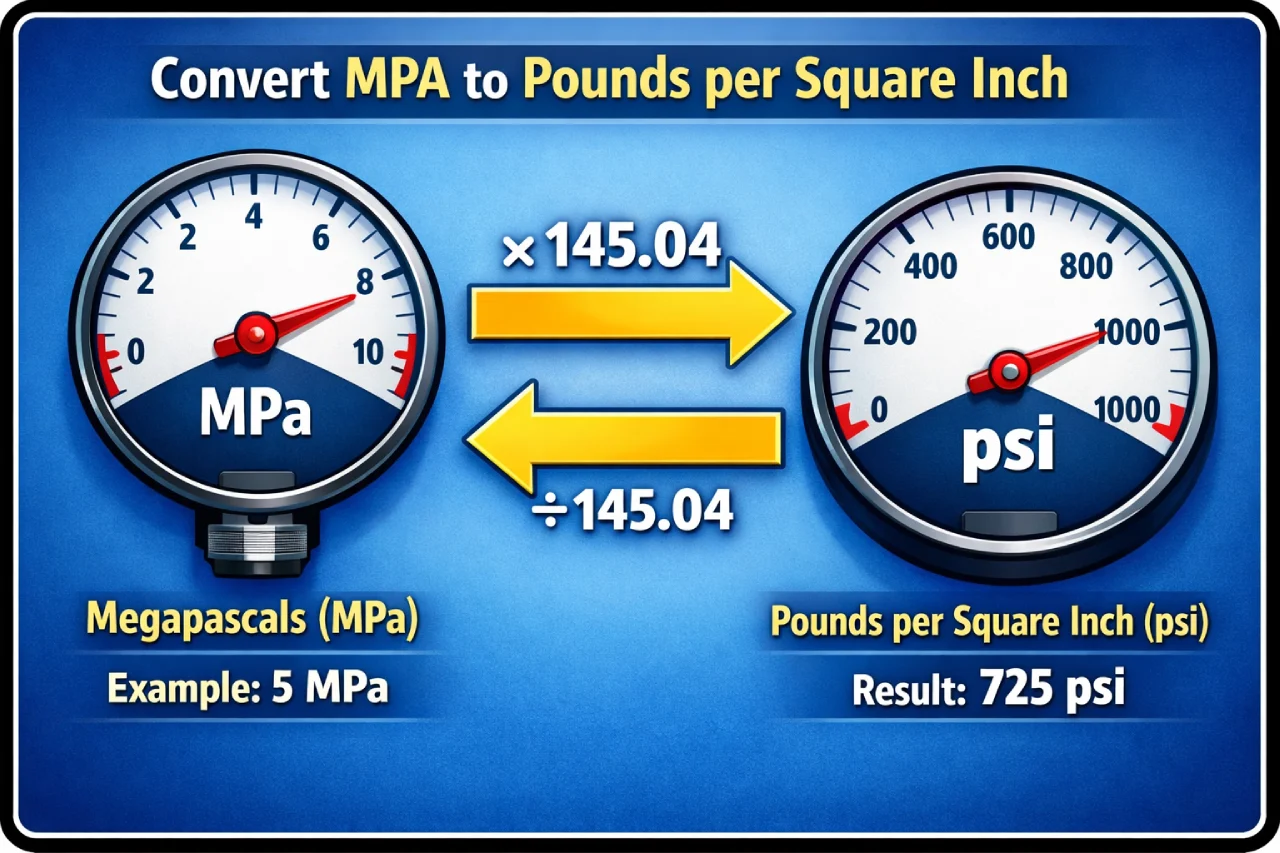
    1 MPa (megapascal) = 145.038 PSI (pounds per square inch)

    So, to convert MPa to PSI, simply:

    PSI = MPa × 145.038

    That’s the key formula. But if you want to fully understand what these units mean, where they’re used, and how to apply this conversion in real-world situations like engineering, construction, and pressure systems, this guide will walk you through everything step by step.

    What Is MPa (Megapascal)?

    A megapascal (MPa) is a metric unit of pressure or stress.

    • 1 MPa = 1,000,000 pascals (Pa)
    • It belongs to the International System of Units (SI)

    MPa is commonly used in:

    • Structural engineering
    • Concrete strength ratings
    • Mechanical systems
    • Material science

    For example:

    • Concrete strength: 20–40 MPa
    • Steel strength: 250–500 MPa

    It’s widely used globally, especially outside the United States.

    What Is PSI (Pounds per Square Inch)?

    PSI (pounds per square inch) is an imperial unit of pressure.

    • It measures force applied over an area
    • Commonly used in the United States

    You’ll see PSI in:

    • Tire pressure (e.g., 32 PSI)
    • Hydraulic systems
    • Air compressors
    • Plumbing systems

    It’s one of the most familiar pressure units in everyday American life.

    Why Convert MPa to PSI?

    This conversion is essential when working across different systems.

    Engineering and Construction

    International designs often use MPa, while U.S. standards use PSI.

    Equipment Specifications

    Manufacturers may list pressure ratings in different units.

    Material Testing

    Understanding both units ensures accurate comparisons and safety.

    In practice, if you’re dealing with global specifications, this conversion becomes incredibly useful.

    The Conversion Formula Explained

    MPa to PSI Converter

    MPa to PSI Converter

    Enter a value in megapascals (MPa) to instantly convert it into pounds per square inch (PSI).

    Result will appear here
    Formula: 1 MPa = 145.0377 PSI

    Here’s the formula again:

    PSI = MPa × 145.038

    This conversion factor comes from the relationship between pascals and pounds per square inch.

    If you need to reverse the conversion:

    MPa = PSI ÷ 145.038

    Step-by-Step Examples

    Let’s make this practical.

    Example 1: Convert 1 MPa to PSI

    1 × 145.038 = 145.038 PSI

    Example 2: Convert 5 MPa to PSI

    5 × 145.038 = 725.19 PSI

    Example 3: Convert 10 MPa to PSI

    10 × 145.038 = 1,450.38 PSI

    Example 4: Convert 30 MPa to PSI

    30 × 145.038 = 4,351.14 PSI

    These are common values used in engineering and construction.

    Quick Conversion Table

    Here’s a handy reference:

    MPaPSI
    1 MPa145 PSI
    2 MPa290 PSI
    5 MPa725 PSI
    10 MPa1,450 PSI
    20 MPa2,901 PSI
    30 MPa4,351 PSI
    40 MPa5,802 PSI

    This table is great for quick estimates without a calculator.

    Real-Life Example: Concrete Strength

    Let’s say you’re working with concrete rated at:

    25 MPa

    Convert:

    25 × 145.038 = 3,625.95 PSI

    Now you can understand the strength in U.S. terms, which is often how contractors and suppliers communicate.

    MPa vs PSI: What’s the Difference?

    Here’s a simple way to think about it:

    • MPa = metric unit (SI system)
    • PSI = imperial unit (U.S. system)

    Both measure pressure or stress, just in different systems.

    Mental Math Trick

    Here’s a quick shortcut:

    • Multiply MPa by 145 instead of 145.038

    Example:

    10 MPa × 145 ≈ 1,450 PSI

    It’s very close and works well for quick estimates.

    Converting PSI Back to MPa

    To reverse the calculation:

    MPa = PSI ÷ 145.038

    Example:

    3,000 PSI ÷ 145.038 ≈ 20.68 MPa

    This is useful when working with U.S.-based equipment or specifications.

    Practical Use Case: Tire Pressure vs Engineering Pressure

    You’ve probably seen PSI in tire pressure, but MPa is used for larger-scale systems.

    For example:

    • Car tire: ~30–35 PSI
    • Industrial system: several MPa

    Understanding the conversion helps you relate small-scale and large-scale pressures.

    Common Mistakes to Avoid

    Using the Wrong Conversion Factor

    Always use:

    1 MPa = 145.038 PSI

    Confusing PSI with KSI

    • PSI = pounds per square inch
    • KSI = 1,000 PSI

    Rounding Too Early

    Keep precision until the final step.

    Mixing Units

    Always convert before combining values in calculations.

    MPa, PSI, and KSI Relationship

    It helps to see how these units connect:

    • 1 MPa = 145.038 PSI
    • 1 KSI = 1,000 PSI

    So:

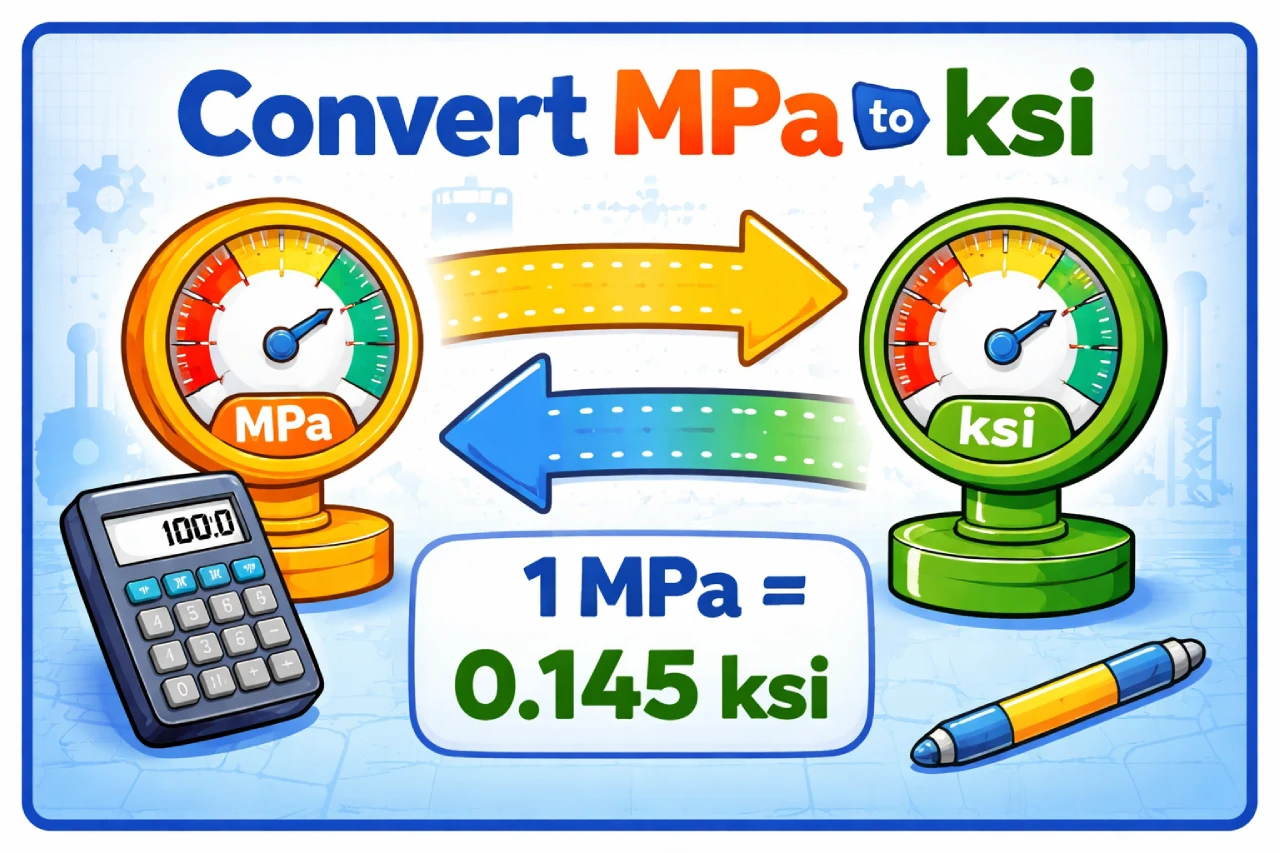
    • 1 MPa = 0.145 KSI

    This gives you a complete picture of pressure units.

    Why Precision Matters

    In many fields, accuracy is critical.

    Engineering Design

    Incorrect pressure values can lead to system failure.

    Construction

    Material strength must meet exact specifications.

    Industrial Systems

    Pressure errors can damage equipment or create safety risks.

    In these cases, always use the exact conversion factor.

    Real-World Comparison

    Let’s compare a few values:

    • 20 MPa concrete ≈ 2,901 PSI
    • 30 MPa concrete ≈ 4,351 PSI
    • 40 MPa concrete ≈ 5,802 PSI

    These comparisons help you quickly interpret material strength.

    When You’ll Use This Conversion

    You’ll encounter MPa to PSI conversion in:

    • Structural engineering
    • Civil construction
    • Mechanical systems
    • Pressure testing

    It’s especially useful when working with international standards.

    Frequently Asked Questions (FAQs)

    How many PSI is 1 MPa?

    1 MPa = 145.038 PSI

    What is the formula to convert MPa to PSI?

    PSI = MPa × 145.038

    How many PSI is 10 MPa?

    10 × 145.038 = 1,450.38 PSI

    How many MPa is 1,000 PSI?

    1,000 ÷ 145.038 ≈ 6.89 MPa

    What is the difference between MPa and PSI?

    MPa is metric, while PSI is an imperial unit.

    Is MPa the same as PSI?

    No, but they measure the same concept (pressure) in different systems.

    Can I round 145.038 to 145?

    Yes, for quick estimates.

    Where is MPa commonly used?

    In engineering and construction worldwide.

    Where is PSI commonly used?

    In the United States for pressure systems.

    Why is PSI more common in the U.S.?

    Because it’s part of the imperial measurement system.

    Final Thoughts

    So, how do you convert MPa to pounds per square inch?

    The key takeaway is simple:

    Multiply MPa by 145.038

    Once you understand this relationship, you can easily move between metric and U.S. units—especially in engineering, construction, and everyday applications like pressure systems.

    After a few calculations, you’ll start estimating it effortlessly—and that’s when you know you’ve truly mastered it.

  • Convert MPA to KSI (Easy Formula + Quick Table)

    Convert MPA to KSI (Easy Formula + Quick Table)

    If you’re looking for a quick answer, here it is:

    1 MPa (megapascal) = 0.145038 KSI

    So, to convert MPa to KSI, simply:

    KSI = MPa × 0.145038

    That’s the core formula. But if you want to understand what these units mean, where they’re used, and how to apply this conversion in real-world scenarios like engineering, construction, and material strength analysis, this guide will walk you through everything clearly.

    What Is MPa (Megapascal)?

    A megapascal (MPa) is a metric unit of pressure or stress.

    • 1 MPa = 1,000,000 pascals (Pa)
    • It’s part of the International System of Units (SI)

    MPa is widely used in:

    • Structural engineering
    • Material science
    • Concrete strength ratings
    • Mechanical systems

    For example:

    • Concrete strength: 20–40 MPa
    • Steel yield strength: 250–500 MPa

    It’s a standard unit in most countries outside the U.S.

    What Is KSI?

    KSI (kips per square inch) is a unit of stress commonly used in the United States.

    • 1 kip = 1,000 pounds-force (lbf)
    • 1 KSI = 1,000 psi (pounds per square inch)

    KSI is often used in:

    • Structural steel design
    • Engineering calculations in the U.S.
    • Material strength specifications

    For example:

    • Structural steel yield strength: ~36 KSI
    • High-strength steel: 50–100 KSI

    Why Convert MPa to KSI?

    This conversion is essential when working across different systems.

    Engineering Projects

    International designs may use MPa, while U.S. standards use KSI.

    Material Specifications

    Manufacturers may list strength values in either unit.

    Construction and Structural Analysis

    Understanding both units ensures accurate calculations and comparisons.

    In my experience, this conversion becomes second nature if you work with both metric and imperial systems.

    The Conversion Formula Explained

    MPa to KSI Converter

    MPa to KSI Converter

    Enter pressure in megapascals (MPa) to convert it into ksi.

    Result will appear here
    Conversion Formula:
    1 MPa = 0.145038 KSI

    Here’s the formula again:

    KSI = MPa × 0.145038

    This conversion factor comes from the relationship between pascals and pounds per square inch.

    If you need to reverse the conversion:

    MPa = KSI ÷ 0.145038

    Step-by-Step Examples

    Let’s make this practical.

    Example 1: Convert 10 MPa to KSI

    10 × 0.145038 = 1.45038 KSI

    Example 2: Convert 25 MPa to KSI

    25 × 0.145038 = 3.62595 KSI

    Example 3: Convert 40 MPa to KSI

    40 × 0.145038 = 5.80152 KSI

    These are common values used in construction and engineering.

    Quick Conversion Table

    Here’s a handy reference chart:

    MPaKSI
    1 MPa0.145 KSI
    5 MPa0.725 KSI
    10 MPa1.45 KSI
    20 MPa2.90 KSI
    30 MPa4.35 KSI
    40 MPa5.80 KSI
    50 MPa7.25 KSI

    This table is useful for quick estimates.

    Real-Life Example: Concrete Strength

    Let’s say you’re working with concrete rated at:

    30 MPa

    Convert:

    30 × 0.145038 = 4.35 KSI

    Now you can interpret that strength in U.S. engineering terms.

    MPa vs KSI: What’s the Difference?

    Here’s a simple way to understand it:

    • MPa = metric unit (SI system)
    • KSI = imperial unit (U.S. system)

    Both measure stress or pressure, but they belong to different measurement systems.

    Mental Math Trick

    Here’s a quick trick for estimating:

    • Multiply MPa by 0.145

    Example:

    20 MPa × 0.145 ≈ 2.9 KSI

    It’s very close to the exact value.

    Converting KSI Back to MPa

    To reverse the calculation:

    MPa = KSI ÷ 0.145038

    Example:

    5 KSI ÷ 0.145038 ≈ 34.47 MPa

    This is useful when working with U.S.-based specifications.

    Common Mistakes to Avoid

    Using the Wrong Conversion Factor

    Always use:

    1 MPa = 0.145038 KSI

    Confusing PSI and KSI

    • PSI = pounds per square inch
    • KSI = 1,000 PSI

    Rounding Too Early

    Keep precision until the final step.

    Mixing Units

    Avoid combining MPa and PSI/KSI without converting properly.

    Practical Use Case: Steel Strength

    Let’s say a steel grade has a yield strength of:

    250 MPa

    Convert:

    250 × 0.145038 = 36.26 KSI

    This aligns with common structural steel values in the U.S.

    Why Precision Matters

    In engineering, small errors can have big consequences.

    Structural Design

    Incorrect conversions can affect safety and stability.

    Material Selection

    Choosing the wrong strength rating can lead to failure.

    Compliance and Standards

    Different regions use different units, so accurate conversion is essential.

    MPa, PSI, and KSI Relationship

    It’s helpful to understand how these units connect:

    • 1 MPa = 145.038 PSI
    • 1 KSI = 1,000 PSI

    So:

    • 1 MPa = 0.145038 KSI

    This relationship ties everything together.

    Real-World Comparison

    Let’s compare a few values:

    • 20 MPa concrete ≈ 2.9 KSI
    • 40 MPa concrete ≈ 5.8 KSI
    • 250 MPa steel ≈ 36.26 KSI

    These conversions help you quickly interpret material strength.

    When You’ll Use This Conversion

    You’ll encounter MPa to KSI conversion in:

    • Structural engineering
    • Civil construction
    • Mechanical design
    • Material testing

    It’s especially useful when working with international specifications.

    Frequently Asked Questions (FAQs)

    How many KSI is 1 MPa?

    1 MPa = 0.145038 KSI

    What is the formula to convert MPa to KSI?

    KSI = MPa × 0.145038

    How many KSI is 30 MPa?

    30 × 0.145038 = 4.35 KSI

    How many MPa is 1 KSI?

    1 ÷ 0.145038 ≈ 6.895 MPa

    What is the difference between MPa and KSI?

    MPa is metric, while KSI is an imperial unit.

    Is MPa the same as PSI?

    No, but:
    1 MPa = 145.038 PSI

    Why is KSI used instead of PSI?

    KSI simplifies large values by grouping them into thousands of PSI.

    Can I round 0.145038 to 0.145?

    Yes, for quick estimates.

    Where is MPa commonly used?

    In most countries for engineering and material strength.

    Where is KSI commonly used?

    Primarily in the United States.

    Final Thoughts

    So, how do you convert MPa to KSI?

    The key takeaway is simple:

    Multiply MPa by 0.145038

    Once you understand this relationship, you can easily switch between metric and U.S. units—especially in engineering and construction contexts.

    Whether you’re working with concrete, steel, or structural designs, this conversion helps you make accurate, confident decisions.

    And after a few calculations, you’ll find yourself estimating it effortlessly.

  • Convert Kilowatts to Btu/hr (kW to Btu/hr Formula & Chart)

    Convert Kilowatts to Btu/hr (kW to Btu/hr Formula & Chart)

    If you’re looking for a quick answer, here it is:

    1 kilowatt (kW) = 3,412.14 Btu/hr

    So, to convert kilowatts to Btu per hour, simply:

    Btu/hr = kW × 3,412.14

    That’s the key formula. But if you want to understand what these units mean, when to use them, and how to apply this conversion in real-world situations like HVAC systems and energy calculations, this guide will walk you through everything clearly.

    What Is a Kilowatt (kW)?

    A kilowatt (kW) is a unit of power in the metric system. It measures how much energy is used or produced per second.

    • 1 kilowatt = 1,000 watts
    • Commonly used for electrical systems, appliances, and power consumption

    For example:

    • A space heater might use 1.5 kW
    • A home air conditioner might use 3–5 kW

    Kilowatts are standard in engineering, electricity billing, and energy systems.

    What Is Btu/hr?

    Btu/hr (British Thermal Units per hour) measures heat energy transfer.

    • 1 Btu = the amount of heat needed to raise the temperature of 1 pound of water by 1°F
    • Btu/hr tells you how much heat is being added or removed per hour

    This unit is widely used in the U.S. for:

    • Heating systems
    • Air conditioning (HVAC)
    • Furnaces and boilers

    For example:

    • A small window AC unit might be 5,000 Btu/hr
    • A central HVAC system might be 36,000 Btu/hr

    Why Convert kW to Btu/hr?

    This conversion is especially important when you’re dealing with electrical power vs heating or cooling capacity.

    Here are common scenarios:

    HVAC Systems

    Air conditioners and heaters are rated in Btu/hr, but their power consumption is often listed in kW.

    Understanding the conversion helps you compare performance and efficiency.

    Energy Calculations

    If you’re calculating energy usage across systems that use different units, you’ll need to convert between kW and Btu/hr.

    Equipment Comparison

    Some manufacturers use metric units (kW), while others use imperial units (Btu/hr). Conversion helps you compare apples to apples.

    The Conversion Formula Explained

    Kilowatts to Btu/hr Converter

    Kilowatts to Btu/hr

    Enter kilowatts and instantly convert to Btu per hour.

    Result will appear here
    Formula: 1 kW = 3412.142 Btu/hr

    Here’s the formula again:

    Btu/hr = kW × 3,412.14

    This number comes from the relationship between electrical energy and heat energy.

    If you need to reverse the conversion:

    kW = Btu/hr ÷ 3,412.14

    Step-by-Step Examples

    Let’s make this practical.

    Example 1: Convert 1 kW to Btu/hr

    1 × 3,412.14 = 3,412.14 Btu/hr

    Example 2: Convert 3 kW to Btu/hr

    3 × 3,412.14 = 10,236.42 Btu/hr

    Example 3: Convert 5 kW to Btu/hr

    5 × 3,412.14 = 17,060.7 Btu/hr

    These are common values you might see when comparing HVAC systems.

    Quick Conversion Table

    Here’s a handy reference chart:

    Kilowatts (kW)Btu/hr
    1 kW3,412 Btu/hr
    2 kW6,824 Btu/hr
    3 kW10,236 Btu/hr
    5 kW17,061 Btu/hr
    10 kW34,121 Btu/hr

    This table is useful when you need quick estimates.

    Real-Life Example: Air Conditioner Sizing

    Let’s say you’re choosing an air conditioner.

    You see two specs:

    • Unit A: 3.5 kW
    • Unit B: 12,000 Btu/hr

    Convert Unit A:

    3.5 × 3,412.14 = 11,942.49 Btu/hr

    Now you can see that both units are almost the same in cooling capacity.

    This makes it much easier to compare options.

    kW vs Btu/hr: What’s the Difference?

    Here’s a simple way to understand it:

    • kW = electrical power input
    • Btu/hr = heat output or removal

    They measure different aspects of energy, but they’re directly related.

    Energy Efficiency and COP

    When working with HVAC systems, you’ll often encounter efficiency ratings like COP (Coefficient of Performance).

    COP tells you how efficiently a system converts electrical energy (kW) into heating or cooling (Btu/hr).

    For example:

    • A system using 1 kW might produce more than 3,412 Btu/hr due to efficiency gains

    This is why real-world systems don’t always match the basic conversion exactly.

    Quick Mental Math Trick

    Here’s a simple way to estimate:

    • Multiply kW by 3,400 instead of 3,412

    Example:

    4 kW × 3,400 ≈ 13,600 Btu/hr

    It’s not exact, but it’s close enough for quick calculations.

    Converting Btu/hr Back to kW

    If you have Btu/hr and want kW:

    kW = Btu/hr ÷ 3,412.14

    Example:

    12,000 Btu/hr ÷ 3,412.14 ≈ 3.52 kW

    This is commonly used when evaluating air conditioners.

    Common Mistakes to Avoid

    Using the Wrong Conversion Factor

    Always use:

    1 kW = 3,412.14 Btu/hr

    Not 3,000 or 3,500 unless estimating.

    Confusing Energy and Power

    • kW and Btu/hr both measure power, not total energy
    • Don’t confuse them with kWh or total Btu

    Ignoring Efficiency

    Real systems may perform differently due to efficiency ratings.

    Rounding Too Early

    Round your final answer, not intermediate steps.

    Practical Use Case: Heating System

    Let’s say you’re installing a heater rated at:

    10 kW

    Convert:

    10 × 3,412.14 = 34,121.4 Btu/hr

    Now you know its heating capacity in a unit commonly used in the U.S.

    Why This Conversion Matters

    Understanding this conversion helps you:

    • Choose the right HVAC system
    • Compare products from different regions
    • Estimate energy usage
    • Avoid costly sizing mistakes

    In my experience, this is one of the most useful conversions when dealing with home systems.

    When Precision Matters

    In some cases, accuracy is critical:

    HVAC Design

    Incorrect sizing can lead to inefficient heating or cooling.

    Engineering Applications

    Precise calculations are essential for system performance.

    Energy Audits

    Accurate conversions help evaluate efficiency and cost.

    In these situations, always use the exact factor.

    Frequently Asked Questions (FAQs)

    How many Btu/hr is 1 kW?

    1 kW = 3,412.14 Btu/hr

    What is the formula to convert kW to Btu/hr?

    Btu/hr = kW × 3,412.14

    How many Btu/hr is 3.5 kW?

    3.5 × 3,412.14 = 11,942.49 Btu/hr

    How many kW is 12,000 Btu/hr?

    12,000 ÷ 3,412.14 ≈ 3.52 kW

    Why is this conversion important?

    It helps compare electrical power with heating or cooling capacity.

    Is kW the same as Btu/hr?

    No, but they measure the same concept (power) in different units.

    Can I round 3,412 to 3,400?

    Yes, for quick estimates.

    What’s the easiest way to estimate quickly?

    Multiply kW by 3,400.

    Does efficiency affect this conversion?

    Yes. Real systems may produce more or less output depending on efficiency.

    Where is Btu/hr commonly used?

    In the U.S., especially for HVAC systems.

    Final Thoughts

    So, how do you convert kilowatts to Btu/hr?

    The key takeaway is simple:

    Multiply kW by 3,412.14

    Once you understand this relationship, you can easily move between metric and imperial systems—especially when dealing with heating and cooling systems.

    Whether you’re choosing an air conditioner, evaluating a heater, or comparing energy systems, this conversion gives you the clarity you need to make smarter decisions.

    And after a few uses, you’ll start estimating it in your head without even thinking.

  • Convert Grains to Grams (Easy Formula + Examples)

    Convert Grains to Grams (Easy Formula + Examples)

    If you’re looking for a quick answer, here it is:

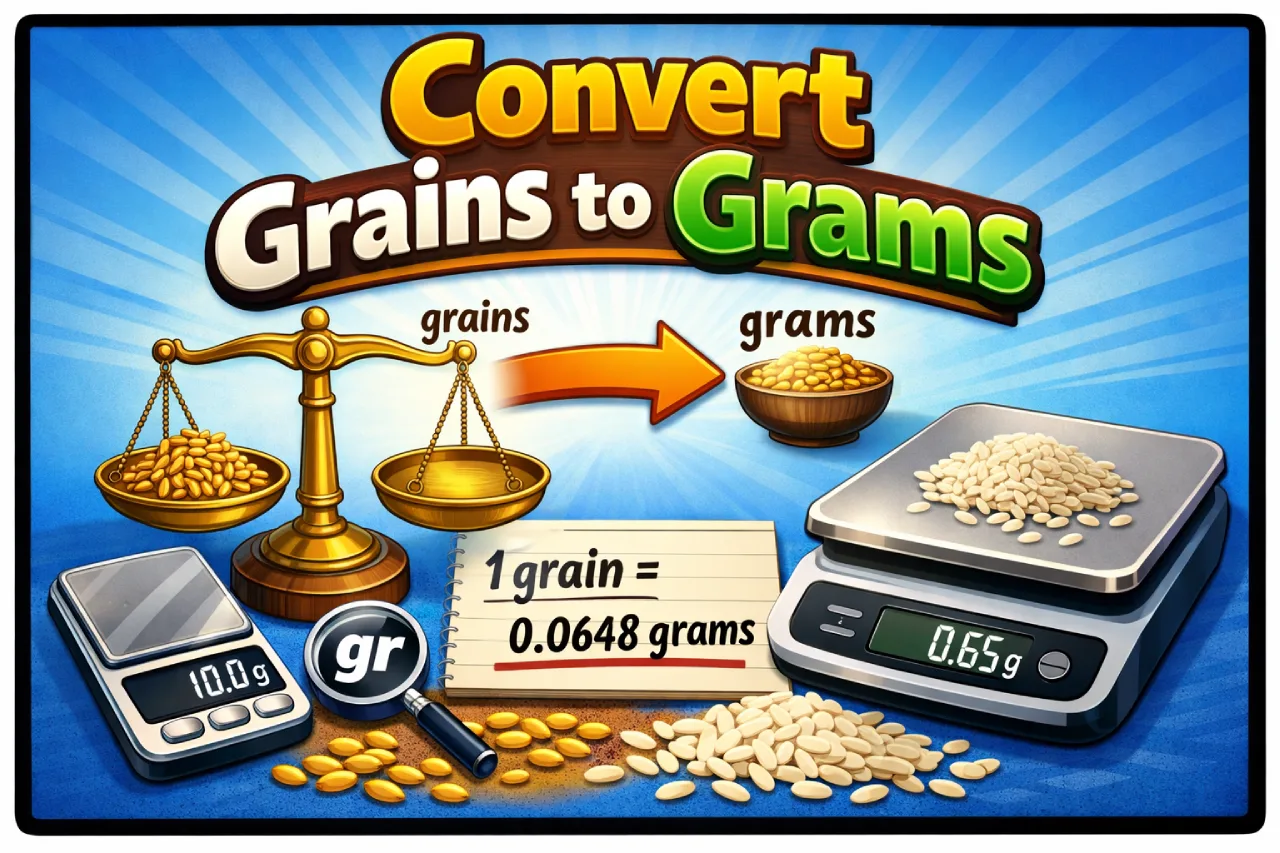
    1 grain (gr) = 0.0648 grams (g)

    So, to convert grains to grams, simply:

    Grams = Grains × 0.0648

    That’s the key formula. But if you want to understand where this unit comes from, how to use it correctly, and why it still matters today, this guide will walk you through everything in a clear, practical way.

    What Is a Grain?

    A grain is one of the oldest units of mass still in use today.

    Historically, it was based on the weight of a single grain of barley. Over time, it became standardized and is now defined precisely as:

    1 grain = 64.79891 milligrams = 0.06479891 grams

    What Is a Gram?

    A gram (g) is a metric unit of mass used worldwide.

    It’s part of the International System of Units (SI) and is commonly used for:

    • Food and nutrition
    • Scientific measurements
    • Everyday weighing

    Compared to grains, grams are much more standardized and easier to work with in modern contexts.

    The Grain to Gram Conversion Formula

    Grain to Gram Converter

    Grain to Gram Converter

    Enter a value in grains to instantly convert it into grams.

    Your result will appear here.
    1 grain = 0.06479891 grams

    Here’s the exact formula:

    Grams = Grains × 0.0648

    If you need more precision:

    Grams = Grains × 0.06479891

    For most everyday purposes, 0.0648 is accurate enough.

    Step-by-Step Conversion Examples

    Let’s make this practical.

    Example 1: Convert 10 grains to grams

    10 × 0.0648 = 0.648 grams

    Example 2: Convert 50 grains to grams

    50 × 0.0648 = 3.24 grams

    Example 3: Convert 100 grains to grams

    100 × 0.0648 = 6.48 grams

    Once you try a few, the pattern becomes easy to remember.

    Quick Conversion Table

    Here’s a handy reference chart:

    Grains (gr)Grams (g)
    1 gr0.0648 g
    5 gr0.324 g
    10 gr0.648 g
    20 gr1.296 g
    50 gr3.24 g
    100 gr6.48 g

    This table is useful for quick estimates without a calculator.

    Why the Grain Unit Still Matters

    You might be wondering—why use grains at all?

    Ammunition Measurements

    In the U.S., bullet weights are almost always measured in grains.

    For example:

    • A 55-grain bullet = about 3.56 grams
    • A 124-grain bullet = about 8.04 grams

    Understanding this conversion helps you compare ammunition specifications more easily.

    Pharmaceuticals (Historical and Occasional Use)

    Some older prescriptions and dosage systems still reference grains.

    For example:

    • 1 grain of aspirin ≈ 64.8 mg

    Although modern medicine mostly uses milligrams, grains still appear occasionally.

    Nutritional Supplements

    Certain supplements—especially imported or older formulations—may list dosages in grains.

    Grain vs Gram: Key Differences

    Here’s a simple comparison:

    UnitSystemValue
    GrainImperial/Traditional0.0648 g
    GramMetric (SI)Standard unit

    Grains are niche and historical, while grams are universal and widely used.

    Converting Grams Back to Grains

    Sometimes you’ll need to reverse the conversion.

    Here’s the formula:

    Grains = Grams ÷ 0.0648

    Or:

    Grains = Grams × 15.43

    Examples:

    • 1 gram × 15.43 = 15.43 grains
    • 5 grams × 15.43 = 77.15 grains

    This is especially useful when working with specifications given in grams but needing grain values.

    Real-Life Example You Can Relate To

    Let’s say you’re comparing two bullet weights:

    • 100 grains
    • 6.5 grams

    Convert 100 grains:

    100 × 0.0648 = 6.48 grams

    Now you can see they’re almost the same.

    This kind of comparison is much easier once you understand the conversion.

    Mental Math Trick

    Here’s a quick trick I use:

    • Multiply grains by 0.065 (slightly rounded)

    Example:

    20 grains × 0.065 ≈ 1.3 grams

    It’s not exact, but it’s close enough for quick estimates.

    Common Mistakes to Avoid

    Using the Wrong Conversion Factor

    Always use:

    1 grain = 0.0648 grams

    Not 0.06 or 0.07 unless estimating.

    Confusing Grains with Grams

    They sound similar but represent very different values.

    Over-Rounding Too Early

    Round your final answer, not your intermediate steps.

    Ignoring Context

    Make sure you know whether the measurement is in grains or grams—especially in technical fields.

    Why Precision Matters

    In some situations, small differences can matter a lot.

    Ammunition

    Even slight variations in bullet weight can affect performance and accuracy.

    Medicine

    Dosage errors—even small ones—can have serious consequences.

    Science and Engineering

    Accurate measurements are essential for reliable results.

    In these cases, always use the precise conversion factor.

    Grain to Gram vs Milligrams

    It’s often helpful to connect grains to milligrams as well.

    • 1 grain = 64.8 mg
    • 1 gram = 1,000 mg

    So:

    • 1 grain ≈ 0.065 grams
    • 15.43 grains ≈ 1 gram

    This relationship helps you move between units more easily.

    If you want a deeper look at measurement standards, you can explore this resource from the National Institute of Standards and Technology (NIST), which explains SI units in detail.

    Practical Use Case: Medication Example

    Let’s say an older prescription says:

    Take 2 grains of a medication

    Convert:

    2 × 0.0648 = 0.1296 grams
    Or:

    0.1296 grams = 129.6 mg

    Now you understand the dosage in modern units.

    Frequently Asked Questions (FAQs)

    How many grams are in 1 grain?

    There are 0.0648 grams in 1 grain.

    What is the formula to convert grains to grams?

    Grams = Grains × 0.0648

    How many grams is 10 grains?

    10 grains = 0.648 grams

    How many grams is 100 grains?

    100 grains = 6.48 grams

    How many grains are in 1 gram?

    1 gram ≈ 15.43 grains

    Why is the grain unit still used?

    It’s commonly used in ammunition, older medical systems, and some supplements.

    Is a grain bigger than a gram?

    No. A grain is much smaller than a gram.

    How accurate is the 0.0648 conversion factor?

    It’s very accurate for most uses. The exact value is 0.06479891 grams.

    Can I round the conversion?

    Yes, for quick estimates you can use 0.065.

    Where is grain used most today?

    Primarily in ammunition and occasionally in pharmaceuticals.

    Final Thoughts

    So, how do you convert grain to gram?

    The key takeaway is simple:

    1 grain = 0.0648 grams

    Once you know that, everything becomes straightforward. Whether you’re working with ammunition, medication, or technical data, this conversion helps you bridge the gap between traditional and metric systems.

    And after a few calculations, you’ll start doing it almost automatically—no calculator needed.

  • Megabit to Kilobit Conversion (1 Mbit = How Many Kbits?)

    Megabit to Kilobit Conversion (1 Mbit = How Many Kbits?)

    If you’re looking for a quick answer, here it is:

    1 megabit (Mbit) = 1,000 kilobits (Kbit)

    So, to convert megabits to kilobits, simply:

    Kbits = Mbits × 1,000

    That’s the core rule. But if you want to understand why this works, how it applies to internet speeds, and how to avoid common mistakes, this guide will walk you through everything in a clear and practical way.

    What Are Mbits and Kbits?

    Before we jump into conversions, let’s clarify what these units actually mean.

    What Is a Bit?

    A bit (short for binary digit) is the smallest unit of digital data. It can be either:

    • 0
    • 1

    Everything in computing—from text to video—is built from bits.

    What Is a Kilobit (Kbit)?

    A kilobit represents:

    1 Kbit = 1,000 bits

    This follows the decimal system, which is commonly used in networking and internet speeds.

    What Is a Megabit (Mbit)?

    A megabit represents:

    1 Mbit = 1,000,000 bits

    So when you compare the two:

    • 1 Mbit = 1,000 Kbits

    That’s where the conversion comes from.

    The Simple Conversion Formula

    Megabit to Kilobit Converter

    Megabit to Kilobit Converter

    Enter a value in Megabits (Mb) to convert it into Kilobits (Kb).

    Result will appear here
    Formula: 1 Megabit = 1,000 Kilobits

    Here’s the formula you’ll use every time:

    Kbits = Mbits × 1,000

    Examples:

    • 1 Mbit = 1,000 Kbits
    • 5 Mbits = 5,000 Kbits
    • 10 Mbits = 10,000 Kbits

    It’s a straightforward multiplication.

    Why the Conversion Uses 1,000 (Not 1,024)

    This is a common question.

    In networking and internet speeds, we use the decimal system (base 10):

    • 1 kilobit = 1,000 bits
    • 1 megabit = 1,000,000 bits

    This is different from storage (like RAM or files), where you might see:

    • 1 KB = 1,024 bytes

    For data transfer speeds, stick with 1,000-based conversions.

    Step-by-Step Conversion Examples

    Let’s walk through a few practical examples.

    Example 1: Convert 2 Mbits to Kbits

    2 × 1,000 = 2,000 Kbits

    Example 2: Convert 7.5 Mbits to Kbits

    7.5 × 1,000 = 7,500 Kbits

    Example 3: Convert 0.8 Mbits to Kbits

    0.8 × 1,000 = 800 Kbits

    Once you see the pattern, it becomes second nature.

    Quick Conversion Table

    Here’s a handy reference:

    Megabits (Mbit)Kilobits (Kbit)
    1 Mbit1,000 Kbits
    2 Mbits2,000 Kbits
    5 Mbits5,000 Kbits
    10 Mbits10,000 Kbits
    50 Mbits50,000 Kbits
    100 Mbits100,000 Kbits

    This is useful when you need quick conversions without calculating.

    Real-Life Applications

    You might not think about it often, but this conversion is extremely useful.

    Internet Speed

    Internet speeds are often advertised in megabits per second (Mbps).

    For example:

    • 100 Mbps = 100,000 Kbps

    Understanding this helps you interpret speed tests and compare plans.

    Network Performance

    In networking, smaller units like Kbits are sometimes used for:

    • Low-bandwidth connections
    • IoT devices
    • Data transfer logs

    Streaming and Downloads

    Knowing how megabits relate to kilobits helps you better understand how data moves across networks.

    Mbits vs MB (Megabytes): Don’t Confuse Them

    This is one of the biggest sources of confusion.

    • Mbit (megabit) → used for speed
    • MB (megabyte) → used for file size

    And remember:

    1 byte = 8 bits

    So:

    • 1 MB = 8 Mbits

    This means:

    100 Mbps ≠ 100 MB per second

    Instead:

    100 Mbps ÷ 8 = 12.5 MB/s

    This explains why downloads often appear slower than expected.

    Converting Kbits Back to Mbits

    To reverse the conversion:

    Mbits = Kbits ÷ 1,000

    Examples:

    • 2,000 Kbits ÷ 1,000 = 2 Mbits
    • 7,500 Kbits ÷ 1,000 = 7.5 Mbits

    Just divide instead of multiply.

    Mental Math Trick

    Here’s the easiest way to do this in your head:

    • Multiply by 1,000 → add three zeros
    • Divide by 1,000 → remove three zeros

    Examples:

    • 3 Mbits → 3,000 Kbits
    • 12 Mbits → 12,000 Kbits

    It’s that simple.

    Common Mistakes to Avoid

    Using 1,024 Instead of 1,000

    That’s for storage, not network speed.

    Confusing Bits and Bytes

    • Bits = lowercase “b”
    • Bytes = uppercase “B”

    Misreading Units

    • Mbps ≠ MBps
    • Kbps ≠ KBps

    These small differences can lead to big misunderstandings.

    Practical Example You Can Relate To

    Let’s say your internet speed is 50 Mbps.

    To convert to kilobits:

    50 × 1,000 = 50,000 Kbps

    This means your connection can transfer:

    • 50,000 kilobits per second

    Understanding this helps you evaluate performance more precisely.

    Why This Conversion Matters

    You might wonder why this even matters.

    In reality, it helps you:

    • Compare internet plans
    • Understand speed test results
    • Estimate download performance
    • Interpret technical data

    It’s one of those small concepts that makes a big difference in understanding how digital systems work.

    Frequently Asked Questions (FAQs)

    How many Kbits are in 1 Mbit?

    There are 1,000 Kbits in 1 Mbit.

    What is the formula to convert Mbits to Kbits?

    Kbits = Mbits × 1,000

    Why is 1 Mbit equal to 1,000 Kbits?

    Because networking uses the decimal system (base 10).

    How many Kbits are in 10 Mbits?

    10 × 1,000 = 10,000 Kbits

    What is the difference between Kbit and KB?

    • Kbit = kilobit (1,000 bits)
    • KB = kilobyte (1,024 bytes in storage context)

    Is Mbps the same as MBps?

    No.

    • Mbps = megabits per second
    • MBps = megabytes per second

    How do you convert Kbits to Mbits?

    Divide by 1,000.

    Why do internet providers use Mbits instead of MB?

    Because bits are the standard unit for measuring data transfer speed.

    Is 1,024 ever used in this conversion?

    No, not for network speed. Use 1,000.

    What’s the easiest way to convert quickly?

    Multiply or divide by 1,000—just add or remove three zeros.

    Final Thoughts

    So, how many kilobits are in a megabit?

    1 Mbit = 1,000 Kbits

    That’s the key takeaway.

    Once you understand that networking uses a base-10 system, everything becomes simple. Whether you’re checking your internet speed, comparing plans, or working with data transfers, this conversion is quick, reliable, and easy to apply.

    And after a few uses, you won’t even think about it—you’ll just know.

  • How Many Drops in 1 mL? Easy Formula & Examples

    How Many Drops in 1 mL? Easy Formula & Examples

    If you’re looking for a quick answer, here it is:

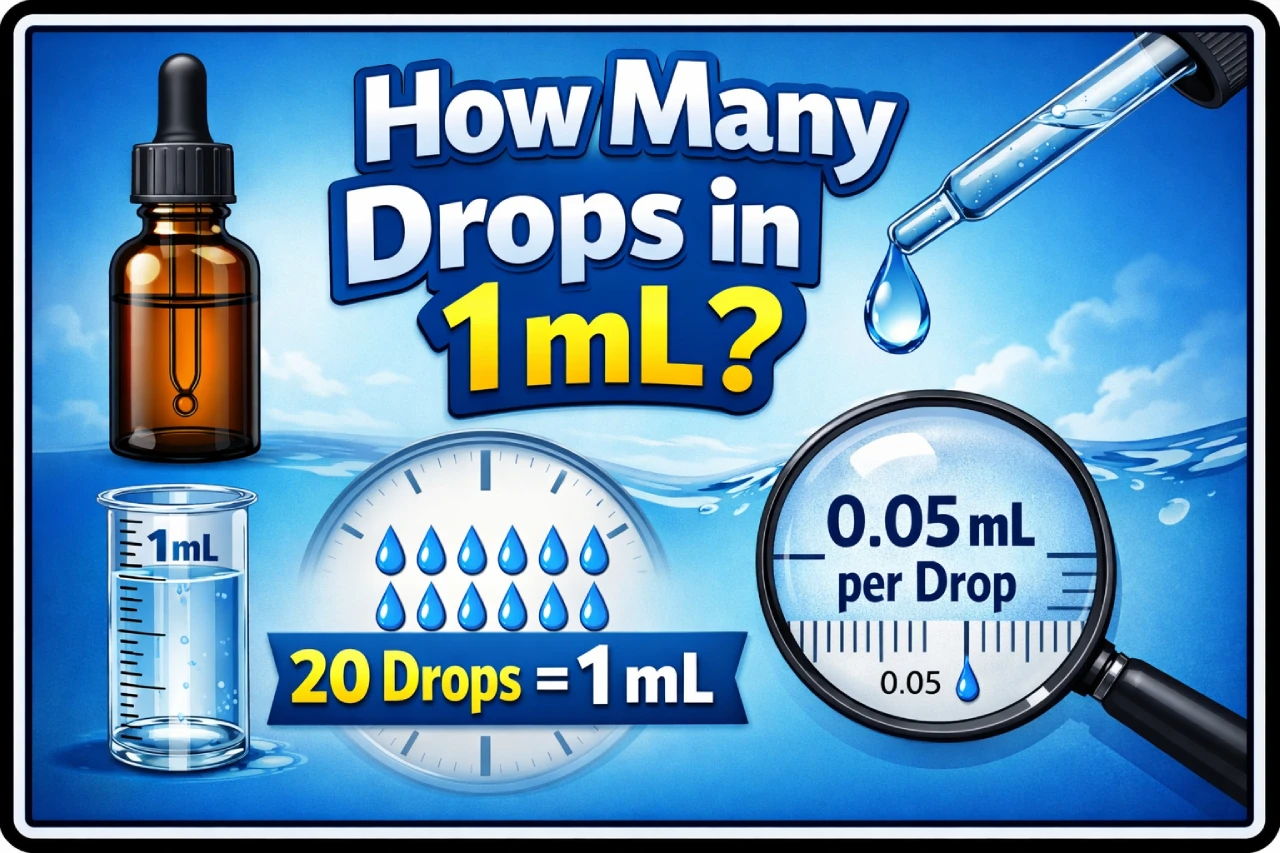
    1 mL (milliliter) ≈ 20 drops

    That’s the most commonly used standard—especially in medicine and pharmacy.

    But here’s the important part:
    The exact number of drops in 1 mL can vary depending on the liquid and the dropper.

    In some cases, 1 mL could be anywhere from 15 to 25 drops.

    So while 20 drops per mL is the standard guideline, it’s not always exact. Let’s break this down so you understand when it applies—and when it doesn’t.

    What Is a Drop (gtt) and Why It Varies

    A “drop” is actually not a fixed unit of measurement.

    In medical terms, a drop is written as gtt (from the Latin gutta, meaning drop). But the size of a drop depends on several factors:

    • The liquid’s thickness (viscosity)
    • The dropper design
    • Surface tension
    • Temperature

    Because of these variables, a drop of water is not always the same as a drop of oil or medicine.

    That’s why we use a standard average for practical use.

    The Standard Conversion:

    mL to Drops Converter

    mL to Drops Converter

    Enter a value in milliliters to convert it into drops.

    Your result will appear here
    Note: This calculator uses the standard approximation of 20 drops = 1 mL.

    In most medical and pharmaceutical settings:

    1 mL = 20 drops (gtt)

    This standard is widely accepted and used for:

    • Liquid medications
    • IV drip calculations (with standard droppers)
    • Basic dosage estimates

    If you’re following general instructions and no other specification is given, this is the value you should use.

    Why 20 Drops per mL Became the Standard

    The “20 drops = 1 mL” rule comes from standardized droppers used in medicine.

    Pharmaceutical droppers are designed so that:

    • Each drop is roughly 0.05 mL
    • 20 drops × 0.05 mL = 1 mL

    This creates consistency in dosing, which is critical for safety.

    However, not all droppers follow this standard—especially household or cosmetic droppers.

    When the Number of Drops Changes

    Here’s where things get interesting.

    1. Type of Liquid

    Different liquids form different drop sizes.

    • Water: ~20 drops per mL
    • Alcohol: ~25 drops per mL (smaller drops)
    • Oil: ~15–20 drops per mL (larger drops)

    Thicker liquids tend to form larger drops, meaning fewer drops per mL.

    2. Dropper Design

    Not all droppers are created equal.

    • Medical droppers are calibrated
    • Cosmetic droppers vary widely
    • Essential oil droppers often produce larger drops

    This can significantly change the number of drops.

    3. Surface Tension

    Liquids with higher surface tension form larger drops.

    For example:

    • Water forms medium-sized drops
    • Oil forms larger drops
    • Alcohol forms smaller drops

    4. Temperature

    Warmer liquids flow more easily and may produce smaller drops.

    While this effect is small, it can still influence measurements in precise situations.

    Quick Reference Table

    Here’s a helpful comparison:

    Liquid TypeDrops per 1 mL (Approx.)
    Water20 drops
    Alcohol20–25 drops
    Oil15–20 drops
    Medicine (standard dropper)20 drops

    Use this table as a general guide, but always follow specific instructions when available.

    Real-Life Uses of mL to Drops Conversion

    This conversion shows up more often than you might think.

    Medication Dosage

    Many liquid medications are measured in drops.

    For example:

    • 1 mL dose = about 20 drops
    • 0.5 mL = about 10 drops

    This is especially common for:

    • Eye drops
    • Infant medications
    • Herbal tinctures

    Essential Oils

    If you’ve ever used essential oils, you’ve probably seen instructions like:

    “Add 5–10 drops.”

    Understanding how drops relate to mL helps you measure more accurately.

    IV Drip Calculations

    In healthcare settings, drops are used to calculate IV flow rates.

    Different IV sets use different drop factors, such as:

    • 10 gtt/mL
    • 15 gtt/mL
    • 20 gtt/mL

    This is why precision matters in medical environments.

    Converting mL to Drops (Simple Formula)

    Here’s the basic formula:

    Drops = mL × 20

    Examples:

    • 1 mL = 20 drops
    • 2 mL = 40 drops
    • 0.25 mL = 5 drops

    If you’re using the standard assumption, this formula works perfectly.

    Converting Drops Back to mL

    To reverse the calculation:

    mL = Drops ÷ 20

    Examples:

    • 40 drops ÷ 20 = 2 mL
    • 10 drops ÷ 20 = 0.5 mL

    This is useful when instructions are given in drops but your measuring tool uses mL.

    Practical Example You Can Relate To

    Let’s say you’re giving a child a liquid supplement.

    The instruction says:

    Give 0.5 mL

    You don’t have a measuring syringe, but you have a dropper.

    Using the standard:

    0.5 × 20 = 10 drops

    Now you know exactly how to measure it.

    Why You Should Be Careful with Drops

    While drops are convenient, they are not always precise.

    When Accuracy Matters

    In situations like:

    • Prescription medication
    • Infant dosing
    • Medical treatments

    You should always use:

    • A calibrated syringe
    • A proper measuring device

    Drops are best used for rough or general measurements.

    Common Mistakes to Avoid

    Assuming All Drops Are Equal

    Different droppers produce different drop sizes.

    Ignoring Liquid Type

    Oil, water, and alcohol behave differently.

    Using Household Droppers for Medication

    These are not always calibrated and can lead to incorrect dosing.

    Not Checking Instructions

    Always follow product-specific guidelines when available.

    Pro Tip: Use a Syringe for Accuracy

    If precision matters, skip the guesswork.

    A 1 mL syringe is far more accurate than counting drops.

    In my experience, this is especially important for:

    • Kids’ medicine
    • Supplements
    • Medical treatments

    Drops are convenient—but not always reliable.

    Why This Conversion Still Matters

    Even with modern measuring tools, knowing how drops relate to mL is useful for:

    • Quick estimates
    • Emergency situations
    • Understanding instructions

    It’s one of those small pieces of knowledge that can make a big difference.

    Frequently Asked Questions (FAQs)

    How many drops are in 1 mL?

    On average, 1 mL equals 20 drops.

    Is 1 mL always 20 drops?

    No. It can vary between 15 and 25 drops, depending on the liquid and dropper.

    What is the formula to convert mL to drops?

    Drops = mL × 20

    How many drops are in 0.5 mL?

    0.5 mL = 10 drops

    How many mL is 10 drops?

    10 drops ÷ 20 = 0.5 mL

    Why does the number of drops vary?

    Because of differences in:

    • Liquid viscosity
    • Dropper design
    • Surface tension

    Are drops accurate for measuring medicine?

    Not always. For accuracy, use a measuring syringe.

    How many drops are in 1 mL of oil?

    Typically 15–20 drops, depending on thickness.

    What does “gtt” mean?

    “gtt” stands for drops, from the Latin word gutta.

    What’s the safest way to measure small liquid amounts?

    Use a calibrated syringe or measuring tool instead of relying on drops.

    Final Thoughts

    So, how many drops are in 1 mL?

    The standard answer is:

    1 mL ≈ 20 drops

    But the real answer is slightly more nuanced—it depends on the liquid, the dropper, and the situation.

    For everyday use, 20 drops per mL works perfectly. But when accuracy matters, always rely on proper measuring tools.

    Once you understand this, you’ll never second-guess drop measurements again.

  • How to Convert Bytes to Mbps (Formula, Chart & FAQs)

    How to Convert Bytes to Mbps (Formula, Chart & FAQs)

    If you’re looking for a quick answer, here it is:

    You can’t directly convert bytes to Mbps unless you include time.

    Why? Because:

    • Bytes (B) measure data size
    • Mbps (megabits per second) measure data transfer speed

    So the correct way to convert is:

    Mbps = (Bytes × 8) ÷ Time (in seconds) ÷ 1,000,000

    That’s the core idea. But once you understand why this works, converting between bytes and Mbps becomes easy—and extremely useful in real-world situations like internet speed, downloads, and file transfers.

    Let’s break it down step by step.

    Understanding the Basics: Bytes vs Mbps

    Before jumping into formulas, it’s important to understand what each unit actually represents.

    What Are Bytes?

    A byte (B) is a unit of data storage.

    • 1 byte = 8 bits
    • Files like photos, videos, and documents are measured in bytes (KB, MB, GB)

    What Is Mbps?

    Mbps (megabits per second) is a unit of data transfer speed.

    • Used by internet providers (e.g., 100 Mbps internet plan)
    • Measures how fast data moves

    Here’s the key difference:

    • Bytes = how much data you have
    • Mbps = how fast that data moves

    That’s why time is required to convert between them.

    The Key Conversion Rule

    Bytes to Mbps Converter

    Bytes to Mbps Converter

    Convert bytes into megabits per second easily.

    Result will appear here
    Formula used:
    Mbps = (Bytes × 8) ÷ 1,000,000

    To convert bytes to Mbps, you need three steps:

    1. Convert bytes to bits (multiply by 8)
    2. Divide by time in seconds
    3. Convert bits to megabits (divide by 1,000,000)

    So the formula becomes:

    Mbps = (Bytes × 8) ÷ Seconds ÷ 1,000,000

    This is the most accurate and widely used formula.

    Simple Example (Real-World)

    Let’s say you download a file:

    • File size: 10 MB (megabytes)
    • Time taken: 2 seconds

    Step 1: Convert MB to bytes
    10 MB = 10,000,000 bytes

    Step 2: Convert bytes to bits
    10,000,000 × 8 = 80,000,000 bits

    Step 3: Divide by time
    80,000,000 ÷ 2 = 40,000,000 bits/sec

    Step 4: Convert to Mbps
    40,000,000 ÷ 1,000,000 = 40 Mbps

    So your speed is 40 Mbps.

    Shortcut Formula (Much Easier)

    If your data is already in megabytes (MB), you can use this shortcut:

    Mbps = (MB × 8) ÷ Seconds

    Example:

    10 MB downloaded in 2 seconds:

    (10 × 8) ÷ 2 = 40 Mbps

    Much simpler, right?

    Bytes vs Bits: The Most Common Confusion

    This is where most people get tripped up.

    • 1 byte = 8 bits
    • Internet speed uses bits, not bytes

    So:

    • 1 MB (megabyte) = 8 Mb (megabits)

    That means:

    A 100 Mbps connection ≠ 100 MB per second

    Instead:

    100 Mbps ÷ 8 = 12.5 MB per second

    This explains why downloads often seem slower than advertised.

    Quick Conversion Table

    Here’s a simple reference:

    Data SizeTimeSpeed (Mbps)
    8 MB1 sec64 Mbps
    10 MB2 sec40 Mbps
    50 MB5 sec80 Mbps
    100 MB10 sec80 Mbps

    Use this as a quick mental check.

    Real-Life Applications

    Understanding bytes to Mbps isn’t just technical—it’s incredibly practical.

    1. Checking Internet Speed

    When you run a speed test, results are in Mbps.

    But when you download files, they’re in MB.

    Knowing the conversion helps you verify if your internet is performing as expected.

    2. Estimating Download Time

    If you know your speed, you can estimate how long a file will take to download.

    Example:

    • File: 800 MB
    • Speed: 100 Mbps

    Convert speed:

    100 Mbps ÷ 8 = 12.5 MB/sec

    Time:

    800 ÷ 12.5 = 64 seconds

    3. Streaming and Gaming

    Streaming platforms recommend speeds in Mbps.

    Understanding how that relates to actual data usage helps you choose the right plan.

    Mbps vs MBps (Important Difference)

    This is a critical distinction:

    • Mbps (megabits per second) → lowercase “b” = bits
    • MBps (megabytes per second) → uppercase “B” = bytes

    And remember:

    1 MBps = 8 Mbps

    This small detail can cause big misunderstandings.

    Binary vs Decimal Units (Advanced Insight)

    There are two systems for measuring data:

    Decimal (Used by Internet Providers)

    • 1 MB = 1,000,000 bytes
    • 1 Mbps = 1,000,000 bits

    Binary (Used by Computers)

    • 1 MiB = 1,048,576 bytes

    For most everyday conversions, you can safely use decimal values.

    Common Mistakes to Avoid

    Ignoring Time

    You cannot convert bytes to Mbps without time.

    Confusing Bytes and Bits

    Always remember:
    1 byte = 8 bits

    Misreading Units

    MB ≠ Mb
    Uppercase vs lowercase matters.

    Expecting Exact Speeds

    Real-world speeds are affected by:

    • Network congestion
    • Server limits
    • Hardware performance

    Practical Example You Can Relate To

    Let’s say you download a 1 GB file in 40 seconds.

    Step 1: Convert GB to MB
    1 GB = 1,000 MB

    Step 2: Apply formula
    (1000 × 8) ÷ 40 = 200 Mbps

    So your connection speed is roughly 200 Mbps.

    Quick Mental Math Trick

    Here’s a trick I use:

    • Multiply MB by 8
    • Divide by seconds

    That’s it.

    Example:

    20 MB in 4 seconds:

    (20 × 8) ÷ 4 = 40 Mbps

    No calculator needed.

    Frequently Asked Questions (FAQs)

    Can you convert bytes directly to Mbps?

    No. You need time because Mbps measures speed, not just data size.

    What is the formula to convert bytes to Mbps?

    Mbps = (Bytes × 8) ÷ Seconds ÷ 1,000,000

    How many Mbps is 1 MB per second?

    1 MB/s = 8 Mbps

    Why is internet speed measured in Mbps?

    Because it reflects how many bits are transferred per second, which is standard for network performance.

    What is the difference between MB and Mbps?

    • MB = megabytes (data size)
    • Mbps = megabits per second (speed)

    How do I calculate download speed from file size?

    Use:
    (MB × 8) ÷ seconds

    Why is my download speed lower than my internet plan?

    Because:

    • Plans are in Mbps
    • Downloads are shown in MB/s
    • Plus network overhead and real-world factors

    Is Mbps faster than MB/s?

    They measure different things.
    But numerically:
    1 MB/s = 8 Mbps

    How long does it take to download 100 MB at 50 Mbps?

    Convert speed:

    50 ÷ 8 = 6.25 MB/s

    Time:

    100 ÷ 6.25 = 16 seconds

    What’s the easiest way to estimate speed?

    Multiply MB by 8 and divide by time in seconds.

    Final Thoughts

    So, how do you convert bytes to Mbps?

    The key takeaway is simple:

    You need both data size and time.

    Once you understand that:

    • Convert bytes to bits
    • Divide by time
    • Convert to megabits

    Or use the shortcut:

    (MB × 8) ÷ seconds

    From checking your internet speed to estimating download times, this conversion is one of the most useful things you can learn in today’s digital world.

    And once you practice it a few times, it becomes second nature—just like checking your Wi-Fi signal.

  • 1L to dL Explained: Quick Conversion + Practical Examples

    1L to dL Explained: Quick Conversion + Practical Examples

    If you’re looking for a quick answer, here it is:

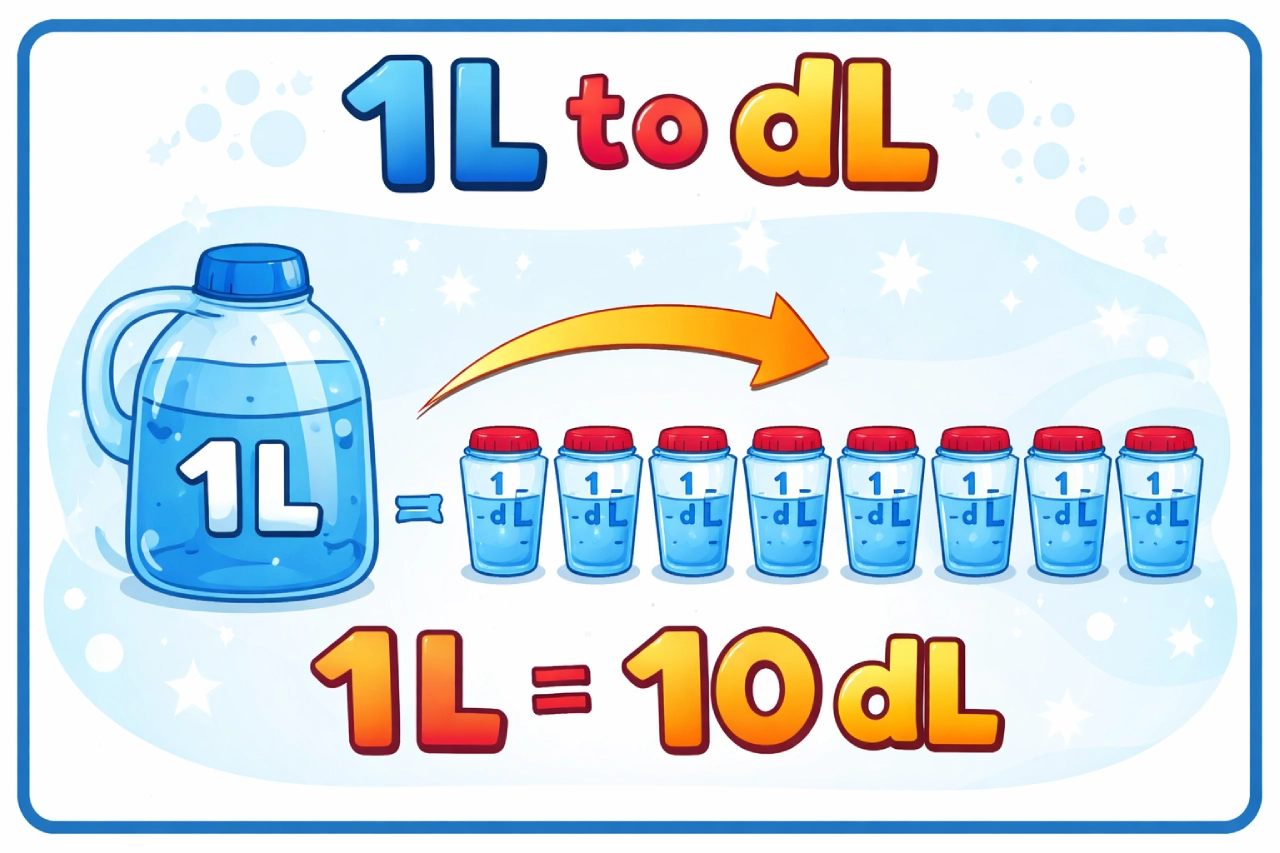
    1 liter (1 L) = 10 deciliters (10 dL)

    That means if you have 1L, you automatically have 10 dL—no complicated math required.

    But if you want to understand why this works, how to apply it in real-life situations, and how to convert other values just as easily, this guide will walk you through everything in a clear and practical way.

    Understanding the Basics: Liters vs Deciliters

    Both liters (L) and deciliters (dL) are units of volume in the metric system—the same system used in science, medicine, and most countries worldwide.

    A liter is a standard unit used for measuring liquids like:

    • Water bottles
    • Milk cartons
    • Fuel and beverages

    A deciliter is a smaller unit. The prefix “deci-” means one-tenth, which tells you exactly how it relates to a liter.

    So:

    • 1 dL = 0.1 L
    • 10 dL = 1 L

    That’s why the conversion is so simple.

    The Key Conversion Rule

    1L to dL Converter

    Liters to Deciliters Converter

    Enter a value in liters (L) to instantly convert it into deciliters (dL).

    Result will appear here
    Formula: 1 liter = 10 deciliters

    Here’s the rule you need to remember:

    1 L = 10 dL

    Or more generally:

    dL = L × 10

    So whenever you convert liters to deciliters, you just multiply by 10.

    Why This Conversion Is So Easy

    The reason this works so smoothly is because the metric system is based on powers of 10.

    Unlike imperial units (which can be confusing), metric conversions follow a consistent pattern:

    • Multiply or divide by 10
    • Move the decimal point

    That’s it.

    This is why conversions like 1L to dL are among the easiest you’ll ever do.

    Visualizing 1L to dL

    Let’s make this more relatable.

    Imagine a 1-liter bottle of water.

    Now divide that bottle into 10 equal parts.

    Each part is:

    1 deciliter (dL)

    So:

    • 1 full bottle = 10 dL
    • Half a bottle = 5 dL
    • A quarter bottle = 2.5 dL

    This mental image makes the conversion much easier to remember.

    Quick Examples Using 1L to dL

    Even though this article focuses on 1 liter, understanding a few variations helps build confidence.

    Example 1: 1 L to dL

    1 × 10 = 10 dL

    Example 2: 1.5 L to dL

    1.5 × 10 = 15 dL

    Example 3: 0.3 L to dL

    0.3 × 10 = 3 dL

    Once you see the pattern, it becomes automatic.

    Quick Conversion Table

    Here’s a simple reference table you can use:

    Liters (L)Deciliters (dL)
    1 L10 dL
    1.5 L15 dL
    2 L20 dL
    5 L50 dL
    10 L100 dL

    This is helpful when you need quick answers without calculating.

    Real-Life Uses of 1L to dL Conversion

    You might think this is just basic math, but it actually comes up more often than you’d expect.

    Cooking and Baking

    Many European recipes use deciliters instead of cups or milliliters.

    For example:

    • 1 L of milk = 10 dL
    • 0.5 L = 5 dL

    If you’ve ever followed an international recipe, this conversion becomes essential.

    Medical Measurements

    Deciliters are commonly used in medical contexts.

    For example:

    • Blood sugar levels are measured in mg/dL (milligrams per deciliter)

    Understanding what a deciliter represents helps you interpret these values correctly.

    Everyday Liquid Measurements

    Some product labels or containers may use different units.

    Knowing that 1L = 10 dL helps you compare quantities easily.

    Mental Math Trick You’ll Actually Use

    Here’s the easiest trick:

    Move the decimal point one place to the right

    That’s it.

    Examples:

    • 1.0 L → 10 dL
    • 1.2 L → 12 dL
    • 0.7 L → 7 dL

    No calculator needed.

    Converting Back: dL to L

    Sometimes you’ll need to reverse the conversion.

    Here’s the formula:

    L = dL ÷ 10

    Or simply:

    Move the decimal one place to the left

    Examples:

    • 10 dL → 1 L
    • 25 dL → 2.5 L
    • 8 dL → 0.8 L

    How 1L Fits Into the Bigger Metric System

    Understanding where liters and deciliters sit in the metric system helps everything make sense.

    • 1 L = 10 dL
    • 1 L = 100 cL (centiliters)
    • 1 L = 1,000 mL (milliliters)

    So:

    • 1 dL = 100 mL
    • 5 dL = 500 mL

    This helps when switching between different units.

    Common Mistakes to Avoid

    Even though this is a simple conversion, a few mistakes still pop up.

    Confusing dL with mL

    • 1 dL = 100 mL
    • Don’t mix them up

    Moving the Decimal the Wrong Direction

    • L → dL = move right
    • dL → L = move left

    Overcomplicating It

    This is a base-10 conversion. Keep it simple.

    Practical Scenario: Cooking Example

    Let’s say a recipe calls for 10 dL of water, but your measuring jug is in liters.

    You convert:

    10 ÷ 10 = 1 L

    Now you know exactly how much to pour.

    This kind of quick conversion is incredibly useful in everyday life.

    Why the Metric System Makes Life Easier

    One thing I always appreciate about the metric system is its consistency.

    Everything is based on powers of 10, which means:

    • No weird fractions
    • No complex formulas
    • Easy mental calculations

    That’s why conversions like 1L to dL are so intuitive.

    When Accuracy Matters

    In some situations, even simple conversions need to be precise.

    Medical Use

    Incorrect conversions can lead to misinterpretation of results.

    Scientific Experiments

    Precision ensures reliable outcomes.

    Professional Cooking

    Exact measurements affect taste and consistency.

    In these cases, always double-check your values.

    Frequently Asked Questions (FAQs)

    How many deciliters are in 1 liter?

    There are 10 deciliters in 1 liter.

    What is 1L in dL?

    1L = 10 dL

    What is the formula to convert L to dL?

    dL = L × 10

    How do you convert 1 liter to deciliters quickly?

    Multiply by 10 or move the decimal one place to the right.

    Is 1 dL bigger than 1 L?

    No. A deciliter is smaller.
    1 dL = 0.1 L

    How many dL are in 0.5 L?

    0.5 L = 5 dL

    How do you convert dL back to liters?

    Divide by 10 or move the decimal one place to the left.

    Why is the metric system easier?

    Because it uses powers of 10, making conversions simple and consistent.

    Where are deciliters commonly used?

    In cooking, medicine, and scientific measurements.

    What is 1 dL in milliliters?

    1 dL = 100 mL

    Final Thoughts

    So, how much is 1L to dL?

    The answer is simple:

    1 liter = 10 deciliters

    Once you understand that, everything else becomes easy. Just multiply by 10—or move the decimal—and you’re done.

    It’s one of those conversions that feels almost effortless once you’ve used it a few times.

    And the best part? It works every single time, because the metric system is built to be simple.

  • 1 Ton How Many Cubic Yards? Full Conversion Guide

    1 Ton How Many Cubic Yards? Full Conversion Guide

    If you’re looking for a quick answer, here it is:

    1 ton is NOT equal to a fixed number of cubic yards.

    Why? Because:

    • A ton measures weight (2,000 pounds)
    • A cubic yard measures volume (3 ft × 3 ft × 3 ft)

    To convert between them, you must know the density of the material.

    That said, here are common real-world estimates:

    • 1 ton of gravel ≈ 0.67 cubic yards
    • 1 ton of sand ≈ 0.74 cubic yards
    • 1 ton of topsoil ≈ 0.75 cubic yards
    • 1 ton of mulch ≈ 2.5–3.5 cubic yards

    Now let’s break this down so you can confidently calculate it for any material.

    Why There’s No Single Answer

    This is the biggest point most articles miss.

    You can’t directly convert tons to cubic yards because they measure different things:

    • Weight (tons) depends on how heavy something is
    • Volume (cubic yards) depends on how much space it takes up

    The missing piece is density, which tells you how much a material weighs per cubic yard.

    Think about it this way:

    A cubic yard of rocks is heavy.
    A cubic yard of mulch is light.

    Same volume, completely different weight.

    That’s why the answer changes depending on what you’re working with.

    The Simple Formula You Need

    Tons to Cubic Yards Converter

    Tons to Cubic Yards

    Convert tons into cubic yards by selecting a material density or entering your own.

    Result will appear here
    Formula: Cubic Yards = Tons ÷ Density

    Here’s the only formula you need to remember:

    Cubic Yards = Tons ÷ (Tons per Cubic Yard)

    This works for any material—as long as you know its density.

    For example:

    If gravel weighs 1.5 tons per cubic yard, then:

    1 ton ÷ 1.5 = 0.67 cubic yards

    That’s your answer.

    Common Materials and Their Conversions

    Let’s look at the most common materials used in construction and landscaping.

    Gravel

    • Average density: 1.4–1.7 tons per cubic yard
    • Conversion:
      1 ton ≈ 0.59–0.71 cubic yards

    Most people use:
    1 ton of gravel ≈ 0.67 cubic yards

    Sand

    • Average density: 1.3–1.5 tons per cubic yard
    • Conversion:
      1 ton ≈ 0.67–0.77 cubic yards

    Typical estimate:
    1 ton of sand ≈ 0.74 cubic yards

    Topsoil

    • Average density: 1.2–1.4 tons per cubic yard
    • Conversion:
      1 ton ≈ 0.71–0.83 cubic yards

    Common estimate:
    1 ton of topsoil ≈ 0.75 cubic yards

    Concrete (Crushed or Dry)

    • Average density: ~2 tons per cubic yard
    • Conversion:
      1 ton ≈ 0.5 cubic yards

    Heavier material = less volume per ton.

    Mulch

    • Average density: 0.2–0.4 tons per cubic yard
    • Conversion:
      1 ton ≈ 2.5–5 cubic yards

    Light material = much more volume.

    Quick Conversion Table

    Here’s a simple reference chart:

    MaterialTons per Cubic Yard1 Ton Equals
    Gravel1.50.67 yd³
    Sand1.350.74 yd³
    Topsoil1.30.77 yd³
    Concrete2.00.50 yd³
    Mulch0.33.33 yd³

    These are averages, but they’re accurate enough for most real-world projects.

    Real-Life Example: Gravel Calculation

    Let’s say you’re ordering gravel for a driveway.

    You’re told you need 1 ton of gravel.

    Using the average density:

    1 ÷ 1.5 = 0.67 cubic yards

    So, 1 ton of gravel gives you about two-thirds of a cubic yard.

    If you need more coverage, you’ll need more tons.

    Why Density Changes the Answer

    Density isn’t always the same. It can vary due to several factors.

    Moisture

    Wet materials weigh more.

    For example, wet sand is heavier than dry sand, which means:

    • Fewer cubic yards per ton when wet

    Compaction

    Loose material takes up more space than compacted material.

    Once compacted, the same material becomes denser.

    Material Type

    Even within the same category (like gravel), different sizes and compositions change the density.

    That’s why it’s always best to:

    • Ask your supplier for exact density
    • Or use industry averages with a small buffer

    Tons vs Cubic Yards: When to Use Each

    Tons (Weight)

    Used when:

    • Buying materials by weight
    • Transporting materials (truck limits are weight-based)

    Cubic Yards (Volume)

    Used when:

    • Measuring coverage area
    • Planning landscaping or construction

    In my experience, contractors often think in cubic yards, while suppliers may quote in tons.

    Quick Estimation Rules

    If you don’t know the exact density, here are simple rules that work surprisingly well:

    • Heavy materials (gravel, concrete):
      1 ton ≈ 0.5–0.7 cubic yards
    • Medium materials (sand, soil):
      1 ton ≈ 0.7–0.8 cubic yards
    • Light materials (mulch):
      1 ton ≈ 2–4 cubic yards

    These are perfect for quick planning.

    Common Mistakes to Avoid

    Assuming a Fixed Conversion

    There is no universal answer. Always consider the material.

    Ignoring Moisture

    Wet materials can significantly change weight and calculations.

    Not Ordering Extra

    Always add 5–10% extra to avoid running short.

    Confusing Units

    Cubic yards (volume) are not the same as square yards (area).

    Practical Example: Landscaping Project

    Let’s say you’re working on a garden bed and plan to use topsoil.

    You have:

    • 1 ton of topsoil
    • Density: 1.3 tons per cubic yard

    Calculation:

    1 ÷ 1.3 = 0.77 cubic yards

    So, 1 ton of topsoil gives you about 0.77 cubic yards.

    That helps you estimate how much area you can cover.

    Converting the Other Way (Yards to Tons)

    Sometimes you’ll need to reverse the calculation.

    Tons = Cubic Yards × Density

    Example:

    1 cubic yard of gravel × 1.5 = 1.5 tons

    Knowing both directions makes your planning much easier.

    Why This Conversion Matters

    Getting this wrong can lead to:

    • Ordering too much (wasting money)
    • Ordering too little (delays and extra delivery costs)
    • Miscalculating project coverage

    Whether you’re building a driveway, laying a patio, or landscaping a yard, understanding this conversion saves time, money, and frustration.

    Frequently Asked Questions (FAQs)

    How many cubic yards is 1 ton?

    It depends on the material. For example:

    • Gravel: ~0.67 cubic yards
    • Sand: ~0.74 cubic yards
    • Mulch: 2.5–3.5 cubic yards

    What is the formula to convert tons to cubic yards?

    Cubic Yards = Tons ÷ Density (tons per cubic yard)

    Is 1 ton equal to 1 cubic yard?

    No. They measure different things:

    • Ton = weight
    • Cubic yard = volume

    How many cubic yards is 1 ton of gravel?

    About 0.67 cubic yards, depending on density.

    How many cubic yards is 1 ton of sand?

    About 0.74 cubic yards, depending on moisture and type.

    Why does the number change for different materials?

    Because each material has a different density.

    How can I estimate quickly without exact data?

    Use rough averages:

    • Gravel: 0.67 yd³
    • Sand/soil: 0.75 yd³
    • Mulch: 3 yd³

    Should I always order extra material?

    Yes. Add 5–10% extra to avoid shortages.

    How do I get exact density values?

    Ask your supplier or check product specifications.

    What’s the biggest mistake people make?

    Assuming there’s a fixed conversion between tons and cubic yards.

    Final Thoughts

    So, 1 ton equals how many cubic yards?

    The honest answer is: it depends on the material.

    Once you understand the relationship between weight, volume, and density, the confusion disappears. With a simple formula and a few common estimates, you can calculate conversions quickly and accurately.

    And after a few projects, you won’t even need a calculator—you’ll just know.

  • How Many Yards in a Ton (Gravel, Sand, Soil Conversion Guide)

    How Many Yards in a Ton (Gravel, Sand, Soil Conversion Guide)

    If you’re looking for a quick answer, here it is:

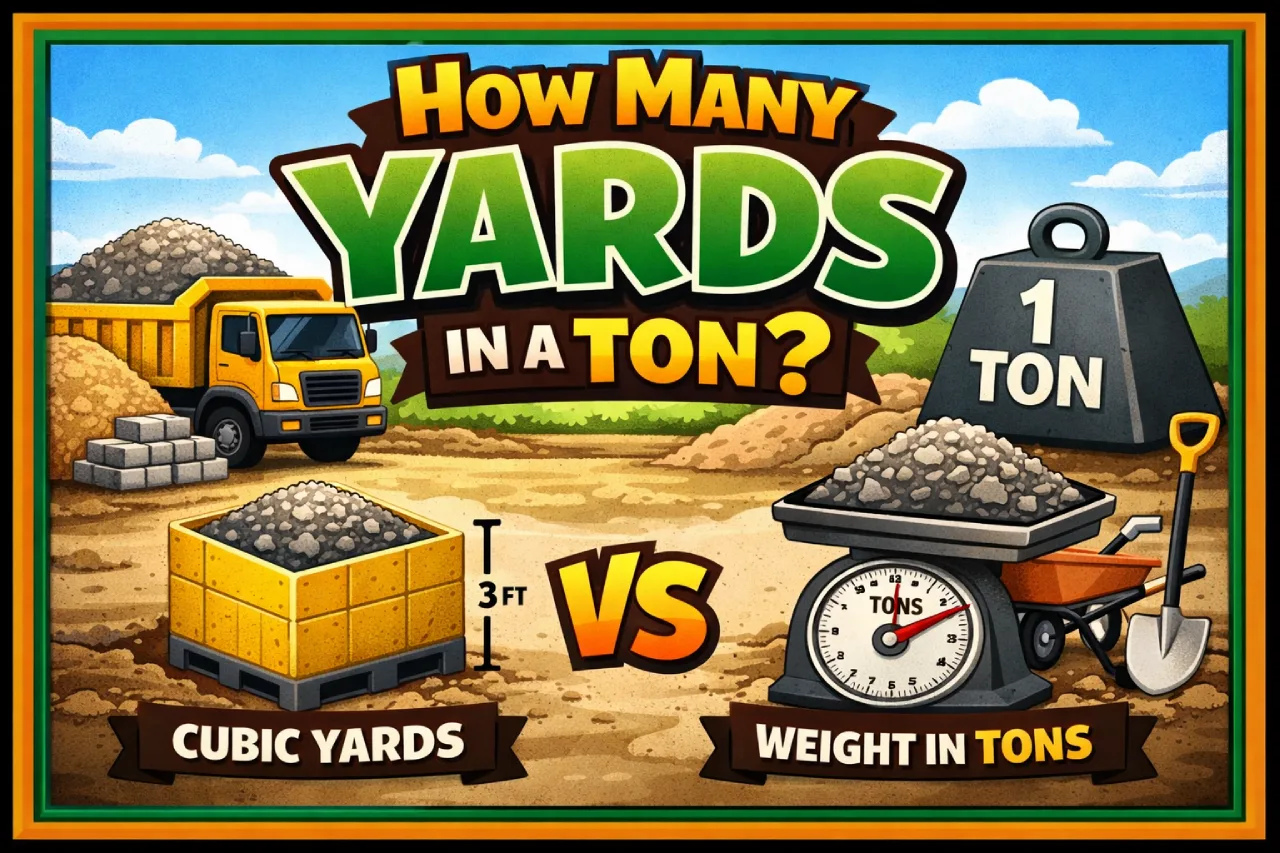
    There is no fixed number of yards in a ton.

    That’s because yards measure volume (cubic yards) and tons measure weight. To convert between them, you must know the density of the material you’re dealing with.

    In simple terms:

    Cubic Yards = Tons ÷ Density (tons per cubic yard)

    Once you understand that, everything else becomes much easier. Let’s break it down in a practical, real-world way so you can confidently convert tons to yards for gravel, soil, sand, concrete, and more.

    Why You Can’t Directly Convert Tons to Yards

    This is where most people get confused.

    A ton is a unit of weight (2,000 pounds in the U.S.), while a cubic yard measures volume (a 3 ft × 3 ft × 3 ft space).

    The missing link is density, which tells you how heavy a material is per unit of volume.

    For example:

    • A cubic yard of feathers weighs almost nothing
    • A cubic yard of gravel can weigh over a ton

    Same volume, completely different weight.

    That’s why the answer depends entirely on the material.

    The Basic Formula You Need

    Yards to Tons Converter

    Yards to Tons Converter

    Convert cubic yards to tons using the material’s density. Since different materials weigh differently, select a preset or enter a custom value.

    Your result will appear here
    Formula:
    Tons = Cubic Yards × Tons per Cubic Yard
    Example: 5 cubic yards of gravel × 1.4 = 7 tons

    Here’s the formula you’ll use every time:

    Cubic Yards = Tons ÷ (Tons per Cubic Yard)

    So if a material weighs 1.5 tons per cubic yard, then:

    1 ton ÷ 1.5 = 0.67 cubic yards

    This formula works for any material—as long as you know its density.

    Common Conversions by Material

    Let’s look at real-world examples. These are approximate averages used in construction and landscaping.

    Gravel

    • Density: ~1.4 to 1.7 tons per cubic yard
    • 1 ton ≈ 0.59 to 0.71 cubic yards

    A commonly used average:
    1 ton of gravel ≈ 0.67 cubic yards

    Sand

    • Density: ~1.3 to 1.5 tons per cubic yard
    • 1 ton ≈ 0.67 to 0.77 cubic yards

    Average:
    1 ton of sand ≈ 0.74 cubic yards

    Topsoil

    • Density: ~1.2 to 1.4 tons per cubic yard
    • 1 ton ≈ 0.71 to 0.83 cubic yards

    Average:
    1 ton of topsoil ≈ 0.75 cubic yards

    Concrete (Crushed or Dry)

    • Density: ~2.0 tons per cubic yard
    • 1 ton ≈ 0.5 cubic yards

    Concrete is heavier than most materials, so you get less volume per ton.

    Mulch

    • Density: ~0.2 to 0.4 tons per cubic yard
    • 1 ton ≈ 2.5 to 5 cubic yards

    Mulch is light, so a ton covers a much larger volume.

    Quick Reference Table

    Here’s a simple table you can use for quick estimates:

    MaterialTons per Cubic Yard1 Ton Equals (Cubic Yards)
    Gravel1.50.67 yd³
    Sand1.350.74 yd³
    Topsoil1.30.77 yd³
    Concrete2.00.50 yd³
    Mulch0.33.33 yd³

    These values are averages, but they’re accurate enough for most projects.

    Real-Life Example: Ordering Gravel

    Let’s say you need 3 tons of gravel for a driveway.

    Using the average:

    3 tons ÷ 1.5 = 2 cubic yards

    So you’d need about 2 cubic yards of gravel.

    This is why suppliers often ask whether you want your order in tons or cubic yards—it affects pricing and delivery.

    Why Density Changes Everything

    Density isn’t fixed. It can vary based on:

    Moisture Content

    Wet sand is heavier than dry sand. That changes the tons-per-yard value.

    Compaction

    Loose soil takes up more space than compacted soil. Once packed, the same material weighs more per cubic yard.

    Material Type

    Even within gravel, sizes and compositions vary, affecting density.

    Because of this, it’s always a good idea to:

    • Ask your supplier for their specific density
    • Add a small buffer (5–10%) to your estimate

    Tons vs Cubic Yards: When Each Is Used

    Tons (Weight)

    Used when:

    • Buying bulk materials by weight
    • Transporting materials (truck loads are weight-limited)

    Cubic Yards (Volume)

    Used when:

    • Measuring coverage area
    • Planning landscaping or construction projects

    In my experience, contractors often think in cubic yards, while suppliers may quote in tons.

    How to Estimate Without Exact Density

    If you don’t know the exact density, here’s a quick rule of thumb:

    • Heavy materials (gravel, concrete): 1 ton ≈ 0.5–0.7 cubic yards
    • Medium materials (sand, soil): 1 ton ≈ 0.7–0.8 cubic yards
    • Light materials (mulch): 1 ton ≈ 2–4 cubic yards

    These estimates are surprisingly reliable for quick planning.

    Common Mistakes to Avoid

    Assuming a Fixed Conversion

    There is no universal conversion between tons and yards. Always check the material.

    Ignoring Moisture

    Wet materials weigh more. This can throw off your calculations.

    Not Ordering Extra

    Running short can delay your project. It’s usually smart to order 5–10% extra.

    Mixing Units

    Don’t confuse square yards (area) with cubic yards (volume). They are completely different.

    Practical Scenario: Landscaping Project

    Let’s say you’re covering a garden bed and need:

    • 2 tons of topsoil
    • Density: 1.3 tons per cubic yard

    Calculation:

    2 ÷ 1.3 = 1.54 cubic yards

    You’d round up and order about 1.6 cubic yards.

    That small rounding ensures you don’t run out mid-project.

    Tons to Yards vs Yards to Tons

    You might also need to reverse the calculation.

    Tons to Yards

    Cubic Yards = Tons ÷ Density

    Yards to Tons

    Tons = Cubic Yards × Density

    Example:

    2 cubic yards of gravel × 1.5 = 3 tons

    Understanding both directions gives you full control over your estimates.

    Why This Matters More Than You Think

    Getting this conversion wrong can lead to:

    • Overpaying for materials
    • Running short during a project
    • Delivery issues (trucks overloaded or underfilled)

    Whether you’re working on a driveway, garden, or construction site, knowing how tons and yards relate can save both time and money.

    Frequently Asked Questions (FAQs)

    How many yards are in a ton?

    There is no fixed answer. It depends on the material’s density. For example, 1 ton of gravel is about 0.67 cubic yards, while 1 ton of mulch can be over 3 cubic yards.

    What is the formula to convert tons to cubic yards?

    Cubic Yards = Tons ÷ (Tons per Cubic Yard)

    How many cubic yards is 1 ton of gravel?

    On average, 1 ton of gravel ≈ 0.67 cubic yards.

    How many cubic yards is 1 ton of sand?

    Typically, 1 ton of sand ≈ 0.74 cubic yards, depending on moisture and type.

    Is a ton the same as a cubic yard?

    No. A ton measures weight, while a cubic yard measures volume. They are different types of units.

    How do I know the density of a material?

    You can:

    • Ask your supplier
    • Check product specifications
    • Use industry averages (as shown in this guide)

    Why does moisture affect the conversion?

    Water adds weight, increasing the tons per cubic yard. Wet materials are heavier than dry ones.

    How many yards is 2 tons of gravel?

    Using the average (1.5 tons per cubic yard):

    2 ÷ 1.5 = 1.33 cubic yards

    Should I order extra material?

    Yes. It’s recommended to order 5–10% extra to account for waste, compaction, or errors.

    What’s the easiest way to estimate quickly?

    Use rough averages:

    • Gravel: 1 ton ≈ 0.67 yards
    • Sand/soil: 1 ton ≈ 0.75 yards
    • Mulch: 1 ton ≈ 3 yards

    Final Thoughts

    So, how many yards are in a ton?

    The honest answer is: it depends on the material.

    Once you understand that tons measure weight and cubic yards measure volume, the confusion disappears. All you need is the material’s density, and you can convert confidently using a simple formula.

    From gravel driveways to garden beds, this knowledge helps you plan smarter, avoid costly mistakes, and get exactly the amount of material you need.

    And next time someone asks, “How many yards are in a ton?”—you’ll know the real answer isn’t just a number. It’s a concept.