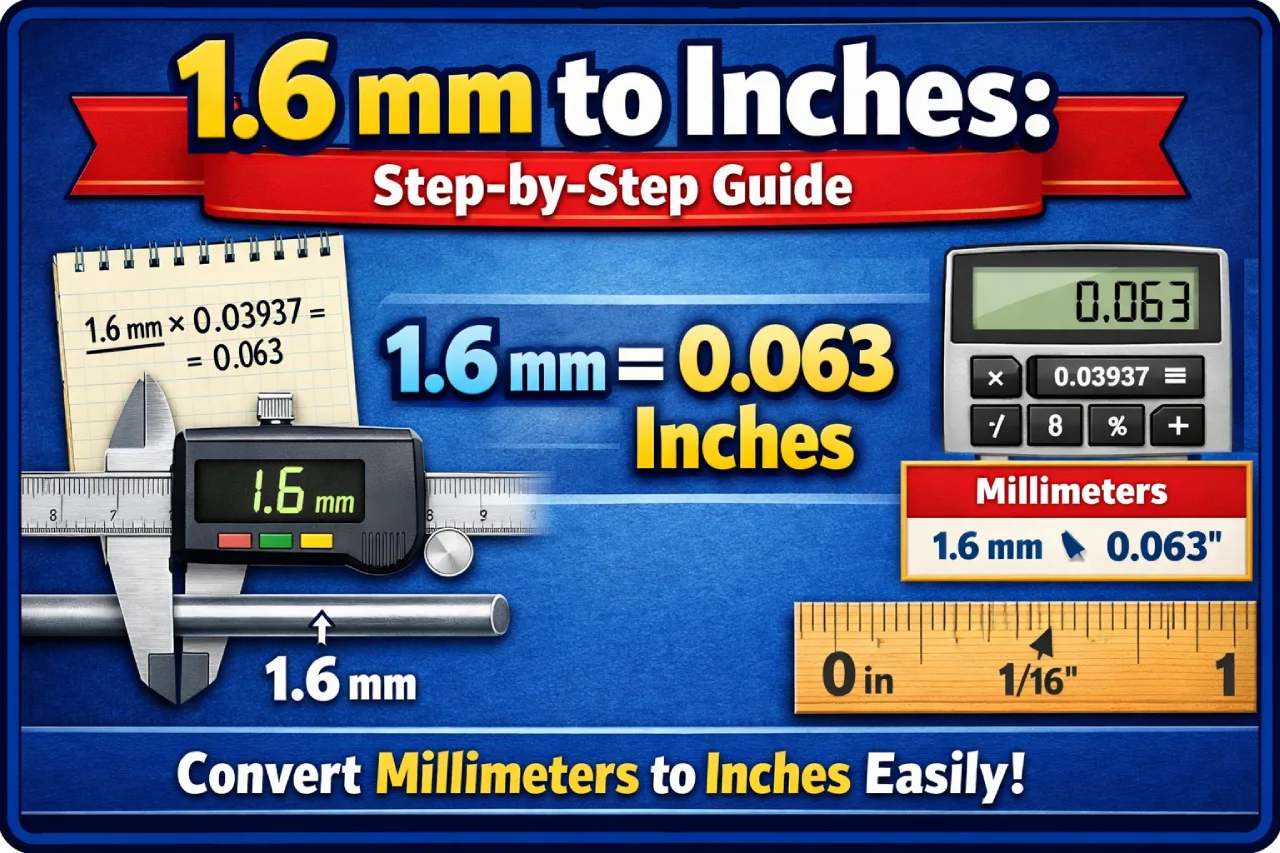
If you’re looking for the quick answer:
1.6 millimeters (mm) = 0.063 inches (approximately).
So when you convert 1.6 mm to inches, the result is about 0.063 in when rounded to three decimal places.
This is a very small measurement, often used in engineering, manufacturing, electronics, jewelry, and precision tools. Since most countries use the metric system (millimeters) while the United States commonly uses inches, knowing how to convert between these units is incredibly useful.
In this guide, we’ll walk through the exact formula, step-by-step calculation, practical examples, and tips so you can confidently convert millimeters to inches in any situation.
If you want to explore larger conversions, you can also check this detailed guide on 730 mm to inches, which explains the process on a bigger scale.
The Conversion Formula: mm to Inches
MM to Inches Converter
Enter a value in millimeters to instantly convert it into inches.
The relationship between millimeters and inches is:
1 inch = 25.4 millimeters
Conversion Formula
Inches = Millimeters ÷ 25.4
This formula works for any millimeter value.
Step-by-Step Conversion: 1.6 mm to Inches
Let’s break it down clearly.
Step 1: Start with the millimeter value
1.6 mm
Step 2: Divide by 25.4
1.6 ÷ 25.4
Step 3: Calculate
= 0.06299 inches
Final Result
1.6 mm ≈ 0.063 inches
Visualizing 1.6 mm
Since this is a very small measurement, it helps to compare it with real-world objects.
Thickness Comparison
- A typical credit card is about 0.76 mm thick
- So 1.6 mm is roughly twice that thickness
Paper Stack
A stack of about 15–16 sheets of paper can measure close to 1.6 mm.
Mechanical Parts
Many small screws, washers, or electronic components have thicknesses around this range.
Understanding these comparisons helps you visualize the measurement better.
Quick mm to Inches Conversion Table
Here’s a handy reference chart.
| Millimeters (mm) | Inches (in) |
|---|---|
| 1 mm | 0.039 in |
| 1.5 mm | 0.059 in |
| 1.6 mm | 0.063 in |
| 2 mm | 0.079 in |
| 5 mm | 0.197 in |
| 10 mm | 0.394 in |
This table makes it easier to estimate nearby values.
Why Convert mm to Inches?
There are many situations where this conversion becomes useful.
1. Engineering and Manufacturing
Designs often use metric units, but tools or specifications may use inches.
2. Construction and DIY Projects
Materials from different countries may use different measurement systems.
3. Electronics and Gadgets
Small components are often measured in millimeters, but product descriptions may use inches.
4. Jewelry and Crafts
Precise measurements are critical in design work.
Understanding both units ensures accuracy.
Millimeters vs Inches: Key Differences
| Unit | System | Equivalent |
|---|---|---|
| Millimeter (mm) | Metric system | 0.03937 inches |
| Inch (in) | U.S. customary | 25.4 mm |
Because inches are larger, converting from mm results in smaller decimal values.
Converting Inches Back to Millimeters
Sometimes you need the reverse conversion.
Formula
Millimeters = Inches × 25.4
Example
0.063 × 25.4 ≈ 1.6 mm
This confirms the original conversion.
Common Mistakes to Avoid
1. Using the Wrong Conversion Factor
Always use:
1 inch = 25.4 mm
2. Rounding Too Early
Wait until the final step before rounding.
3. Confusing mm with cm
Remember:
- 1 cm = 10 mm
Tips for Quick Mental Conversion
Here are some simple tricks.
Trick 1: Divide by 25
Instead of 25.4, use 25 for quick estimates.
Example:
1.6 ÷ 25 ≈ 0.064 inches
This is very close to the exact value.
Trick 2: Remember Benchmarks
- 1 mm ≈ 0.04 inches
- 10 mm ≈ 0.4 inches
These help estimate quickly.
Real-World Examples of 1.6 mm
Jewelry Thickness
Some rings or chains may have thicknesses around 1.5–2 mm.
Electronics
Thin components like connectors or small panels often fall in this range.
Manufacturing
Precision parts often require measurements in millimeters, especially under 5 mm.
Understanding the inch equivalent helps when working with U.S.-based tools.
Frequently Asked Questions (FAQs)
How many inches is 1.6 mm?
1.6 mm ≈ 0.063 inches
How do you convert mm to inches?
Divide millimeters by 25.4.
Is 1.6 mm thick?
It’s relatively thin—about twice the thickness of a credit card.
What is the easiest way to estimate mm to inches?
Divide by 25 for a quick estimate.
How many mm are in 1 inch?
1 inch = 25.4 mm
Is mm smaller than inches?
Yes.
Millimeters are much smaller units.
What is 2 mm in inches?
2 ÷ 25.4 ≈ 0.079 inches
Why do most countries use mm?
Because the metric system is the global standard.
Can calculators convert mm to inches?
Yes. Most calculators and apps support unit conversions.
What is 10 mm in inches?
10 ÷ 25.4 ≈ 0.394 inches
Final Thoughts
Converting 1.6 mm to inches is simple once you understand the relationship between these units.
Using the formula:
Inches = mm ÷ 25.4
we find:
1.6 mm ≈ 0.063 inches
This conversion is especially useful in precision work, where small measurements matter.
Once you remember the key rule—1 inch equals 25.4 mm—you can quickly convert between systems with confidence.
Now here’s a quick thought for you:
The next time you see a measurement in millimeters, will you instantly picture it in inches?
Leave a Reply