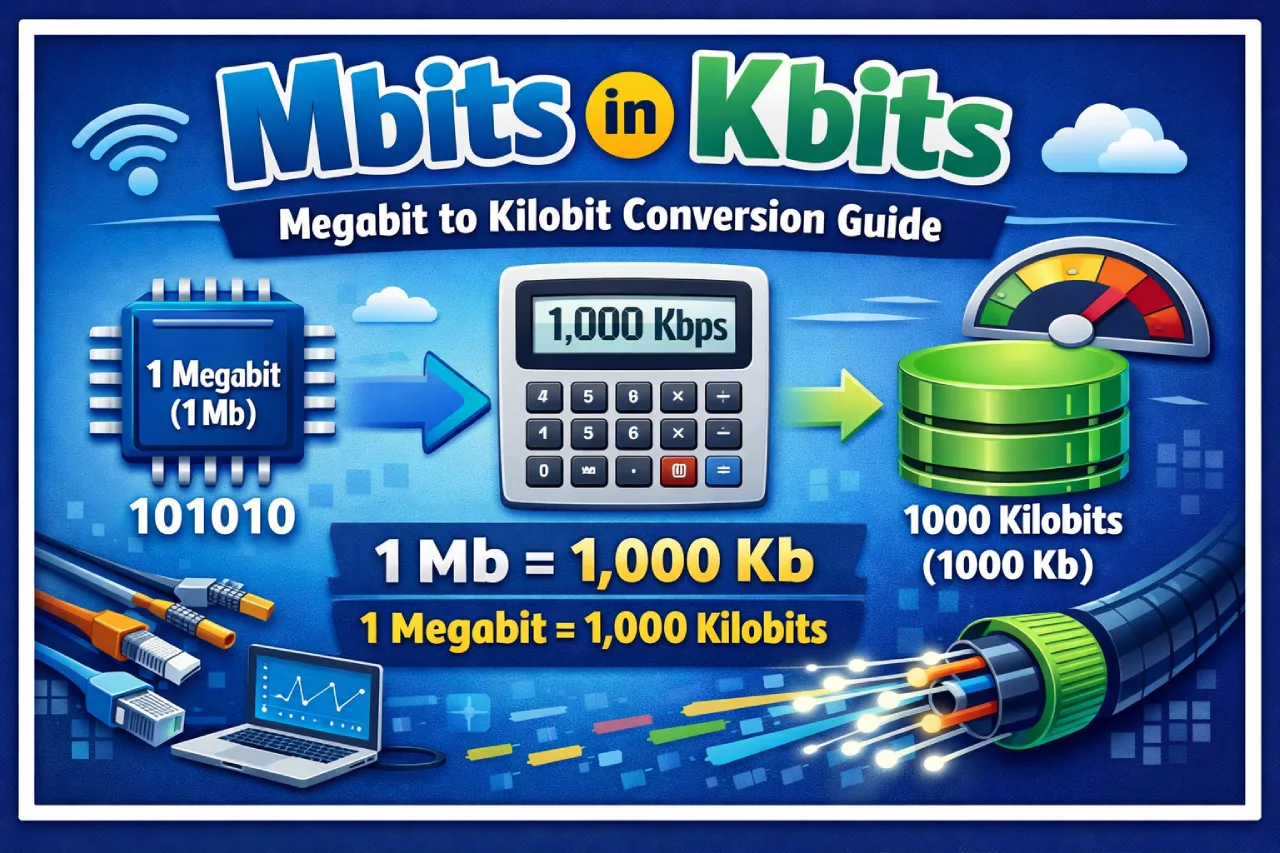
If you’re looking for the quick answer:
1 megabit (Mbit) = 1,000 kilobits (kbit)
So, to convert Mbits to Kbits, you simply multiply by 1,000.
For example:
- 1 Mbit = 1,000 Kbits
- 5 Mbits = 5,000 Kbits
- 10 Mbits = 10,000 Kbits
This conversion is widely used in internet speed measurements, data transfer rates, networking, and digital communication. If you’ve ever seen internet speeds like “100 Mbps” or “50 Mbps,” you’re already dealing with megabits.
In this guide, we’ll break down what megabits and kilobits are, explain the conversion clearly, and show practical examples so you can understand how these units apply in real-world scenarios.
If you want a deeper explanation of this conversion, check out this detailed guide on megabit to kilobit conversion.
The Key Conversion: Mbits to Kbits
Mbits to Kbits Converter
Enter megabits (Mbits) to convert them into kilobits (Kbits).
The relationship between megabits and kilobits is simple:
1 Mbit = 1,000 Kbits
Conversion Formula
Kbits = Mbits × 1,000
This formula works for any value.
Step-by-Step Example
Let’s convert 25 Mbits to Kbits.
Step 1: Start with megabits
25 Mbits
Step 2: Multiply by 1,000
25 × 1,000
Step 3: Calculate
= 25,000 Kbits
Final Answer
25 Mbits = 25,000 Kbits
Quick Conversion Table
Here’s a handy reference chart.
| Megabits (Mbit) | Kilobits (Kbit) |
|---|---|
| 1 Mbit | 1,000 Kbits |
| 2 Mbits | 2,000 Kbits |
| 5 Mbits | 5,000 Kbits |
| 10 Mbits | 10,000 Kbits |
| 50 Mbits | 50,000 Kbits |
| 100 Mbits | 100,000 Kbits |
This makes it easy to estimate conversions quickly.
Why Multiply by 1,000?
In networking and data transfer, units are based on the decimal system (base 10).
That means:
- 1 kilobit = 1,000 bits
- 1 megabit = 1,000,000 bits
So:
1 Mbit = 1,000 × 1,000 bits = 1,000,000 bits
1 Kbit = 1,000 bits
Dividing:
1,000,000 ÷ 1,000 = 1,000 Kbits
That’s why the conversion factor is 1,000.
Mbits vs MB (Megabytes): Common Confusion
One of the biggest mistakes people make is confusing megabits (Mbit) with megabytes (MB).
Key Difference
- 1 byte = 8 bits
So:
- 1 MB = 8 Mbits
Example
If your internet speed is 100 Mbps, that equals:
100 ÷ 8 = 12.5 MB per second
Understanding this difference is crucial when downloading files or comparing internet speeds.
Real-World Examples of Mbits to Kbits
Internet Speed
If your internet speed is 50 Mbps, that equals:
50 × 1,000 = 50,000 Kbps
Streaming Video
Streaming platforms may require:
- 5 Mbps for HD video
- 25 Mbps for 4K
Converted:
- 5 Mbps = 5,000 Kbps
- 25 Mbps = 25,000 Kbps
File Downloads
If a file downloads at 10 Mbps, that equals:
10 × 1,000 = 10,000 Kbps
Why This Conversion Matters
Understanding Mbits to Kbits is useful in many areas.
1. Internet Speed Comparison
Different providers may display speeds in Mbps or Kbps.
2. Network Troubleshooting
Technicians often work with different units.
3. Data Transfer Understanding
Knowing how units relate helps you estimate download times.
4. Streaming and Gaming
Bandwidth requirements are often listed in megabits.
Mbits vs Kbits: Key Differences
| Unit | Equivalent | Usage |
|---|---|---|
| Kilobit (kbit) | 1,000 bits | Older or smaller speeds |
| Megabit (Mbit) | 1,000,000 bits | Modern internet speeds |
Megabits represent larger data rates, so values are smaller compared to kilobits.
Converting Kbits Back to Mbits
Sometimes you need to reverse the conversion.
Formula
Mbits = Kbits ÷ 1,000
Example
10,000 Kbits ÷ 1,000 = 10 Mbits
Common Mistakes to Avoid
1. Confusing Bits and Bytes
Remember:
- Bits = lowercase “b”
- Bytes = uppercase “B”
2. Using 1024 Instead of 1000
For networking speeds, use 1,000, not 1,024.
3. Mixing Units
Always check whether values are in:
- Kbps (kilobits per second)
- Mbps (megabits per second)
Tips for Quick Mental Conversion
Here are some easy tricks.
Trick 1: Add Three Zeros
To convert Mbits to Kbits, just add three zeros.
Example:
5 Mbits → 5,000 Kbits
Trick 2: Remove Three Zeros
To go the other way:
10,000 Kbits → 10 Mbits
Trick 3: Use Benchmarks
- 1 Mbit = 1,000 Kbits
- 10 Mbits = 10,000 Kbits
- 100 Mbits = 100,000 Kbits
Frequently Asked Questions (FAQs)
How many Kbits are in 1 Mbit?
1 Mbit = 1,000 Kbits
How do you convert Mbits to Kbits?
Multiply by 1,000.
Is 1 Mbit equal to 1,024 Kbits?
No. In networking, 1 Mbit = 1,000 Kbits.
What is 10 Mbits in Kbits?
10 × 1,000 = 10,000 Kbits
Why do internet speeds use megabits?
Because megabits provide a convenient way to express large data transfer rates.
What is the difference between Mbps and Kbps?
- Mbps = megabits per second
- Kbps = kilobits per second
Is Mbit the same as MB?
No.
1 MB = 8 Mbits
What is 100 Mbits in Kbits?
100 × 1,000 = 100,000 Kbits
Why is the conversion based on 1,000?
Because networking uses the decimal system (base 10).
Can calculators convert Mbits to Kbits?
Yes. Most tools support data unit conversions.
Final Thoughts
Converting Mbits to Kbits is one of the simplest conversions in digital data measurement.
The key rule to remember is:
1 Mbit = 1,000 Kbits
Once you know this, you can quickly convert internet speeds, data transfer rates, and bandwidth values without any confusion.
Whether you’re comparing internet plans, troubleshooting network issues, or just trying to understand download speeds, this conversion gives you a clearer picture of how data moves.
Now here’s a quick question for you:
Next time you see your internet speed in Mbps, will you instantly know its value in Kbps?
Leave a Reply