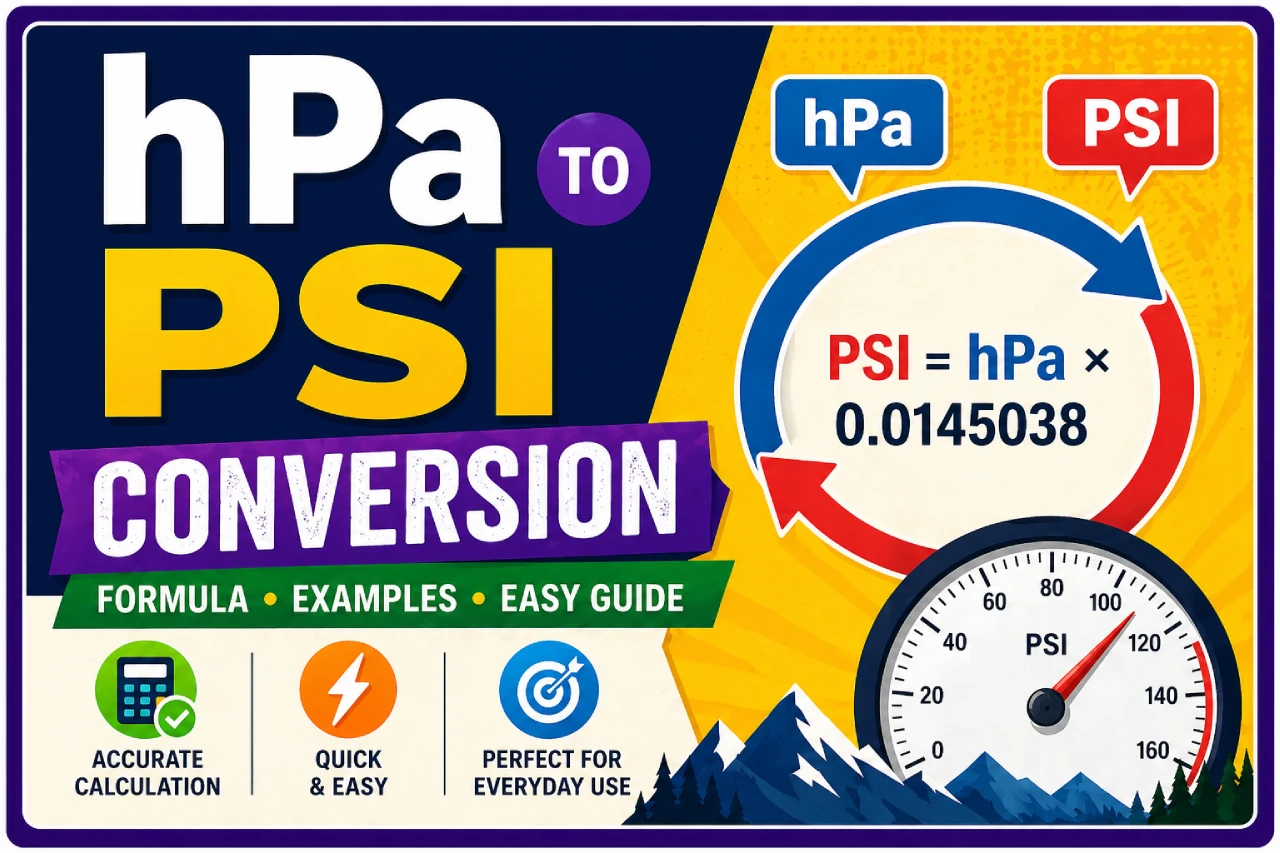
If you’re looking for the quick answer:
👉 1 hPa = 0.0145038 psi
👉 PSI = hPa × 0.0145038
For example:
- 100 hPa ≈ 1.450 psi
- 500 hPa ≈ 7.252 psi
- 1013.25 hPa ≈ 14.696 psi (standard atmospheric pressure)
This conversion is especially useful in weather data, aviation, HVAC systems, and engineering, where pressure readings are often given in hectopascals (hPa) but need to be understood in PSI.
In this guide, you’ll learn exactly how to convert hPa to PSI, understand what these units mean, and confidently apply the conversion in real-life situations.
What Is hPa (Hectopascal)?
A hectopascal (hPa) is a metric unit of pressure.
Definition
👉 1 hPa = 100 pascals (Pa)
The pascal is the SI unit of pressure, defined as:
👉 1 Pa = 1 newton per square meter (N/m²)
Why hPa Is Used
Hectopascals are commonly used because they produce manageable numbers.
Common Uses
- Weather reports
- Atmospheric pressure measurements
- Aviation systems
Example
- Normal atmospheric pressure = 1013.25 hPa
What Is PSI?
PSI (pounds per square inch) is a unit of pressure used mainly in the United States.
Definition
👉 It measures how much force (in pounds) is applied over one square inch.
Common Uses
- Tire pressure
- Air compressors
- Hydraulic systems
- Gas pressure
Example
- Car tires: 30–35 PSI
- Air compressors: 90–120 PSI
hPa to PSI Conversion Formula
hPa to PSI Converter
Enter pressure in hectopascals (hPa) to convert it into pounds per square inch (PSI).
Here’s the key formula:
👉 PSI = hPa × 0.0145038
Reverse Formula
👉 hPa = PSI ÷ 0.0145038
This conversion factor is precise and widely accepted.
Step-by-Step Conversion Example
Let’s convert 750 hPa to PSI.
Step 1: Start with hPa
750 hPa
Step 2: Multiply by conversion factor
750 × 0.0145038
Step 3: Calculate
= 10.87785 psi
Final Answer
👉 750 hPa ≈ 10.88 PSI
Quick Conversion Table
Here’s a handy reference chart.
| hPa | PSI |
|---|---|
| 1 hPa | 0.0145 psi |
| 10 hPa | 0.145 psi |
| 100 hPa | 1.450 psi |
| 500 hPa | 7.252 psi |
| 1000 hPa | 14.504 psi |
| 1013.25 hPa | 14.696 psi |
This table helps you estimate values quickly.
Understanding the Relationship
Let’s simplify it.
👉 1 PSI ≈ 68.95 hPa
This is useful for quick reverse conversions.
Example
- 2 PSI ≈ 138 hPa
- 10 PSI ≈ 689 hPa
Real-World Applications
Understanding hPa to PSI conversion is more useful than you might think.
1. Weather and Atmospheric Pressure
Weather forecasts often use hPa.
Example:
- A pressure system at 980 hPa:
👉 980 × 0.0145038 ≈ 14.21 PSI
2. Aviation
Pilots rely on hPa for altitude and pressure readings.
3. HVAC Systems
Engineers may need PSI for system pressure calculations.
4. Industrial Equipment
Some machines use metric pressure units, others use PSI.
hPa vs PSI: Key Differences
| Unit | System | Typical Use |
|---|---|---|
| hPa | Metric (SI) | Weather, aviation |
| PSI | U.S. customary | Mechanical systems |
Both measure pressure—but in different systems.
Converting PSI Back to hPa
Sometimes you need the reverse.
Formula
👉 hPa = PSI × 68.95
Example
5 PSI × 68.95 = 344.75 hPa
Why hPa Is Common in Weather
Meteorologists prefer hPa because:
- It aligns with the metric system
- It produces manageable numbers
- It’s internationally standardized
Common Mistakes to Avoid
1. Using the Wrong Conversion Factor
Always use:
👉 0.0145038 for hPa → PSI
2. Confusing Pa, hPa, and kPa
- 1 hPa = 100 Pa
- 1 kPa = 1,000 Pa
3. Rounding Too Early
Keep precision until the final step.
Tips for Quick Mental Conversion
Here are some simple tricks.
Trick 1: Multiply by 0.015
Close enough for quick estimates.
Trick 2: Divide by 70
To convert PSI → hPa quickly.
Trick 3: Use Benchmarks
- 1000 hPa ≈ 14.5 PSI
- 500 hPa ≈ 7.25 PSI
Practical Examples
Example 1: Weather Pressure
A storm system at 990 hPa:
990 × 0.0145038 ≈ 14.36 PSI
Example 2: Low Pressure System
850 hPa:
850 × 0.0145038 ≈ 12.33 PSI
Example 3: Standard Atmosphere
1013.25 hPa:
👉 14.696 PSI
This is the standard atmospheric pressure at sea level.
Why This Conversion Matters
Understanding hPa to PSI helps you:
- Interpret weather data
- Work across measurement systems
- Avoid confusion in technical fields
- Improve accuracy in calculations
Frequently Asked Questions (FAQs)
What is 1 hPa in PSI?
👉 0.0145038 PSI
How do you convert hPa to PSI?
Multiply by 0.0145038.
What is 1000 hPa in PSI?
👉 14.504 PSI
What is 1 PSI in hPa?
👉 68.95 hPa
Why is hPa used in weather?
Because it’s part of the metric system and easy to interpret.
Is PSI higher than hPa?
They measure the same pressure in different units.
Can calculators convert hPa to PSI?
Yes, easily.
What is 500 hPa in PSI?
👉 7.252 PSI
What is standard atmospheric pressure?
👉 1013.25 hPa or 14.696 PSI
Is hPa the same as millibar?
👉 Yes, 1 hPa = 1 millibar
Final Thoughts
Converting hPa to PSI is straightforward once you know the formula:
👉 PSI = hPa × 0.0145038
And the reverse:
👉 hPa = PSI × 68.95
Whether you’re reading weather reports, working with engineering systems, or comparing pressure values across regions, this conversion helps you stay accurate and confident.
Now here’s a quick question for you:
Next time you see atmospheric pressure in hPa, will you instantly know what it means in PSI?
Leave a Reply