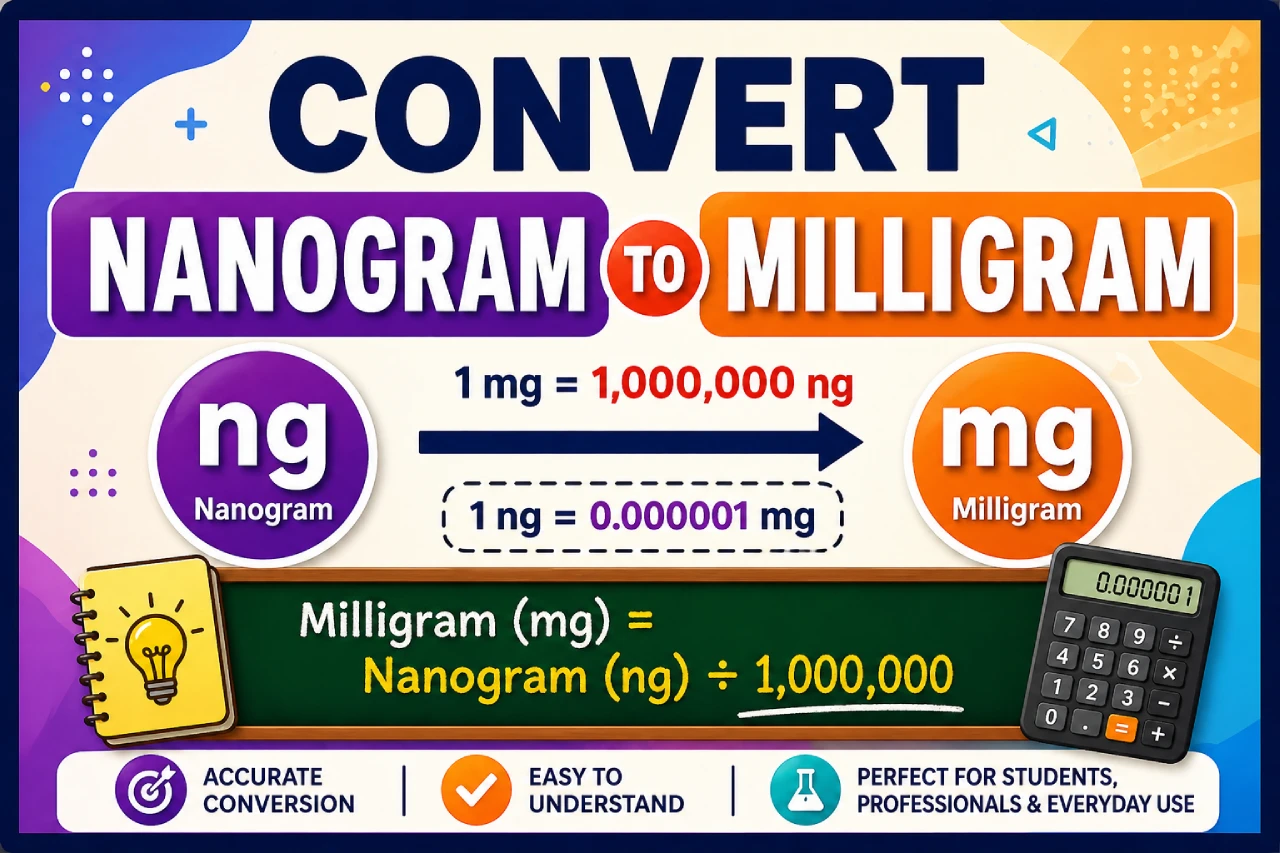
If you’re looking for the quick answer:
👉 1 nanogram (ng) = 0.000001 milligram (mg)
👉 Milligrams = Nanograms ÷ 1,000,000
So, for example:
- 1,000 ng = 0.001 mg
- 1,000,000 ng = 1 mg
- 500 ng = 0.0005 mg
This conversion is extremely important in medicine, laboratory work, pharmacology, and scientific research, where measurements are incredibly small and precision matters.
In this guide, we’ll break down everything step by step—so you don’t just memorize the formula, but actually understand it.
Understanding the Units
Before we convert anything, let’s understand what nanograms and milligrams really are.
What Is a Nanogram (ng)?
A nanogram is a very tiny unit of mass.
Definition
👉 1 nanogram = 1 billionth of a gram
👉 1 ng = 0.000000001 grams (10⁻⁹ g)
Where It’s Used
- Drug dosages
- DNA measurements
- Environmental testing
- Medical diagnostics
To give you perspective:
👉 A nanogram is so small that it’s often used to measure microscopic substances.
What Is a Milligram (mg)?
A milligram is a larger unit compared to a nanogram—but still very small.
Definition
👉 1 milligram = 1 thousandth of a gram
👉 1 mg = 0.001 grams (10⁻³ g)
Common Uses
- Medication doses
- Nutritional values
- Food labeling
Key Relationship Between ng and mg
Let’s connect the two units.
- 1 mg = 1,000,000 ng
- 1 ng = 0.000001 mg
👉 That’s a difference of six decimal places
Conversion Formula
Nanogram to Milligram Converter
Enter a value in nanograms to convert it into milligrams.
Here’s the formula you need.
👉 Milligrams (mg) = Nanograms (ng) ÷ 1,000,000
Reverse Formula
👉 Nanograms (ng) = Milligrams (mg) × 1,000,000
Step-by-Step Conversion Example
Let’s convert 750,000 ng to mg.
Step 1: Start with nanograms
750,000 ng
Step 2: Divide by 1,000,000
750,000 ÷ 1,000,000
Step 3: Calculate
= 0.75 mg
Final Answer
👉 750,000 ng = 0.75 mg
Another Example
Convert 2,500 ng to mg.
Step 1
2,500 ÷ 1,000,000
Step 2
= 0.0025 mg
👉 Final Answer: 0.0025 mg
Quick Conversion Table
Here’s a helpful chart for quick reference.
| Nanograms (ng) | Milligrams (mg) |
|---|---|
| 1 ng | 0.000001 mg |
| 100 ng | 0.0001 mg |
| 1,000 ng | 0.001 mg |
| 10,000 ng | 0.01 mg |
| 100,000 ng | 0.1 mg |
| 1,000,000 ng | 1 mg |
This makes it easy to estimate values quickly.
Why This Conversion Matters
You might wonder why such small units are important.
1. Medicine and Dosage
Certain drugs are measured in micrograms or nanograms.
Even tiny errors can have serious consequences.
2. Laboratory Testing
Scientific experiments often involve extremely small quantities.
3. Environmental Science
Pollutants in air and water are measured in ng.
4. Nutrition and Supplements
Trace elements may be measured in very small amounts.
Visualizing the Difference
Let’s make this easier to understand.
- 1 gram = a paperclip
- 1 milligram = 1/1,000 of that
- 1 nanogram = 1/1,000,000,000 of that
👉 So a nanogram is one million times smaller than a milligram
Converting mg Back to ng
Sometimes you need to reverse the conversion.
Formula
👉 ng = mg × 1,000,000
Example
0.5 mg × 1,000,000 = 500,000 ng
Common Mistakes to Avoid
1. Misplacing the Decimal
Since the numbers are small, decimal placement is critical.
2. Confusing Units
- ng (nanogram)
- mg (milligram)
They are very different.
3. Forgetting the Conversion Factor
Always remember:
👉 1 mg = 1,000,000 ng
Tips for Quick Mental Conversion
Here are some simple tricks.
Trick 1: Move the Decimal 6 Places
To convert ng → mg:
👉 Move the decimal 6 places left
Example:
500,000 ng → 0.5 mg
Trick 2: Use Scientific Notation
- ng = 10⁻⁹ g
- mg = 10⁻³ g
Difference = 10⁶
Trick 3: Use Benchmarks
- 1,000,000 ng = 1 mg
- 500,000 ng = 0.5 mg
Practical Examples
Example 1: Medical Dose
A medication contains 250,000 ng:
👉 250,000 ÷ 1,000,000 = 0.25 mg
Example 2: Lab Measurement
A sample has 75,000 ng:
👉 75,000 ÷ 1,000,000 = 0.075 mg
Example 3: Environmental Data
Pollution level = 10,000 ng:
👉 10,000 ÷ 1,000,000 = 0.01 mg
Why the Metric System Makes This Easy
The metric system is based on powers of 10.
This means:
- Conversions are just decimal shifts
- No complicated fractions
- Easy to learn and apply
Practice Problems
Try these yourself.
- 1,500 ng = ? mg
- 250,000 ng = ? mg
- 5,000,000 ng = ? mg
- 80,000 ng = ? mg
Answers
- 0.0015 mg
- 0.25 mg
- 5 mg
- 0.08 mg
Frequently Asked Questions (FAQs)
What is 1 ng in mg?
👉 0.000001 mg
How do you convert nanograms to milligrams?
Divide by 1,000,000.
What is 1 mg in ng?
👉 1,000,000 ng
Why are nanograms used?
To measure extremely small quantities.
What is 500,000 ng in mg?
👉 0.5 mg
Is ng smaller than mg?
Yes, much smaller.
Can calculators convert ng to mg?
Yes, easily.
What is 10,000 ng in mg?
👉 0.01 mg
Why is precision important?
Small errors can lead to large inaccuracies.
Is this conversion exact?
Yes, it’s based on the metric system.
Final Thoughts
Converting nanograms to milligrams is simple once you understand the relationship:
👉 1 ng = 0.000001 mg
👉 mg = ng ÷ 1,000,000
The key idea is:
👉 Move the decimal six places to the left
This conversion is critical in fields where precision matters—like medicine, science, and environmental studies.
Once you master it, you’ll handle even the smallest measurements with confidence.
Now here’s a quick question for you:
Next time you see a value in nanograms, will you instantly know its equivalent in milligrams?
Leave a Reply