If you’re looking for the quick answer:
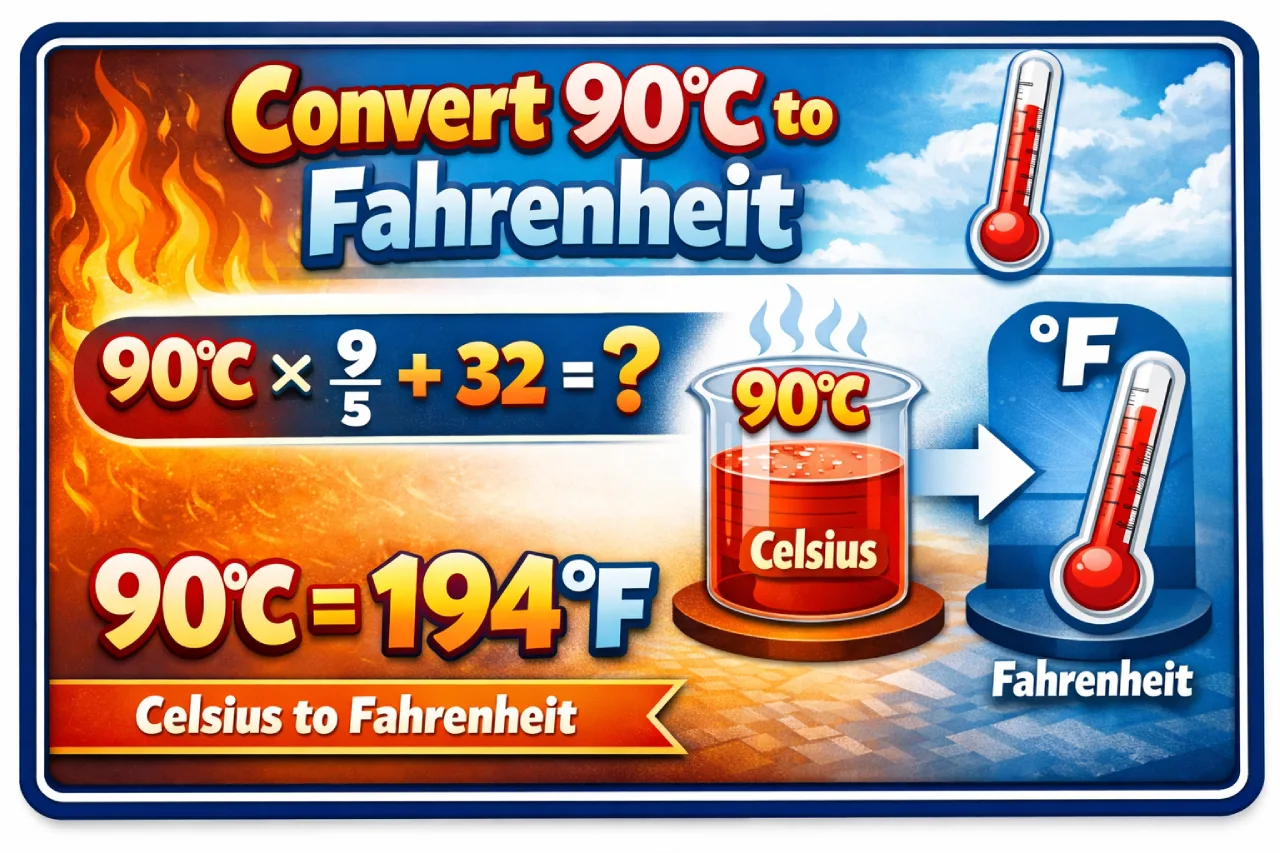
90°C = 194°F
So when you convert 90 Celsius to Fahrenheit, the result is 194 degrees Fahrenheit.
This is a common temperature conversion, especially when dealing with cooking instructions, weather comparisons, scientific data, or international appliances. Since most countries use Celsius, while the United States primarily uses Fahrenheit, knowing how to convert between the two helps you interpret temperatures accurately.
In this guide, we’ll break down the formula, show the step-by-step calculation, explain what 90°C actually feels like, and provide practical examples so you can confidently use this conversion in real life.
Understanding Celsius and Fahrenheit
Before we dive into the calculation, let’s quickly understand the two temperature scales.
What Is Celsius (°C)?
The Celsius scale is part of the metric system and is used worldwide.
It’s based on simple reference points:
- 0°C = freezing point of water
- 100°C = boiling point of water
Because of this logical structure, Celsius is widely used in:
- Science and education
- Weather reporting (outside the U.S.)
- Cooking in many countries
- Industrial applications
What Is Fahrenheit (°F)?
The Fahrenheit scale is primarily used in the United States.
Its reference points are:
- 32°F = freezing point of water
- 212°F = boiling point of water
Fahrenheit is commonly used for:
- Weather forecasts in the U.S.
- Oven temperatures
- Household thermostats
Because the scale has smaller increments, it allows for more precise temperature readings in everyday use.
The Formula: Celsius to Fahrenheit
Celsius to Fahrenheit Converter
Enter a temperature in Celsius to instantly convert it to Fahrenheit.
The conversion between Celsius and Fahrenheit follows a standard formula:
Fahrenheit = (Celsius × 9/5) + 32
This formula works for any temperature.
Step-by-Step Conversion: 90°C to °F
Let’s walk through the calculation.
Step 1: Start with the Celsius value
90°C
Step 2: Multiply by 9/5
90 × 9/5 = 162
Step 3: Add 32
162 + 32 = 194
Final Answer
90°C = 194°F
Quick Reference Conversion Table
Here’s a helpful chart for nearby temperatures.
| Celsius (°C) | Fahrenheit (°F) |
|---|---|
| 50°C | 122°F |
| 60°C | 140°F |
| 70°C | 158°F |
| 80°C | 176°F |
| 90°C | 194°F |
| 100°C | 212°F |
This makes it easy to estimate similar values.
What Does 90°C (194°F) Feel Like?
Now that we know the number, let’s understand what 90°C actually represents.
Boiling Point Context
Water boils at 100°C (212°F), so 90°C is just below boiling.
This means:
- The water is extremely hot
- Steam may be visible
- It can cause burns instantly
Cooking Example
In cooking, 90°C (194°F) is commonly used for:
- Simmering liquids
- Brewing coffee or tea
- Cooking delicate sauces
- Sous vide preparation
It’s hot enough to cook food but slightly below full boiling.
Everyday Comparison
- Hot tap water can reach 120–140°F
- 194°F is significantly hotter and dangerous to touch
Understanding this helps you interpret recipes and safety guidelines.
Why Convert Celsius to Fahrenheit?
There are several situations where this conversion becomes useful.
1. Cooking and Recipes
Many international recipes use Celsius, while U.S. ovens use Fahrenheit.
For example:
- A recipe might say 90°C simmer, which equals 194°F.
2. Travel and Weather
If you’re traveling internationally, temperatures may be listed in Celsius.
3. Science and Education
Scientific measurements often use Celsius, but U.S. readers may need Fahrenheit.
4. Appliances and Equipment
Imported appliances may display temperature in Celsius.
Celsius vs Fahrenheit: Key Differences
| Feature | Celsius | Fahrenheit |
|---|---|---|
| Freezing point of water | 0°C | 32°F |
| Boiling point of water | 100°C | 212°F |
| Common use | Global | United States |
| Scale size | Larger increments | Smaller increments |
Because Fahrenheit uses smaller increments, it allows for more detailed temperature readings.
Converting Fahrenheit Back to Celsius
If you need to reverse the conversion, use this formula:
Celsius = (Fahrenheit − 32) × 5/9
Example
(194 − 32) × 5/9 = 90°C
This confirms the earlier result.
Common Mistakes in Temperature Conversion
Even simple formulas can cause confusion.
Forgetting to Add 32
Always remember the full formula:
(°C × 9/5) + 32
Mixing Up Multiplication Factors
Use 9/5, not 5/9, when converting to Fahrenheit.
Rounding Too Early
Wait until the final step before rounding.
Tips for Quick Mental Conversion
Here are some helpful shortcuts.
Trick 1: Double and Add 30
For a rough estimate:
(C × 2) + 30
Example:
90 × 2 = 180
180 + 30 = 210°F (estimate)
The exact value is 194°F, so this method gives a quick approximation.
Trick 2: Use Benchmarks
- 0°C = 32°F
- 50°C = 122°F
- 100°C = 212°F
Knowing these helps you estimate quickly.
Real-World Examples of 90°C
Coffee Brewing
Many coffee experts recommend water temperatures between 90°C and 96°C for optimal extraction.
Cooking Liquids
Soups and sauces often simmer around this temperature.
Industrial Use
Some processes require controlled heating below boiling point.
Understanding the Fahrenheit equivalent ensures accuracy when working with U.S.-based equipment.
Frequently Asked Questions (FAQs)
What is 90°C in Fahrenheit?
90°C equals 194°F.
How do you convert Celsius to Fahrenheit?
Use the formula:
(°C × 9/5) + 32
Is 90°C boiling?
No.
Boiling occurs at 100°C (212°F).
What is 90°C used for?
It’s commonly used for:
- Simmering
- Brewing coffee
- Cooking delicate foods
Is 194°F very hot?
Yes. It’s extremely hot and can cause burns quickly.
What is the easiest way to estimate Celsius to Fahrenheit?
Multiply by 2 and add 30 for a quick estimate.
Why does the U.S. use Fahrenheit?
It’s part of the historical measurement system used in the country.
How accurate is the formula?
The formula is exact when used correctly.
Can calculators convert temperatures automatically?
Yes. Most calculators and apps include temperature conversion.
What is 100°C in Fahrenheit?
100°C = 212°F
Final Thoughts
Converting 90 Celsius to Fahrenheit is simple once you understand the formula:
(°C × 9/5) + 32
Using this, we find:
90°C = 194°F
This temperature is just below boiling, making it especially important in cooking and scientific applications.
Once you remember the formula and a few key benchmarks, you’ll be able to convert temperatures quickly and confidently.
Now here’s a quick thought for you:
The next time you see a temperature in Celsius, will you instantly know its Fahrenheit equivalent—or still reach for a calculator?
Leave a Reply