If you’re looking for the quick answer:
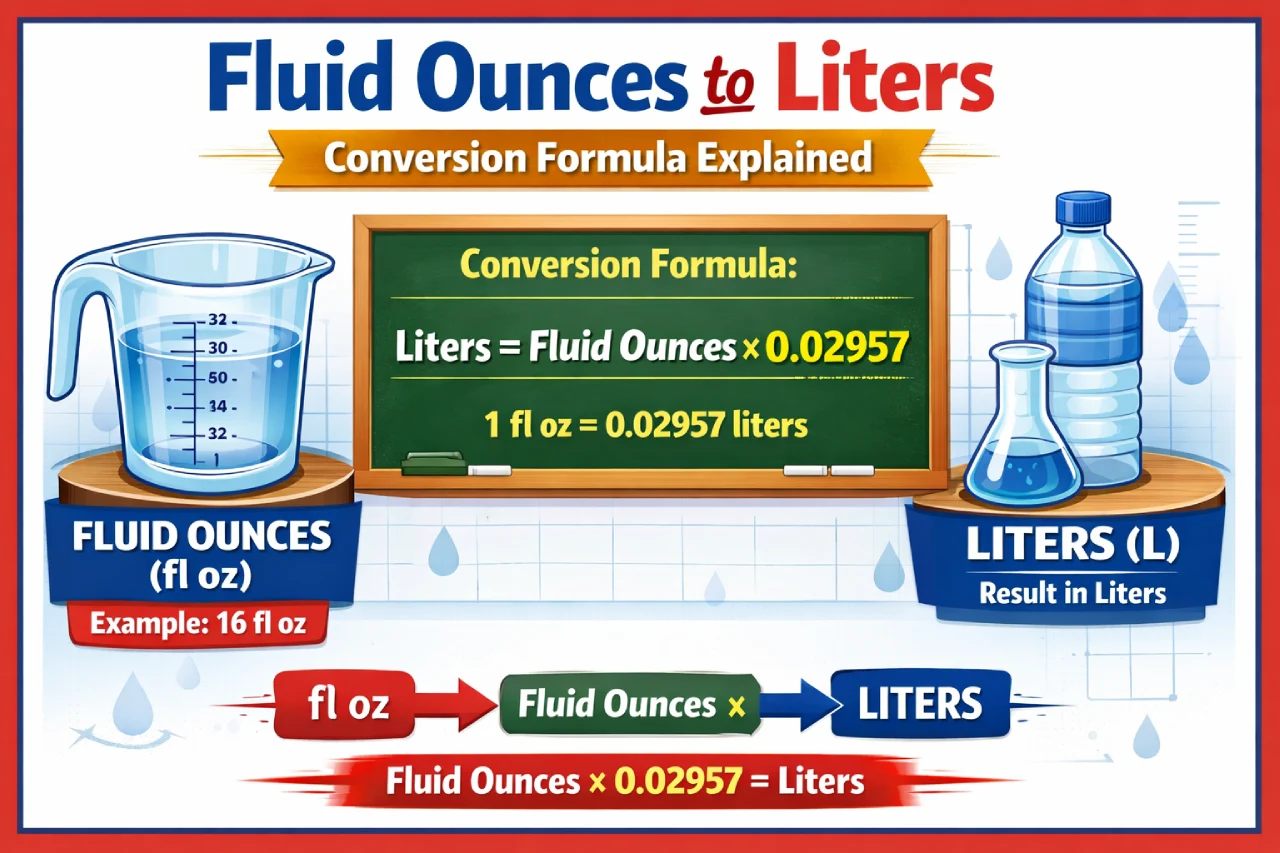
Multiply fluid ounces by 0.0295735 to get liters.
That means:
Liters = Fluid Ounces × 0.0295735
For example:
- 10 fl oz = 0.2957 liters
- 16 fl oz = 0.4732 liters
- 32 fl oz = 0.9464 liters
This is one of the most useful conversions when switching between the U.S. customary system (fluid ounces) and the metric system (liters). Whether you’re measuring water intake, following international recipes, or understanding product labels, this simple number—0.0295735—does all the heavy lifting.
In this guide, we’ll break down where this number comes from, how to use it step by step, and how to apply it in real-world situations.
Understanding Fluid Ounces and Liters
Before we jump into the formula, it helps to understand what these units actually represent.
What Is a Fluid Ounce?
A fluid ounce (fl oz) is a unit of volume used in the U.S. customary system. It measures liquids, not weight.
Fluid ounces are commonly used for:
- Beverage servings
- Nutrition labels
- Cooking measurements
- Bottled drinks
- Household liquids
For example:
- A standard water bottle may hold 16.9 fl oz
- A soda can contains 12 fl oz
- A measuring cup might show ounces for liquid ingredients
What Is a Liter?
A liter (L) is a unit of volume in the metric system, used worldwide.
One liter equals:
- 1,000 milliliters (mL)
- About 33.814 fluid ounces
Liters are used for:
- Bottled water
- Fuel measurements
- Cooking and baking (internationally)
- Scientific and medical applications
Because liters are part of the global standard, most countries use them instead of fluid ounces.
The Key Conversion Number
Fluid Ounces to Liters Converter
Enter a value in fluid ounces to instantly convert it into liters.
Here’s the most important part of this entire guide:
1 fluid ounce (U.S.) = 0.0295735 liters
This is the exact number you multiply by.
Conversion Formula
Liters = Fluid Ounces × 0.0295735
That’s it—no complicated steps required.
Step-by-Step Example
Let’s convert 20 fluid ounces to liters.
Step 1: Start with fluid ounces
20 fl oz
Step 2: Multiply by the conversion factor
20 × 0.0295735
Step 3: Calculate
= 0.59147 liters
Final Answer
20 fl oz ≈ 0.59 liters
Why This Number Works
The number 0.0295735 comes from standardized measurement relationships.
Here’s the breakdown:
- 1 U.S. fluid ounce = 29.5735 milliliters
- Since 1,000 mL = 1 liter, we divide:
29.5735 ÷ 1000 = 0.0295735 liters
Quick Fluid Ounces to Liters Conversion Table
Here’s a handy chart for common values.
| Fluid Ounces (fl oz) | Liters (L) |
|---|---|
| 8 fl oz | 0.237 L |
| 12 fl oz | 0.355 L |
| 16 fl oz | 0.473 L |
| 20 fl oz | 0.591 L |
| 32 fl oz | 0.946 L |
| 64 fl oz | 1.893 L |
This table helps you estimate conversions quickly.
Real-World Examples
Water Bottles
A typical 16.9 fl oz water bottle equals:
16.9 × 0.0295735 ≈ 0.5 liters
That’s why many bottles are labeled 500 mL.
Soda Can
A 12 fl oz soda can equals:
12 × 0.0295735 ≈ 0.355 liters
This matches the common 355 mL size.
Large Beverage
A 32 fl oz drink equals:
32 × 0.0295735 ≈ 0.946 liters
That’s almost 1 liter.
Why Convert Fluid Ounces to Liters?
This conversion is useful in many situations.
1. International Recipes
Recipes from other countries often use liters or milliliters instead of ounces.
2. Nutrition Tracking
Health apps may use metric units for fluid intake.
3. Travel
Most countries use liters for beverages and liquids.
4. Product Labels
Imported products often list volume in liters.
Understanding this conversion helps you avoid confusion.
Fluid Ounces vs Liters: Key Differences
| Unit | System | Equivalent |
|---|---|---|
| Fluid ounce (fl oz) | U.S. customary | 0.0295735 L |
| Liter (L) | Metric system | 33.814 fl oz |
Because liters are larger units, the numbers are smaller when converting from ounces.
Converting Liters Back to Fluid Ounces
Sometimes you need the reverse conversion.
Formula
Fluid Ounces = Liters × 33.814
Example
1 liter × 33.814 = 33.814 fl oz
This confirms the relationship.
Common Mistakes to Avoid
1. Using the Wrong Conversion Factor
Always use:
0.0295735, not 0.03 if you need accuracy.
2. Confusing Fluid Ounces with Weight Ounces
Fluid ounces measure volume, not weight.
3. Rounding Too Early
Keep decimals until the final step.
Easy Mental Conversion Tips
You don’t always need a calculator.
Trick 1: Multiply by 0.03
For quick estimates:
16 × 0.03 ≈ 0.48 L
The exact value is 0.473 L, so it’s close.
Trick 2: Divide by 34
Fl oz ÷ 34 ≈ liters
Example:
34 fl oz ≈ 1 liter
Trick 3: Memorize Key Benchmarks
- 16 fl oz ≈ 0.47 L
- 32 fl oz ≈ 0.95 L
- 34 fl oz ≈ 1 L
These help you estimate quickly.
Fluid Ounces to Liters in Daily Life
Hydration Goals
Many people track water intake in liters, but bottles are labeled in ounces.
Example:
- 64 fl oz ≈ 1.9 liters
Cooking
Liquid ingredients may need conversion when using international recipes.
Fitness
Athletes often measure hydration in liters.
Understanding the conversion helps maintain accuracy.
Frequently Asked Questions (FAQs)
What number do you multiply fluid ounces by to get liters?
Multiply by 0.0295735.
How many liters is 16 fluid ounces?
16 × 0.0295735 ≈ 0.473 liters
How many fluid ounces are in 1 liter?
1 liter ≈ 33.814 fluid ounces
What is the easiest way to estimate fl oz to liters?
Multiply by 0.03 for a quick estimate.
Is 32 oz equal to 1 liter?
No, but it’s close.
32 oz ≈ 0.946 liters
Why do most countries use liters?
Because the metric system is the global standard.
Can calculators convert fluid ounces to liters?
Yes. Most calculators and apps support unit conversions.
Is a fluid ounce the same as an ounce?
No.
A fluid ounce measures volume, while an ounce measures weight.
What is 8 fl oz in liters?
8 × 0.0295735 ≈ 0.237 liters
What is 64 fl oz in liters?
64 × 0.0295735 ≈ 1.89 liters
Final Thoughts
Converting fluid ounces to liters becomes incredibly simple once you remember one key number:
Multiply fluid ounces by 0.0295735 to get liters.
This single formula allows you to handle everything from cooking and hydration to international product comparisons.
Once you memorize a few common values—like 16 oz ≈ 0.47 L and 32 oz ≈ 0.95 L—you’ll be able to estimate conversions quickly without even thinking.
Here’s a quick question for you:
Next time you pick up a drink labeled in ounces, will you instantly know how many liters it is?
Leave a Reply