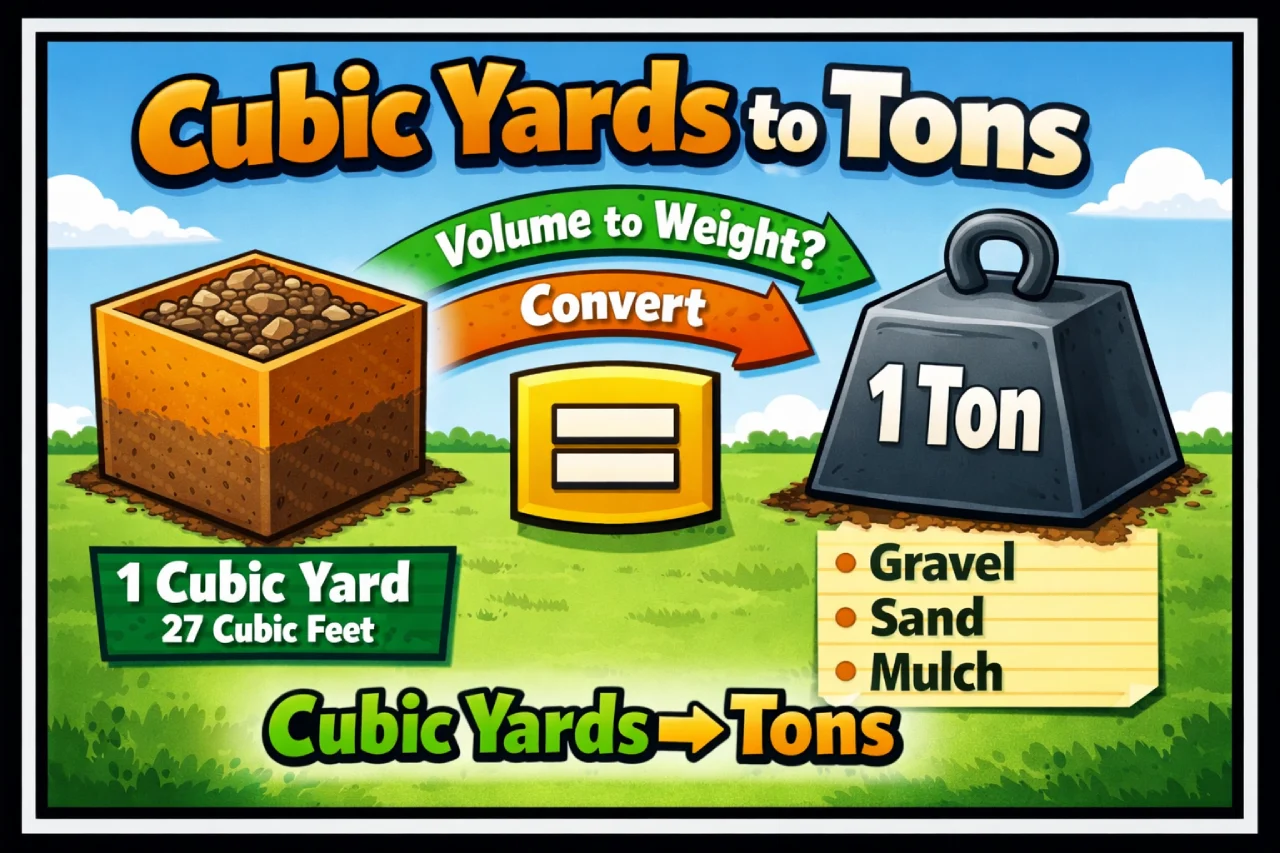
If you’re looking for the quick answer:
There is no single fixed conversion from cubic yards to tons.
Why? Because cubic yards measure volume, while tons measure weight, and the conversion depends entirely on the material’s density.
However, here’s a useful rule of thumb:
- 1 cubic yard of gravel ≈ 1.4 to 1.7 tons
- 1 cubic yard of sand ≈ 1.3 to 1.5 tons
- 1 cubic yard of soil ≈ 1.1 to 1.4 tons
So, to convert cubic yards to tons, you must multiply by the material’s density factor.
If you want a detailed breakdown for different materials, you can also check this complete guide on how many cubic yards are in a ton.
In this article, we’ll explain exactly how this conversion works, why density matters, and how to calculate it step by step for real-world applications like construction, landscaping, and hauling.
Why There Is No Fixed Conversion
This is the most important concept:
👉 Volume and weight are different things.
A cubic yard measures how much space something takes up, while a ton measures how heavy it is.
Different materials have different densities.
Example
- A cubic yard of feathers would weigh very little
- A cubic yard of stone would be extremely heavy
That’s why the conversion depends on density.
The Conversion Formula
Cubic Yards to Tons Converter
Convert cubic yards into tons based on the material’s density. Different materials weigh differently, so select the right material for an accurate result.
Tons = Cubic Yards × Material Density
To convert cubic yards to tons, use this formula:
Tons = Cubic Yards × Density (tons per cubic yard)
The density varies by material.
Common Material Conversion Factors
Here are typical conversion values used in construction and landscaping.
| Material | Tons per Cubic Yard |
|---|---|
| Gravel | 1.4 – 1.7 tons |
| Sand | 1.3 – 1.5 tons |
| Topsoil | 1.1 – 1.4 tons |
| Mulch | 0.2 – 0.4 tons |
| Crushed stone | 1.5 – 1.7 tons |
| Concrete | 2.0 – 2.4 tons |
These values are estimates, but they’re widely used in real-world projects.
Step-by-Step Conversion Example
Let’s convert 3 cubic yards of gravel into tons.
Step 1: Identify the material
Gravel
Step 2: Use the density factor
Average gravel density = 1.5 tons per cubic yard
Step 3: Multiply
3 × 1.5 = 4.5 tons
Final Answer
3 cubic yards of gravel ≈ 4.5 tons
Real-World Applications
Understanding cubic yards to tons is essential in many industries.
1. Construction Projects
Contractors often estimate materials in cubic yards but purchase them in tons.
Example:
- Ordering gravel for a driveway
- Calculating concrete weight
2. Landscaping
Landscapers use cubic yards for soil and mulch but need tons for transport.
3. Trucking and Hauling
Trucks are rated by weight capacity (tons), not volume.
4. Home Improvement
DIY projects often require converting between these units for budgeting and planning.
Cubic Yards vs Tons: Key Differences
| Unit | Measures | Example |
|---|---|---|
| Cubic yard | Volume | Amount of space material occupies |
| Ton | Weight | How heavy the material is |
Understanding this difference prevents costly mistakes.
Converting Tons Back to Cubic Yards
Sometimes you need to reverse the calculation.
Formula
Cubic Yards = Tons ÷ Density
Example
If you have 6 tons of sand:
6 ÷ 1.4 ≈ 4.3 cubic yards
Common Mistakes to Avoid
1. Assuming a Fixed Conversion
There is no universal number—always consider the material.
2. Ignoring Moisture Content
Wet materials weigh more than dry ones.
3. Using Incorrect Density Values
Always use realistic averages for your material.
4. Confusing Units
Remember:
- Cubic yards = volume
- Tons = weight
Quick Estimation Tips
Here are some easy ways to estimate.
Rule of Thumb
- Soil ≈ 1.2 tons per cubic yard
- Gravel ≈ 1.5 tons per cubic yard
- Sand ≈ 1.4 tons per cubic yard
Simple Shortcut
Multiply cubic yards by:
- 1.5 for gravel
- 1.3–1.4 for sand
- 1.2 for soil
This gives a quick estimate.
Practical Examples
Example 1: Mulch
5 cubic yards × 0.3 = 1.5 tons
Example 2: Crushed Stone
4 cubic yards × 1.6 = 6.4 tons
Example 3: Concrete
2 cubic yards × 2.2 = 4.4 tons
These examples show how much the weight varies depending on the material.
Why This Conversion Matters
Understanding cubic yards to tons helps you:
- Avoid overordering or underordering materials
- Calculate transportation costs accurately
- Ensure trucks are not overloaded
- Plan projects efficiently
It’s especially important in construction and landscaping where mistakes can be expensive.
Frequently Asked Questions (FAQs)
How many tons are in a cubic yard?
It depends on the material.
For example, gravel is about 1.5 tons per cubic yard.
Is 1 cubic yard equal to 1 ton?
No. The weight depends on density.
How do you convert cubic yards to tons?
Multiply cubic yards by the material’s tons-per-yard factor.
How many cubic yards are in a ton?
Divide tons by the material’s density.
What is the weight of 1 cubic yard of soil?
Approximately 1.1 to 1.4 tons.
How much does 1 cubic yard of gravel weigh?
About 1.4 to 1.7 tons.
Why is there no fixed conversion?
Because different materials have different densities.
Does moisture affect weight?
Yes. Wet materials weigh more than dry ones.
Can calculators convert cubic yards to tons?
Yes, but you must input the correct density.
What is the easiest way to estimate?
Use common averages like 1.5 tons per cubic yard for gravel.
Final Thoughts
Converting cubic yards to tons isn’t about memorizing a single number—it’s about understanding how volume and weight relate through density.
The key takeaway is:
Tons = Cubic Yards × Material Density
Once you know the type of material you’re working with, the conversion becomes simple.
Whether you’re planning a landscaping project, ordering construction materials, or estimating hauling loads, this knowledge helps you make smarter decisions and avoid costly mistakes.
Now here’s a quick question for you:
Next time you order materials, will you think in cubic yards—or in tons?
Leave a Reply